
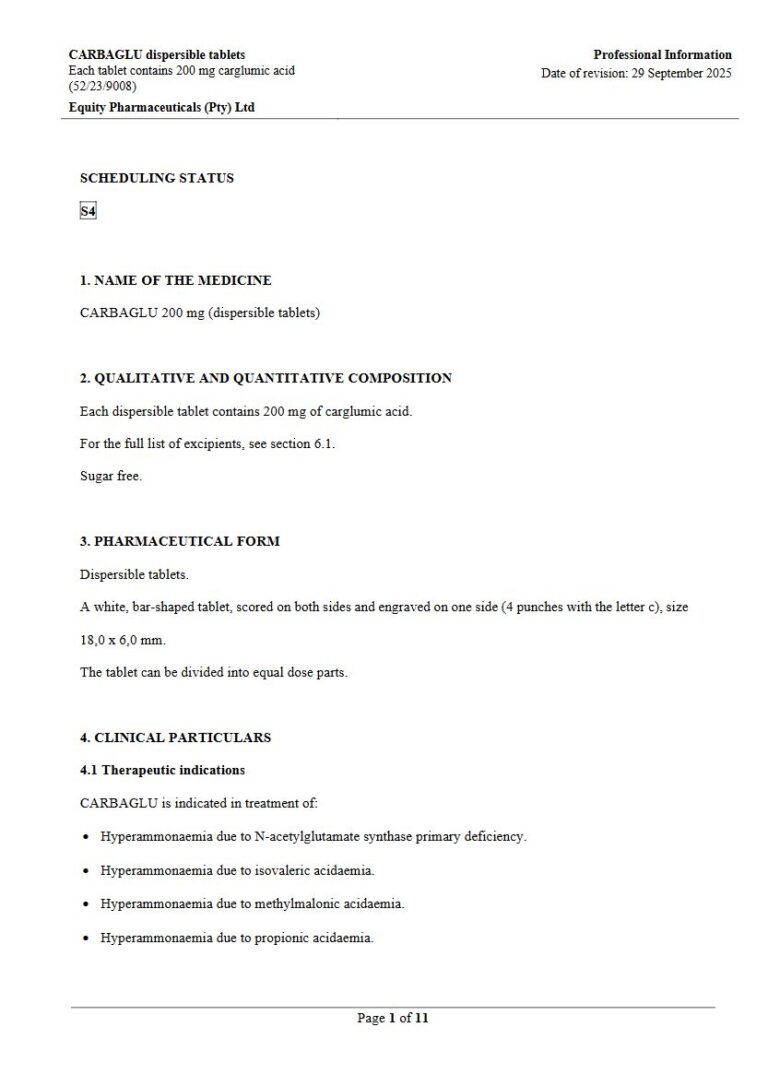
Carbaglu 200 Mg Dispersible Tablets
PDF Leaflet Revision Date: 29 September 2025
Clinical Summary
Quick overview from the medicine insert
Indication
Treatment of hyperammonaemia due to specific metabolic disorders.
Dosage (summary)
Initial dose: 100 mg/kg, up to 250 mg/kg; adjust to maintain normal ammonia levels.
Onset of Action / Duration
Onset: within hours, Duration: varies based on individual response.
Special Populations
- Renal impairment
- Paediatric population
Pregnancy & Breastfeeding
Safety in pregnancy not established; contraindicated in breastfeeding.
Contraindications
- Hypersensitivity
- Breastfeeding
Common side effects
- Increased transaminases
- Increased sweating
- Bradycardia
- Diarrhoea
- Vomiting
Counselling Points
- Monitor for side effects
- Adjust dose based on ammonia levels
- Administer before meals
Serious warnings
- Therapeutic monitoring of ammonia levels required
- Caution in renal impairment
Important Disclaimer
The Carbaglu 200 Mg Dispersible Tablets professional information leaflet below is the property of Equity Pharmaceuticals and is provided on Medinsert exactly as issued, with no.. alterations or editorial changes. We make every effort to keep content current by updating documents as soon as new versions become available. Medinsert serves as a trusted access point for healthcare professionals, but does not replace official sources or clinical judgement. For more details, please read our full disclaimer. read more>>
 Healthcare Professionals Only
This content is for registered healthcare professionals
Sign in or create a free account to read the full package insert.
Free for HPCSA-registered professionals. Powered by Medinsert.
Clinical Particulars
Section 4 of the official insert — extracted exactly as issued, no alterations
4.1 Therapeutic indications
CARBAGLU is indicated in treatment of:
- Hyperammonaemia due to N-acetylglutamate synthase primary deficiency.
- Hyperammonaemia due to isovaleric acidaemia.
- Hyperammonaemia due to methylmalonic acidaemia.
- Hyperammonaemia due to propionic acidaemia.
4.2 Posology and method of administration
CARBAGLU treatment should be initiated under the supervision of a medical practitioner experienced in the treatment of metabolic disorders.
Posology:
For N-acetylglutamate synthase deficiency: Based on clinical experience, the treatment may be started as early as the first day of life. The initial daily dose should be 100 mg/kg, up to 250 mg/kg if necessary. It should then be adjusted individually in order to maintain normal ammonia plasma levels (refer to section 4.4). In the long term, it may not be necessary to increase the dose according to body weight as long as adequate metabolic control is achieved; daily doses range from 10 mg/kg to 100 mg/kg.
Carglumic acid responsiveness test: It is recommended to test individual responsiveness to carglumic acid before initiating any long-term treatment. As examples:
- In a comatose child, start with a dose of 100 to 250 mg/kg/day and measure ammonia plasma concentration at least before each administration; it should normalise within a few hours after starting CARBAGLU.
- In a patient with moderate hyperammonaemia, administer a test dose of 100 to 200 mg/kg/day for 3 days with a constant protein intake and perform repeated determinations of ammonia plasma concentration (before and 1 hour after a meal); adjust the dose in order to maintain normal ammonia plasma levels.
For isovaleric acidaemia, methylmalonic acidaemia and propionic acidaemia: The treatment should start upon hyperammonaemia in organic acidaemia patients. The initial daily dose should be 100 mg/kg, up to 250 mg/kg if necessary. It should then be individually adjusted in order to maintain normal ammonia plasma levels (refer to section 4.4).
Renal impairment: Caution is advised when administering CARBAGLU to patients with impaired renal function. Dosage adjustment is required according to GFR.
- Patients with moderate renal impairment (GFR 30-59 mL/min)
- the recommended initial dose is 50 mg/kg/day to 125 mg/kg/day for patients presenting an hyperammonaemia due to NAGS deficiency or organic acidaemia,
- In the long term use the daily dose will be in the range of 5 mg/kg/day to 50 mg/kg/day and should be adjusted individually in order to maintain normal ammonia plasma levels.
- Patients with severe renal impairment (GFR u2264 29 mL/min)
- the recommended initial dose is 15 mg/kg/day to 40 mg/kg/day for patients presenting an hyperammonaemia due to NAGS deficiency or organic acidaemia,
- In the long term use the daily dose will be in the range of 2 mg/kg/day to 20 mg/kg/day and should be adjusted individually in order to maintain normal ammonia plasma levels.
Paediatric population: The safety and effectiveness of CARBAGLU for the treatment of paediatric patients (birth to 17 years of age) with acute or chronic hyperammonaemia due to NAGS deficiency and acute hyperammonaemia due to IVA, PA or MMA have been established.
Method of administration: This medicine is for oral use only (ingestion or via a nasogastric tube using a syringe, if necessary). Based on pharmacokinetic data and clinical experience, it is recommended to divide the total daily dose into two to four doses to be given before meals or feedings. The breaking of the tablets in halves allows most of the required posology adjustments. Occasionally, the use of quarter tablets may also be useful to adjust the posology prescribed by the medical practitioner. The tablets must be dispersed in a minimum of 5 u2013 10 ml of water and ingested immediately or administered by fast push through a syringe via a nasogastric tube. The suspension has a slightly acidic taste.
4.3 Contraindications
Hypersensitivity to the active substance or to any of the excipients listed in section 6.1. Breastfeeding during the use of carglumic acid is contraindicated (refer to sections 4.6 and 5.3).
4.4 Special warnings and precautions for use
Therapeutic monitoring: Plasma levels of ammonia and amino acids should be maintained within normal limits. As very few data on the safety of carglumic acid are available, systematic surveillance of liver, renal, cardiac functions and haematological parameters is recommended.
Nutritional management: Protein restriction and arginine supplementation may be indicated in case of low protein tolerance.
Use in patients with renal impairment: The dose of CARBAGLU must be reduced in patients with renal impairment (see section 4.2).
4.5 Interaction with other medicines and other forms of interaction
No specific interaction studies have been performed.
4.6 Fertility, pregnancy and lactation
Pregnancy: Safe use during pregnancy has not been established. For carglumic acid no clinical data on exposed pregnancies are available. Animal studies have revealed minimal developmental toxicity (refer to section 5.3). Caution should be exercised when prescribing to pregnant women.
Breastfeeding: Carglumic acid has been shown to be present in the milk of lactating rats (refer to section 5.3). Therefore, breastfeeding during the use of carglumic acid is contraindicated (refer to section 4.3).
Fertility: No data exists on the effect of carglumic acid on fertility.
4.7 Effects on ability to drive and use machines
No studies on the effects of carglumic acid on the ability to drive and use machines have been performed.
4.8 Undesirable effects
Tabulated list of adverse reactions: Reported adverse reactions are listed below, by system organ class and by frequency. Frequencies are defined as: very common (u2265 1/10), common (u22651/100 to <1/10), uncommon (u22651/1 000 to <1/100), rare (u2265 1/10 000 to < 1/1 000), very rare (< 1/10 000), not known (cannot be estimated from the available data). Within each frequency grouping, undesirable effects are presented in order of decreasing seriousness.
u2022 Undesirable effects in N-acetylglutamate synthase deficiency
- Investigations: Uncommon: increased transaminases
- Skin and subcutaneous tissue disorders: Common: increased sweating; Not known: rash
u2022 Undesirable effects in organic acidaemia
- Cardiac disorders: Uncommon: bradycardia
- Gastrointestinal disorders: Uncommon: diarrhoea, vomiting
- General disorders and Administration site conditions: Uncommon: pyrexia
- Skin and subcutaneous tissue disorders: Not known: rash
Reporting of suspected adverse reactions: Reporting suspected adverse reactions after authorisation of the medicine is important. It allows continued monitoring of the benefit/risk balance of the medicine. Healthcare providers are asked to report any suspected adverse reactions to SAHPRA via the Med Safety APP (Medsafety X SAHPRA) and eReporting platform (who-umc.org) found on SAHPRA website.
4.9 Overdose
Overdose symptoms have been characterised as a sympathomimetic reaction: tachycardia, profuse sweating, increased bronchial secretion, increased body temperature and restlessness. There is no known antidote for carglumic acid. The treatment of carglumic acid overdose should consist of general supportive measures.
