
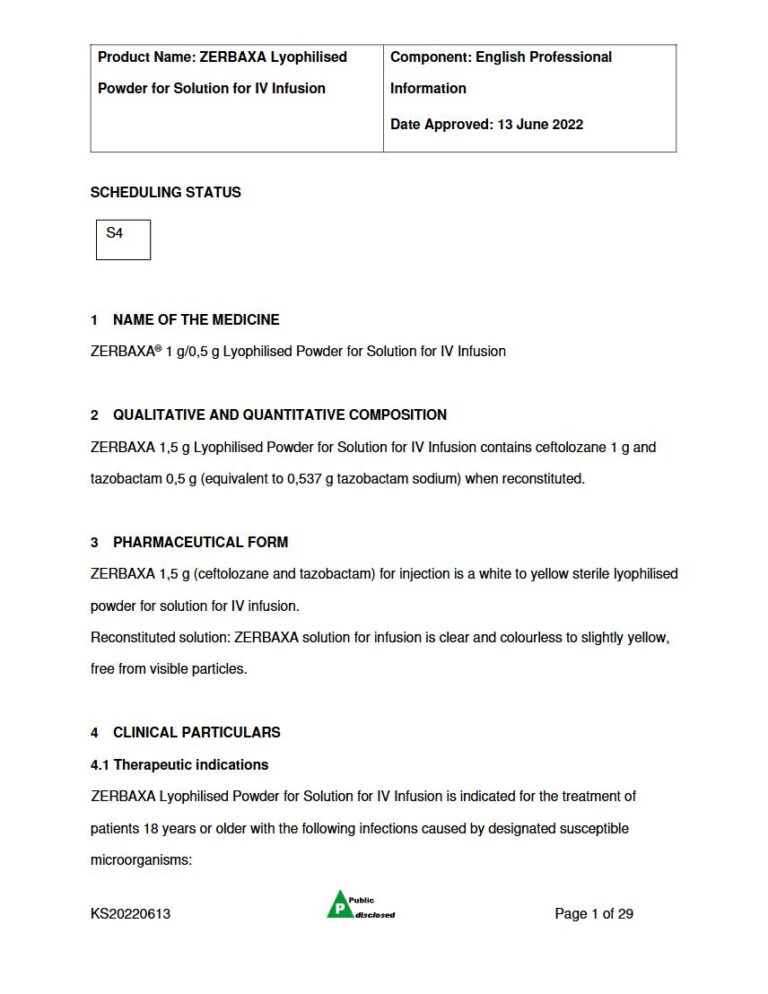
Zerbaxa 1 g/0,5 g Lyophilised Powder for Solution for IV Infusion
PDF Leaflet Revision Date: 13 June 2022
Clinical Summary
Quick overview from the medicine insert
Indication
Treatment of complicated infections in adults.
Dosage (summary)
1.5 g IV every 8 hours for cIAI and cUTI; 3 g IV every 8 hours for HABP/VABP.
Special Populations
- Renal impairment
- Hepatic impairment
- Elderly
Pregnancy & Breastfeeding
Not established as safe in pregnancy; avoid breastfeeding.
Key Drug Interactions
- Probenecid may increase tazobactam levels.
Contraindications
- Hypersensitivity to ceftolozane or tazobactam
- Severe hypersensitivity to beta-lactams.
Common side effects
- Nausea
- Headache
- Diarrhoea
- Constipation
- Pyrexia
Counselling Points
- Report any signs of allergic reactions.
- Avoid use in suspected non-susceptible infections.
- Monitor for gastrointestinal symptoms.
Serious warnings
- Risk of Clostridium difficile-associated diarrhoea
- Monitor renal function.
Important Disclaimer
The Zerbaxa 1 g/0,5 g Lyophilised Powder for Solution for IV Infusion professional information leaflet below is the property of Msd and is provided on Medinsert exactly as issued, with no.. alterations or editorial changes. We make every effort to keep content current by updating documents as soon as new versions become available. Medinsert serves as a trusted access point for healthcare professionals, but does not replace official sources or clinical judgement. For more details, please read our full disclaimer. read more>>
 Healthcare Professionals Only
This content is for registered healthcare professionals
Sign in or create a free account to read the full package insert.
Free for HPCSA-registered professionals. Powered by Medinsert.
Clinical Particulars
Section 4 of the official insert — extracted exactly as issued, no alterations
4.1 Therapeutic indications
ZERBAXA Lyophilised Powder for Solution for IV Infusion is indicated for the treatment of patients 18 years or older with the following infections caused by designated susceptible microorganisms:
- Complicated Intra-abdominal Infections (cIAI)
ZERBAXA used in combination with metronidazole is indicated for the treatment of complicated intra-abdominal infections caused by the following Gram-negative and Gram-positive microorganisms: Enterobacter cloacae, Escherichia coli, Klebsiella oxytoca, Klebsiella pneumoniae, Proteus mirabilis, Pseudomonas aeruginosa, Bacteroides fragilis, Streptococcus anginosus, Streptococcus constellatus and Streptococcus salivarius. - Complicated Urinary Tract Infections (cUTI), including Pyelonephritis
ZERBAXA is indicated for the treatment of complicated urinary tract infections, including pyelonephritis, with or without concurrent bacteraemia, caused by the following Gram-negative microorganisms: Escherichia coli, Klebsiella pneumoniae, Proteus mirabilis and Pseudomonas aeruginosa. - Hospital Acquired Bacterial Pneumonia (HABP) and Ventilator Associated Bacterial Pneumonia (VABP)
ZERBAXA is indicated for the treatment of HABP and VABP, caused by the following Gram-negative microorganisms: Enterobacter cloacae, Escherichia coli, Haemophilus influenzae, Klebsiella (Enterobacter) aerogenes, Klebsiella oxytoca, Klebsiella pneumoniae, Proteus mirabilis, Pseudomonas aeruginosa and Serratia marcescens.
Usage
To reduce the development of drug-resistant bacteria and maintain the effectiveness of ZERBAXA and other antibacterial medicines, ZERBAXA should be used only to treat infections that are proven or strongly suspected to be caused by susceptible bacteria. When culture and susceptibility information are available, they should be considered in selecting or modifying antibacterial therapy. In the absence of such data, local epidemiology and susceptibility patterns may contribute to the empiric selection of therapy.
Paediatric Use
The safety and efficacy of ZERBAXA in children and adolescents below 18 years of age have not yet been established.
4.2 Posology and method of administration
Posology
The recommended dosage regimen of ZERBAXA for injection is 1,5 gram (g) (ceftolozane 1 g and tazobactam 0,5 g) for cIAI and cUTI and 3 g (ceftolozane 2 g and tazobactam 1 g) for hospital acquired bacterial pneumonia administered every 8-hours by intravenous infusion over 1-hour in patients 18 years or older and with creatinine clearance (CrCL) u02c3 50 mL/min. The duration of therapy should be guided by the severity and site of infection and the patientu2019s clinical and bacteriological progress as shown in Table 1.
Table 1: Dosage of ZERBAXA by Infection in Patients with Creatinine Clearance (CrCl) u02c3 50 mL/min
| Infection | Dose | Frequency | Infusion Time (hours) | Duration of Treatment |
|---|---|---|---|---|
| Complicated Intra-abdominal Infections* | 1,5 g ZERBAXA (1 g ceftolozane/0,5 g tazobactam) | Every 8-hours | 1 | 4 to 14 days |
| Complicated Urinary Tract Infections, including Pyelonephritis | 1,5 g ZERBAXA (1 g ceftolozane/0,5 g tazobactam) | Every 8-hours | 1 | 7 days |
| Hospital Acquired Bacterial Pneumonia and Ventilator Associated Bacterial Pneumonia | 3 g ZERBAXA (2 g ceftolozane/1 g tazobactam) | Every 8-hours | 1 | 8 to 14 days |
*Used in conjunction with metronidazole 500 mg intravenously every 8-hours.
Special populations
Renal Impairment
Dose adjustment is required for patients whose CrCL is 50 mL/min or less. Renal dose adjustments are listed in Table 2. For patients with changing renal function, monitor CrCL at least daily and adjust the dosage of ZERBAXA accordingly (see section 4.4).
Table 2: Recommended Dosage Regimens for ZERBAXA in Patients with Renal Impairment
| Estimated CrCL (mL/min) | Complicated Intra-abdominal Infections and Complicated Urinary Tract Infectionsu2020 including Pyelonephritis | Hospital Acquired Bacterial Pneumonia (HABP) and Ventilator Associated Bacterial Pneumonia (VABP)u2020 |
|---|---|---|
| 30 to 50 | 750 mg (500 mg and 250 mg) intravenously every 8-hours | 1,5 g (1 g and 0,5 g) intravenously every 8-hours |
| 15 to 29 | 375 mg (250 mg and 125 mg) intravenously every 8-hours | 750 mg (500 mg and 250 mg) intravenously every 8-hours |
| End stage renal disease (ESRD) on haemodialysis (HD) | A single loading dose of 750 mg (500 mg and 250 mg) followed by a 150 mg (100 mg and 50 mg) maintenance dose administered every 8-hours for the remainder of the treatment period. With HD, the dose should be administered immediately following completion of dialysis. | A single loading dose of 2,25 g (1,5 g and 0,75 g) followed by a 450 mg (300 mg and 150 mg) maintenance dose administered every 8-hours for the remainder of the treatment period (on haemodialysis days, administer the dose at the earliest possible time following completion of dialysis). |
*CrCL estimated using Cockcroft-Gault formula.
u2020 All doses of ZERBAXA are administered over 1-hour.
Hepatic impairment
No dose adjustment is necessary in patients with hepatic impairment.
Elderly (u2265 65 years of age)
No dose adjustment is necessary for the elderly based on age alone. ZERBAXA is substantially excreted by the kidney and the risk of adverse reactions to ZERBAXA may be greater in patients with impaired renal function. Because elderly patients are more likely to have decreased renal function, care should be taken in dose selection, and it may be useful to monitor renal function. Adjust dosage for elderly patients based on renal function.
Paediatric population
The safety and efficacy of ceftolozane/tazobactam in children and adolescents below 18 years of age have not yet been established. No data are available.
Method of administration
Preparation of solutions
ZERBAXA does not contain a bacteriostatic preservative. Aseptic technique must be followed in preparing the infusion solution.
Preparation of doses
Constitute each vial of ZERBAXA with 10 mL of Sterile Water for injection or 0,9 % Sodium Chloride for injection, USP and gently shake to dissolve. The final volume is approximately 11,4 mL per vial.
CAUTION: THE CONSTITUTED SOLUTION IS NOT FOR DIRECT INJECTION.
To prepare the required dose, withdraw the appropriate volume determined from Table 3 from the reconstituted vial(s). Add the withdrawn volume to an infusion bag containing 100 mL of 0,9 % Sodium Chloride for Injection, USP or 5 % Dextrose Injection, USP.
Table 3: Preparation of doses ZERBAXA (ceftolozane and tazobactam) Dose Volume to Withdraw from Reconstituted Vial(s)
| 3 g (2 g and 1 g) | Two vials of 11,4 mL each (entire contents from two vials) |
|---|---|
| 2,25 g (1,5 g and 0,75 g) | 11,4 mL from one vial (entire contents) and 5,7 mL from a second vial |
| 1,5 g (1 g and 0,5 g) | 11,4 mL (entire contents from one vial) |
| 750 mg (500 mg and 250 mg) | 5,7 mL |
| 450 mg (300 mg and 150 mg) | 3,5 mL |
| 375 mg (250 mg and 125 mg) | 2,9 mL |
| 150 mg (100 mg and 50 mg) | 1,2 mL |
Inspect medicine products visually for particulate matter and discoloration prior to use. ZERBAXA infusions range from clear, colourless solutions to solutions that are clear and slightly yellow. Variations in colour within this range do not affect the potency of the product.
Storage of constituted solutions
Upon constitution with Sterile Water for Injection or 0,9 % Sodium Chloride injection, reconstituted ZERBAXA solution may be held for 1-hour prior to transfer and dilution in a suitable infusion bag. Following dilution of the solution with 0,9 % Sodium Chloride or 5 % Dextrose, ZERBAXA is stable for 24-hours when stored at room temperature or 7 days when stored under refrigeration at 2 to 8 u00b0C.
Constituted ZERBAXA solution or diluted ZERBAXA infusion should not be frozen. Although physical and chemical stability has been proven for 48-hours at 2 to 8 u00b0C and 24-hours at 25 u00b0C from a microbiological point of view the solution should be used immediately after preparation. If not used immediately, in-use storage times and conditions prior to use are the responsibility of the user and would normally not be longer than 24-hours at 2 to 8 u00b0C, unless reconstitution or dilution has taken place in controlled and validated aseptic conditions.
4.3 Contraindications
ZERBAXA is contraindicated in patients with:
- Hypersensitivity to ceftolozane, tazobactam or to any of the inactive excipients.
- Hypersensitivity to any cephalosporin antibacterial medicines.
- Severe hypersensitivity (e.g. anaphylactic reaction, severe skin reaction) to any other type of beta-lactam antibacterial medicines (e.g. penicillins or carbapenems).
4.4 Special warnings and precautions for use
Prescribers should adhere to the principles of antibiotic stewardship.
Impaired renal function
The ZERBAXA dose should be adjusted based on renal function (see section 4.2). In a subgroup analysis of a Phase 3 intra-abdominal infection trial, clinical cure rates were lower in patients with baseline CrCL of 30 to u2264 50 mL/min compared to those with CrCL > 50 mL/min. The reduction in clinical cure rates was more marked in the ZERBAXA plus metronidazole arm compared to the meropenem arm. A similar trend was also seen in the urinary tract infection trial. Patients with renal impairment at baseline should be monitored frequently for any changes in renal function during treatment and the dose of ZERBAXA should be adjusted as necessary.
Hypersensitivity reactions
Serious and occasionally fatal hypersensitivity (anaphylactic) reactions have been reported in patients receiving beta-lactam antibacterial medicines. Before initiating therapy with ZERBAXA, make careful inquiry about previous hypersensitivity reactions to other cephalosporins, penicillins or other beta-lactams. If ZERBAXA is to be given to a patient with a cephalosporin, penicillin or other beta-lactam allergy, exercise caution because cross sensitivity has been established. If an anaphylactic reaction to ZERBAXA occurs, discontinue ZERBAXA and institute appropriate therapy.
Clostridium difficile -associated diarrhoea
Clostridium difficile -associated diarrhoea (CDAD) has been reported for nearly all systemic antibacterial medicines, including ZERBAXA, and may range in severity from mild diarrhoea to fatal colitis. Treatment with antibacterial medicines alters the normal flora of the colon and may permit overgrowth of C. difficile (see section 4.8). These types of infection may range in severity from mild to life-threatening. Therefore, it is important to consider this diagnosis in patients who present with diarrhoea during or subsequent to the administration of ZERBAXA. In such circumstances, the discontinuation of therapy with ZERBAXA and the use of supportive measures together with the administration of specific treatment for Clostridium difficile should be considered.
Development of drug resistant bacteria
Prescribing ZERBAXA in the absence of a proven or strongly suspected bacterial infection is unlikely to provide benefit to the patient and risks the development of drug-resistant bacteria.
Non-susceptible micro-organisms
The use of ceftolozane/tazobactam may promote the overgrowth of non-susceptible micro-organisms. If super infection occurs during or following treatment, appropriate measures should be taken. Ceftolozane/tazobactam is not active against bacteria that produce beta-lactamase enzymes which are not inhibited by tazobactam.
Direct antiglobulin test (Coombs test) seroconversion and potential risk of haemolytic anaemia
The development of a positive direct antiglobulin test (DAGT) may occur during treatment with ceftolozane/tazobactam. The incidence of DAGT seroconversion in patients receiving ceftolozane/tazobactam was 0,2 % in the clinical trials. In clinical studies, there was no evidence of haemolysis in patients who developed a positive DAGT on treatment.
Limitations of the clinical data
Patients who were immunocompromised and patients with severe neutropenia were excluded from clinical trials.
Paediatric population
The safety and efficacy of ceftolozane/tazobactam in children and adolescents below 18 years of age have not yet been established. No data are available (see section 4.2).
4.5 Interaction with other medicines and other forms of interaction
No significant interactions are anticipated between ZERBAXA and medicines that are substrates, inhibitors and inducers of cytochrome P450 enzymes. In vitro studies demonstrated that ceftolozane, tazobactam and the M1 metabolite of tazobactam did not inhibit CYP1A2, CYP2B6, CYP2C8, CYP2C9, CYP2C19, CYP2D6 or CYP3A4 and did not induce CYP1A2, CYP2B6 or CYP3A4 at therapeutic plasma concentrations. A clinical interaction study was conducted, and results indicated interactions involving CYP1A2 and CYP3A4 inhibition by ZERBAXA are not anticipated.
Ceftolozane and tazobactam were not substrates for P-gp or BCRP and tazobactam was not a substrate for OCT2, in vitro at therapeutic plasma concentrations. In vitro data indicate that ceftolozane did not inhibit P-gp, BCRP, OATP1B1, OATP1B3, OCT1, OCT2, MRP, BSEP, OAT1, OAT3, MATE1 or MATE2-K at therapeutic plasma concentrations. In vitro data indicate that neither tazobactam nor the tazobactam metabolite M1 inhibit P-gp, BCRP, OATP1B1, OATP1B3, OCT1, OCT2 or BSEP transporters at therapeutic plasma concentrations. Tazobactam is a substrate for OAT1 and OAT3. In vitro, tazobactam inhibited human OAT1 and OAT3 transporters with IC50 values of 118 and 147 u03bcg/mL, respectively. Co-administration of ceftolozane and tazobactam with OAT1 and OAT3 substrate furosemide in a clinical study did not significantly increase furosemide plasma exposures (geometric mean ratios of 0,83 and 0,87 for C max and AUC, respectively). However, active substances that inhibit OAT1 or OAT3 (e.g. probenecid) may increase tazobactam plasma concentrations. Co-administration of tazobactam with the OAT1/OAT3 inhibitor probenecid has been shown to prolong the half-life of tazobactam by 71 %.
4.6 Fertility, pregnancy and lactation
Pregnancy
Safe use during pregnancy has not been established.
Breastfeeding
Women receiving ZERBAXA should not breastfeed their infants.
4.7 Effects on ability to drive and use machines
ZERBAXA may have an influence on the ability to drive and use machines. Dizziness may occur following administration of ZERBAXA.
4.8 Undesirable effects
Clinical Trials Experience
Complicated Intra-abdominal Infections and Complicated Urinary Tract Infections, including Pyelonephritis
ZERBAXA was evaluated in Phase 3 comparator-controlled clinical trials of complicated intra-abdominal infections and complicated urinary tract infections (including pyelonephritis), which included a total of 1 015 patients, treated with ZERBAXA [1 g/0,5 g intravenously every 8-hours, adjusted to match renal function where appropriate (1,5 g every 8-hours, adjusted based on renal function where appropriate)] for up to 14 days.
a. Summary of the safety profile
The most common side effects (u2265 3 % in pooled Phase 3 trials) occurring in patients receiving ZERBAXA were nausea, headache, constipation, diarrhoea and pyrexia and were generally mild or moderate in severity.
ZERBAXA was evaluated in a Phase 3 comparator-controlled clinical trial of hospital-acquired bacterial pneumonia, including ventilator-associated bacterial pneumonia. The most common adverse reactions (u2265 5% in a Phase 3 trial of hospital-acquired bacterial pneumonia, including ventilator-associated bacterial pneumonia) occurring in patients receiving ZERBAXA were diarrhoea, alanine aminotransferase increased and aspartate aminotransferase increased and were generally mild or moderate in severity.
b. Tabulated summary of adverse reactions
Side effects have been identified during clinical trials with ZERBAXA. Side effects are classified according to MedDRA System Organ Class and frequency. Frequency categories are derived according to the following conventions: common (u2265 1/100 to < 1/10), uncommon (u2265 1/1 000 to < 1/100) (see Table 5).
Table 5: Adverse reactions identified during clinical trials with ceftolozane/tazobactam (n=1 015)
| System organ class | Common (u2265 1/100 to < 1/10) | Uncommon (u2265 1/1 000 to < 1/100) |
|---|---|---|
| Infections and infestations | Clostridioides difficile colitis 2 | candidiasis including oropharyngeal and vulvovaginal 1, Clostridium difficile colitis 1, fungal urinary tract infection, Clostridioides difficile infection 2 |
| Blood and the lymphatic system disorders | thrombocytosis 1 | anaemia 1 |
| Metabolism and nutrition disorders | hypokalaemia 1 | hyperglycaemia 1, hypomagnesaemia 1, hypophosphatemia 1 |
| Psychiatric disorders | insomnia 1, anxiety 1 | |
| Nervous system disorders | headache 1, dizziness 1 | ischaemic stroke 1 |
| Cardiac disorders | atrial fibrillation 1, tachycardia 1, angina pectoris 1 | |
| Vascular disorders | hypotension 1 | phlebitis 1, venous thrombosis 1 |
| Respiratory, thoracic and mediastinal disorders | dyspnoea 1 | |
| Gastrointestinal disorders | nausea 1, diarrhoea 3, constipation 1, vomiting 3, abdominal pain 1, gastritis 1, abdominal distension 1, dyspepsia 1, flatulence 1, ileus paralytic 1 | |
| Skin and subcutaneous tissue disorders | rash 1 | urticaria 1 |
| Renal and urinary disorders | renal impairment 1 | renal failure 1 |
| General disorders and administration site conditions | pyrexia 1, infusion site reactions 1 | |
| Investigations | alanine aminotransferase increased 3, aspartate aminotransferase increased 3, transaminases increased 2, liver function test abnormal 2, blood alkaline phosphatase increased 2, gamma-glutamyltransferase increased 2 | Coombs test positive 3, increased serum gamma-glutamyl transpeptidase (GGT) 1, increased serum alkaline phosphatase 1, Clostridioides test positive 2 |
1 Specific for the complicated intra-abdominal infections, acute pyelonephritis and complicated urinary tract infections indications treated with ZERBAXA (1 g/0,5 g intravenously every 8-hours) for up to 14 days.
2 Specific for the hospital-acquired bacterial pneumonia, including ventilator-associated bacterial pneumonia indication treated with ZERBAXA (2 g/1 g intravenously every 8-hours) for up to 14 days.
3 Applies across all indications: complicated intra-abdominal infections, acute pyelonephritis, complicated urinary tract infections and hospital-acquired bacterial pneumonia, including ventilator-associated bacterial pneumonia.
Description of selected adverse reactions
Laboratory values
The development of a positive direct Coombs test may occur during treatment with ZERBAXA. The incidence of seroconversion to a positive direct Coombs test was 0,2 % in patients receiving ZERBAXA and 0 % in patients receiving the comparator in the complicated intra-abdominal infections and complicated urinary tract infections clinical trials. The incidence of seroconversion to a positive direct Coombs test was 31,2 % in patients receiving ZERBAXA and 3,6 % in patients receiving meropenem in the hospital-acquired bacterial pneumonia, including ventilator-associated bacterial pneumonia clinical trial. In clinical studies, there was no evidence of haemolysis in patients who developed a positive direct Coombs test in any treatment group.
Reporting of suspected adverse reactions
Reporting suspected adverse reactions after authorisation of the medicine is important. It allows continued monitoring of the benefit/risk balance of the medicine. Healthcare providers are asked to report any suspected adverse reactions to SAHPRA via the u201c6.04 Adverse Drug Reactions Reporting Formu201d, found online under SAHPRAu2019s publications: https://www.sahpra.org.za/Publications/Index/8.
4.9 Overdose
In the event of overdose, discontinue ZERBAXA and provide general supportive treatment. ZERBAXA can be removed by haemodialysis. Approximately 66 % of ceftolozane, 56 % of tazobactam and 51 % of the tazobactam metabolite M1 were removed by dialysis. No information is available on the use of haemodialysis to treat overdosage.
