
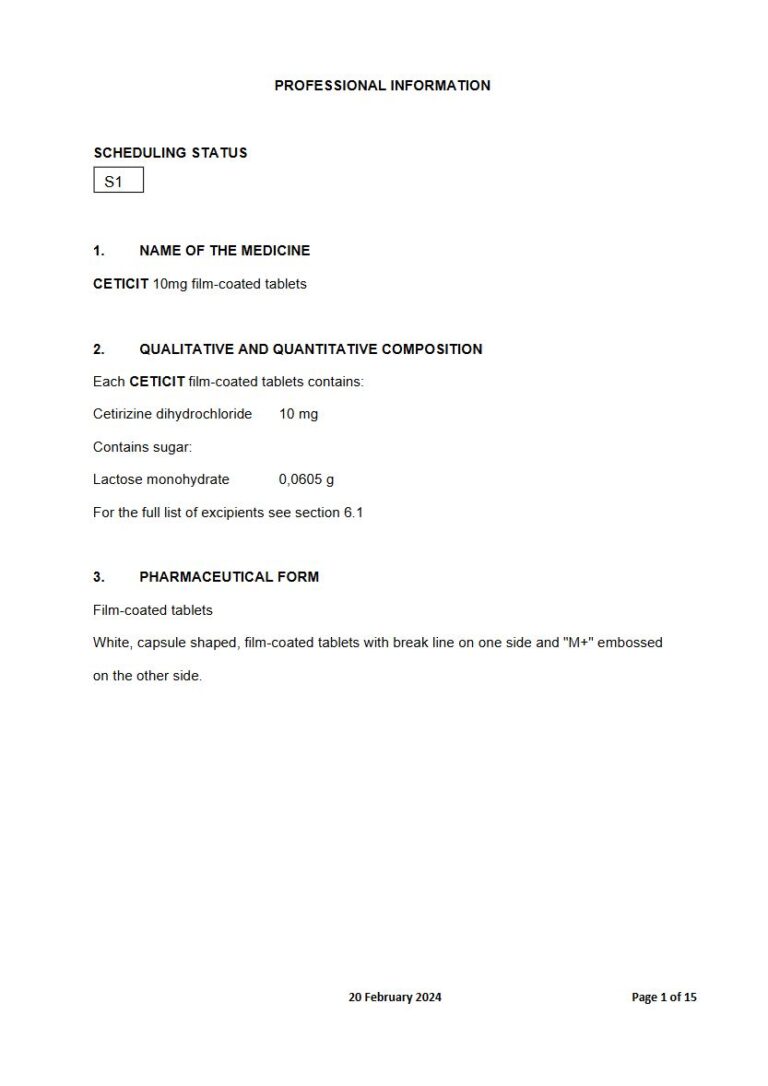
Ceticit 10mg FC tablets
PDF Leaflet Revision Date: 20 February 2024
Clinical Summary
Quick overview from the medicine insert
Indication
Allergic processes responding to a histamine H1 receptor antagonist.
Dosage (summary)
Adults: 10 mg once daily; Children 6-12 years: 10 mg once or 5 mg twice daily.
Special Populations
- Elderly
- Renal impairment
- Hepatic impairment
Pregnancy & Breastfeeding
Contraindicated in pregnancy and lactation.
Key Drug Interactions
- CNS depressants
- Alcohol
Contraindications
- Hypersensitivity to cetirizine
- Pregnancy
- Lactation
- Severe renal impairment
- Children under 2 years
Common side effects
- Drowsiness
- Fatigue
- Dry mouth
Counselling Points
- Avoid alcohol and other sedatives.
- Do not exceed recommended dose.
- Report any severe allergic reactions.
Serious warnings
- May cause sedation in sensitive individuals.
- Caution in patients with urinary retention.
Important Disclaimer
The Ceticit 10mg FC tablets professional information leaflet below is the property of Adcock Ingram and is provided on Medinsert exactly as issued, with no.. alterations or editorial changes. We make every effort to keep content current by updating documents as soon as new versions become available. Medinsert serves as a trusted access point for healthcare professionals, but does not replace official sources or clinical judgement. For more details, please read our full disclaimer. read more>>
 Healthcare Professionals Only
This content is for registered healthcare professionals
Sign in or create a free account to read the full package insert.
Free for HPCSA-registered professionals. Powered by Medinsert.
Clinical Particulars
Section 4 of the official insert — extracted exactly as issued, no alterations
4.1 Therapeutic indications
Allergic processes responding to a histamine H 1 receptor antagonist. Respiratory: Allergic rhinitis, hay fever. Cutaneous: Allergic skin conditions associated with prurtis, e.g. urticaria
4.2 Posology and method of administration
Posology
Adults or children 12 years of age or older: One 10 mg tablet daily once daily.
Children 6 to 12 years old: 10 mg (one tablet) once daily or 5 mg (half a tablet) twice daily.
Special populations
Elderly
No dose adjustment is necessary in healthy elderly patients with normal renal function (see section 4.4 and 5.2).
Pregnancy
CETICIT is contraindicated in pregnancy as the safety has not been established (see section 4.6).
Lactation
CETICIT is contraindicated in lactating women since the active ingredient is excreted in breast milk (see section 4.6).
Renal impairment
In patients with renal impairment, where the creatinine clearance is less than 40 ml/min, the recommended daily dose of cetirizine should be halved (see section 4.2 & 4.3 & 4.8).
Hepatic impairment
In moderate to severe hepatic impairment, half the recommended daily dose should be used (see section 4.2 & 4.3 & 4.8).
Paediatric population
CETICIT 10mg film-coated tablets are contraindicated in children under the age of two years, as safety and efficacy have not been demonstrated (see section 4.3).
Method of administration
Oral administration.
Missed dose
Doctors should advise patients who forget to take CETICIT 10 mg film-coated tablets to take a dose as soon as possible and then continue with the normal dose. Patients should not take a double dose to compensate for the missed dose.
4.3 Contraindications
- History of hypersensitivity to cetirizine, hydroxyzine, any piperazine derivatives or to any of the ingredients of the formulation of CETICIT.
- CETICIT is contraindicated in lactating women since the active ingredient is excreted in breast milk (see section 4.6).
- CETICIT is contraindicated in pregnancy as the safety has not been established (see section 4.6).
- Patients with severe renal impairment at less than 30 mL/min creatinine clearance (see section 4.2 & 4.3 & 4.8).
- Asthma, as it may cause airway obstruction in patients who have previously experienced adverse reactions to antihistamines.
- Children under the age of two years, as safety and efficacy have not been demonstrated (see section 4.2 & 4.3 & 4.4).
4.4 Special warnings and precautions for use
Refer to u201cCONTRAINDICATIONSu201d (see section 4.3). CETICIT lacks significant sedative effects. Patients should, however, be warned that a small number of individuals may experience sedation. It is therefore advisable to determine individual response before driving or performing complicated tasks (see section 4.7). This effect may be compounded by the simultaneous intake of other central nervous system depressants. At therapeutic doses, no clinically significant interactions have been demonstrated with alcohol (for a blood alcohol level of u2264 0,5 g/L). Nevertheless, precaution is recommended if alcohol is taken concomitantly (see section 4.5). Caution should be taken in patients with predisposition factors of urinary retention (e.g. spinal cord lesion, prostatic hyperplasia) as CETICIT may increase the risk of urinary retention (see section 4.3 & 4.4). Caution in epileptic patients and patients at risk of convulsions is recommended.
The use of the film-coated tablet formulation is not recommended in children aged less than 6 years since this formulation does not allow for appropriate dose adaptation. Allergy skin tests are inhibited by CETICIT and a wash-out period (of 3 days) is required before performing them. Pruritus and/or urticaria may occur when CETICIT is stopped, even if those symptoms were not present before treatment initiation. The symptoms may be intense and may require treatment to be restarted. The symptoms should resolve when the treatment is restarted. CETICIT contains lactose. Patients with the rare hereditary conditions of galactose intolerance e.g. galactosaemia, Lapp lactase deficiency, glucose-galactose malabsorption or fructose intolerance should not take CETICIT tablets. Lactose may have an effect on the glycaemic control of patients with diabetes mellitus.
Special Populations
Porphyria Safety has not been established. Pregnancy CETICIT is contraindicated in pregnancy as the safety has not been established (see section 4.6). Lactation CETICIT is contraindicated in lactating women since the active ingredient is excreted in breast milk (see section 4.6).
4.5 Interaction with other medicines and other forms of interaction
To date there are no known interactions with other drugs, notably with pseudoephedrine or theophylline (400 mg/day). Studies with diazepam, glipizide, pseudoephedrine, ketoconazole, azithromycin, erythromycin and cimetidine have revealed no evidence of pharmacokinetic interactions. As with other antihistamines it is advisable to avoid excessive alcohol consumption and other sedating medicines (see section 4.3 & 4.4). The extent of absorption of cetirizine is not reduced with food, although the rate of absorption is decreased. Alcohol and other Central Nervous System (CNS) depressants In sensitive patients, the concurrent use of alcohol or other CNS depressants may cause additional reductions in alertness and impairment of performance, although cetirizine, as in CETICIT, does not potentiate the effect of alcohol (see section 4.3 & 4.4).
4.6 Fertility, pregnancy and lactation
Refer to u201cCONTRAINDICATIONSu201d (see section 4.3). Safety and efficacy in pregnancy and lactation have not been established. Breastfeeding Caution should be exercised when prescribing CETICIT to lactating women. Cetirizine is excreted in human breast milk at concentrations representing 25 % to 90 % of those measured in plasma, depending on sampling time after administration. Fertility Limited data is available on human fertility but no safety concern has been identified. Animal data show no safety concern for human reproduction.
4.7 Effects on ability to drive and use machines
CETICIT lacks significant sedative effects. Patients should, however, be warned that a small number of individuals may experience sedation. It is therefore advisable to determine individual response before driving or performing complicated and/or hazardous tasks and/or operating hazardous machinery. This effect may be compounded by the simultaneous intake of alcohol or other central nervous system depressants (see section 4.4).
4.8 Undesirable effects
Tabulated summary of adverse reactions
System Organ Class Frequency Side-effects Blood and lymphatic system disorders Less frequent Thrombocytopenia, leucopoenia, haemolytic anaemia, agranulocytosis Immune system disorders Less frequent Urticaria, skin rash, pruritus, angioedema, hypersensitivity reactions, anaphylaxis Metabolism and nutrition disorders Frequency unknown Increased appetite Psychiatric disorders Less frequent Frequency unknown Somnolence, depression, confusion, agitation, aggression, hallucinations, insomnia, Suicidal ideation, nightmares Nervous system disorders Less frequent Frequency unknown Drowsiness, fatigue, malaise asthenia, tics Headaches, dizziness, anxiety, nervousness, paraesthesia, convulsions, movement disorders, dysgeusia, syncope, tremor, dystonia, dyskinesia, amnesia, memory impairment Eye disorders Less frequent Accommodation disorder, blurred vision oculogyration Ear and labyrinth disorders Less frequent Tinnitus, vertigo Cardiac disorders Less frequent Palpitations, dysrhythmias, tachycardia Vascular disorders Frequent Less frequent Hypotension Respiratory, thoracic and mediastinal disorders Frequent Less frequent Pharyngitis, rhinitis Thickening of mucous, bronchospasm Gastrointestinal disorders Less frequent Nausea, gastrointestinal discomfort, diarrhoea, constipation, dry mouth Hepatobiliary disorders Less frequent Frequency unknown Hepatic function abnormal (increased transaminase, alkaline phosphatase, u03b3 -GT and bilirubin), jaundice Hepatitis Skin and subcutaneous tissue disorders Less frequent Frequency unknown Pruritus, rash, urticaria, fixed drug eruption, photosensitivity, hair loss, sweating Acute generalised exanthematous pustulosis Musculoskeletal, connective tissue and bone disorders Less frequent Frequency unknown Myalgia Arthralgia Renal and urinary disorders Less frequent Dysuria, enuresis, urinary retention General disorders and administration site conditions Less frequent Asthenia, malaise, oedema Investigations Less frequent Weight increased
Description of selected adverse reactions Skin reactions occurring after discontinuation of CETICIT: After discontinuation of CETICIT, pruritus (intense itching) and/or urticaria have been reported (see section 4.4).
Post-marketing data Not applicable Reporting of suspected adverse reactions Reporting suspected adverse reactions after authorisation of the medicine is important. It allows continued monitoring of the benefit/risk balance of the medicine. Healthcare providers are asked to report any suspected adverse reactions to SAHPRA via the u201c6.04 Adverse Drug Reaction Reporting Formu201d, found online under SAHPRAu2019s publications: https://www.sahpra.org.za/Publications/Index/8 Adverse Drug Reactions may also report to Adcock Ingram Limited using the following email: [email protected]
4.9 Overdose
Signs and symptoms Symptoms observed after an overdose of cetirizine, as in CETICIT, are mainly associated with CNS effects or with effects that could suggest an anticholinergic effect. Drowsiness is an expected symptom of overdosage. Overdosage may produce agitation, confusion, diarrhoea, dizziness, headache, malaise, mydriasis, restlessness, sedation, somnolence, stupor, pruritus, rash, urinary retention, fatigue, tremor and tachycardia.
Management of overdose There is no specific antidote. Cetirizine is not effectively removed by dialysis. Further treatment is symptomatic and supportive.
