
Litak 10 10 mg/ml. Solution for injection
PDF Leaflet Revision Date: 27 June 2025
Clinical Summary
Quick overview from the medicine insert
Indication
First line treatment for hairy cell leukaemia.
Dosage (summary)
0.14 mg/kg/day subcutaneously for 5 days or 0.10 mg/kg/day intravenously for 7 days.
Special Populations
- Elderly
- Renal impairment
- Hepatic impairment
Pregnancy & Breastfeeding
Contraindicated in pregnancy and lactation due to potential harm.
Key Drug Interactions
- Other myelosuppressive medicines
- Corticosteroids
Contraindications
- Hypersensitivity to cladribine
- Pregnancy and lactation
- Children under 18
- Moderate to severe renal impairment
- Moderate to severe hepatic impairment
Common side effects
- Myelosuppression
- Neutropenia
- Thrombocytopenia
- Anaemia
- Infections
Counselling Points
- Monitor for signs of infection and blood count changes.
- Avoid pregnancy during and for 6 months after treatment.
- Consider sperm cryoconservation for men prior to treatment.
Serious warnings
- Risk of myelosuppression and opportunistic infections
- Progressive multifocal leukoencephalopathy (PML)
- Secondary malignancies
Important Disclaimer
The Litak 10 10 mg/ml. Solution for injection professional information leaflet below is the property of Key Oncologics and is provided on Medinsert exactly as issued, with no.. alterations or editorial changes. We make every effort to keep content current by updating documents as soon as new versions become available. Medinsert serves as a trusted access point for healthcare professionals, but does not replace official sources or clinical judgement. For more details, please read our full disclaimer. read more>>
 Healthcare Professionals Only
This content is for registered healthcare professionals
Sign in or create a free account to read the full package insert.
Free for HPCSA-registered professionals. Powered by Medinsert.
Clinical Particulars
Section 4 of the official insert — extracted exactly as issued, no alterations
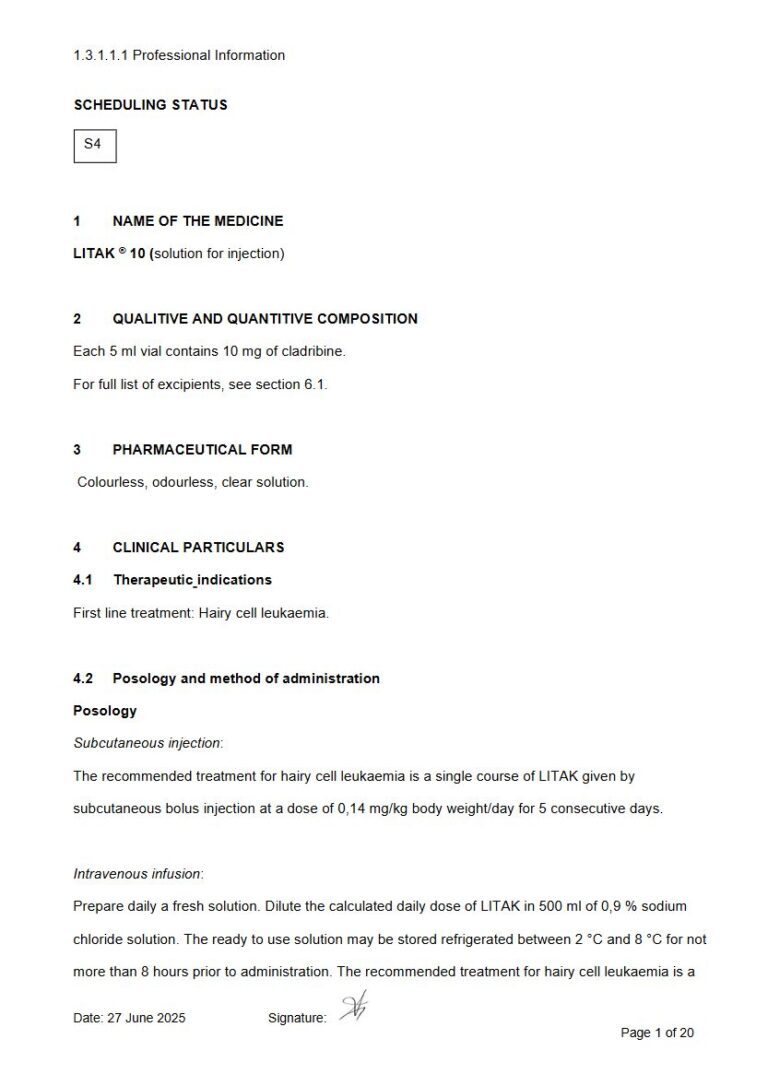
4.1 Therapeutic indications
First line treatment: Hairy cell leukaemia.
4.2 Posology and method of administration
Posology
Subcutaneous injection: The recommended treatment for hairy cell leukaemia is a single course of LITAK given by subcutaneous bolus injection at a dose of 0,14 mg/kg body weight/day for 5 consecutive days.
Intravenous infusion: Prepare daily a fresh solution. Dilute the calculated daily dose of LITAK in 500 ml of 0,9 % sodium chloride solution. The ready to use solution may be stored refrigerated between 2 u00b0C and 8 u00b0C for not more than 8 hours prior to administration. The recommended treatment for hairy cell leukaemia is a single course of LITAK given by continuous intravenous infusion at a dose of 0,10 mg/kg body weight/day for 7 consecutive days.
Special populations
- Elderly population: Experience with patients older than 65 years is limited. Elderly patients should be treated by individual assessment and careful monitoring of the blood counts and of the renal and hepatic function. The risk requires assessment on a case-by-case basis (see section 4.4).
- Impaired bone marrow, renal and hepatic impairment: Patients with known or suspected renal insufficiency as well as patients with a manifestation of bone marrow impairment related to multiple pre-treatments, tumour infiltration or due to any other aetiology should be treated carefully and monitored regularly for haematologic and non-haematologic toxicity. There is no experience in patients with hepatic impairment.
- Paediatric population: Safety and efficacy of LITAK in children have not been established. LITAK is contraindicated in patients less than 18 years of age (see section 4.3).
Method of administration
- LITAK is supplied as a ready-to-use solution for injection.
- The recommended dose is directly withdrawn by a syringe and injected as a subcutaneous bolus injection without dilution.
- LITAK should be inspected visually for particulate matter and discoloration prior to administration.
- LITAK should warm up to room temperature prior to administration.
4.3 Contraindications
- Patients hypersensitive to cladribine or any of the ingredients.
- Pregnancy and lactation.
- Children (patients less than 18 years of age).
- Moderate to severe renal impairment (creatinine clearance u2264 50 ml/min) or moderate to severe hepatic impairment (Child-Pugh score > 6) (see section 4.4).
- Concomitant use of other myelosuppressive medicines.
4.4 Special warnings and precautions for use
Cladribine is an antineoplastic and immunosuppressive substance that can induce considerable toxic adverse effects, like myelo- and immunosuppression, long-lasting lymphocytopenia, and opportunistic infections. Patients undergoing treatment with LITAK should be closely monitored for signs of haematologic and non-haematologic toxicities. Particular caution is advised and risks/benefits should be carefully evaluated, if administration of LITAK is considered in patients with increased infection risk, manifested bone marrow failure or infiltration, myelosuppressive pre-treatments, as well as in patients with suspected or manifested renal and hepatic insufficiency. Patients with active infection should be treated for the underlying condition prior to receiving therapy with LITAK. Although anti-infective prophylaxis is not generally recommended, it may be beneficial for patients immunocompromised prior to therapy with LITAK or for patients with a pre-existing agranulocytosis. If severe toxicity occurs, the doctor should consider delaying or discontinuing the therapy with the medicine until serious complications resolve. In case of infections, antibiotic treatment should be initiated as required.
It is recommended that patients receiving LITAK should receive irradiated cellular blood components/products to prevent transfusion-related graft-versus-host disease (Ta-GVHD).
Progressive multifocal leukoencephalopathy (PML): Cases of PML, including fatal cases, have been reported with cladribine, as contained in LITAK. PML was reported 6 months to several years after treatment with cladribine, as contained in LITAK. An association with prolonged lymphopenia has been reported in several of these cases. Doctors should consider PML in the differential diagnosis in patients with new or worsening neurological, cognitive or behavioural signs or symptoms. Suggested evaluation for PML includes neurology consultation, magnetic resonance imaging of the brain, and cerebrospinal fluid analysis for JC virus (JCV) DNA by polymerase chain reaction (PCR) or a brain biopsy with testing for JCV. A negative JCV PCR does not exclude PML. Additional follow-up and evaluation may be warranted if no alternative diagnosis can be established. Patients with suspected PML should not receive further treatment with cladribine, as contained in LITAK.
Secondary malignancies: Treatment with cladribine is associated with myelosuppression and profound and prolonged immunosuppression. Secondary malignancies are expected to occur in patients with hairy cell leukaemia. Their frequency varies widely, ranging from 2 % to 21 %. The peak risk is at 2 years after diagnosis with a median between 40 and 66 months. The cumulative frequencies of second malignancy are 5 %, 10 - 12 % and 13 - 14 % following 5, 10 and 15 years respectively after diagnosis of hairy cell leukaemia. Following cladribine, the incidence of second malignancies ranges from 0 % to 9,5 % after a median observation period of 2,8 to 8,5 years. The frequency of second malignancy following treatment with LITAK was 3,4 % in all 232 hairy cell leukaemia patients treated during a 10-year period. The highest incidence of second malignancy with LITAK was 6,5 % after a median follow up of time of 8,4 years. Therefore, patients treated with LITAK should be regularly monitored.
Haematologic toxicity: During the first month following treatment, myelosuppression is most notable and red blood cell or platelet transfusions may be required. Patients with a manifestation of bone marrow depression should be treated with caution since further suppression of bone marrow function should be anticipated. Therapeutic risks and benefits should be carefully evaluated in patients with active or suspected infections. The risk of severe myelotoxicity and long-lasting immunosuppression is increased in patients with a disease-related bone marrow infiltration or a previous myelosuppressive treatment. A dose reduction and a regular monitoring of the patient is required in such cases. Increased haematological toxicity (myelosuppression, infections) has been observed in patients receiving repeated cycles of LITAK. Therefore, it is recommended that the dosage regimen of LITAK should not exceed 0,5 mg/kg body weight per cycle in patients receiving multiple treatment courses. A discontinuation of the therapy may be necessary depending on the severity and intensity of the complications. Pancytopenia is normally reversible and the intensity of bone marrow aplasia is dose-dependent. An increased incidence of opportunistic infections is expected during and 6 months following therapy with LITAK. Careful and regular monitoring of peripheral blood counts is essential during and 2 to 4 months following treatment with LITAK to detect potential side effects and consequent complications (anaemia, neutropenia, thrombocytopenia, infections, haemolysis or bleedings), and to survey haematologic recovery. Fever of unknown origin frequently occurs in patients treated for hairy cell leukaemia but rarely in patients with other neoplasias, and is manifested predominantly during the first 4 weeks of therapy. The origin of febrile events should be investigated by appropriate laboratory and radiologic tests. Less than a third of febrile events are associated with a documented infection. In case of fever related to infections or agranulocytosis an antibiotic treatment is indicated. Patients with active infection should be treated for the underlying condition prior to receiving therapy with LITAK. Patients who are or who become Coombsu2018 positive should be monitored closely for occurrence of haemolysis.
Acute, irreversible neuro- and nephrotoxicity have only been observed at high doses of cladribine (u2265 4 times the recommended dose).
Renal and hepatic impairment: There are no data on the use of LITAK in patients with renal or hepatic impairment. Clinical experience is very limited and safety of LITAK in these patients is not well established (see section 4.3). Careful treatment is required in patients with known or suspected renal or hepatic dysfunction. For all patients treated with LITAK, periodic assessment of renal and hepatic function is advised as clinically indicated.
Elderly: Elderly patients should be treated by individual assessment and careful monitoring of the blood counts and of the renal and hepatic function.
Prevention of tumour lysis syndrome: Prophylactic allopurinol therapy to control the serum levels of uric acid, adequate hydration, and close monitoring of renal function are recommended in patients with a high tumour burden. The allopurinol prophylaxis usually starts at the first day of chemotherapy. A daily oral dose of 100 mg of allopurinol is recommended for a period of 2 weeks. In case of an accumulation of the serum uric acid above the normal range, the dose of allopurinol may be increased to 300 mg/day.
Carcinogenesis/mutagenesis: Long-term studies in animals to evaluate the carcinogenic potential of cladribine have not been conducted. On the basis of available data, no evaluation can be made of the carcinogenic risk of LITAK to humans. Cladribine is a cytotoxic agent, which is mutagenic to cultured mammalian cells. Cladribine is incorporated into DNA strands and inhibits DNA synthesis and repair. Exposure to cladribine induces DNA fragmentation and cell death in various normal and leukaemic cells and cell lines at concentrations of 5 nM to 20 u03bcM.
4.5 Interactions with other medicines
Interactions with other medicinal products are not known.
- Due to a potential increase of haematological toxicity and bone marrow suppression, LITAK should not be used concomitantly with other myelosuppressive medicines. Cross reactions with other antineoplastic medicines in vitro (e.g. doxorubicin, vincristin, cytarabine, cyclophosphamide) and in vivo have not been observed. However, an in vitro study revealed cross-resistance between cladribine and nitrogen mustard (chlormethine).
- Due to the similar intracellular metabolism, cross-resistance with other nucleoside analogues, such as fludarabine or 2'-deoxycoformycin may occur. Therefore, simultaneous administration of nucleoside analogues with cladribine is not advisable.
- Corticosteroids have been shown to enhance the risk for severe infections when used in combination with cladribine and should not be given concomitantly with cladribine.
- Since interactions with medicinal products undergoing intracellular phosphorylation, such as antiviral agents, or with inhibitors of adenosine uptake may be expected, their concomitant use with cladribine is not recommended.
4.6 Fertility, pregnancy and lactation
Women of childbearing potential/ Contraception in males and females
Women of childbearing potential must use effective contraception during treatment with LITAK and for 6 months after the last LITAK dose. In case of pregnancy during therapy with LITAK, the woman should be informed about the potential hazard to the foetus.
Pregnancy: LITAK is contraindicated during pregnancy. Cladribine as contained in LITAK causes serious birth defects when administered during pregnancy. Animal studies and in vitro studies with human cell lines demonstrated the teratogenicity and mutagenicity of cladribine.
Breastfeeding: Limited data from case reports have shown that cladribine is excreted in human milk. The quantity is not yet well established. Because of the potential for serious adverse reactions in nursing infants, lactation is contraindicated during treatment with LITAK and for 6 months after the last LITAK dose.
Fertility: The effects of cladribine on fertility have not been studied in animals. However, a toxicity study conducted with Cynomolgus monkeys has shown that cladribine suppresses maturation of rapidly generating cells, including testicular cells. The effect on human fertility is unknown. Antineoplastic agents, such as cladribine (LITAK), which interfere with DNA, RNA and protein synthesis, might be expected to have adverse effects on human gametogenesis. Men being treated with LITAK should be advised not to father a child up to 6 months after treatment and to seek advice of cryoconservation of sperm prior to treatment because of the possibility of infertility due to therapy with cladribine (see section 4.4).
4.7 Effects on ability to drive and use machines
LITAK may cause drowsiness or dizziness and have a major effect on mental and/or physical abilities to perform or execute tasks or activities requiring mental alertness, judgment and/or sound coordination and vision.
4.8 Undesirable effects
a. Summary of the safety profile
Very common adverse reactions observed during the three most relevant clinical trials with LITAK in 279 patients treated for various indications and in 62 patients with hairy cell leukaemia (HCL) were myelosuppression, especially severe neutropenia (41 % (113/279), 98 % (HCL, 61/62)), severe thrombocytopenia (21 % (58/279), 50 % (HCL, 31/62) and severe anaemia (14 % (21/150), 55 % (HCL, 34/62)), as well as severe immunosuppression/lymphopenia (63 % (176/279), 95 % (HCL, 59/62), infections (39 % (110/279), 58 % (HCL, 36/62) and fever (up to 64 %). Culture-negative fever following treatment with cladribine occurs in 10 - 40 % of patients with hairy cell leukaemia and is rarely observed in patients with other neoplastic disorders. Skin rashes (2 u2013 31 %) are mainly described in patients with other concomitant medications known to cause rash (antibiotics and/or allopurinol). Gastrointestinal adverse events like nausea (5 u2013 28 %), vomiting (1 - 13%), and diarrhoea (3 u2013 12 %) as well as fatigue (2 u2013 48 %), headache (1 u2013 23 %), and decreased appetite (1 u2013 22 %) have been reported during treatment with cladribine. LITAK is unlikely to cause alopecia; mild and transient alopecia for a few days was observed in 4/523 patients during the treatment with LITAK, but could not clearly be associated with cladribine.
Adverse reactions that have been reported including information on frequency are listed in the table below. The frequencies are defined as follows: Very common (> 1/10), common (> 1/100, 1/1 000, 1/10 000, < 1/1 000), very rare (< 1/10 000) including isolated reports.
4.9 Overdose
Symptoms: Common symptoms after overdosage are nausea, vomiting, diarrhoea, severe bone marrow depression (including anaemia, thrombocytopenia, leukopenia, and agranulocytosis), acute renal insufficiency as well as irreversible neurologic toxicity (paraparesis / quadriparesis), Guillan-Barru00e9 syndrome, and Brown-Su00e9quard syndrome. Acute, irreversible neuro- and nephrotoxicity have been described in individual patients treated at a dose which was u2265 4 times higher than the recommended regimen for hairy cell leukaemia.
Treatment: No specific antidotal therapy exists. Immediate discontinuation of therapy, careful observation, and initiation of appropriate supportive measures (blood transfusions, dialysis, haemofiltration, antiinfectious therapy, etc.) are the indicated treatment of overdosage of LITAK. Patients who have been exposed to overdosage of LITAK should be monitored haematologically for at least four weeks.
