
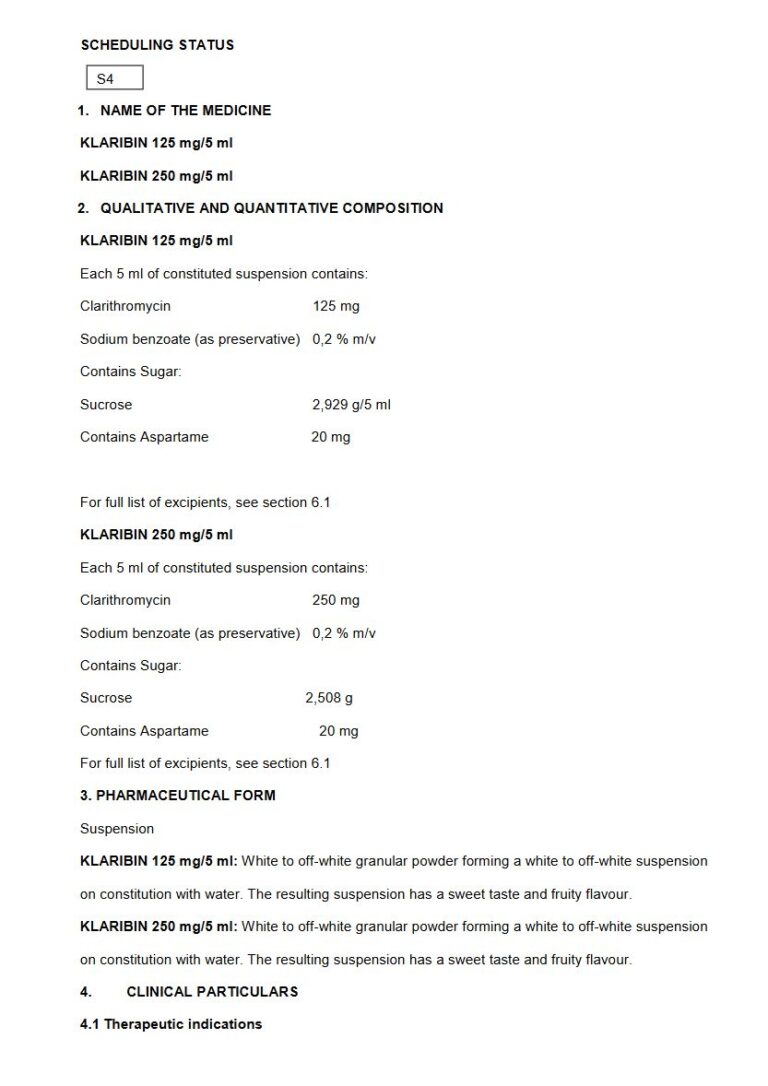
Klaribin 125 mg/5 ml/250 mg Suspension
PDF Leaflet Revision Date: 28 September 2022
Clinical Summary
Quick overview from the medicine insert
Indication
Treatment of mild to moderately severe infections.
Dosage (summary)
Adults: 250 mg twice daily; may increase to 500 mg for severe infections.
Special Populations
- Renal impairment
- Hepatic impairment
Pregnancy & Breastfeeding
Safety in pregnancy and lactation not established; excreted in breast milk.
Key Drug Interactions
- Warfarin
- Digoxin
- Simvastatin
- Rifabutin
- Theophylline
Contraindications
- Hypersensitivity to macrolides
- Concomitant use with astemizole
- Porphyria
Common side effects
- Nausea
- Vomiting
- Diarrhea
- Headache
- Rash
Counselling Points
- Take with or without food
- Monitor for signs of hepatic dysfunction
- Report any allergic reactions
Serious warnings
- Hepatic dysfunction
- QT prolongation
- Rhabdomyolysis risk
Important Disclaimer
The Klaribin 125 mg/5 ml/250 mg Suspension professional information leaflet below is the property of Ranbaxy Pharmaceuticals and is provided on Medinsert exactly as issued, with no.. alterations or editorial changes. We make every effort to keep content current by updating documents as soon as new versions become available. Medinsert serves as a trusted access point for healthcare professionals, but does not replace official sources or clinical judgement. For more details, please read our full disclaimer. read more>>
 Healthcare Professionals Only
This content is for registered healthcare professionals
Sign in or create a free account to read the full package insert.
Free for HPCSA-registered professionals. Powered by Medinsert.
Clinical Particulars
Section 4 of the official insert — extracted exactly as issued, no alterations
4.1 Therapeutic indications
KLARIBIN is indicated for the treatment of the following mild to moderately severe infections caused by susceptible organisms:
- Lower respiratory tract infections such as bronchitis and pneumonia.
- Upper respiratory tract infections such as pharyngitis and sinusitis.
- Mild to moderately severe acute otitis media due to S. pneumoniae, M. catarrhalis and H. influenza.
- Skin and soft tissue infections such as folliculitis, cellulitis or erysipelas.
- Eradication of Helicobacter pylori when used in combination with a proton pump inhibitor and another antibiotic to decrease recurrence of duodenal ulcer.
4.2 Posology and method of administration
Children
Safety and efficacy in infants under 6 months of age has not been established. The recommended dose for children over 6 months is based upon a 7.5 mg/kg dose administered twice daily. See dosage table below. The usual duration of treatment is 5 to 10 days, depending on the pathogen involved and the severity of infection. In patients with severe renal function impairment (creatinine clearance <30 ml/min), the dosage of KLARIBIN should be reduced by half. Do not continue treatment in these patients for more than 14 days. KLARIBIN may be taken with or without meals and can be taken with milk.
Weight Approximate age Dose in ml of 125 mg/5 ml suspension Dose in ml of 250 mg/5 ml suspension
- 8 to 11 kg 1 to 2 years 2.5 ml twice daily -
- 12 to 19 kg 2 to 4 years 5 ml twice daily 2.5 ml twice daily
- 20 to 29 kg 4 to 8 years 7.5 ml twice daily 3.75 ml twice daily
- 30 to 40 kg 8 to 12 years 10 ml twice daily 5 ml twice daily
Reconstitution instructions: The quantity of distilled water specified for the pack size in the table below should be added to the granules and the contents shaken well.
Pack size Volume of water to be added
- 60 ml 34 ml
- 70 ml 40 ml
- 100 ml 55 ml
Adults: 250 mg twice daily. In more severe infections, the dosage may be increased to 500 mg twice daily. Renal impairment Creatinine clearance (<30 ml/min): Reduce dose by half i.e. 250 mg once daily or 250 mg twice daily for severe infections. Limit the duration of treatment to 14 days. Eradication of H. pylori Adults: 500 mg twice daily, in combination with an appropriate antibiotic and an acid lowering agent, for 7 to 10 days. The safety and efficacy of KLARIBIN in combination with proton - pump inhibitors other than omeprazole has not been established. Atypical mycobacterial infections (MAC) in HIV patients Adults: 500 mg twice daily Treatment of disseminated MAC infections in AIDS patients should continue as long as clinical and microbiological benefit is demonstrated. A decrease in efficacy has been noted in patients taking KLARIBIN for more than 12 weeks. KLARIBIN should be used in conjunction with other antimycobacterial agents. Method of administration: Administration is by the oral route.
4.3 Contraindications
- Hypersensitivity to macrolide antibiotics or excipients in listed in section 6.1.
- Concomitant administration of KLARIBIN with astemizole, cisapride, pimozide and terfenadine (See Section 4.5).
- Porphyria.
4.4 Special warnings and precautions for use
KLARIBIN should be used with caution in:
- Liver function impairment u2013 The pharmacokinetics are altered. No dosage adjustment is required in patients with hepatic function impairment, unless there is also concurrent severe renal function impairment.
- Renal function impairment (severe) u2013 The elimination of KLARIBIN is reduced in patients with renal function impairment, especially those with a creatinine clearance of <30 ml/min. The dose of KLARIBIN should be halved or the dosing interval doubled in patients with a creatinine clearance of <30 ml/min.
- Rhabdomyolysis has been reported with concomitant use of KLARIBIN and the HMGCo A reductase inhibitors e.g. simvastatin (See Section 4.5).
- Rifabutin and rifampicin u2013 May decrease serum concentration of KLARIBIN by >50 %. Co-administration has been reported to cause a higher incidence of uveitis compared to rifabutin alone (See Section 4.5).
- Theophylline u2013 The area under the plasma concentration - time curve is increased. Monitoring of theophylline serum concentrations is recommended (See Section 4.5).
- Cross-resistance between KLARIBIN and other macrolides, lincomycin and clindamycin have been reported. Treatment with KLARIBIN should be discontinued if any signs of hepatic dysfunction develop. Hepatic dysfunction is usually reversible, but may be severe. In rare instances, hepatic failure with fatal outcome has been reported, usually associated with other serious underlying diseases and/or concomitant medicines. Isolated cases of increased serum creatinine have been reported, but an association with KLARIBIN has not been established. There have been less frequent reports of hypoglycaemia, some of which occurred in patients on concomitant oral hypoglycaemics or insulin.
Adverse effects in immunocompromised patients treated with higher doses of KLARIBIN over long periods include nausea, vomiting, taste perversion, abdominal pain, diarrhoea, rash, flatulence, headache, hearing disturbance, AST (Aspartate aminotransferase and ALT (Alanine aminotransferase) elevations, elevated BUN (Blood Urea Nitrogen) levels and abnormally low white blood cell and platelet counts. Additional low-frequency events included dyspnoea, insomnia and dry mouth. KLARIBIN contains sucrose. Patients with rare hereditary problems of fructose intolerance, glucose-galactose malabsorption or sucrase-isomaltase insufficiency should not take this medicine. Aspartame KLARIBIN contains 20 mg Aspartame in each 5 ml which is equivalent 4 mg/ml. Aspartame is a source of phenylalanine. It may be harmful if you have phenylketonuria (PKU), a rare genetic disorder in which phenylalanine builds up because the body cannot remove it properly. Sodium KLARIBIN contains less than 1 mmol sodium (23 mg) per tablet, that is to say essentially 'sodium-free'.
4.5 Interaction with other medicines and other forms of interaction
Concomitant use of KLARIBIN with:
- Astemizole, cisapride, pimozide and terfenadine u2013 Has resulted in cardiac arrhythmias, including QTc-interval prolongation, ventricular arrhythmia, ventricular tachycardia, ventricular fibrillation and torsade de pointes. Fatalities have occurred. The most likely cause is the inhibition of metabolism of these medicines by KLARIBIN. Concurrent use is contra-indicated. See Section 4.3.
- Anticoagulants such as warfarin u2013 KLARIBIN may result in the potentiation of the effects of warfarin. Prothrombin time should be monitored closely.
- Digoxin u2013 KLARIBIN has been shown to increase serum digoxin concentrations. Monitoring of digoxin serum concentrations is recommended.
- Carbamazepine or other medicines metabolised by the cytochrome P450 enzyme system for example, alprazolam, cyclosporine, disopyramide, ergot alkaloids, methylprednisolone, midazolam, omeprazole, quinidine, sildenafil, simvastatin, tacrolimus, triazolam, vinblastine, phenytoin, and valproate u2013 KLARIBIN may be associated with increased levels of these medicines. Serum concentrations of these medicines may require monitoring.
- Rhabdomyolysis has been reported with concomitant use of KLARIBIN and the HMGCoA reductase inhibitors e.g. simvastatin (See Section 4.4).
- Rifabutin and rifampicin u2013 May decrease serum concentration of KLARIBIN by >50 %. Co-administration has been reported to cause a higher incidence of uveitis compared to rifabutin alone (See Section 4.4).
- Theophylline u2013 The area under the plasma concentration - time curve is increased. Monitoring of theophylline serum concentrations is recommended (See Section 4.4).
- Zidovudine u2013 A decrease in the steady-state concentration of zidovudine may occur. Doses of zidovudine and KLARIBIN should be taken at least 4 hours apart.
- Ritonavir u2013 The metabolism of KLARIBIN is inhibited. No dosage reduction of KLARIBIN is needed in patients with normal renal function. Patients with renal function impairment require a reduction in the dosage of KLARIBIN as follows: Creatinine clearance 30 to 60 ml/min u2013 Reduce dose by 50 %. Creatinine clearance of <30 ml/min u2013 Reduce dose by 75 %. Do not exceed a dose of 1 g/day during concurrent administration of KLARIBIN with ritonavir. It has been suggested that other HIV-protease inhibitors and non-nucleoside reverse transcriptase inhibitors may have a similar effect on KLARIBIN.
4.6 Fertility, pregnancy and lactation
Safety and efficacy in pregnancy and lactation have not been established. KLARIBIN is excreted in the breast milk.
4.7 Effects on ability to drive and use machines
The effects on ability to drive and use machines has not been established.
4.8 Undesirable effects
System Organ Class Frequency Adverse Reaction
- Blood and lymphatic system disorders Less frequent Leucopenia, thrombocytopenia.
- Endocrine disorders Less frequent Hypoglycaemia.
- Nervous System disorders Frequency Unknown Headache, anxiety, dizziness, insomnia, hallucinations, bad dreams, vertigo, tinnitus, disorientation, depersonalisation, confusion, hearing loss, convulsions.
- Cardiac disorders Frequency Unknown QT prolongation, ventricular tachycardia, torsades de pointes.
- Gastro-intestinal disorders Frequent Nausea, vomiting, abdominal pain, abnormal taste, diarrhoea. Less frequent Glossitis, stomatitis, oral candidiasis, tongue discolouration, tooth discolouration, pseudomembranous colitis (abdominal cramps or pain, tenderness, severe, watery diarrhoea which may also be bloody, fever).
- Hepato-biliary Disorders Less frequent Increase in liver enzymes, hepatocellular and/or cholestatic hepatitis (with or without jaundice), pancreatitis.
- Skin and subcutaneous tissue disorders Frequency Unknown Mild skin eruptions, urticaria, Stevenu2019s - Johnson syndrome, toxic epidermal necrolysis.
- Other Frequency Unknown Allergic reactions, anaphylaxis.
Reporting suspected adverse reactions after authorisation of the medicine is important. It allows continued monitoring of the benefit/risk balance of the medicine. Health care providers are asked to report any suspected adverse reactions to SAHPRA via the u201c6.04 Adverse Drug Reaction Reporting Formu201d, found online under SAHPRAu2019s publications: https://www.sahpra.org.za/Publications/Index/8
4.9 Overdose
Symptoms of overdose Ingestion of large amounts of KLARIBIN can be expected to produce gastro-intestinal symptoms. Allergic reactions accompanying overdosage should be treated by the prompt elimination of unabsorbed medicine and supportive measures.
Treatment of overdose Treatment is symptomatic and supportive. KLARIBIN is not expected to be appreciably affected by haemodialysis or dialysis.
