
Clarihexal 500 500 mg FC tablets
PDF Leaflet Revision Date: 05 August 2021
Clinical Summary
Quick overview from the medicine insert
Indication
Treatment of mild to moderate severe infections.
Dosage (summary)
Adults: 250 mg twice daily; may increase to 500 mg twice daily for severe infections.
Special Populations
- Renal impairment
- Hepatic impairment
Pregnancy & Breastfeeding
Safety in pregnancy not established; excreted in breast milk.
Key Drug Interactions
- Statins (lovastatin, simvastatin)
- Ergot alkaloids
- Oral midazolam
Contraindications
- Hypersensitivity to macrolides
- QT prolongation history
- Severe hepatic failure with renal impairment
Common side effects
- Nausea
- Diarrhoea
- Headache
- Rash
Counselling Points
- Take with or without food
- Monitor for signs of hepatic dysfunction
- Avoid alcohol
Serious warnings
- Risk of QT prolongation
- Hepatic dysfunction
- Rhabdomyolysis with statins
Important Disclaimer
The Clarihexal 500 500 mg FC tablets professional information leaflet below is the property of Sandoz Sa and is provided on Medinsert exactly as issued, with no.. alterations or editorial changes. We make every effort to keep content current by updating documents as soon as new versions become available. Medinsert serves as a trusted access point for healthcare professionals, but does not replace official sources or clinical judgement. For more details, please read our full disclaimer. read more>>
 Healthcare Professionals Only
This content is for registered healthcare professionals
Sign in or create a free account to read the full package insert.
Free for HPCSA-registered professionals. Powered by Medinsert.
Clinical Particulars
Section 4 of the official insert — extracted exactly as issued, no alterations
4.1 Therapeutic indications
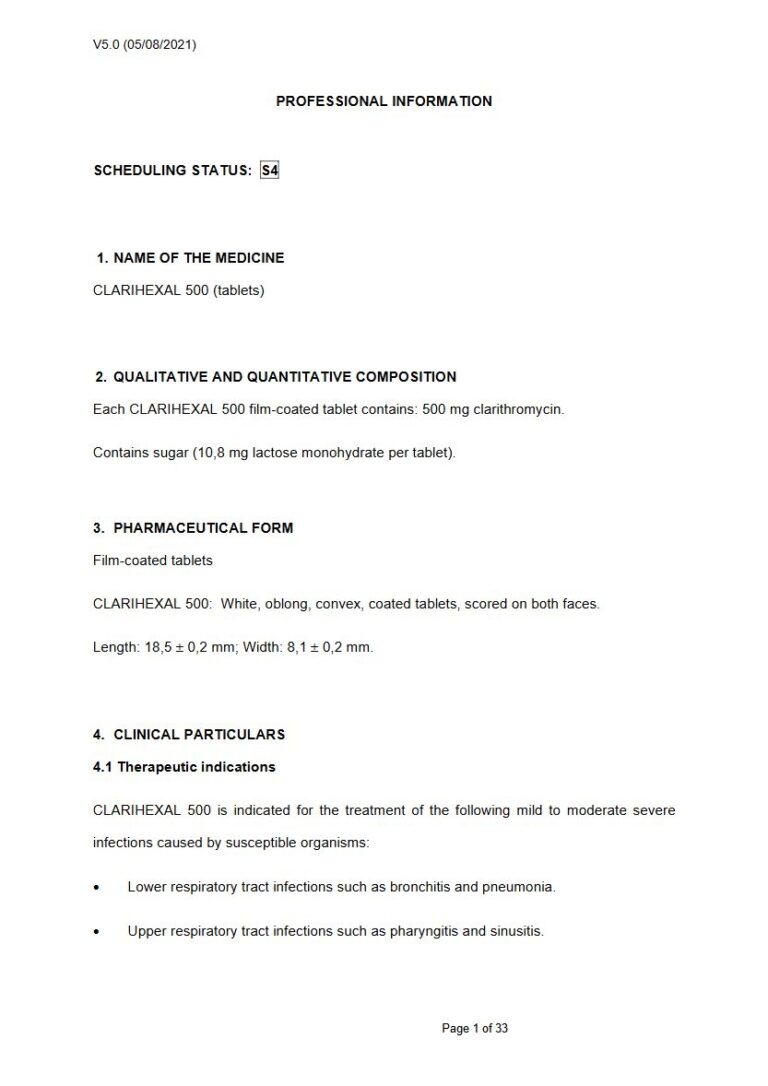
CLARIHEXAL 500 is indicated for the treatment of the following mild to moderate severe infections caused by susceptible organisms:
- Lower respiratory tract infections such as bronchitis and pneumonia.
- Upper respiratory tract infections such as pharyngitis and sinusitis.
- Mild to moderately severe acute otitis media due to S. pneumoniae, M. catarrhalis and H. influenzae.
- Skin and soft tissue infections such as folliculitis, cellulitis or erysipelas.
- Eradication of Helicobacter pylori when used in combination with a proton pump inhibitor and another antibiotic to decrease recurrence of duodenal ulcer.
4.2 Posology and method of administration
Safety and efficacy in infants under 6 months of age has not been established. The recommended dose for children over 6 months is based upon a 7,5 mg/kg dose, administered twice daily. The usual duration of treatment is 5 to 10 days, depending on the pathogen involved and the severity of infection. In patients with severe renal function impairment (creatinine clearance < 30 ml/min), the dosage of CLARIHEXAL 500 should be reduced by half. Do not continue treatment in these patients for more than 14 days. CLARIHEXAL 500 may be taken with or without meals and can be taken with milk.
Adults: 250 mg twice daily. In more severe infections, the dosage may be increased to 500 mg twice daily.
Renal impairment:
Creatinine clearance (< 30 ml/min): Reduce dose by half i.e. 250 mg once daily or 250 mg twice daily for severe infections. Limit the duration of treatment to 14 days.
Eradication of H. pylori: Adults: 500 mg twice daily, in combination with an appropriate antibiotic and an acid lowering agent, for 7 to 10 days. The safety and efficacy of CLARIHEXAL 500 in combination with proton-pump inhibitors other than omeprazole has not been established.
Atypical mycobacterial infections (MAC) in HIV patients: Adults: 500 mg twice daily. Treatment of disseminated MAC infections in AIDS patients should continue as long as clinical and microbiological benefit is demonstrated. A decrease in efficacy has been noted in patients taking CLARIHEXAL 500 for more than 12 weeks. CLARIHEXAL 500 should be used in conjunction with other antimycobacterial agents.
4.3 Contraindications
- Hypersensitivity to macrolide antibiotics or to any of the excipients listed in section 6.1.
- Concomitant administration of clarithromycin and ergot alkaloids (e.g. ergotamine or dihydroergotamine) is contraindicated, as this may result in ergot toxicity (see sections 4.4 and 4.5).
- Concomitant administration of clarithromycin and oral midazolam is contraindicated (see section 4.5).
- Concomitant administration of clarithromycin and lomitapide is contraindicated (see section 4.5).
- Concomitant administration of clarithromycin and any of the following medicine is contraindicated: astemizole, cisapride, domperidone, pimozide and terfenadine as this may result in QT prolongation and cardiac arrhythmias, including ventricular tachycardia, ventricular fibrillation, and torsades de pointes (see section 4.4 and 4.5).
- Clarithromycin should not be given to patients with history of QT prolongation (congenital or documented acquired QT prolongation) or ventricular cardiac arrhythmia, including torsades de pointes (see sections 4.4 and 4.5).
- Concomitant administration with ticagrelor or ranolazine is contraindicated.
- Clarithromycin should not be used concomitantly with HMG-CoA reductase inhibitors (statins) that are extensively metabolized by CYP3A4, (lovastatin or simvastatin), due to the increased risk of myopathy, including rhabdomyolysis (see section 4.5).
- As with other strong CYP3A4 inhibitors, Clarithromycin should not be used in patients taking colchicine (see sections 4.4 and 4.5).
- Clarithromycin should not be given to patients with electrolyte disturbances (hypokalaemia or hypomagnesaemia, due to the risk of prolongation of the QT interval).
- Clarithromycin should not be used in patients who suffer from severe hepatic failure in combination with renal impairment.
- Porphyria.
4.4 Special warnings and precautions for use
CLARIHEXAL 500 should be used with caution in:
- Clarithromycin is principally metabolised by the liver. Therefore, caution should be exercised in administering this antibiotic to patients with impaired hepatic function.
- Caution should also be exercised when administering clarithromycin to patients with moderate to severe renal impairment (see section 4.2).
- Renal function impairment (severe) u2013 the elimination of CLARIHEXAL 500 is reduced in patients with renal function impairment, especially those with a creatinine clearance of < 30 ml/min. The dose of CLARIHEXAL 500 should be halved or the dosing interval doubled in patients with a creatinine clearance of < 30 ml/min.
- Hepatic dysfunction, including increased liver enzymes, and hepatocellular and/or cholestatic hepatitis, with or without jaundice, has been reported with clarithromycin. Treatment with CLARIHEXAL 500 should be discontinued if any signs of hepatic dysfunction develop. Hepatic dysfunction is usually reversible but may be severe. In rare instances, hepatic failure with fatal outcome has been reported, usually associated with other serious underlying diseases and/or concomitant medicines. Some patients may have had pre-existing hepatic disease or may have been taking other hepatotoxic medicines. Patients should be advised to stop treatment and contact their doctor if signs and symptoms of hepatic disease develop, such as anorexia, jaundice, dark urine, pruritus, or tender abdomen. Isolated cases of increased serum creatinine have been reported.
- Rhabdomyolysis has been reported with concomitant use of CLARIHEXAL 500 and the HMG-CoA reductase inhibitors e.g. simvastatin (see section 4.5).
- Rifabutin and rifampicin u2013 may decrease serum concentration of CLARIHEXAL 500 by > 50 %. Co-administration has been reported to cause a higher incidence of uveitis compared to rifabutin alone (see section 4.5).
- Theophylline u2013 the area under the plasma concentration-time curve is increased. Monitoring of theophylline serum concentrations is recommended (see section 4.5).
- Pseudomembranous colitis has been reported with nearly all antibacterial medicines, including macrolides, and may range in severity from mild to life-threatening. Clostridioides difficile-associated diarrhoea (CDAD) has been reported with use of nearly all antibacterial medicines including clarithromycin and may range in severity from mild diarrhoea to fatal colitis. Treatment with antibacterial medicines alters the normal flora of the colon, which may lead to overgrowth of C. difficile.
- CDAD must be considered in all patients who present with diarrhoea following antibiotic use. Careful medical history is necessary since CDAD has been reported to occur over two months after the administration of antibacterial medicines. Therefore, discontinuation of clarithromycin therapy should be considered regardless of the indication. Microbial testing should be performed and adequate treatment initiated. Medicines inhibiting peristalsis should be avoided.
- There have been post-marketing reports of colchicine toxicity with concomitant use of clarithromycin and colchicine, especially in the elderly, some of which occurred in patients with renal insufficiency. Deaths have been reported in some such patients (see section 4.5). Concomitant administration of clarithromycin and colchicine is contraindicated (see section 4.3).
- Caution is advised regarding concomitant administration of clarithromycin and triazolobenzodiazepines, such as triazolam, and intravenous or oromucosal midazolam (see section 4.5).
- Cardiovascular Events: Prolongation of the QT interval, reflecting effects on cardiac repolarisation imparting a risk of developing cardiac dysrhythmia and torsades de pointes, have been seen in patients treated with macrolides including clarithromycin (see section 4.8). Due to increased risk of QT prolongation and ventricular dysrhythmias (including torsades de pointes), the use of clarithromycin is contraindicated: in patients taking any of astemizole, cisapride, domperidone, pimozide and terfenadine; in patients who have electrolyte disturbances such as hypomagnesaemia or hypokalaemia; and in patients with a history of QT prolongation or ventricular cardiac dysrhythmia (see section 4.3).
- Furthermore, clarithromycin should be used with caution in the following: Patients with coronary artery disease, severe cardiac insufficiency, conduction disturbances or clinically relevant bradycardia. Patients concomitantly taking other medicines associated with QT prolongation other than those which are contraindicated. Epidemiological studies investigating the risk of adverse cardiovascular outcomes with macrolides have shown variable results. Some observational studies have identified a rare short-term risk of dysrhythmia, myocardial infarction and cardiovascular mortality associated with macrolides including clarithromycin. Consideration of these findings should be balanced with treatment benefits when prescribing clarithromycin.
- Pneumonia: In view of the emerging resistance of Streptococcus pneumoniae to macrolides, it is important that sensitivity testing be performed when prescribing clarithromycin for community-acquired pneumonia. In hospital-acquired pneumonia, clarithromycin should be used in combination with additional appropriate antibiotics.
- Skin and soft tissue infections of mild to moderate severity: These infections are most often caused by Staphylococcus aureus and Streptococcus pyogenes, both of which may be resistant to macrolides. Therefore, it is important that sensitivity testing be performed. In cases where betau2013lactam antibiotics cannot be used (e.g. allergy), other antibiotics, such as clindamycin, may be the drug of first choice. Currently, macrolides are only considered to play a role in some skin and soft tissue infections, such as those caused by Corynebacterium minutissimum, acne vulgaris, and erysipelas and in situations where penicillin treatment cannot be used.
- In the event of severe acute hypersensitivity reactions, such as anaphylaxis, severe cutaneous adverse reactions (SCAR) (e.g. Acute generalised exanthematous pustulosis (AGEP), Stevens-Johnson Syndrome, toxic epidermal necrolysis and drug rash with eosinophilia and systemic symptoms (DRESS)), clarithromycin therapy should be discontinued immediately and appropriate treatment should be urgently initiated.
- Clarithromycin should be used with caution when administered concurrently with medications that induce the cytochrome CYP3A4 enzyme (see section 4.5).
- HMG-CoA Reductase Inhibitors (statins): Concomitant use of clarithromycin with lovastatin or simvastatin is contraindicated (see section 4.3). Caution should be exercised when prescribing clarithromycin with other statins. Rhabdomyolysis has been reported in patients taking clarithromycin and statins. Patients should be monitored for signs and symptoms of myopathy. In situations where the concomitant use of clarithromycin with statins cannot be avoided, it is recommended to prescribe the lowest registered dose of the statin. Use of a statin that is not dependent on CYP3A metabolism (e.g. fluvastatin) can be considered (see section 4.5).
- Oral hypoglycaemic medicines/Insulin: There have been less frequent reports of hypoglycaemia, some of which occurred in patients on concomitant oral hypoglycaemics (such as sulphonylurias) or insulin. Careful monitoring of glucose is recommended (see section 4.5).
- Oral anticoagulants: There is a risk of serious haemorrhage and significant elevations in International Normalized Ratio (INR) and prothrombin time when clarithromycin is co-administered with warfarin (see section 4.5). INR and prothrombin times should be frequently monitored while patients are receiving clarithromycin and oral anticoagulants concurrently. Caution should be exercised when clarithromycin is co-administered with direct acting oral anticoagulants such as dabigatran, rivaroxaban and apixaban, particularly to patients at high risk of bleeding (see section 4.5).
- Long-term use may, as with other antibiotics, result in colonisation with increased numbers of non-susceptible bacteria and fungi. If superinfections occur, appropriate therapy should be instituted.
- Cross-resistance between CLARIHEXAL 500 and other macrolides, lincomycin and clindamycin has been reported.
- Adverse effects in immunocompromised patients treated with higher doses of CLARIHEXAL 500 over long periods include nausea, vomiting, taste perversion, abdominal pain, diarrhoea, rash, flatulence, headache, hearing disturbance, AST and ALT elevations, elevated BUN levels and abnormally low white blood cell and platelet counts. Additional low-frequency events included dyspnoea, insomnia and dry mouth.
- CLARIHEXAL 500 contains lactose. Patients with the rare hereditary conditions of galactose intolerance e.g. galactosaemia, Lapp lactase deficiency, glucose-galactose malabsorption or fructose intolerance should not take CLARIHEXAL 500.
4.5 Interactions with other medicines
Concomitant use of CLARIHEXAL 500 with:
- Astemizole, cisapride, domperidone, pimozide and terfenadine: Elevated cisapride levels have been reported in patients receiving clarithromycin and cisapride concomitantly. This may result in QT prolongation and cardiac dysrhythmias including ventricular tachycardia, ventricular fibrillation and torsades de pointes. Similar effects have been observed in patients taking clarithromycin and pimozide concomitantly (see section 4.3).
- Macrolides have been reported to alter the metabolism of terfenadine resulting in increased levels of terfenadine which has occasionally been associated with cardiac dysrhythmias, such as QT prolongation, ventricular tachycardia, ventricular fibrillation and torsades de pointes (see section 4.3). In one study in 14 healthy volunteers, the concomitant administration of clarithromycin and terfenadine resulted in 2- to 3-fold increase in the serum level of the acid metabolite of terfenadine and in prolongation of the QT interval which did not lead to any clinically detectable effect. Similar effects have been observed with concomitant administration of astemizole and other macrolides.
- Ergot alkaloids: Post-marketing reports indicate that co-administration of clarithromycin with ergotamine or dihydroergotamine has been associated with acute ergot toxicity characterized by vasospasm, and ischaemia of the extremities and other tissues including the central nervous system. Concomitant administration of clarithromycin and ergot alkaloids is contraindicated (see section 4.3).
- Oral Midazolam: When midazolam was co-administered with clarithromycin tablets (500 mg twice daily), midazolam AUC was increased 7-fold after oral administration of midazolam. Concomitant administration of oral midazolam and clarithromycin is contraindicated (see section 4.3).
- HMG-CoA Reductase Inhibitors (statins): Concomitant use of clarithromycin with lovastatin or simvastatin is contraindicated (see section 4.3) as these statins are extensively metabolized by CYP3A4 and concomitant treatment with clarithromycin increases their plasma concentration, which increases the risk of myopathy, including rhabdomyolysis. Reports of rhabdomyolysis have been received for patients taking clarithromycin concomitantly with these statins. If treatment with clarithromycin cannot be avoided, therapy with lovastatin or simvastatin must be suspended during the course of treatment.
- Caution should be exercised when prescribing clarithromycin with statins. In situations where the concomitant use of clarithromycin with statins cannot be avoided, it is recommended to prescribe the lowest registered dose of the statin. Use of a statin that is not dependent on CYP3A metabolism (e.g. fluvastatin) can be considered. Patients should be monitored for signs and symptoms of myopathy.
- Effects of Other medicines on Clarithromycin: Medicines that are inducers of CYP3A (e.g. rifampicin, phenytoin, carbamazepine, phenobarbital, St John's wort) may induce the metabolism of clarithromycin. This may result in sub-therapeutic levels of clarithromycin leading to reduced efficacy. Furthermore, it might be necessary to monitor the plasma levels of the CYP3A inducer, which could be increased owing to the inhibition of CYP3A by clarithromycin (see also the relevant product information for the CYP3A4 inducer administered). Concomitant administration of rifabutin and clarithromycin resulted in an increase in rifabutin and decrease in clarithromycin serum levels together with an increased risk of uveitis.
4.6 Fertility, pregnancy and lactation
Pregnancy: The safety of CLARIHEXAL 500 for use during pregnancy has not been established. Based on variable results obtained from animal studies and experience in humans, the possibility of adverse effects on embryofoetal development cannot be excluded. Some observational studies evaluating exposure to clarithromycin during the first and second trimester have reported an increased risk of miscarriage compared to no antibiotic use or other antibiotic use during the same period. The available epidemiological studies on the risk of major congenital malformations with use of macrolides including clarithromycin during pregnancy provide conflicting results.
Breastfeeding: The safety of CLARIHEXAL 500 for using during breastfeeding of infants has not been established. CLARIHEXAL 500 is excreted into human breast milk in small amounts. It has been estimated that an exclusively breastfed infant would receive about 1,7 % of the maternal weight-adjusted dose of clarithromycin.
Fertility: In the rat, fertility studies have not shown any evidence of harmful effects.
4.7 Effects on ability to drive and use machines
There are no data on the effect of CLARIHEXAL 500 on the ability to drive or use machines. The potential for dizziness, vertigo, confusion and disorientation, which may occur with the medication, should be taken into account before patients drive or use machines.
4.8 Undesirable effects
Infections and Infestations: Less frequent: Cellulitis, candidiasis, gastroenteritis, infection, vaginal infection. Frequency unknown*: Pseudomembranous colitis, erysipelas.
Blood and lymphatic system disorders: Less frequent: Leucopenia, neutropenia, thrombocythaemia, eosinophilia. Frequency unknown*: Agranulocytosis, thrombocytopenia.
Immune system disorders: Less frequent: Hypersensitivity, anaphylactoid reaction. Frequency unknown*: Anaphylactoid reaction, angioedema.
Metabolism and nutrition disorders: Less frequent: Anorexia, decreased appetite.
Psychiatric disorders: Frequent: Insomnia. Less frequent: Anxiety, nervousness. Frequency unknown*: Psychotic disorder, confusional state, depersonalisation, depression, disorientation, hallucination, abnormal dreams, mania.
Nervous system disorders: Frequent: Dysgeusia, headache. Less frequent: Loss of consciousness, dyskinesia, dizziness, somnolence, tremor. Frequency unknown*: Convulsion ageusia, parosmia, anosmia, paraesthesia.
Ear and labyrinth disorders: Less frequent: Vertigo, tinnitus, impaired hearing. Frequency unknown*: Deafness.
Cardiac disorders: Less frequent: Cardiac arrest, atrial fibrillation, electrocardiogram QT prolonged, extrasystoles, palpitations. Frequency unknown*: Ventricular fibrillation, ventricular tachycardia, torsades de pointes.
Vascular disorders: Frequent: Vasodilation. Frequency unknown*: Haemorrhage.
Respiratory, thoracic and mediastinal disorders: Less frequent: Asthma, epistaxis, pulmonary embolism.
Gastrointestinal disorders: Frequent: Nausea, vomiting, abdominal pain, diarrhoea, dyspepsia. Less frequent: Oesophagitis, gastroesophageal reflux disease, gastritis, proctalgia, glossitis, stomatitis, abdominal distension, constipation, dry mouth, eructation, flatulence. Frequency unknown: Tongue discolouration, tooth discolouration, pancreatitis acute.
Hepatobiliary disorders: Frequent: Abnormal liver function test. Less frequent: Cholestasis, hepatitis, increased alanine aminotransferase, increased aspartate aminotransferase, increased gamma glutamyltransferase. Frequency unknown*: Hepatic failure, jaundice hepatocellular.
Skin and subcutaneous tissue disorders: Frequent: Rash, hyperhidrosis. Less frequent: Dermatitis bullous, pruritus, rash maculo-papular, urticaria. Frequency unknown*: Stevens-Johnson syndrome, toxic epidermal necrolysis, severe cutaneous adverse reactions (SCAR) (e.g. acute generalised exanthematous pustulosis (AGEP), drug rash with eosinophilia and systemic symptoms (DRESS), acne.
Musculoskeletal and connective tissue disorders: Less frequent: Muscle spasms, musculoskeletal stiffness, myalgia. Frequency unknown*: Rhabdomyolysis, myopathy.
Renal and urinary disorders: Less frequent: Increased blood creatinine, increased blood urea. Frequency unknown*: Nephritis interstitial, renal failure.
General disorders and administration site conditions: Frequent: Injection site phlebitis, injection site pain, injection site inflammation. Less frequent: Malaise, pyrexia, asthenia, chest pain, chills, fatigue.
Investigations: Less frequent: Albumin globulin ratio abnormal, increased blood alkaline phosphatase, increased blood lactate dehydrogenase. Frequency unknown*: Increased international normalised ratio, prothrombin time prolonged, abnormal urine colour.
1 Undesirable effects reported only for the powder for solution for injection formulation. 2 Undesirable effects reported only for the extended-release tablets formulation. 3 Undesirable effects reported only for the granules for oral suspension formulation. 4 Undesirable effects reported only for the immediate-release tablets formulation. 5,6 see Description of selected adverse reactions. * Because these reactions are reported voluntarily from a population of uncertain size, it is not always possible to reliably estimate their frequency or establish a causal relationship to medicinal product exposure. Patient exposure is estimated to be greater than 1 billion patient treatment days for clarithromycin.
4.9 Overdose
(See section 4.4). Symptoms of overdose: Ingestion of large amounts of CLARIHEXAL 500 can be expected to produce gastrointestinal symptoms. Adverse reactions accompanying overdosage should be treated by the prompt elimination of unabsorbed medicine and supportive measures. Treatment of overdose: Treatment is symptomatic and supportive. As with other macrolides, CLARIHEXAL 500 is not expected to be appreciably affected by haemodialysis or peritoneal dialysis.
