
Clindamycin Fresenius 600 Mg/4 Ml Solution
PDF Leaflet Revision Date: 17 March 2022
Clinical Summary
Quick overview from the medicine insert
Indication
Treatment of infections caused by susceptible strains of bacteria.
Dosage (summary)
Adults: 600-2700 mg/day in divided doses; Children: 15-40 mg/kg/day.
Special Populations
- Renal impairment
- Hepatic impairment
- Neonates
Pregnancy & Breastfeeding
Safety in pregnancy not established; crosses into breast milk.
Key Drug Interactions
- Erythromycin
- Vitamin K antagonists
- CYP3A4 inhibitors
Contraindications
- Hypersensitivity to clindamycin
- Gastrointestinal disease
- Meningitis
Common side effects
- Pseudomembranous colitis
- Skin rashes
- Diarrhoea
Counselling Points
- Monitor for diarrhoea
- Avoid concurrent use with erythromycin
- Consider alternative in pregnancy
Serious warnings
- Risk of severe colitis
- Gasping syndrome in neonates
- Hypersensitivity reactions
Important Disclaimer
The Clindamycin Fresenius 600 Mg/4 Ml Solution professional information leaflet below is the property of Fresenius Kabi Manufacturing Sa and is provided on Medinsert exactly as issued, with no.. alterations or editorial changes. We make every effort to keep content current by updating documents as soon as new versions become available. Medinsert serves as a trusted access point for healthcare professionals, but does not replace official sources or clinical judgement. For more details, please read our full disclaimer. read more>>
 Healthcare Professionals Only
This content is for registered healthcare professionals
Sign in or create a free account to read the full package insert.
Free for HPCSA-registered professionals. Powered by Medinsert.
Clinical Particulars
Section 4 of the official insert — extracted exactly as issued, no alterations
4.1 Therapeutic indications
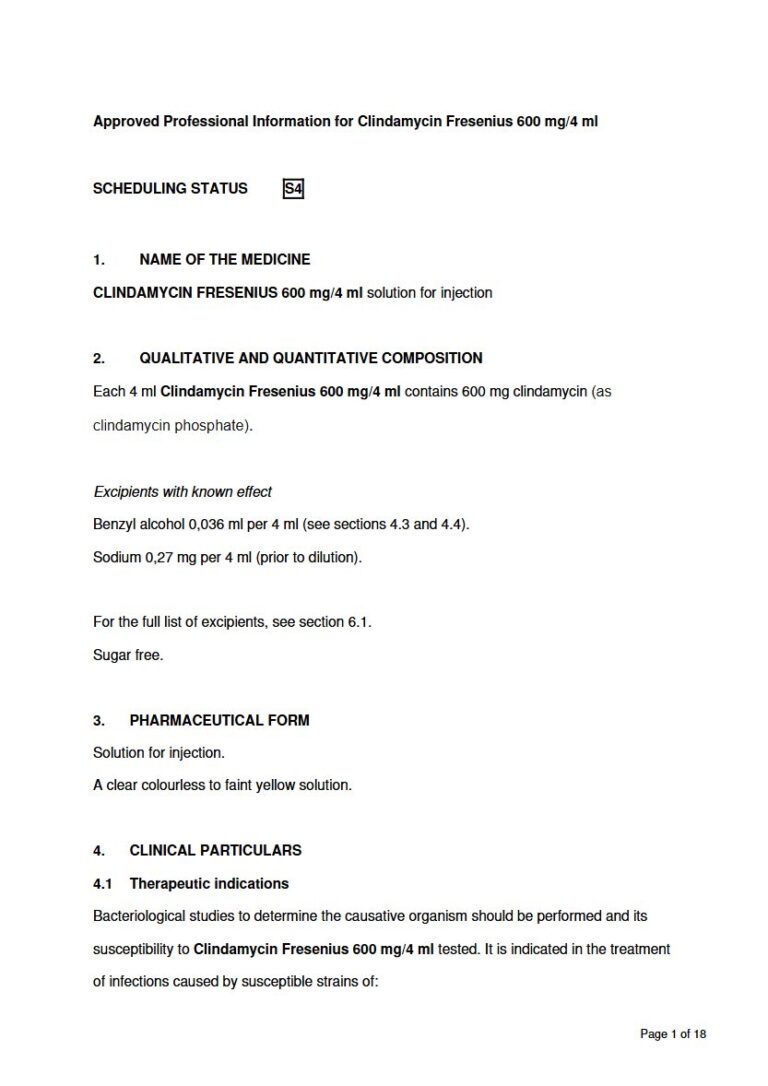
Bacteriological studies to determine the causative organism should be performed and its susceptibility to Clindamycin Fresenius 600 mg/4 ml tested. It is indicated in the treatment of infections caused by susceptible strains of:
- Staphylococcus aureus: abscesses, bacteraemia, endocarditis, pneumonia and osteomyelitis, but not in meningitis or in methicillin-resistant organisms.
- Streptococcus (anaerobic species): bacteraemia, endocarditis, abscesses and upper respiratory infections (sinusitis).
- Streptococcus pneumoniae: pneumonia, arthritis and upper respiratory infections.
- Clostridium perfringens: gas gangrene.
- Campylobacter jejuni: enteritis.
- Bacteroides species: oral disease, upper respiratory tract infections and lung abscess.
- Fusobacterium nucleatum: ulcerative pharyngitis, lung abscess, empyema, genital infections, gingivitis.
4.2 Posology and method of administration
Posology
Intramuscular injection:
Adults:
- Moderate to severe infections: 600 u2013 1 200 mg/day in 2, 3 or 4 equally divided doses.
- Severe infections: 1 200 u2013 2 700 mg/day in 2, 3 or 4 equal doses.
Paediatric population
Children: Over the age of 1 month: 15 u2013 40 mg/kg body mass daily in divided doses. Severe infections: Not less than 300 mg daily (irrespective of body mass).
Neonates: Safety and appropriate dosages in infants less than one month old have not been established (see section 4.3).
Intravenous infusion:
Clindamycin Fresenius 600 mg/4 ml may be administered in the form of a single rapid infusion of the initial dose followed by continuous IV infusion. This will maintain the serum levels of clindamycin at the following levels:
Serum clindamycin level
- Rapid infusion rate
- above 4 u03bcg/ml: 10 mg/min for 30 min; Maintenance infusion rate: 0,75 mg/min
- above 5 u03bcg/ml: 15 mg/min for 30 min; Maintenance infusion rate: 1,00 mg/min
- above 6 u03bcg/ml: 20 mg/min for 30 min; Maintenance infusion rate: 1,25 mg/min
In the treatment of beta-haemolytic streptococcal infections, a therapeutic dose must be administered for at least 10 days to diminish the likelihood of subsequent severe complications such as rheumatic fever or glomerulonephritis.
Method of administration
IM or IV infusion. Infusion rates are as follows:
- 300 mg: 50 ml, 10 min
- 600 mg: 100 ml, 20 min
- 900 mg: 150 ml, 30 min
- 1 200 mg: 200 ml, 45 min
Administration of more than 1 200 mg in a single 1-hour infusion is not recommended. Clindamycin Fresenius 600 mg/4 ml should not be injected intravenously as an undiluted bolus, but should rather be infused over at least 20 to 60 minutes.
Since intramuscular injections of greater than 600 mg are not recommended, Clindamycin Fresenius 600 mg/4 ml must be diluted prior to intravenous administration to a dilution of 300 mg in 50 ml of diluent (6 mg/ml) or more. Suitable diluents may contain: sodium chloride, dextrose.
4.3 Contraindications
- Hypersensitivity to clindamycin, lincomycin, doxorubicin or to any of the excipients of Clindamycin Fresenius 600 mg/4 ml, listed in section 6.1.
- Patients with diarrhoeal states or gastrointestinal disease, particularly those with a history of colitis.
- Treatment of meningitis. No significant levels of Clindamycin Fresenius 600 mg/4 ml are attained in the cerebrospinal fluid, even in the presence of inflamed meninges.
- Clindamycin Fresenius 600 mg/4 ml must not be given to premature babies or neonates because of the benzyl alcohol content (see sections 4.4 and 4.6).
4.4 Special warnings and precautions for use
Benzyl alcohol may cause fatal u201cgasping syndromeu201d in neonates. Clindamycin Fresenius 600 mg/4 ml contains benzyl alcohol (0,036 ml/4 ml). Intravenous administration of the preservative benzyl alcohol has been associated with serious adverse events and death in paediatric patients, including neonates, characterised by central nervous system depression, metabolic acidosis, gasping respirations, cardiovascular failure and haematological anomalies (u201cgasping syndromeu201d). Although normal therapeutic doses of Clindamycin Fresenius 600 mg/4 ml ordinarily deliver amounts of benzyl alcohol that are substantially lower than those reported in association with the u201cgasping syndromeu201d, the minimum amount of benzyl alcohol at which toxicity may occur is not known. Use only if there are no alternatives available. If given in high volumes, Clindamycin Fresenius 600 mg/4 ml should be used with caution and preferably for short-term treatment in patients with liver or kidney impairment, because of the risk of accumulation and toxicity (metabolic acidosis) due to benzoic acid (a metabolite of benzyl alcohol). Premature and low birth mass infants may be more likely to develop toxicity. Benzyl alcohol-containing products should not be used in preterm or full term neonates. Benzyl alcohol can cross the placenta (see section 4.6).
Severe hypersensitivity reactions, including severe skin reactions such as drug reaction with eosinophilia and systemic symptoms (DRESS), Stevens-Johnson syndrome (SJS), toxic epidermal necrolysis (TEN) and acute generalised exanthematous pustulosis (AGEP) have been reported in patients receiving clindamycin therapy. If a hypersensitivity or severe skin reaction occurs, Clindamycin Fresenius 600 mg/4 ml should be discontinued and appropriate therapy should be initiated (see sections 4.3 and 4.8).
Antibiotic-associated diarrhoea (AAD) and Clostridium difficile-associated diarrhoea (CDAD): Clindamycin Fresenius 600 mg/4 ml should be used with caution in patients with gastrointestinal disease, particularly those with a history of colitis. Clindamycin Fresenius 600 mg/4 ml therapy has been associated with severe colitis which may end fatally. Toxin(s) produced by Clostridia (especially Clostridium difficile) is the principal direct cause of antibiotic-associated colitis. Clindamycin Fresenius 600 mg/4 ml should be reserved for serious infections where less toxic antimicrobial medicines are inappropriate. In considering the use of the Clindamycin Fresenius 600 mg/4 ml, the health care provider should bear in mind the type of infection and the potential hazard of the diarrhoea which may develop, since cases of colitis have been reported during, or even two or three weeks following the administration of Clindamycin Fresenius 600 mg/4 ml.
Treatment with antibacterial medicines alters the normal flora of the colon leading to overgrowth of Clostridium difficile. This has been reported with use of nearly all antibacterial medicines, including clindamycin. Clostridium difficile produces toxins A and B which contribute to the development of Clostridium difficile-associated diarrhoea (CDAD) and is a primary cause of antibiotic-associated colitis. The disease is likely to follow a more severe course in older patients or patients who are debilitated. Diagnosis is usually made by the recognition of the clinical symptoms but can be substantiated by endoscopic demonstration of pseudomembranous colitis. Colitis is a disease, which has a clinical spectrum from mild, watery diarrhoea to severe, persistent diarrhoea, leucocytosis, fever, and severe abdominal cramps, which may be associated with the passage of blood and mucus. When significant diarrhoea occurs, the medicine should be discontinued. If allowed to progress, it may produce peritonitis, shock and toxic megacolon. The presence of the disease may be further confirmed by culture of the stool for Clostridium difficile on selective media and assay of the stool specimen for the toxin(s) of C. difficile. It is important to consider the diagnosis of CDAD in patients who present with diarrhoea subsequent to the administration of antibacterial medicines. This may progress to colitis, including pseudomembranous colitis (see section 4.8), which may range from mild to fatal colitis. If antibiotic-associated diarrhoea or antibiotic-associated colitis is suspected or confirmed, ongoing treatment with antibacterial medicines, including Clindamycin Fresenius 600 mg/4 ml, should be discontinued and adequate therapeutic measures should be initiated immediately. When 125 mg to 500 mg of vancomycin are administered orally four times a day for 7 u2013 10 days, there is a rapid observed disappearance of the toxin from faecal samples and a coincident clinical recovery from the diarrhoea. Medicines inhibiting peristalsis are contraindicated in this situation. Hypertoxin-producing strains of C. difficile cause increased morbidity and mortality, as these infections can be refractory to antimicrobial therapy and may require colectomy. CDAD must be considered in all patients who present with diarrhoea following antibiotic use. Careful medical history is necessary since diarrhoea, CDAD and pseudomembranous colitis have been observed commencing up to several weeks following cessation of therapy with Clindamycin Fresenius 600 mg/4 ml. Fluid, electrolyte and protein supplementation and use of an antibacterial medicine against Clostridium spp. should be considered for severe antibiotic-associated colitis. Since clindamycin does not diffuse adequately into cerebrospinal fluid, Clindamycin Fresenius 600 mg/4 ml should not be used in the treatment of meningitis. Acute kidney injury, including acute renal failure, has been reported infrequently. In patients suffering from pre-existing renal dysfunction or taking concomitant nephrotoxic medicines, monitoring of renal function should be considered (see section 4.8).
Superinfection
Prolonged administration of Clindamycin Fresenius 600 mg/4 ml may result in superinfection due to organisms resistant to clindamycin. The use of Clindamycin Fresenius 600 mg/4 ml may result in the overgrowth of non-susceptible organisms, particularly yeasts.
Reduced efficacy of oral contraceptives
Antibiotics, including Clindamycin Fresenius 600 mg/4 ml, can reduce the efficacy of the combined oral contraceptive pill. Additional contraceptive precautions should be taken during treatment and for up to seven days after stopping treatment.
Special populations
Infants
Safety and appropriate dosage in infants less than one month old have not been established. When used in infants of less than 1 month in age, appropriate monitoring of organ system functions is desirable.
Atopic patients
Care should be observed in the use of Clindamycin Fresenius 600 mg/4 ml in atopic individuals, particularly those with asthma.
Patients with renal and hepatic disorders
Patients with renal and/or hepatic disease should be treated with caution. Periodic liver and kidney function and haematology tests should be carried out during prolonged therapy.
Patients with porphyria
Clindamycin Fresenius 600 mg/4 ml is possibly porphyrinogenic.
Sodium content
Clindamycin Fresenius 600 mg/4 ml contains less than 1 mmol sodium (23 mg) per 4 ml, that is to say essentially sodium free.
4.5 Interaction with other medicines and other forms of interaction
Clindamycin Fresenius 600 mg/4 ml has neuromuscular blocking activity in high doses and may enhance the effect of other medicines with this action, with a potential danger of respiratory depression. Therefore, Clindamycin Fresenius 600 mg/4 ml should be used with caution in patients receiving such medicines. Clindamycin Fresenius 600 mg/4 ml may antagonise the activity of parasympathomimetics. Antagonism has been demonstrated between clindamycin and erythromycin in vitro. Because of possible clinical significance, Clindamycin Fresenius 600 mg/4 ml and erythromycin should not be administered concurrently. Increased coagulation tests, Prothrombin Time and International Normalized Ratio (PT/INR) and/or bleeding have been reported in patients treated with clindamycin in combination with a vitamin K antagonist (e.g. warfarin, acenocoumarol and fluindione). Coagulation tests, therefore, should be frequently monitored in patients treated with vitamin K antagonists. Co-administration of clindamycin with inhibitors of CYP3A4 and CYP3A5 Clindamycin is metabolised predominantly by CYP3A4, and to a lesser extent by CYP3A5, to the major metabolite clindamycin sulphoxide and minor metabolite N-desmethylclindamycin. Therefore, inhibitors of CYP3A4 and CYP3A5 may reduce Clindamycin Fresenius 600 mg/4 ml clearance and inducers of these isoenzymes may increase Clindamycin Fresenius 600 mg/4 ml clearance. In the presence of strong CYP3A4 inducers such as rifampicin, monitor for loss of effectiveness. In vitro studies indicate that clindamycin does not inhibit CYP1A2, CYP2C9, CYP2C19, CYP2E1 or CYP2D6 and only moderately inhibits CYP3A4. Therefore, clinically important interactions between Clindamycin Fresenius 600 mg/4 ml and co-administered medicines metabolised by these CYP enzymes are unlikely.
4.6 Fertility, pregnancy and lactation
Pregnancy
The safety for use of Clindamycin Fresenius 600 mg/4 ml in pregnancy has not been established. Clindamycin Fresenius 600 mg/4 ml crosses the placenta in humans. After multiple doses, amniotic fluid concentrations were approximately 30 % of maternal blood concentrations. Benzyl alcohol can cross the placenta (see section 4.4). The systemic administration of clindamycin during the second and third trimesters has not been associated with an increased frequency of congenital abnormalities. There are no adequate and well controlled studies in pregnant women during the first trimester of pregnancy.
Breastfeeding
Clindamycin Fresenius 600 mg/4 ml is distributed into breast milk and it should be used with caution during breastfeeding. Clindamycin Fresenius 600 mg/4 ml appears in human breast milk in ranges from < 0,5 to 3,8 u03bcg/ml. Clindamycin Fresenius 600 mg/4 ml has the potential to cause adverse effects on the breastfed infant's gastrointestinal flora, such as diarrhoea or blood in the stool, or rash. If Clindamycin Fresenius 600 mg/4 ml is required by a nursing mother, it is not a reason to discontinue breastfeeding, but an alternate medicine may be preferred. The developmental and health benefits of breastfeeding should be considered along with the mother's clinical need for Clindamycin Fresenius 600 mg/4 ml and any potential adverse effects on the breastfed child from Clindamycin Fresenius 600 mg/4 ml or from the underlying maternal condition.
4.7 Effects on ability to drive and use machines
No or negligible influence.
4.8 Undesirable effects
Infections and infestations:
- Frequent: Pseudomembranous colitis, clostridium difficile colitis (see section 4.4).
- Frequency unknown: Vaginal infection.
Blood and lymphatic system disorders:
- Frequency unknown: Leucopenia, eosinophilia and polyarthritis, agranulocytosis, neutropenia, thrombocytopenia.
Immune system disorders:
- Frequent: Hypersensitivity reactions including skin rashes.
- Frequency unknown: Anaphylactic shock, anaphylactoid reaction, anaphylactic reaction, hypersensitivity reactions: urticaria, unpleasant or metallic taste after high intravenous doses.
Nervous system disorders:
- Less frequent: Dysgeusia.
Cardiac disorders:
- Less frequent: Cardiopulmonary arrest following too rapid intravenous administration.
Vascular disorders:
- Frequent: Thrombophlebitis with IV injection.
- Less frequent: Hypotension following too rapid intravenous administration.
Respiratory, thoracic and mediastinal disorders:
- Frequency unknown: Benzyl alcohol may cause fatal u201cgasping syndromeu201d in neonates.
Gastrointestinal disorders:
- Less frequent: Diarrhoea, nausea which can be severe and persistent.
- Frequency unknown: Vomiting, abdominal cramps, oesophageal ulcers, oesophagitis.
Hepato-biliary disorders:
- Frequent: Abnormalities of liver function tests.
- Frequency unknown: Jaundice, hepatic damage.
Skin and subcutaneous tissue disorders:
- Frequent: Generalised mild to moderate morbilliform-like skin rashes, maculopapular rash.
- Less frequent: Urticaria, erythema multiforme, pruritus, exfoliative and vesiculobullous dermatitis.
- Frequency unknown: Serious cutaneous adverse reaction (SCAR), toxic epidermal necrolysis (TEN), Stevens-Johnson syndrome (SJS), drug reaction with eosinophilia and systemic symptom (DRESS), acute generalised exanthematous pustulosis (AGEP), exfoliative dermatitis, bullous dermatitis.
Renal and urinary disorders:
- Less frequent: Uraemia, oliguria and/or proteinuria.
- Frequency unknown: Acute kidney injury (see section 4.4).
General disorders and administration site conditions:
- Less frequent: Pain; injection site abscess with IM injection.
- Frequency unknown: Injection site irritation.
Reporting of suspected adverse reactions
Reporting suspected adverse reactions after authorisation of Clindamycin Fresenius 600 mg/4 ml is important. It allows continued monitoring of the benefit/risk balance of Clindamycin Fresenius 600 mg/4 ml. Health care providers are asked to report any suspected adverse reactions via the u201c6.04 Adverse Drug Reaction Reporting Formu201d, found online under SAHPRAu2019s publications: https://www.sahpra.org.za/Publications/Index/8. Health care providers are asked to report any suspected Adverse Drug Reactions to the Holder of the Certificate of Registration at the following email address: [email protected], and to the relevant medicineu2019s regulatory authority in the country where the product is marketed.
4.9 Overdose
Treatment should be symptomatic and supportive. The serum biological half-life of lincomycin is 2,4 hours. Haemodialysis and peritoneal dialysis are not effective in removing clindamycin from the serum. If an allergic adverse reaction occurs, therapy should be with the usual emergency treatments, including corticosteroids, adrenaline and antihistamines.
