
Clobazam 10 mg/20 mg Tablets
PDF Leaflet Revision Date: 21 January 2025
Clinical Summary
Quick overview from the medicine insert
Indication
Treatment of anxiety in neurotic patients and pre-operative medication.
Dosage (summary)
10-30 mg daily; elderly and children: halve the dose.
Special Populations
- Elderly
- Paediatric Population
- CYP2C19 poor metabolizers
Pregnancy & Breastfeeding
Not recommended in the first trimester; contraindicated in breastfeeding.
Key Drug Interactions
- Alcohol
- Opioids
- CNS depressants
Contraindications
- Hypersensitivity to benzodiazepines
- History of drug/alcohol dependence
- Myasthenia gravis
- Severe respiratory insufficiency
- Severe hepatic insufficiency
- First trimester of pregnancy
- Breastfeeding
Common side effects
- Somnolence
- Dizziness
- Irritability
- Dry mouth
- Fatigue
Counselling Points
- Avoid alcohol during treatment.
- May impair ability to drive or operate machinery.
- Treatment duration should be limited to 8-12 weeks.
Serious warnings
- Risk of dependence
- Amnesia
- Serious skin reactions (SJS/TEN)
- Respiratory depression
Important Disclaimer
The Clobazam 10 mg/20 mg Tablets professional information leaflet below is the property of Adcock Ingram and is provided on Medinsert exactly as issued, with no.. alterations or editorial changes. We make every effort to keep content current by updating documents as soon as new versions become available. Medinsert serves as a trusted access point for healthcare professionals, but does not replace official sources or clinical judgement. For more details, please read our full disclaimer. read more>>
 Healthcare Professionals Only
This content is for registered healthcare professionals
Sign in or create a free account to read the full package insert.
Free for HPCSA-registered professionals. Powered by Medinsert.
Clinical Particulars
Section 4 of the official insert — extracted exactly as issued, no alterations
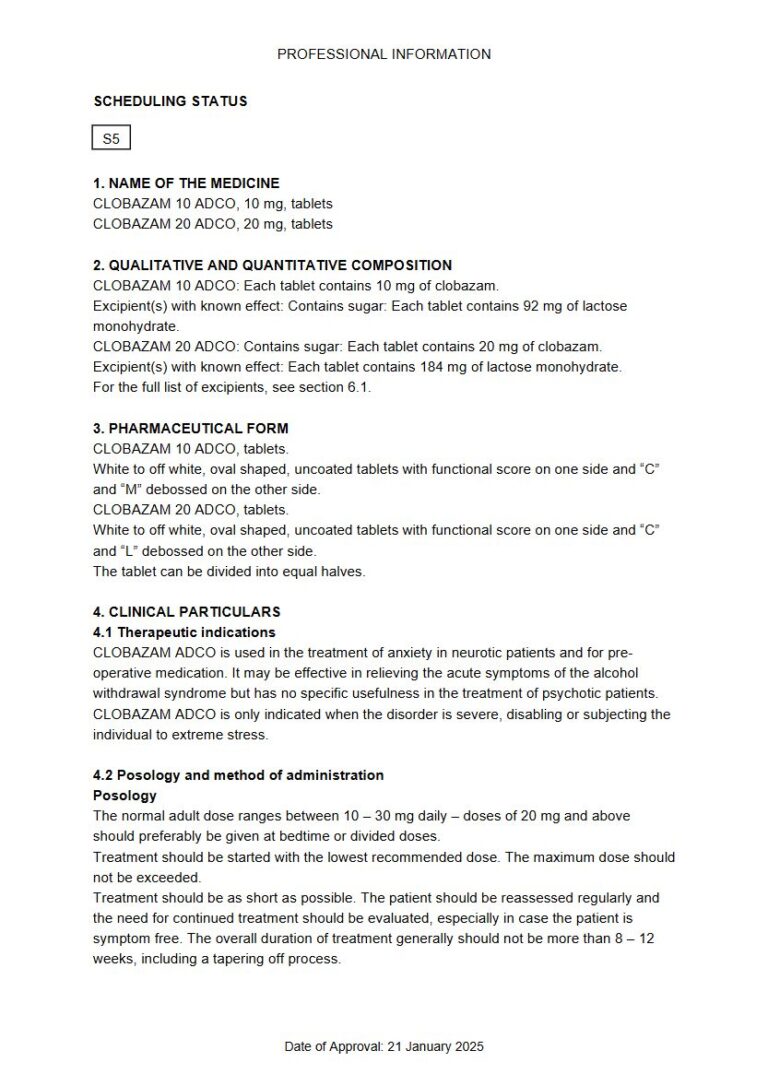
4.1 Therapeutic indications
CLOBAZAM ADCO is used in the treatment of anxiety in neurotic patients and for pre-operative medication. It may be effective in relieving the acute symptoms of the alcohol withdrawal syndrome but has no specific usefulness in the treatment of psychotic patients.
CLOBAZAM ADCO is only indicated when the disorder is severe, disabling or subjecting the individual to extreme stress.
4.2 Posology and method of administration
Posology
The normal adult dose ranges between 10 u2013 30 mg daily u2013 doses of 20 mg and above should preferably be given at bedtime or divided doses. Treatment should be started with the lowest recommended dose. The maximum dose should not be exceeded. Treatment should be as short as possible. The patient should be reassessed regularly and the need for continued treatment should be evaluated, especially in case the patient is symptom free. The overall duration of treatment generally should not be more than 8 u2013 12 weeks, including a tapering off process.
In certain cases, extension beyond the maximum treatment period may be necessary; if so, it should not take place without re-evaluation of the patient status.
Special populations
Elderly
For elderly, debilitated and light-weight patients, the daily dose should be halved. Increased responsiveness and higher susceptibility to adverse effects may be present in these patients, and low initial doses and gradual dose increments under careful observation, are required.
Paediatric Population
The daily dose should be halved for children. The dose should be taken orally with a small amount of liquid as appropriate.
4.3 Contraindications
- In patients with hypersensitivity to benzodiazepines or any of the excipients of CLOBAZAM ADCO (refer to section 6.1).
- In patients with any history of drug or alcohol dependence (increased risk of development of dependence).
- In patients with myasthenia gravis (risk of aggravation of muscle weakness).
- In patients with severe respiratory insufficiency (risk of deterioration).
- In patients with sleep apnoea syndrome (risk of deterioration).
- In patients with severe hepatic insufficiencies (risk of precipitating encephalopathy).
- During the first trimester of pregnancy (for use during second and third trimester, refer to section 4.6).
- In breastfeeding women.
- Benzodiazepines must not be given to children without careful assessment of the need for their use. CLOBAZAM ADCO must not be used in children under 3 years.
4.4 Special warnings and precautions for use
Amnesia
Amnesia may occur with benzodiazepines. In case of loss or bereavement psychological adjustment may be inhibited by benzodiazepines.
Muscle weakness
CLOBAZAM ADCO can cause muscle weakness. Therefore, in patients with pre-existing muscle weakness or spinal or cerebellar ataxia or sleep apnoea, special observation is required, and a dose reduction may be necessary. CLOBAZAM ADCO is contraindicated in patients with myasthenia gravis.
Depression and personality disorders
Disinhibiting effects may be manifested in various ways. Suicide may be precipitated in patients who are depressed and aggressive behaviour towards self and others may be precipitated. Extreme caution should therefore be used in prescribing benzodiazepines in patients with personality disorders.
Paradoxical reactions such as acute hyperexcitable states with rage may occur u2013 if these occur, CLOBAZAM ADCO should be discontinued.
Dependence
Use of benzodiazepines u2013 including CLOBAZAM ADCO u2013 may lead to the development of physical and psychic dependence upon these products. The risk of dependence increases with dose and duration of treatment; it is also greater in patients with a history of alcohol or drug abuse. Therefore, the duration of treatment should be as short as possible (refer to section 4.2).
Once physical dependence has developed, abrupt termination of treatment will be accompanied by withdrawal symptoms (or rebound phenomena). Rebound phenomena are characterised by a recurrence in enhanced form of the symptoms which originally led to CLOBAZAM ADCO treatment. This may be accompanied by other reactions including mood changes, anxiety or sleep disturbances and restlessness. Other symptoms due to abrupt withdrawal may include headaches, muscle pain, extreme anxiety, tension, restlessness, confusion and irritability. In severe cases after abrupt termination the following symptoms may occur derealisation, depersonalisation, hyperacusis, numbness and tingling of extremities, hypersensitivity to light, noise and physical contact, hallucinations or epileptic seizures. A withdrawal syndrome may also occur when abruptly changing over from a benzodiazepine with a long duration of action (for example, CLOBAZAM ADCO) to one with a short duration of action.
Serious skin reaction
Serious skin reactions, including Stevens-Johnson syndrome (SJS) and toxic epidermal necrolysis (TEN), have been reported with CLOBAZAM ADCO in both children and adults during the post-marketing experience. A majority of the reported cases involved the concomitant use of other medicines, including anti-epileptic medicines that are associated with serious skin reactions. SJS/TEN could be associated with a fatal outcome. Patients should be closely monitored for signs or symptoms of SJS/TEN, especially during the first 8 weeks of treatment. CLOBAZAM ADCO should immediately be discontinued when SJS/TEN is suspected. If signs or symptoms suggest SJS/TEN, use of this medicine should not be resumed and alternative therapy should be considered (refer to section 4.8).
Respiratory depression
Respiratory function should be monitored in patients with chronic or acute severe respiratory insufficiency and a dose reduction of CLOBAZAM ADCO may be necessary. CLOBAZAM ADCO is contraindicated in patients with severe respiratory insufficiency (refer to section 4.3).
Renal and hepatic impairment
In patients with impairment of renal or hepatic function, responsiveness to CLOBAZAM ADCO and susceptibility to adverse effects are increased, and a dose reduction may be necessary. In long term treatment renal and hepatic function must be checked regularly. Blood dyscrasias and hepatic dysfunction have been reported.
Elderly patients
In the elderly and debilitated, due to the increased sensitivity to adverse reactions such as drowsiness, dizziness, muscle weakness, respiratory depression, and ataxia, there is an increased risk of fall that may result in serious injury. A dose reduction is recommended.
CYP2C19 poor metabolisers
In patients who are CYP2C19 poor metabolisers, levels of the active metabolite N-desmethylclobazam are expected to be increased as compared to extensive metabolisers. As this may lead to increased side effects, dosage adjustment of CLOBAZAM ADCO may be necessary (e.g. low starting dose with careful dose titration (refer to section 5.2)).
Alcohol
It is recommended that patients abstain from drinking alcohol during treatment with CLOBAZAM ADCO (increased risk of sedation and other adverse effects) (refer to section 4.5).
Concomitant use of opioids and benzodiazepines
Concomitant use of opioids and benzodiazepines, including CLOBAZAM ADCO, may results in sedation, respiratory depression, coma, and death. Because of these risks, reserve concomitant prescribing of opioids and benzodiazepines for use in patients for whom alternative treatment options are inadequate. If a decision is made to prescribe CLOBAZAM ADCO concomitantly with opioids, prescribe the lowest effective dosages and minimum durations of concomitant use, and follow patients closely for signs and symptoms of respiratory depression and sedation (refer to section 4.5).
Concomitant use of barbiturates, antihistamines, narcotics or other central nervous system depressants
There is an additive risk of central nervous system depression when these medicines are taken together (refer to section 4.5). Large doses may produce syncope.
Duration of treatment
The duration of treatment should be as short as possible (refer to section 4.2) but should not exceed eight to twelve weeks in case of anxiety, including the tapering-off process. Extension beyond these periods should not take place without re-evaluation of the situation. It may be useful to inform the patient when treatment is started that it will be of limited duration and to explain precisely how the dosage will be progressively decreased. Moreover, it is important that the patient should be aware of the possibility of rebound phenomena, thereby a minimising anxiety over such symptoms, should they occur while the product is being discontinued.
CLOBAZAM ADCO contains lactose monohydrate. Patients with rare hereditary problems of galactose intolerance, total lactase deficiency or glucose-galactose malabsorption should not take CLOBAZAM ADCO.
Drug Reaction with Eosinophilia and Systemic Symptoms (DRESS): CLOBAZAM ADCO can cause rare but serious reactions that can be life threatening if not diagnosed and treated quickly. This reaction is called Drug Reaction with Eosinophilia and Systemic Symptoms (DRESS). It may start as a rash but can quickly progress, resulting to injury to internal organs, the need for hospitalisation, and even death. This hypersensitivity reaction to this medicine is serious but rare. DRESS can include fever, rash, swollen lymph nodes, or injury to organs including the liver, kidney, lungs, heart, or pancreas. Early symptoms of DRESS such as fever or swollen lymph nodes can be present even when a rash cannot be seen.
4.5 Interaction with other medicines and other forms of interaction
Alcohol
Concomitant consumption of alcohol can increase the bioavailability of CLOBAZAM ADCO by 50% (refer to section 5.2) and therefore increase the effects of CLOBAZAM ADCO e.g. sedation (refer to section 4.5).
Central nervous system depressant medicines
Especially when CLOBAZAM ADCO is administered at higher doses, an enhancement of the central depressive effect may occur in cases of concomitant use with antipsychotics, hypnotics, anxiolytics/sedatives, antidepressant agents, narcotic analgesics, anti-convulsant medicines, anaesthetics and sedative antihistamines. Special caution is also necessary when CLOBAZAM ADCO is administered in cases of intoxication with such substances or with lithium.
Opioids
The concomitant use of benzodiazepines, including CLOBAZAM ADCO, and opioids increases the risk of sedation, respiratory depression, coma and death because of additive CNS depressant effect. Limit the dosage and duration of concomitant use of benzodiazepines and opioids (refer to section 4.4).
Anti-convulsants
Addition of CLOBAZAM ADCO to established anticonvulsant medication (e.g. phenytoin, valproic acid) may cause a change in plasma levels of these medicines. If used as an adjuvant in epilepsy the dosage of CLOBAZAM ADCO should be determined by monitoring the EEG and the plasma levels of the other medicines checked.
Phenytoin and carbamazepine may cause an increase in the metabolic conversion of CLOBAZAM ADCO to the active metabolite N-desmethylclobazam.
Stiripentol increases plasma levels of CLOBAZAM ADCO and its active metabolite N-desmethylclobazam, through inhibition of CYP3A and CYP2C19. Monitoring of blood levels of CLOBAZAM ADCO and active metabolite is recommended, prior to initiation of stiripentol, and then again once new steady-state concentration has been reached, i.e. after 2 weeks approximately. Clinical monitoring is recommended, and dose adjustment may be necessary.
Narcotic analgesics
If CLOBAZAM ADCO is used concomitantly with narcotic analgesics, possible euphoria may be enhanced; this may lead to increased psychological dependence.
Muscle relaxants
The effects of muscle relaxants, analgesics and nitrous oxide may be enhanced.
CYP 2C19 inhibitors
Strong and moderate inhibitors of CYP2C19 may result in increased exposure to N-desmethylclobazam (N-CLB), the active metabolite of clobazam. Dosage adjustment of CLOBAZAM ADCO may be necessary when co-administered with strong (e.g. fluconazole, fluvoxamine, ticlopidine) or moderate (e.g. omeprazole) CYP2C19 inhibitors (refer to section 5.2).
CYP 2D6 substrates
CLOBAZAM ADCO is a weak CYP2D6 inhibitor. Dose adjustment of medicines metabolised by CYP2D6 (e.g. dextromethorphan, pimozide, paroxetine, nebivolol) may be necessary.
4.6 Fertility, pregnancy and lactation
Pregnancy
There is limited amount of data from the use of CLOBAZAM ADCO in pregnant women. Nevertheless, a large amount of data collected from cohort studies has not demonstrated evidence of the occurrence of major malformations following exposure of benzodiazepines during the first trimester of pregnancy, although incidence of cleft lip and palate were observed in case-control studies. CLOBAZAM ADCO is not recommended during the first trimester of pregnancy and in women of childbearing potential not using contraception. CLOBAZAM ADCO crossed the placenta. Animal studies have demonstrated reproductive toxicity. Women of childbearing potential should be informed of the risks and benefits of the use of CLOBAZAM ADCO during pregnancy. Women of childbearing potential should be informed to contact her medical practitioner regarding discontinuation of the product if they are pregnant or intend to become pregnant. If CLOBAZAM ADCO treatment is to be continued, use CLOBAZAM ADCO at the lowest effective dose. Cases of reduced foetal movement and foetal heart rate variability have been described after administration of benzodiazepines during the second and/or third trimester of pregnancy. Administration of CLOBAZAM ADCO before or during childbirth can result in the occurrence of respiratory depression (including respiratory distress and apnoea), which may be associated with other disorders such as sedation signs, hypothermia, hypotonia, and feeding difficulties in the newborn (signs and symptoms of the so-called u201cfloppy infant syndromeu201d). In the later stages of pregnancy, it must only be used if there are compelling indications. Moreover, infants born to mothers who have taken benzodiazepines over longer periods during the later stages of pregnancy may have developed physical dependence and may be at risk for developing withdrawal symptoms in the postnatal period. Appropriate monitoring of the newborn in the postnatal period is recommended.
Breastfeeding
Since CLOBAZAM ADCO passes into the breastmilk, it should not be given to breastfeeding mothers.
Fertility
No clinical data on fertility are available. In a fertility study in male and female rats no effect on fertility was observed.
4.7 Effects on ability to drive and use machines
Sedation, amnesia, impaired concentration and impaired muscular function may adversely affect the ability to drive or to use machines. If insufficient sleep duration occurs, the likelihood of impaired alertness may be increased (refer to section 4.5). CLOBAZAM ADCO can impair cognitive function and can affect a patient's ability to drive safely. Patients should be advised particularly at the initiation of therapy, not to drive motor-vehicles, climb dangerous heights, or operate dangerous machinery. In these situations, impaired decision making could lead to accidents.
When prescribing CLOBAZAM ADCO, patients should be told:
- CLOBAZAM ADCO is likely to affect your ability to drive.
- Do not drive until you know how CLOBAZAM ADCO affects you.
4.8 Undesirable effects
Metabolism and nutrition disorders
Frequent: decreased appetite
Psychiatric disorders
Frequent: irritability, aggression, restlessness, depression (pre-existing depression may be unmasked), medicine tolerance (especially during prolonged use) (refer to section 4.4), agitation
Less frequent: abnormal behaviour, confusional state, anxiety, delusion, nightmare, loss of libido (particularly with high doses or in long-term treatment, and is reversible)
Frequency not known: dependence (especially during prolonged use) (refer to section 4.4), initial insomnia, anger, hallucination, psychotic disorder, poor sleep quality, suicidal ideation
Nervous system disorders
Frequent: somnolence, especially at the beginning of treatment and when higher doses are used, sedation, dizziness, disturbance in attention, slow speech/dysarthria/speech disorder (particularly with high doses or in long term treatment, and is reversible), headache, tremor, ataxia
Less frequent: emotional poverty, amnesia (may be associated with abnormal behaviour), memory impairment, anterograde amnesia (in the normal dose range, but especially at higher dose levels), depression of mood and affect, lethargy, increased motor activity, decreased motor activity, paradoxical reactions such as hyperexcitable state with rage may occur.
Frequency not known: cognitive disorder, altered state of consciousness (particularly in elderly patients, may be combined with respiratory disorders), nystagmus (particularly with high doses or in long term treatment), gait disturbance (particularly with high doses or in long term treatment, and is reversible)
Eye disorders
Less frequent: diplopia (particularly with high doses or in long term treatment, and is reversible)
Respiratory, thoracic and mediastinal disorders
Frequency not known: respiratory depression, respiratory failure particularly in patients with pre-existing compromised respiratory function e.g. in patients with bronchial asthma or brain damage (refer to section 4.3 and 4.4)
Gastrointestinal disorders
Frequent: dry mouth, nausea, constipation
Skin and subcutaneous tissue disorders
Less frequent: rash
Frequency not known: photosensitivity reaction, urticaria, Stevens-Johnson syndrome, toxic epidermal necrolysis (including some cases with fatal outcome)
Musculoskeletal and connective tissue disorders
Frequency not known: muscle spasms, muscle weakness
General disorders and administration site conditions
Frequent: fatigue, especially at the beginning of treatment and when higher doses are used
Less frequent: weight increase (particularly with high doses or in long-term treatment, and is reversible)
Frequency not known: slow response to stimuli, hypothermia
Injury, poisoning and procedural complications
Less frequent: fall
Blood dyscrasias and hepatic dysfunction have been reported.
Reporting of suspected adverse reactions
Reporting suspected adverse reactions after authorisation of the medicine is important. It allows continued monitoring of the benefit/risk balance of the medicine. Healthcare providers are asked to report any suspected adverse reactions to SAHPRA via the Med Safety APP (Medsafety X SAHPRA) and eReporting platform (who-umc.org) found on SAHPRA website.
4.9 Overdose
Overdose of benzodiazepines is usually manifested by degrees of central nervous system depression ranging from drowsiness to coma. In mild cases, symptoms include drowsiness, mental confusion and lethargy, in more serious cases, symptoms may include ataxia, hypotonia, hypotension, respiratory depression, rarely coma and very rarely death. As with other benzodiazepines, overdose should not present a threat to life unless combined with other CNS depressants (including alcohol).
In the management of overdose, it is recommended that the possible involvement of multiple agents be taken into consideration. Manifestations of overdosage include somnolence, confusion, coma, respiratory and cardiovascular depression and hypotension. Following overdose with oral benzodiazepines activated charcoal should be given to reduce absorption. Special attention should be paid to respiratory and cardiovascular functions in intensive care. Secondary elimination of clobazam (by forced diuresis or haemodialysis) is ineffective. Consideration should be given to the use of flumazenil as a benzodiazepine antagonist.
