
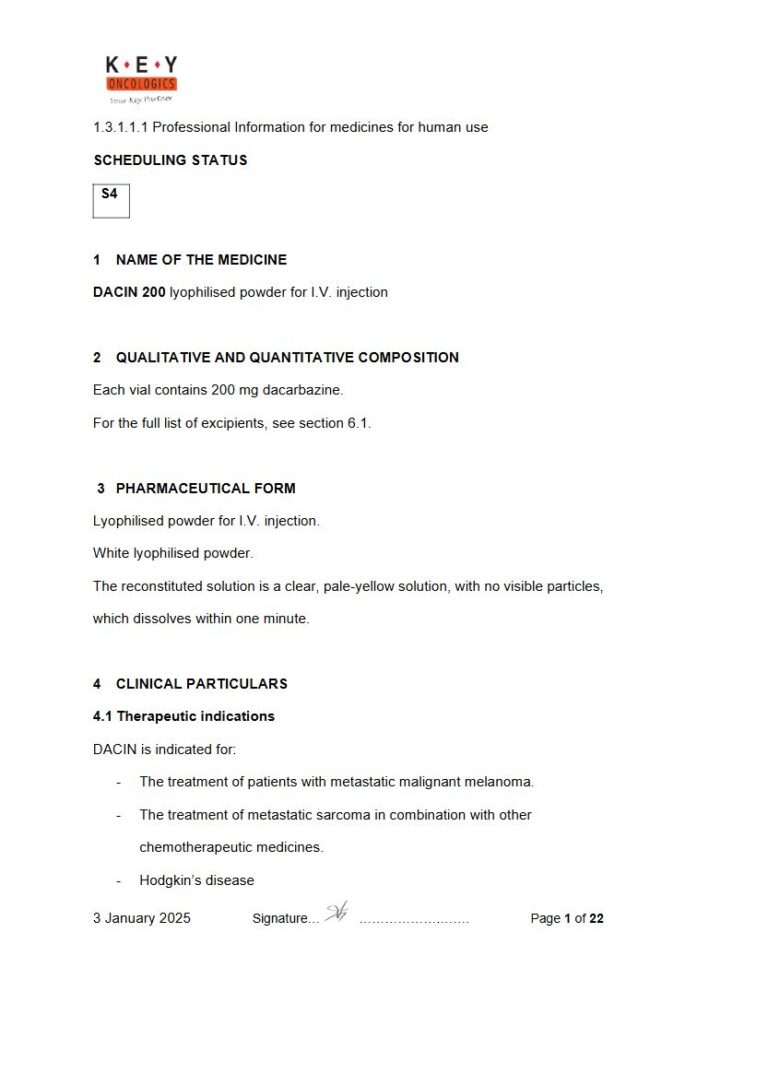
Dacin 200 200 mg Lyophilised powder for I.V. injection
PDF Leaflet Revision Date: 3 January 2025
Clinical Summary
Quick overview from the medicine insert
Indication
Treatment of metastatic malignant melanoma, metastatic sarcoma, and Hodgkinu2019s disease.
Dosage (summary)
2-4.5 mg/kg/day for 10 days, repeated every 3 weeks.
Special Populations
- Pregnant women
- Breastfeeding women
- Severe liver disease
- Severe kidney disease
Pregnancy & Breastfeeding
Contraindicated in pregnancy and breastfeeding due to mutagenic and teratogenic risks.
Key Drug Interactions
- Live-attenuated vaccines
- Phenytoin
- Oral anticoagulants
- Ciclosporin
- Fotemustine
Contraindications
- Hypersensitivity to dacarbazine
- Leukopenia
- Thrombocytopenia
- Pregnancy
- Breastfeeding
Common side effects
- Nausea
- Vomiting
- Anaemia
- Leukopenia
- Thrombocytopenia
Counselling Points
- Avoid food before administration
- Use effective contraception during treatment
- Monitor for signs of liver dysfunction
Serious warnings
- Severe gastrointestinal disturbances
- Hepatotoxicity
- Immunosuppression
- Risk of veno-occlusive disease
Important Disclaimer
The Dacin 200 200 mg Lyophilised powder for I.V. injection professional information leaflet below is the property of Key Oncologics and is provided on Medinsert exactly as issued, with no.. alterations or editorial changes. We make every effort to keep content current by updating documents as soon as new versions become available. Medinsert serves as a trusted access point for healthcare professionals, but does not replace official sources or clinical judgement. For more details, please read our full disclaimer. read more>>
 Healthcare Professionals Only
This content is for registered healthcare professionals
Sign in or create a free account to read the full package insert.
Free for HPCSA-registered professionals. Powered by Medinsert.
Clinical Particulars
Section 4 of the official insert — extracted exactly as issued, no alterations
4.1 Therapeutic indications
DACIN is indicated for:
- The treatment of patients with metastatic malignant melanoma.
- The treatment of metastatic sarcoma in combination with other chemotherapeutic medicines.
- Hodgkinu2019s disease.
In addition, DACIN has been shown, when used in combination with other cytotoxic agents, to be of value in other malignant diseases, including carcinomas of the colon, ovary, breast and lung and testicular teratoma.
4.2 Posology and method of administration
Posology
The following dosage regimen is recommended: 2 u2013 4,5 mg/kg/day for 10 days, which may be repeated at 3 weeks intervals. It has been found that DACIN may be as efficacious at the lower dosage as at the higher dosage. Combinations of cancer chemotherapeutic agents have often shown an improved response over the use of a single agent.
Method of administration
Care should be taken during the administration of the injection to avoid extravasation into tissues, since this will cause local pain and tissue damage (see section 4.4). If extravasation occurs, the injection should be discontinued immediately and any remaining portion of the dose should be introduced into another vein. Food intake prior to administration of DACIN should be avoided to reduce the severity of nausea and vomiting. Excreta and vomit should be handled with care.
Testing the patency of the vein first is recommended with a 5 to 10 ml flush of isotonic sodium chloride infusion solution or glucose 5 %. The same solutions should be used after infusion to flush any remaining medicine from the tubing. After reconstitution with water for injections and without further dilution with isotonic sodium chloride solution or glucose 5 %, DACIN preparations are hypo-osmolar and should therefore be given by slow intravenous injection, e.g., over 1 minute and not as an i.v. bolus injection over a few seconds.
Therapy duration
The treating medical practitioner should decide about the duration of therapy to the individual taking into account the type and stage of the underlying disease, the combination therapy administered, and the response to, and adverse effects of DACIN. In metastatic malignant melanoma and in advanced soft tissue sarcoma the duration of treatment depends on the efficacy and tolerability in the individual patient.
Instructions for preparation and reconstitution
Recommendations for safe handling
DACIN is sensitive to light exposure. All reconstituted solutions should be suitably protected from light also during administration (light-resistant infusion set).
DACIN is an antineoplastic agent. Before preparing a solution, local cytotoxic guidelines should be referred to regarding handling of cytotoxic agents. DACIN should only be opened by trained staff. As with all cytotoxic agents, precautions should be taken to avoid exposing staff. Handling of cytotoxic medicines should be avoided during pregnancy. Preparation of the solution for administration should be carried out in a designated handling area, working over a washable tray or disposable plastic-backed absorbent paper. It is recommended that suitable eye protection, disposable gloves, face mask and a disposable apron are worn. Syringes and infusion sets should be assembled carefully to avoid leaks (use of Luer lock fittings is recommended). Once completed, any exposed surfaces should be thoroughly cleaned and the hands and face washed. In the event of spillage, operators should put on gloves, face masks, eye protection and a disposable apron and mop up the spilled material with an absorbent material laid out in the area for that purpose. The area should then be cleaned and all contaminated material transferred to a cytotoxic spillage bag or sealed for incineration. Handling of DACIN: DACIN should be handled according to standard procedures for cytostatics that have mutagenic, carcinogenic and teratogenic effects.
4.3 Contraindications
DACIN is contraindicated in the following instances:
- Hypersensitivity to the active substance dacarbazine or to any of the excipients (see section 6.1),
- Pregnant or breastfeeding women,
- Leukopenia and/or thrombocytopenia,
- Severe liver or kidney disease,
- In combination with yellow fever vaccine (see section 4.5).
4.4 Special warnings and precautions for use
It is recommended that DACIN should only be administered under the supervision of a medical practitioner specialised in oncology, having the facilities for the necessary regular monitoring of clinical, biochemical and haematological effects, during and after therapy. During DACIN treatment frequent monitoring of blood counts should be conducted as well as monitoring of hepatic and renal function. As severe gastrointestinal and haematological disturbances can occur, a very careful benefit-risk analysis must be carried out before each treatment with DACIN.
Haemopoeietic depression: Long-term therapy can cause cumulative bone marrow toxicity. Leukopenia and thrombocytopaenia may occur and may be severe. Possible suppression of the bone marrow requires careful and frequent monitoring of the red and white blood cells and platelets. Haematopoietic toxicity may warrant temporary discontinuation or cessation of therapy with DACIN.
Hepatotoxicity: Hepatic toxicity accompanied by hepatic vein thrombosis and hepatocellular necrosis resulting in death, has been reported. If symptoms of a liver or kidney functional disorder or symptoms of a hypersensitivity reaction are observed, therapy must immediately be discontinued.
If veno-occlusive disease of the liver occurs, further therapy with DACIN is contraindicated. The responsible medical practitioner must be made aware that the administration of DACIN as monotherapy or combined chemotherapy, may result in a rare, severe complication of liver necrosis that occurs as a result of occlusion of the intrahepatic veins. Normally the syndrome occurred during the second cycle of therapy. Symptoms included fever, eosinophilia, abdominal pain, enlarged liver, jaundice and shock which worsened rapidly over a few hours or days. As fatal outcomes have been described, frequent monitoring of liver size, function and blood counts (especially eosinophils) is particularly important during treatment. In single suspected cases of veno-occlusive disease, early treatment with high dose corticosteroids, with or without fibrinolytic substances such as heparin or tissue plasminogen activator, was successful.
Hepatotoxic medicines and alcohol are contraindicated during chemotherapy.
Immunosuppression: DACIN can cause immunosuppression, with a reduced capacity to cope with infections. Where possible, immunosuppressant medicines such as DACIN should not be prescribed to patients with acute infections. It should be considered to reduce the dosage or withdraw DACIN if infections develop, until the infection is under control. Administration of live vaccines (live-attenuated) in patients immunocompromised by chemotherapeutic agents including dacarbazine, may result in serious or fatal infections. Vaccination with a live vaccine should be avoided in patients receiving DACIN. Inactivated vaccines may be used where they exist.
Thrombotic risk: Due to the increase of thrombotic risk in the event of tumoural diseases, the use of anti-coagulant treatment is often required. If it is decided to treat the patient with oral anti-coagulants, the high intra-individual variability of coagulation observed during the disease and the occurrence of interactions between oral anti-coagulants and anti-cancer chemotherapy, require an increased frequency in INR monitoring.
Gastro-intestinal effects: Severe gastrointestinal reactions occur frequently, therefore anti-emetic and supportive measures are advisable. Extravasation can result in tissue damage and severe pain. Concomitant use of phenytoin should be avoided since there is a risk of exacerbation of convulsions resulting from the decrease of phenytoin digestive absorption (see section 4.5).
Women of childbearing potential/contraception in men and women: Due to the genotoxic potential of dacarbazine, women of childbearing potential should use effective contraceptive measures while being treated with DACIN and for 6 months following completion of treatment. Men are recommended to use effective contraceptive measures and to not father a child while receiving DACIN and for 3 months following completion of therapy. Patients considering pregnancy should seek genetic counselling after the period of contraceptive use (see section 4.6).
Paediatric population: DACIN is not recommended for use in children and adolescents as safety and efficacy have not been established.
4.5 Interaction with other medicines and other forms of interaction
Concomitant use of live-attenuated vaccines should be avoided since there is a risk of systemic, possibly fatal disease (see section 4.3). This risk is increased in patients who are already immunosuppressed by their underlying disease. It is recommended using an inactivated vaccine where this exists (poliomyelitis) (see section 4.4).
Concomitant use of yellow fever vaccine is contraindicated because of the risk of fatal systemic disease (see section 4.3).
Concomitant use of phenytoin should be avoided since there is a risk of exacerbation of convulsions resulting from the decrease of phenytoin digestive absorption (see section 4.4).
DACIN may increase or decrease the effect of oral anticoagulants such as warfarin (see section 4.4).
Concomitant use of ciclosporin (and by extrapolation tacrolimus) should be carefully considered since use of these agents causes excessive immunosuppression with the risk of lymphoproliferation.
DACIN may reduce the absorption of digoxin.
Concomitant use of fotemustine can cause acute lung toxicity (adult respiratory distress syndrome). Fotemustine and DACIN should not be used concomitantly. DACIN should be administered over one week after fotemustine administration.
Myelotoxic interactions with other treatment modalities having adverse effects on the bone marrow (particularly cytostatic agents, irradiation) are possible.
DACIN may cause a prolonged effect of suxamethonium.
The hydroxylation of the parent compound to metabolites with anti-tumour activity has been identified.
Dacarbazine is metabolised by cytochrome P450 (CYP1A1, CYP1A2 and CYP2E1). This must be taken into account if other medicines that are metabolised by the same hepatic enzymes are co-administered with DACIN.
DACIN can enhance the effects of methoxypsoralen because of photosensitisation.
4.6 Fertility, pregnancy and lactation
Pregnancy and breastfeeding: Dacarbazine has been shown to be mutagenic, teratogenic and carcinogenic in animals. It must therefore be assumed that there is an increased risk for teratogenic effects exists in humans. For this reason, DACIN must not be used during pregnancy and while breastfeeding (see also section 4.3). It is not known if dacarbazine crosses the placenta or distributes into milk.
Women of childbearing potential: Women of childbearing age must use effective methods of contraception while being treated with DACIN and for 6 months following completion of treatment.
Contraceptive measures for men: Men are advised to take contraceptive measures during and for 3 months after cessation of therapy.
Fertility: Due to the genotoxic potential of dacarbazine, patients are advised to seek advice on fertility preservation options before starting treatment with DACIN. After treatment with DACIN, patients planning pregnancy are advised to seek genetic counselling.
4.7 Effects on ability to drive and use machines
DACIN may influence the ability to drive or operate machines because of its central nervous side effects or because of nausea and vomiting.
4.8 Undesirable effects
a) Summary of adverse effects
The most frequently reported adverse drug reaction are gastrointestinal disorders (anorexia, nausea and vomiting) and blood and lymphatic system disorders such as anaemia, leukopenia and thrombocytopenia. The latter are dose-dependent and delayed, with the nadirs often only occurring after 3 to 4 weeks.
b) Tabulated list of adverse reactions
The following side effects have been reported:
| Body System | Frequent | Less frequent |
|---|---|---|
| Infections and infestations | Infections | |
| Blood and lymphatic system disorders | Anaemia, leukopenia, thrombocytopenia, bone marrow suppression | Pancytopenia, agranulocytosis |
| Immune system disorders | Anaphylaxis, hypersensitivity reactions | |
| Psychiatric disorders | Confusion | |
| Nervous system disorders | Headache, lethargy, convulsions, facial paraesthesia | |
| Eye disorders | Blurred vision, impaired vision | |
| Vascular disorders | Facial flushing | |
| Gastrointestinal disorders | Anorexia, nausea, vomiting | Diarrhoea |
| Hepato-biliary disorders | Hepatotoxicity, hepatic vein thrombosis, hepatic necrosis due to veno-occlusive disease (VOD) of the liver, Budd-Chiari syndrome with potentially fatal outcome. | |
| Skin and subcutaneous tissue disorders | Alopecia, hyperpigmentation, photosensitivity, transient rash, erythema, maculopapular exanthema, urticaria | |
| Renal and urinary disorders | Impaired renal function with increased blood creatinine and increased blood urea | |
| General disorders and administration site conditions | Flu-like symptoms, malaise, injection site irritation | |
| Investigations | Elevation of liver enzymes, increased transaminases (AST, ALT), increased alkaline phosphatase, increased lactate dehydrogenase (LDH). |
c) Description of selected adverse reactions
Gastrointestinal disturbances such as anorexia, nausea and vomiting are frequent and severe. In rare cases diarrhoea has been observed.
Changes in blood counts often observed (anaemia, leukopenia, thrombocytopenia) are dose-dependent and delayed, with the nadirs often occurring only after 3 to 4 weeks. In less frequent cases, pancytopenia and agranulocytosis have been described. Flu-like symptoms with exhaustion, chills, fever and muscular pain are occasionally observed during or often only days after DACIN administration. These disturbances may recur with the next infusion. Elevation of liver enzymes (e.g. alkaline phosphatase) is observed in less frequent cases. Less frequently liver necrosis due to occlusion of intrahepatic veins (veno-occlusive disease of the liver) has been observed after administration of DACIN in monotherapy or in combined chemotherapy modalities. In general, the syndrome occurred during the second cycle of therapy. Symptoms included fever, eosinophilia, abdominal pain, enlarged liver, jaundice and shock which worsened rapidly over a few hours or days. As fatal outcome has been described, regular monitoring of liver size, function and blood counts (especially eosinophils) is particularly important. In single cases of suspected veno-occlusive disease, therapy with high-dose corticosteroids (for example hydrocortisone 300 mg/day), with or without fibrinolytic agents like heparin or tissue plasminogen activator, was successful (see sections 4.2 and 4.4).
Application site reactions such as irritation of the vein and some of the systemic adverse reactions are thought to result from formation of photodegradation products. Impaired renal function with increased blood levels of substances obligatorily excreted by urine is rare. Central nervous side effects such as headaches, impaired vision, confusion, lethargy and convulsions less frequently may occur. Facial paraesthesia and flushing may occur shortly after administration. Allergic reactions of the skin in the form of erythema, maculopapular exanthema or urticaria are observed rarely. Infrequently alopecia, hyperpigmentation and photosensitivity of the skin may occur. In less frequent cases anaphylactic reactions have been described.
Reporting of suspected adverse reactions
Reporting suspected adverse reactions after authorisation of the medicine is important. It allows continued monitoring of the benefit/risk balance of the medicine. Healthcare providers are asked to report any suspected adverse reactions to SAHPRA via the Med Safety APP (Medsafety X SAHPRA) and eReporting platform (who-umc.org) found on SAHPRA website.
4.9 Overdose
Severe bone marrow toxicity and eventually bone marrow aplasia can be expected as consequences of an overdose and the onset can be delayed by up to 2 weeks. The time to occurrence of nadirs of leucocytes and thrombocytes can be 4 weeks. Hypotensive episodes have been observed with high doses of DACIN (> 850 mg/mu00b2). If hypotension is observed, supportive treatment is recommended, for example hydration with 500 ml of 0,9 % sodium chloride solution. Even if an overdose is only suspected, long-term, careful haematologic monitoring is essential. Since there is no known antidote available utmost care has to be taken at each administration to avoid an overdose. Treatment is symptomatic and supportive.
