
Cosmegen 0,5 Mg Solution
PDF Leaflet Revision Date: 6 September 2022
Clinical Summary
Quick overview from the medicine insert
Indication
Treatment of various cancers including nephroblastoma and rhabdomyosarcoma.
Dosage (summary)
Adults: 15-45 mcg/kg IV for 5 days; adjust for toxicity.
Special Populations
- Elderly
- Infants
Pregnancy & Breastfeeding
Contraindicated in pregnancy and breastfeeding due to teratogenic effects.
Key Drug Interactions
- Potentiates effects of X-ray therapy
Contraindications
- Hypersensitivity to dactinomycin
- Active varicella or herpes zoster
- Pregnancy
Common side effects
- Myelosuppression
- Nausea
- Vomiting
- Fatigue
Counselling Points
- Monitor for signs of toxicity
- Avoid contact with skin and eyes
- Report any adverse reactions immediately
Serious warnings
- Highly toxic
- Corrosive
- Risk of severe tissue damage on extravasation
Important Disclaimer
The Cosmegen 0,5 Mg Solution professional information leaflet below is the property of Key Oncologics and is provided on Medinsert exactly as issued, with no.. alterations or editorial changes. We make every effort to keep content current by updating documents as soon as new versions become available. Medinsert serves as a trusted access point for healthcare professionals, but does not replace official sources or clinical judgement. For more details, please read our full disclaimer. read more>>
 Healthcare Professionals Only
This content is for registered healthcare professionals
Sign in or create a free account to read the full package insert.
Free for HPCSA-registered professionals. Powered by Medinsert.
Clinical Particulars
Section 4 of the official insert — extracted exactly as issued, no alterations
4.1 Therapeutic indications
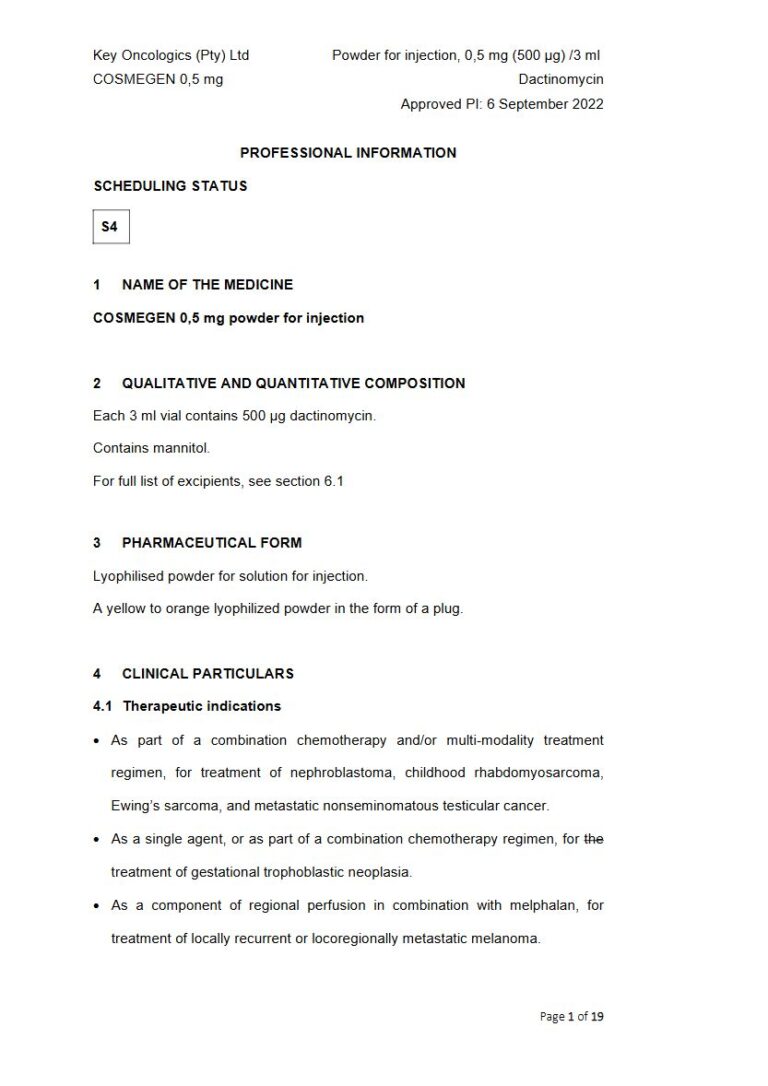
u2022 As part of a combination chemotherapy and/or multi-modality treatment regimen, for treatment of nephroblastoma, childhood rhabdomyosarcoma, Ewingu2019s sarcoma, and metastatic nonseminomatous testicular cancer.
u2022 As a single agent, or as part of a combination chemotherapy regimen, for the treatment of gestational trophoblastic neoplasia.
u2022 As a component of regional perfusion in combination with melphalan, for treatment of locally recurrent or locoregionally metastatic melanoma.
4.2 Posology and method of administration
Toxic reactions due to COSMEGEN are frequent and may be severe (see Section 4.8), thus limiting the dose that may be administered in many cases. However, the severity of toxicity varies markedly and is only partly dependent on the dose administered.
Posology
Intravenous use
The dose of COSMEGEN will vary with the tolerance of the patient, the size and location of the neoplasm, and the concurrent use of other forms of therapy. It may be necessary to reduce the usual dos suggested below when additional chemotherapy or radiation therapy is used concurrently or has been used previously.
The dose of COSMEGEN is calculated in micrograms. The dose intensity per-two-week cycle for adults or children should not exceed 15 micrograms per kg per day or 400-600 micrograms per square meter of body surface daily, intravenously, for five days. Calculation of the dose for obese or oedematous patients should be on the basis of surface area in an effort to relate dosage to lean body mass.
As there is a greater frequency of toxic effects of COSMEGEN in infants, close monitoring is recommended when COSMEGEN is given to infants. A wide variety of single agent and combination chemotherapy regimens with COSMEGEN may be used. Because chemotherapeutic regimens are constantly changing, dosing and administration should be performed under the direct supervision of medical practitioners familiar with current oncologic practices and new advances in therapy. The following suggested regimens are based upon a review of current literature concerning therapy with COSMEGEN and are on a per-cycle basis.
Nephroblastoma
COSMEGEN 45 micrograms per kg intravenously administered in various combinations and schedules with other chemotherapeutic agents. 45 u03bcg/kg (micrograms per kg) correspond to 1 200-1 800 u03bcg/m2 (micrograms per square meter) or 1,2-1,8 mg/m2 (milligrams per square meter).
Rhabdomyosarcoma
COSMEGEN 15 micrograms per kg intravenously daily for five days administered in various combinations and schedules with other chemotherapeutic agents.
Ewingu2019s Sarcoma
COSMEGEN 1,25 milligrams per m2 intravenously administered in various combinations and schedules with other chemotherapeutic agents.
Testicular carcinoma
COSMEGEN 1 000 micrograms per m2 intravenously on Day 1 as part of a combination regimen with cyclophosphamide, bleomycin, vinblastine, and cisplatin.
Gestational trophoblastic neoplasia
COSMEGEN 12 micrograms per kg intravenously daily for five days as a single agent.
COSMEGEN 500 micrograms intravenously on Days 1 and 2 as part of a combination regimen with etoposide, methotrexate, folinic acid, vincristine, cyclophosphamide and cisplatin.
Elderly patients: The general considerations already outlined also apply to elderly patients. Administration of COSMEGEN to elderly patients may be associated with an increased risk of myelosuppression compared to younger patients.
Regional perfusion in locally recurrent and locoregionally metastatic melanoma
The dose schedules and the technique itself vary from one investigator to another, and the published literature should, therefore, be consulted for details. In general the following doses of COSMEGEN are suggested: For a lower extremity or pelvis - 50 micrograms per kg bodyweight. For an upper extremity - 35 micrograms per kg bodyweight. It may be advisable to use lower doses in obese patients, or when previous chemotherapy or radiation therapy has been employed.
Method of administration
Reconstituted COSMEGEN is for intravenous administration. For instructions on reconstitution of the medicine before administration, see Section 6.6. Although reconstituted COSMEGEN is chemically stable, the product does not contain a preservative and accidental microbial contamination might result. Any unused portion of the solution should be discarded.
Partial removal of dactinomycin from intravenous solutions by cellulose ester membrane filters used in some intravenous in-line filters has been reported. If COSMEGEN is to be injected directly into the vein without the use of an infusion, the u2018two-needleu2019 technique should be used. The calculated dose should be reconstituted and withdrawn from the vial with one sterile needle; direct injection into the vein should then be performed with another sterile needle.
4.3 Contraindications
u2022 Hypersensitivity to dactinomycin or to any of the excipients (see section 6.1).
u2022 Use in patients with varicella or herpes zoster. If COSMEGEN is given at or about the time of infection with chickenpox or herpes zoster, a severe generalised disease, which may be fatal can occur.
u2022 Pregnancy
4.4 Special warnings and precautions for use
COSMEGEN should be administered only under the supervision of a medical practitioner who is experienced in the use of a cancer. COSMEGEN is HIGHLY TOXIC (e.g. corrosive, carcinogenic, mutagenic and teratogenic, etc), therefore, both the powder and solution must be handled and administered with care. Since COSMEGEN is extremely corrosive to soft tissues, it is intended for intravenous administration only. Inhalation of dust or vapours and contact with skin or mucous membranes, especially those of the eyes, must be avoided. Appropriate protective equipment should be worn when handling COSMEGEN. Should accidental eye contact occur, copious irrigation for at least 15 minutes with water, normal saline or a balanced salt ophthalmic irrigating solution should be instituted immediately, followed by prompt ophthalmic consultation. Should accidental skin contact occur, the affected part must be irrigated immediately with copious amounts of water for at least 15 minutes while removing contaminated clothing and shoes. Medical attention should be sought immediately. Contaminated clothing should be destroyed and shoes cleaned thoroughly before reuse (see Section 6.6).
If extravasation occurs during intravenous use, severe damage to soft tissue may occur (see Section 6.6). COSMEGEN, is a toxic medicine, and very careful and frequent observation of the patient for adverse reactions is necessary. These reactions may involve any tissue of the body, most frequently the haematopoietic system resulting in myelosuppression. The possibility of an anaphylactoid reaction should be borne in mind. It is extremely important to observe the patient daily for toxic side effects when combined therapy is used, since a full course of therapy is occasionally not tolerated. If stomatitis, diarrhoea or severe haematopoietic depression appear during therapy, these medicines should be discontinued until the patient has recovered.
Veno-occlusive disease
Veno-occlusive disease (primarily hepatic) may result in fatality, particularly in children younger than 48 months (see Section 4.8). COSMEGEN and radiation therapy: An increased incidence of gastrointestinal toxicity and marrow suppression has been reported with combination therapy incorporating COSMEGEN and radiation.
Moreover, the normal skin, as well as the buccal and pharyngeal mucosa, may show early erythema. A smaller than usual radiation dose administered in combination with COSMEGEN causes erythema and vesiculation, which progress more rapidly through the stages of tanning and desquamation. Healing may occur in four to six weeks. Erythema from previous radiation therapy may be reactivated by COSMEGEN alone, even when radiotherapy was administered many months earlier, and especially when the interval between the two forms of therapy is brief. This potentiation of radiation effect represents a special problem when the radiotherapy involves the mucous membrane. When irradiation is directed toward the nasopharynx, the combination may produce severe oropharyngeal mucositis. Severe reactions may ensue if high doses of both COSMEGEN and radiation therapy are used or if the patient is particularly sensitive to such combined therapy. Particular caution is necessary when administering COSMEGEN within two months of irradiation for the treatment of right-sided nephroblastoma, since hepatomegaly and elevated AST levels have been noted. In general, COSMEGEN should not be concomitantly administered with radiotherapy in the treatment of nephroblastoma. Reports indicate an increased incidence of secondary primary tumours (including leukaemia) following treatment with radiation and antineoplastic agents, such as COSMEGEN. Multi-modal therapy creates the need for careful, long-term observation of cancer survivors.
Laboratory tests
A variety of abnormalities of renal, hepatic and bone-marrow function have been reported in patients with neoplastic disease receiving COSMEGEN. Renal, hepatic and bone-marrow functions should be assessed frequently.
Mannitol
COSMEGEN contains mannitol and may have a laxative effect.
4.5 Interaction with other medicines and other forms of interaction
Much evidence suggests that COSMEGEN potentiates the effects of X-ray therapy. The converse also appears likely: that COSMEGEN may be more effective when radiation therapy is given concurrently (see Section 4.4). COSMEGEN may interfere with bio-assay procedures for the determination of antibacterial medicine levels.
4.6 Fertility, pregnancy and lactation
Pregnancy
COSMEGEN has been shown to be teratogenic in animals and should not be given to pregnant women. Teratogenicity: Dactinomycin has been shown to cause malformations and embryotoxicity in the rat, rabbit and hamster when given in doses of 50-100 micrograms per kg intravenously (three to seven times the maximum recommended human dose).
Breastfeeding
COSMEGEN should not be administered to mothers who are breastfeeding.
Fertility
Adequate fertility studies have not been reported, although, an increased incidence of infertility following treatment with other antineoplastic agents has been reported.
4.7 Effects on ability to drive and use machines
COSMEGEN may cause fatigue and lethargy which affect mental and/or physical abilities to perform or execute tasks or activities requiring mental alertness, judgment and/or sound coordination and vision.
4.8 Undesirable effects
a. Summary of the safety profile
Toxic effects (except nausea and vomiting) do not usually become apparent until two to four days after a course of therapy is stopped and may not peak until one to two weeks have elapsed. Deaths have been reported. Side effects include the following (frequencies are not known):
b. Tabulated summary of adverse reactions
MedDRA System Organ Class Frequency Adverse reactions
Infections and Infestations Frequency unknown Sepsis (including neutropenic sepsis) with fatal outcome, infection, pharyngitis
Blood and lymphatic system disorders Frequency unknown Anaemia (even to the point of aplastic anaemia), agranulocytosis, disseminated intravascular coagulation (DIC), leukopenia, thrombocytopenia, pancytopenia, reticulocytopenia, neutropenia, febrile neutropenia. Platelet and white blood-cell counts should be performed frequently to detect severe haemopoietic depression. If either count shows a marked decrease, dactinomycin should be withheld to allow marrow recovery. This often takes up to three weeks.
Immune system disorders Hypersensitivity
Metabolism and nutrition disorders Frequency unknown Anorexia, hypocalcaemia, tumour lysis syndrome.
Nervous system disorders Frequency unknown Peripheral neuropathy was commonly observed in patients receiving combination chemotherapy regimens that included dactinomycin. Lethargy.
Eye disorders Frequency unknown Optic neuropathy
Vascular disorders Frequency unknown Haemorrhage, thrombophlebitis
Respiratory, thoracic and mediastinal disorders Frequency unknown Pneumonitis
Gastrointestinal disorders Frequency unknown Nausea, vomiting, abdominal pain, diarrhoea, gastro-intestinal ulceration, cheilitis, dysphagia, constipation, esophagitis, proctitis, ulcerative stomatitis, ascites. Nausea and vomiting, which occur early during the first few hours after administration, may be alleviated by the administration of anti-emetics.
epato-biliary disorders Frequency unknown Liver toxicity including liver function test abnormalities, hepatomegaly, hepatitis, and hepatic failure with reports of death. Hepatic veno-occlusive disease, which may be associated with intravascular clotting disorder and multi-organ failure, has been reported in patients receiving Cosmegen as part of a multidrug chemotherapy regimen (see 4.4 'Special warnings and precautions for use: Veno-occlusive disease'). Hepatic encephalopathy, pleural effusion as a complication of various hepatic disorders.
Skin and subcutaneous tissue disorders Frequency unknown Alopecia, rash, skin toxicity and dermatitis, erythema multiforme, acne, flare-up of erythema or increased pigmentation of previously irradiated skin. Toxic Epidermal Necrolysis (TEN) and Stevens Johnson Syndrome (SJS) have been observed from post-marketing experience. Dactinomycin is extremely corrosive. If extravasation occurs during intravenous use, severe damage to soft tissues will occur. In at least one instance, this has led to contracture of the arms. Epidermolysis, erythema, and oedema, at times severe, have been reported with regional limb perfusion.
Musculoskeletal, connective tissue and bone disorders Myalgia, growth retardation.
General disorders and administrative site conditions Epidermolysis, erythema, and oedema, at times severe, have been reported with regional limb perfusion, fatigue, fever, growth retardation, lethargy, malaise. Dactinomycin is extremely corrosive. If extravasation occurs during intravenous use, severe damage to soft tissues will occur. In at least one instance, this has led to contracture of the arms.
c. Description of selected adverse reactions
COSMEGEN and regional-perfusion therapy Complications of the perfusion technique are related mainly to the amount of medicine that escapes into the systemic circulation and may consist of haemopoietic depression, increased susceptibility of infection, absorption of toxic products from massive destruction of neoplastic tissue, impaired wound healing and superficial ulceration of the gastric mucosa. Other side effects may include oedema of the extremity involved, damage to the soft tissues of the perfused area, and potentially venous thrombosis.
Reporting of suspected adverse reactions
Reporting suspected adverse reactions after authorisation of the medicine is important. It allows continued monitoring of the benefit/risk balance of the medicine. Health care providers are asked to report any suspected adverse reactions to SAHPRA via the u201c6.04 Adverse Drug Reactions Reporting Formu201d, found online under SAHPRAu2019s publications: https://www.sahpra.org.za/Publications/Index/8
4.9 Overdose
In the event of overdosage, COSMEGEN therapy should be withdrawn immediately. Limited information is available on overdosage in humans. Manifestations of overdose have included nausea, vomiting, diarrhoea, mucositis including stomatitis, gastro-intestinal ulceration, severe skin disorders including skin exfoliation, exanthema, desquamation and epidermolysis, severe haemopoietic depression, veno-occlusive disease, acute renal failure, sepsis (including neutropenic sepsis) with fatal outcome and death. Treatment should be symptomatic and supportive. There is no known antidote. It is advisable to check skin and mucous membrane integrity as well as renal, hepatic and bone-marrow functions frequently.
