
Priligy 30 mg & 60 mg FC tablet
PDF Leaflet Revision Date: 15 August 2025
Clinical Summary
Quick overview from the medicine insert
Indication
Treatment of premature ejaculation in men aged 18 to 64.
Dosage (summary)
Starting dose 30 mg, taken 1-3 hours before sexual activity; max 60 mg if needed.
Special Populations
- Elderly
- Renal impairment
- Hepatic impairment
Pregnancy & Breastfeeding
Not indicated for women; limited data show no adverse effects on pregnancy.
Key Drug Interactions
- CYP2D6 inhibitors
- CYP3A4 inhibitors
- SSRIs
- MAOIs
Contraindications
- Hypersensitivity to dapoxetine
- Severe hepatic impairment
- Uncontrolled epilepsy
Common side effects
- Nausea
- Dizziness
- Headache
- Diarrhea
- Insomnia
Counselling Points
- Take only when sexual activity is anticipated
- Avoid alcohol
- Be cautious of dizziness or light-headedness
Serious warnings
- Orthostatic hypotension
- Risk of syncope
- Caution in cardiovascular disease
Important Disclaimer
The Priligy 30 mg & 60 mg FC tablet professional information leaflet below is the property of Lebasi Pharmaceuticals and is provided on Medinsert exactly as issued, with no.. alterations or editorial changes. We make every effort to keep content current by updating documents as soon as new versions become available. Medinsert serves as a trusted access point for healthcare professionals, but does not replace official sources or clinical judgement. For more details, please read our full disclaimer. read more>>
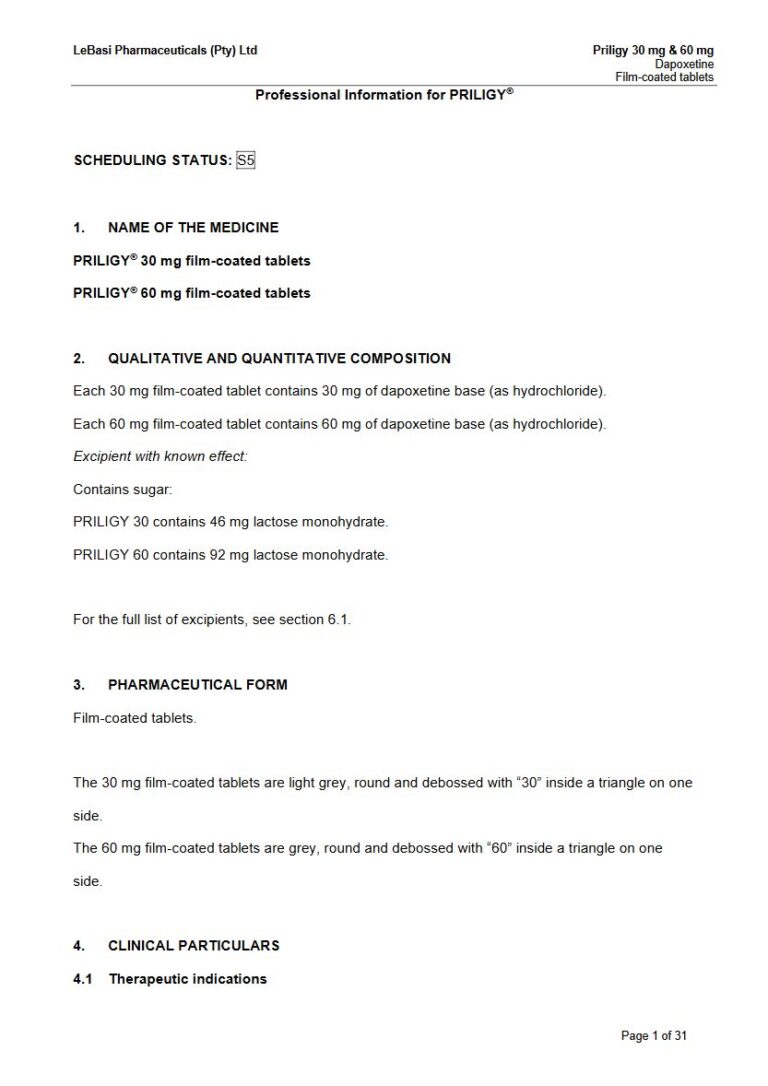 Healthcare Professionals Only
This content is for registered healthcare professionals
Sign in or create a free account to read the full package insert.
Free for HPCSA-registered professionals. Powered by Medinsert.
Clinical Particulars
Section 4 of the official insert — extracted exactly as issued, no alterations
4.1 Therapeutic indications
PRILIGY is indicated for the treatment of premature ejaculation (PE) in men 18 to 64 years of age, who have all of the following:
- An intravaginal ejaculatory latency time (IELT) of less than two minutes; and
- Persistent or recurrent ejaculation with minimal sexual stimulation before, on, or shortly after penetration and before the patient wishes; and
- Marked personal distress or interpersonal difficulty as a consequence of PE; and
- Poor control over ejaculation; and
- A history of premature ejaculation in the majority of intercourse attempts over the period of 6 months.
PRILIGY should be administered only as on-demand treatment before anticipated sexual activity. PRILIGY should not be prescribed to delay ejaculation in men who have not been diagnosed with PE.
4.2 Posology and method of administration
Posology
Adult men (18 to 64 years of age)
The recommended starting dose is 30 mg, (on demand use) approximately 1 to 3 hours prior to sexual activity. PRILIGY must not be taken more frequently than once every 24 hours. Treatment with PRILIGY should not be initiated with the 60 mg dose. PRILIGY is not intended for continuous daily use. PRILIGY should be taken only when sexual activity is anticipated. If the individual response to 30 mg is insufficient and the patient has not experienced moderate or severe adverse reactions or prodromal symptoms suggestive of syncope, the dose may be increased to a maximum recommended dose of 60 mg taken as needed approximately 1 to 3 hours prior to sexual activity. The incidence and severity of adverse events is higher with the 60 mg dose. If the patient experienced orthostatic reactions on the starting dose, no dose escalation to 60 mg should be performed (see section 4.4). A careful appraisal of individual benefit risk of PRILIGY should be performed by the prescriber after the first four weeks of treatment (or at least after 6 doses of treatment) to determine whether continuing treatment with PRILIGY is appropriate. Data regarding the efficacy and safety of PRILIGY beyond 24 weeks are limited. The clinical need of continuing and the benefit risk balance of treatment with PRILIGY should be re-evaluated at least every six months.
Special populations
Elderly (age 65 years and over)
Safety and efficacy of PRILIGY have not been established in patients aged 65 years and over as limited data are available in this population.
Children and adolescents
PRILIGY should not be used in individuals below 18 years of age.
Patients with renal impairment
No dose adjustment is required in patients with mild or moderate renal impairment. PRILIGY is not recommended for use in patients with severe renal impairment (see sections 4.4 and 5.2).
Patients with hepatic impairment
PRILIGY is contraindicated in patients with moderate and severe hepatic impairment (Child-Pugh Class B and C) (see sections 4.3 and 5.2).
Known CYP2D6 poor metabolisers or patients treated with potent CYP2D6 inhibitors
Caution is advised if increasing the dose to 60 mg in patients known to be of CYP2D6 poor metaboliser genotype or in patients concomitantly treated with potent CYP2D6 inhibitors (see sections 4.4 and 4.5).
Patients treated with moderate or potent inhibitors of CYP3A4
Concomitant use of potent CYP3A4 inhibitors is contraindicated. The dose should be restricted to 30 mg in patients concomitantly treated with moderate CYP3A4 inhibitors and caution is advised (see sections 4.3, 4.4 and 4.5).
Method of administration
For oral use. Tablets should be swallowed whole to avoid the bitter taste. It is recommended that tablet be taken with at least one full glass of water. PRILIGY may be taken with or without food.
Precautions to be taken before handling or administering PRILIGY
Before treatment is initiated, see section 4.4 regarding orthostatic hypotension.
4.3 Contraindications
PRILIGY is contraindicated:
- In patients with known hypersensitivity to dapoxetine hydrochloride or to any of the excipients (see section 6.1).
- In significant pathological conditions such as:
- heart failure (NYHA class II-IV)
- conduction abnormalities such as AV block or sick sinus syndrome
- significant ischaemic heart disease
- significant mono or multiple valvular disease
- a history of syncope
- carotid artery stenosis.
- In patients with a history of mania or severe depression.
- For concomitant treatment with monoamine oxidase inhibitors (MAOIs), or within 14 days of discontinuing treatment with an MAOI. Similarly, an MAOI should not be administered within 7 days after PRILIGY has been discontinued (see section 4.5).
- For concomitant treatment with thioridazine, or within 14 days of discontinuing treatment with thioridazine. Similarly, thioridazine should not be administered within 7 days after PRILIGY has been discontinued (see section 4.5).
- PRILIGY is contraindicated in patients experiencing uncontrolled epilepsy.
- PRILIGY is contraindicated in children under the age of 18 years (see section 4.4).
- In concomitant treatment with serotonin reuptake inhibitors [selective serotonin reuptake inhibitors (SSRIs), serotonin u2212 norepinephrine/noradrenaline reuptake inhibitors (SNRIs), tricyclic antidepressants (TCAs)] or other medicines with serotonergic effects [e.g. L u2212 tryptophan, triptans, tramadol, linezolid, lithium, St. Johnu2019s wort (Hypericum perforatum)] or within 14 days of discontinuing treatment with these medicines. Similarly, these medicines should not be administered within 7 days after PRILIGY has been discontinued (see section 4.5).
- Concomitant treatment of potent CYP3A4 inhibitors such as ketoconazole, itraconazole, ritonavir, saquinavir, telithromycin, nefazodone, nelfinavir, atazanavir, grapefruit juice, etc. (see section 4.5).
- Moderate and severe hepatic impairment.
4.4 Special warnings and precautions for use
General recommendations
PRILIGY is only indicated in men with premature ejaculation who meet all the criteria listed under INDICATIONS. PRILIGY should not be prescribed to men who have not been diagnosed with premature ejaculation. Safety has not been established and there are no data on the ejaculation-delaying effects in men without premature ejaculation.
Other forms of sexual dysfunction
Before treatment, subjects with other forms of sexual dysfunction, including erectile dysfunction, should be carefully investigated by healthcare professionals. PRILIGY should not be used in men with erectile dysfunction (ED) who are using phosphodiesterase-5 (PDE5) inhibitors (see section 4.5).
Orthostatic hypotension
Before treatment initiation, a careful medical examination including history of orthostatic events should be performed by the healthcare professional. An orthostatic test should be performed before initiating therapy (blood pressure and pulse rate, supine and standing). In case of a history of documented or suspected orthostatic reaction, treatment with PRILIGY should be avoided. Orthostatic hypotension has been reported in clinical trials. The prescriber should counsel the patient in advance that if he experiences possibly prodromal symptoms, such as light-headedness soon after standing, he should immediately lie down so his head is lower than the rest of his body or sit down with his head between his knees until the symptoms pass. The prescriber should also inform the patient not to rise quickly after prolonged lying or sitting.
Syncope
Patients should be cautioned to avoid situations where injury could result, including driving or operating hazardous machinery, should syncope or its prodromal symptoms such as dizziness or light-headedness occur (see section 4.8). Possible prodromal symptoms such as nausea, dizziness/light-headedness, and diaphoresis were reported more frequently among patients treated with PRILIGY compared to placebo. The frequency of syncope in the PRILIGY clinical development program varied from 0,06 % (30 mg) to 0,23 % (60 mg) for subjects enrolled in the Phase 3 placebo-controlled clinical trials to 0,64 % for Phase 1 non-PE healthy volunteer studies. Cases of syncope observed in the clinical trials were considered vasovagal in etiology and the majority occurred during the first 3 hours after dosing. Prodromal symptoms, such as nausea, dizziness, light-headedness, palpitations, asthenia, confusion and diaphoresis often preceded the syncope. Patients need to be made aware that they could experience syncope at any time with or without prodromal symptoms during their treatment with PRILIGY. Prescribers should counsel patients about the importance of maintaining adequate hydration and about how to recognise prodromal signs and symptoms to decrease the likelihood of serious injury associated with falls due to loss of consciousness. If the patient experiences possibly prodromal symptoms, the patient should immediately lie down until the symptoms pass, and be cautioned to avoid situations where injury could result, including driving or operating hazardous machinery, should syncope or other CNS effects occur (see section 4.7).
Patients with cardiovascular risk factors
Subjects with underlying cardiovascular disease were excluded from Phase 3 clinical trials. The risk of adverse cardiovascular outcomes from syncope (cardiac syncope and syncope from other causes) is increased in patients with underlying structural cardiovascular disease (e.g. documented outflow obstruction, valvular heart disease, carotid stenosis and coronary artery disease). There are insufficient data to determine whether this increased risk extends to vasovagal syncope in patients with underlying cardiovascular disease.
Suicide/suicidal thoughts
Antidepressants, including SSRIs, increased the risk compared to placebo of suicidal thinking and suicidality in short-term studies in children and adolescents with major depressive disorder and other psychiatric disorders. Short-term studies did not show an increase in the risk of suicidality with antidepressants compared to placebo in adults beyond age 24. In clinical trials with PRILIGY for the treatment of premature ejaculation, there was no clear indication of treatment-emergent suicidality.
Use with recreational drugs
Patients should be advised not to use PRILIGY in combination with recreational drugs. Recreational drugs with serotonergic activity such as ketamine, methylenedioxymethamphetamine (MDMA) and lysergic acid diethylamide (LSD) may lead to potentially serious reactions if combined with PRILIGY. These reactions include, but are not limited to, dysrhythmia, hyperthermia, and serotonin syndrome. Use of PRILIGY with recreational drugs with sedative properties such as narcotics and benzodiazepines may further increase somnolence and dizziness.
Medicines with vasodilatation properties
PRILIGY should be prescribed with caution in patients taking medicines with vasodilatation properties (such as alpha-adrenergic receptor antagonists and nitrates) due to possible reduced orthostatic tolerance (see section 4.5).
Moderate CYP3A4 inhibitors
Caution is advised in patients taking moderate CYP3A4 inhibitors and the dose is restricted to 30 mg (see section 4.5).
Potent CYP2D6 inhibitors
Caution is advised if increasing the dose to 60 mg in patients taking potent CYP2D6 inhibitors or if increasing the dose to 60 mg in patients known to be of CYP2D6 poor metaboliser genotype, as this may increase exposure levels, which may result in a higher incidence and severity of dose dependent adverse events (see section 4.5).
Mania
PRILIGY should not be used in patients with a history of mania/hypomania or bipolar disorder and should be discontinued in any patient who develops symptoms of these disorders.
Seizure
Due to the potential of SSRIs to lower the seizure threshold, PRILIGY should be discontinued in any patient who develops seizures and avoided in patients with unstable epilepsy. Patients with controlled epilepsy should be carefully monitored.
Use in children and adolescents under 18 years of age
PRILIGY should not be used in individuals below 18 years of age. Safety and efficacy in children under 18 years of age have not been established. In clinical trials in Major Depressive Disorder, treated with other SSRIs, there were increased reports of hostility and suicide-related adverse events such as suicidal ideation and self-harm (see section 4.8).
Depression and/or psychiatric disorders
Men with underlying signs and symptoms of depression should be evaluated prior to treatment with PRILIGY to rule out undiagnosed depressive disorders. Concomitant treatment of PRILIGY with antidepressants, including SSRIs and SNRIs, is contraindicated (see section 4.3). Discontinuation of treatment for ongoing depression or anxiety in order to initiate PRILIGY for the treatment of PE is not recommended. PRILIGY should not be used in men with psychiatric disorders, such as schizophrenia, or in those suffering with co-morbid depression, as worsening of symptoms associated with depression cannot be excluded. This could be the result of the underlying psychiatric disorder or might be a result of treatment with PRILIGY. Doctors should encourage patients to report any distressing thoughts or feelings at any time and if symptoms of depression develop during treatment, PRILIGY should be discontinued.
Haemorrhage
There have been reports of bleeding abnormalities with SSRIs. Caution is advised in patients taking PRILIGY, particularly in concomitant use with medicines known to affect platelet function (e.g. atypical antipsychotics and phenothiazines, most tricyclic antidepressants [TCAs], aspirin, nonsteroidal anti-inflammatory drugs [NSAIDs], anti-platelet agents) or anticoagulants (e.g. warfarin), as well as in patients with a history of bleeding or coagulation disorders (see section 4.5).
Renal impairment
PRILIGY is not recommended for use in patients with severe renal impairment and caution is advised in patients with mild to moderate renal impairment (see sections 4.2 and 4.5).
Withdrawal effects
Abrupt discontinuation of chronically administered SSRIs used to treat chronic depressive disorders has been reported to result in the following symptoms: dysphoric mood, irritability, agitation, dizziness, sensory disturbances (e.g. paresthesias such as electric shock sensations), anxiety, confusion, headache, lethargy, emotional lability, insomnia, and hypomania. However, a double-blind clinical trial in subjects with PE designed to assess the withdrawal effects of 62 days of daily or as needed dosing with 60 mg PRILIGY showed no evidence of withdrawal syndrome and little evidence of withdrawal symptoms with only a slightly higher incidence of mild or moderate insomnia and dizziness reported in subjects switched to placebo after daily dosing. Consistent results were seen in a second double-blind clinical trial with a 24-week treatment phase of 30 and 60 mg doses as needed followed by a 1-week withdrawal assessment period.
Alcohol (ethanol)
Patients should be advised not to use PRILIGY in combination with alcohol. Combining alcohol with PRILIGY may increase alcohol-related neurocognitive effects and may also enhance neurocardiogenic adverse events such as syncope, thereby increasing the risk of accidental injury; therefore, patients should be advised to avoid alcohol while taking PRILIGY (see section 4.5).
Eye disorders
The use of PRILIGY has been associated with ocular effects such as mydriasis and eye pain. PRILIGY should be used with caution in patients with raised intraocular pressure or those at risk of angle closure glaucoma.
Lactose intolerance
Patients with rare hereditary problems of galactose intolerance, total lactase deficiency or glucose-galactose malabsorption should not take PRILIGY. PRILIGY contains less than 1 mmol sodium (23 mg) per tablet, that is to say essentially sodium free.
4.5 Interactions with other medicines
Interaction studies have only been performed in adults.
Pharmacodynamic interactions
Potential for interaction with monoamine oxidase inhibitors
In patients receiving an SSRI in combination with a monoamine oxidase inhibitor (MAOI), there have been reports of serious, sometimes fatal, reactions including hyperthermia, rigidity, myoclonus, autonomic instability with possible rapid fluctuations of vital signs, and mental status changes that include extreme agitation progressing to delirium and coma. These reactions have also been reported in patients who have recently discontinued an SSRI and have been started on an MAOI. Some cases presented with features resembling neuroleptic malignant syndrome. Animal data on the effects of combined use of an SSRI and MAOIs suggest that these medicines may act synergistically to elevate blood pressure and evoke behavioural excitation. Therefore, PRILIGY should not be used in combination with an MAOI, or within 14 days of discontinuing treatment with an MAOI. Similarly, an MAOI should not be administered within 7 days after PRILIGY has been discontinued (see section 4.3).
Potential for interaction with thioridazine
Thioridazine administration alone produces prolongation of the QTc interval, which is associated with serious ventricular dysrhythmias. Medicines such as PRILIGY that inhibit the CYP2D6 isoenzyme appear to inhibit the metabolism of thioridazine and the resulting elevated levels of thioridazine are expected to augment the prolongation of the QTc interval. PRILIGY should not be used in combination with thioridazine or within 14 days of discontinuing treatment with thioridazine. Similarly, thioridazine should not be administered within 7 days after PRILIGY has been discontinued (see section 4.3).
CNS active medicines
The use of PRILIGY in combination with CNS active medicines has not been systematically evaluated in patients with premature ejaculation. Consequently, caution is advised if the concomitant administration of PRILIGY and such medicines is required.
Medicines or herbal products with serotonergic effects
Co-administration with serotonergic medicines (including MAOIs, L-tryptophan, triptans, tramadol, linezolid, SSRIs, lithium and St. John's wort (Hypericum perforatum) preparations) may lead to an increased incidence of serotonin associated effects. PRILIGY should not be used concomitantly with other SSRIs or MAOIs and caution is advised and a closer clinical monitoring is required when other serotonergic medicines are used concomitantly with PRILIGY (see sections 4.3 and 4.4).
Pharmacokinetic interactions
Effects of co-administered medicines on dapoxetine hydrochloride
In vitro studies in human liver, kidney, and intestinal microsomes indicate dapoxetine is metabolised primarily by CYP2D6, CYP3A4 and flavin monooxygenase 1 (FMO1). Therefore, inhibitors of these enzymes may reduce dapoxetine clearance.
Potent CYP2D6 inhibitors
The C max and AUC inf of dapoxetine (60 mg single dose) increased by 50 % and 88 %, respectively, in the presence of fluoxetine (60 mg/day for 7 days). Therefore, concomitant use of PRILIGY and potent CYP2D6 inhibitors may increase blood concentrations of dapoxetine. This is not expected to result in clinically significant interactions.
CYP3A4 inhibitors
Potent CYP3A4 inhibitors: Administration of ketoconazole (200 mg twice daily for 7 days) increased the C max and AUC inf of dapoxetine (60 mg single dose) by 35 % and 99 %, respectively. Therefore, concomitant use of PRILIGY and potent CYP3A4 inhibitors, such as ketoconazole, itraconazole, ritonavir, saquinavir, telithromycin, nefazodone, nelfinavir and atazanavir, is contraindicated. Grapefruit juice is also a potent CYP3A4 inhibitor and should be avoided within 24 hours prior to taking PRILIGY (see section 4.3).
Moderate CYP3A4 inhibitors: Concomitant treatment with moderate CYP3A4 inhibitors (e.g. erythromycin, clarithromycin, fluconazole, amprenavir, fosamprenavir, aprepitant, verapamil, diltiazem) may also give rise to significantly increased exposure of dapoxetine and desmethyldapoxetine, especially in CYP2D6 poor metabolisers. The maximum dose of dapoxetine should be 30 mg if dapoxetine is combined with any of these medicines (see sections 4.2, 4.4 and below). These two measures apply to all patients unless the patient has been verified to be a CYP2D6 extensive metaboliser by geno u2212 or phenotyping. In patients verified to be CYP2D6 extensive metabolisers, a maximum dose of 30 mg is advised if dapoxetine is combined with a potent CYP3A4 inhibitor and caution is advised if dapoxetine in 60 mg doses is taken concomitantly with a moderate CYP3A4 inhibitor.
Potent CYP2D6 inhibitors
The C max and AUC inf of dapoxetine (60 mg single dose) increased by 50 % and 88 %, respectively, in the presence of fluoxetine (60 mg/day for 7 days). Considering the contribution of both unbound dapoxetine and desmethyldapoxetine, the C max of the active fraction may be increased by approximately 50 % and the AUC of the active fraction may be doubled if taken with potent CYP2D6 inhibitors. These increases in the C max and AUC of the active fraction are similar to those expected for CYP2D6 poor metabolisers and may result in a higher incidence and severity of dose dependent adverse events (see section 4.4).
PDE5 inhibitors
PRILIGY should not be used in patients using PDE5 inhibitors due to possible reduced orthostatic tolerance. The pharmacokinetics of dapoxetine (60 mg) in combination with tadalafil (20 mg) and sildenafil (100 mg) were evaluated in a single dose crossover study. Tadalafil did not affect the pharmacokinetics of dapoxetine. Sildenafil caused slight changes in dapoxetine pharmacokinetics (22 % increase in AUC inf and 4% increase in C max), which are not expected to be clinically significant. Concomitant use of PRILIGY with PDE5 inhibitors may result in orthostatic hypotension (see section 4.4). The efficacy and safety of PRILIGY in patients with both premature ejaculation and erectile dysfunction concomitantly treated with PRILIGY and PDE5 inhibitors have not been established.
Effects of dapoxetine on the pharmacokinetics of co-administered medicines
Tamsulosin
In a clinical pharmacology study of patients receiving daily doses of tamsulosin with multiple doses of dapoxetine 30 mg or 60 mg, dapoxetine pharmacokinetics were comparable to those noted in previous studies in healthy subjects, indicating that tamsulosin does not affect dapoxetine pharmacokinetics. The pharmacokinetics of tamsulosin were similar in the dapoxetine 30 and 60 mg groups and similar on Days 1 and 7, indicating that dapoxetine did not affect the pharmacokinetics of tamsulosin. The addition of dapoxetine to tamsulosin did not result in a change in the orthostatic profile and there were no differences in orthostatic effects between tamsulosin combined with either dapoxetine 30 or 60 mg and tamsulosin alone. However, PRILIGY should be prescribed with caution in patients who use alpha adrenergic receptor antagonists due to possible reduced orthostatic tolerance (see section 4.4).
Medicines metabolised by CYP2D6
Multiple doses of dapoxetine (60 mg/day for 6 days) followed by a single 50 mg dose of desipramine increased the mean C max and AUC inf of desipramine approximately 11 % and 19 %, respectively, compared to desipramine administered alone. These differences are not likely to be clinically important. Dapoxetine is unlikely to affect the pharmacokinetics of other CYP2D6 substrates.
Medicines metabolised by CYP3A4
Multiple dosing of dapoxetine (60 mg/day for 6 days) did not inhibit the metabolism of midazolam (8 mg single dose). Therefore, dapoxetine is unlikely to affect the pharmacokinetics of other CYP3A4 substrates.
Medicines metabolised by CYP2C19
Multiple dosing of dapoxetine (60 mg/day for 6 days) did not affect the pharmacokinetics of a single 40 mg dose of omeprazole. Dapoxetine is unlikely to affect the pharmacokinetics of other CYP2C19 substrates.
Medicines metabolised by CYP2C9
Multiple dosing of dapoxetine (60 mg/day for 6 days) did not affect the pharmacokinetics or pharmacodynamics of a single 5 mg dose of glibenclamide. Dapoxetine is unlikely to affect the pharmacokinetics of other CYP2C9 substrates.
PDE5 inhibitors
In a single-dose crossover study, dapoxetine (60 mg) did not affect the pharmacokinetics of tadalafil (20 mg) or sildenafil (100 mg).
Warfarin and medicines that are known to affect coagulation and/or platelet function
There are no data evaluating the effect of chronic use of warfarin with PRILIGY; therefore, caution is advised when PRILIGY is used in patients taking warfarin chronically (see section 4.4). In a pharmacokinetic study, dapoxetine (60 mg/day for 6 days) did not affect the pharmacokinetics or pharmacodynamics (PT or INR) of warfarin following a single 25 mg dose.
There have been reports of bleeding abnormalities with SSRIs (see section 4.4).
Alcohol (ethanol)
Coadministration of a single dose of ethanol, 0,5 g/kg (approximately 2 drinks), did not affect the pharmacokinetics of dapoxetine (60 mg single dose). Similarly, dapoxetine coadministration did not affect ethanol pharmacokinetics. PRILIGY in combination with ethanol increased somnolence and significantly decreased self-rated alertness. Pharmacodynamic measures of cognitive impairment also showed an additive effect when PRILIGY was co-administered with ethanol. Concomitant use of alcohol and PRILIGY increases the chance or severity of adverse reactions such as dizziness, drowsiness, slow reflexes, or altered judgment. Combining alcohol with dapoxetine may increase these alcohol-related effects and may also enhance neurocardiogenic adverse events such as syncope, thereby increasing the risk of accidental injury; therefore, patients should be advised to avoid alcohol while taking PRILIGY.
4.6 Fertility, pregnancy and lactation
PRILIGY is not indicated for use by women. Observational data on a limited number of partneru2019s pregnancies during clinical trials indicate no adverse effects of PRILIGY on pregnancy or on the health of the fetus/new-born child. It is not known if either dapoxetine or its metabolites are excreted in human breast milk.
4.7 Effects on ability to drive and use machines
PRILIGY may influence the ability to drive and use machines. Dizziness, disturbance in attention, syncope, blurred vision and somnolence have been reported in subjects receiving PRILIGY in clinical trials. Therefore, patients should be warned to avoid situations where injury could result, including driving or operating hazardous machinery, should syncope or other CNS effects occur. Combining alcohol with dapoxetine may increase alcohol-related neurocognitive effects and may also enhance neurocardiogenic adverse events such as syncope, thereby increasing the risk of accidental injury; therefore, patients should be advised to avoid alcohol while taking PRILIGY (see section 4.4).
4.8 Undesirable effects
Summary of safety profile
Syncope and orthostatic hypotension have been reported in clinical trials (see section 4.4). The following adverse drug reactions were reported during Phase 3 clinical trials most commonly and were dose related: nausea (11,0 % and 22,2 % in 30 mg and 60 mg prn dapoxetine groups, respectively), dizziness (5,8 % and 10,9 %), headache (5,6 % and 8,8 %), diarrhoea (3,5 % and 6,9 %), insomnia (2,1 % and 3,9 %) and fatigue (2,0 % and 4,1 %). The most common adverse events leading to discontinuation were nausea (2,2 % of PRILIGY-treated subjects) and dizziness (1,2 % of PRILIGY-treated subjects).
In children treated with other SSRIs, hostility, suicidal ideation and self-harm have been reported.
Tabulated list of adverse reactions
The safety of PRILIGY was evaluated in 4 224 subjects with premature ejaculation who participated in five double-blind, placebo-controlled clinical trials. Of the 4 224 subjects, 1 616 received PRILIGY 30 mg as needed and 2 608 received 60 mg, either as needed or once daily. Table 1 presents the adverse drug reactions that have been reported. Frequency: very common (u22651/10); common (u22651/100 to <1/10); uncommon (u22651/1 000 to <1/100); rare.
4.9 Overdose
No case of overdose has been reported. In general, symptoms of overdose with SSRIs include serotonin-mediated adverse reactions such as somnolence, gastrointestinal disturbances such as nausea and vomiting, tachycardia, tremor, agitation and dizziness. In cases of overdose, standard supportive measures should be adopted as required. Due to high protein binding and large volume of distribution of dapoxetine hydrochloride, forced diuresis, dialysis, haemoperfusion and exchange transfusion are unlikely to be of benefit. No specific antidotes for PRILIGY are known.
