
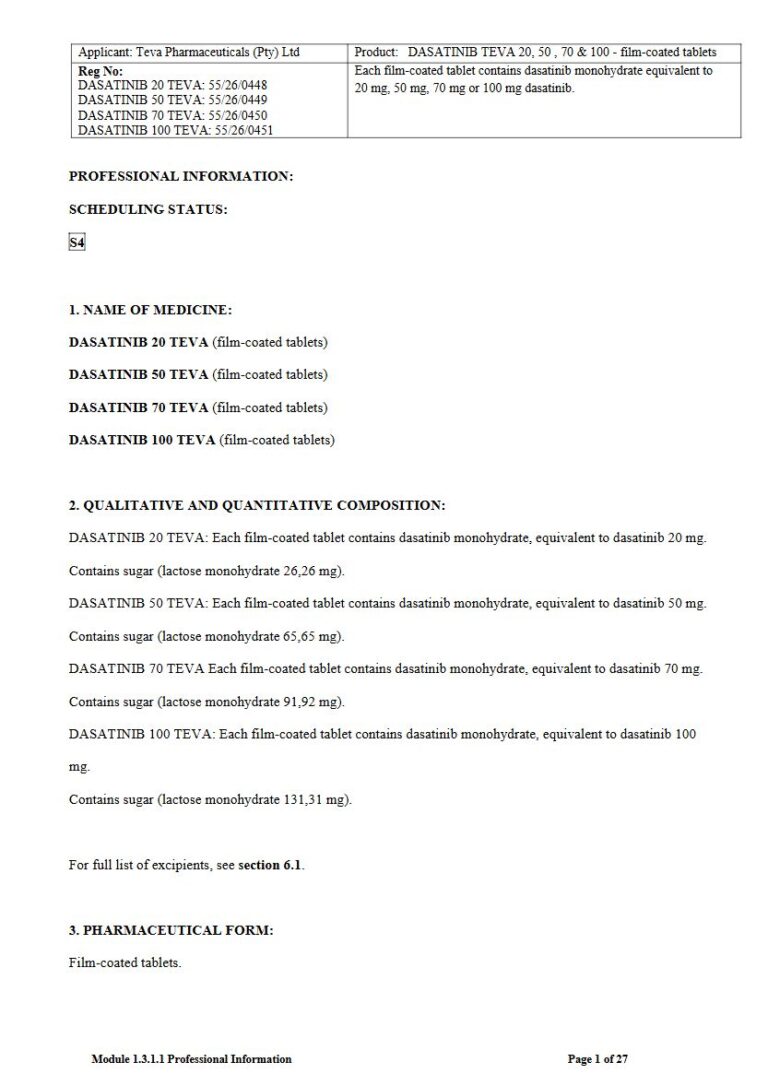
Dasatinib 20/50/70/100 Teva 20 mg, 50 mg, 70 mg, 100 mg Tablet
PDF Leaflet Revision Date: 15 November 2022
Clinical Summary
Quick overview from the medicine insert
Indication
Treatment of adults with Ph+ CML and Ph+ ALL.
Dosage (summary)
100 mg once daily for chronic phase CML; 70 mg twice daily for advanced phase CML or Ph+ ALL.
Special Populations
- Hepatic impairment
- Renal impairment
- Elderly
Pregnancy & Breastfeeding
Not recommended in pregnancy; contraindicated in breastfeeding.
Key Drug Interactions
- CYP3A4 inhibitors
- CYP3A4 inducers
- H2 antagonists
- Proton pump inhibitors
Contraindications
- Hypersensitivity to dasatinib
- Concomitant use of H2 antagonists or proton pump inhibitors
Common side effects
- Myelosuppression
- Fluid retention
- CNS bleeding
- QT prolongation
Counselling Points
- Take consistently with or without food
- Monitor for signs of bleeding or fluid retention
- Use contraception during treatment
Serious warnings
- Pulmonary arterial hypertension
- Severe dermatologic reactions
- Hepatitis B reactivation
Important Disclaimer
The Dasatinib 20/50/70/100 Teva 20 mg, 50 mg, 70 mg, 100 mg Tablet professional information leaflet below is the property of Teva Pharmaceuticals and is provided on Medinsert exactly as issued, with no.. alterations or editorial changes. We make every effort to keep content current by updating documents as soon as new versions become available. Medinsert serves as a trusted access point for healthcare professionals, but does not replace official sources or clinical judgement. For more details, please read our full disclaimer. read more>>
 Healthcare Professionals Only
This content is for registered healthcare professionals
Sign in or create a free account to read the full package insert.
Free for HPCSA-registered professionals. Powered by Medinsert.
Clinical Particulars
Section 4 of the official insert — extracted exactly as issued, no alterations
4.1 Therapeutic indications
DASATINIB TEVA is indicated for the treatment of adults with newly diagnosed Philadelphia chromosome-positive (Ph+) chronic myeloid leukaemia (CML) in chronic phase. DASATINIB TEVA is indicated for the treatment of adults with chronic, accelerated, or myeloid or lymphoid blast phase chronic myeloid leukaemia (CML) with resistance or intolerance to prior therapy including imatinib. DASATINIB TEVA is also indicated for the treatment of adults with Philadelphia chromosome-positive acute lymphoblastic leukaemia (Ph+ ALL) with resistance or intolerance to prior therapy.
4.2 Posology and method of administration
Posology: The recommended starting dosage of DASATINIB TEVA for chronic phase CML is 100 mg once daily, administered orally. The recommended starting dosage of DASATINIB TEVA for accelerated, myeloid or lymphoid blast phase (advanced phase) CML or Ph+ ALL is 70 mg twice daily, administered orally. DASATINIB TEVA can be taken with or without a meal and should be taken consistently in the morning and in the evening.
Method of administration: DASATINIB TEVA can be taken with or without a meal and should be taken consistently either in the morning or in the evening. Tablets should not be crushed or cut; they should be swallowed whole.
4.3 Contraindications
DASATINIB TEVA is contraindicated in patients with hypersensitivity to dasatinib or to any other component of DASATINIB TEVA listed in section 6.1. The concomitant use of H2 antagonists or proton pump inhibitors with DASATINIB TEVA is not recommended.
4.4 Special warnings and precautions for use
Clinically relevant interactions: Dasatinib is a substrate and an inhibitor of cytochrome P450 (CYP) 3A4. Therefore, there is a potential for interaction with other concomitantly administered medicines that are metabolised primarily by or modulate the activity of CYP3A4 (see section 4.5). Concomitant use of DASATINIB TEVA and medicinal products that potently inhibit CYP3A4 (e.g. ketoconazole, itraconazole, erythromycin, clarithromycin, ritonavir, telithromycin, grapefruit juice) may increase exposure to dasatinib. Therefore, in patients receiving DASATINIB TEVA, co-administration of a potent CYP3A4 inhibitor is not recommended (see section 4.5).
Concomitant use of DASATINIB TEVA and medicines that induce CYP3A4 (e.g. dexamethasone, phenytoin, carbamazepine, rifampicin, phenobarbital or herbal preparations containing Hypericum perforatum, also known as St. John's Wort) may substantially reduce exposure to dasatinib, potentially increasing the risk of therapeutic failure. Therefore, in patients receiving DASATINIB TEVA, co-administration of alternative medicines with less potential for CYP3A4 induction should be selected (see section 4.5).
Concomitant use of DASATINIB TEVA and a CYP3A4 substrate may increase exposure to the CYP3A4 substrate. Therefore, caution is warranted when DASATINIB TEVA is co-administered with CYP3A4 substrates of narrow therapeutic index, such as astemizole, terfenadine, cisapride, pimozide, quinidine, bepridil or ergot alkaloids (ergotamine, dihydroergotamine) (see section 4.5).
The concomitant use of DASATINIB TEVA and a histamine-2 (H2) antagonist (e.g. famotidine), proton pump inhibitor (e.g. omeprazole), or aluminium hydroxide/magnesium hydroxide may reduce the exposure to dasatinib. Thus, H2 antagonists and proton pump inhibitors are not recommended, and aluminium hydroxide/magnesium hydroxide products should be administered up to 2 hours prior to, or 2 hours following the administration of DASATINIB TEVA (see sections 4.3 and 4.5).
Special populations: Based on the findings from a single-dose pharmacokinetic study, patients with mild, moderate or severe hepatic impairment may receive the recommended starting dose (see section 5.2). Due to the limitations of this clinical study, caution is recommended when administering DASATINIB TEVA to patients with hepatic impairment.
Important adverse reactions: Myelosuppression: Treatment with DASATINIB TEVA is associated with anaemia, neutropenia and thrombocytopenia. Their occurrence is earlier and more frequent in patients with advanced phase CML or Ph+ ALL than in chronic phase CML. In adult patients with advanced phase CML or Ph+ ALL treated with DASATINIB TEVA as monotherapy, complete blood counts (CBCs) should be performed weekly for the first 2 months, and then monthly thereafter, or as clinically indicated. In adult and paediatric patients with chronic phase CML, complete blood counts should be performed every 2 weeks for 12 weeks, then every 3 months thereafter or as clinically indicated. In paediatric patients with Ph+ ALL treated with DASATINIB TEVA in combination with chemotherapy, CBCs should be performed prior to the start of each block of chemotherapy and as clinically indicated. During the consolidation blocks of chemotherapy, CBCs should be performed every 2 days until recovery (see sections 4.2 and 4.8). Myelosuppression is generally reversible and usually managed by withholding DASATINIB TEVA temporarily or by dose reduction.
4.5 Interactions with other medicines
Active substances that may increase dasatinib plasma concentrations: In vitro studies indicate that dasatinib is a CYP3A4 substrate. Concomitant use of DASATINIB TEVA and medicines or substances which potently inhibit CYP3A4 (e.g. ketoconazole, itraconazole, erythromycin, clarithromycin, ritonavir, atazanavir, indinavir, nelfinavir, saquinavir, telithromycin, grapefruit juice) may increase exposure to dasatinib and should be avoided. Therefore, in patients receiving DASATINIB TEVA, systemic administration of a potent CYP3A4 inhibitor is not recommended (see section 4.2).
Active substances that may decrease dasatinib plasma concentrations: When dasatinib was administered following 8 daily evening administrations of 600 mg rifampicin, a potent CYP3A4 inducer, the AUC of dasatinib was decreased by 82%. Other medicines that induce CYP3A4 activity (e.g. dexamethasone, phenytoin, carbamazepine, phenobarbital or herbal preparations containing Hypericum perforatum, also known as St. Johnu00b4s Wort) may also increase metabolism and decrease dasatinib plasma concentrations. Therefore, concomitant use of potent CYP3A4 inducers with dasatinib is not recommended. In patients in whom rifampicin or other CYP3A4 inducers are indicated, alternative medicines with less enzyme induction potential should be used. Concomitant use of dexamethasone, a weak CYP3A4 inducer, with dasatinib is allowed; dasatinib AUC is predicted to decrease approximately 25% with concomitant use of dexamethasone, which is not likely to be clinically meaningful.
Histamine-2 antagonists and proton pump inhibitors: Long-term suppression of gastric acid secretion by H2 antagonists or proton pump inhibitors (e.g. famotidine and omeprazole) is likely to reduce dasatinib exposure by > 60%. In a single-dose study in healthy subjects, the administration of famotidine 10 hours prior to a single dose of DASATINIB TEVA reduced dasatinib exposure by 61%. In a study of 14 healthy subjects, administration of a single 100-mg dose of DASATINIB TEVA 22 hours following a 4-day, 40-mg omeprazole dose at steady state reduced the AUC of dasatinib by 43% and the Cmax of dasatinib by 42%. The use of antacids should be considered in place of H2 antagonists or proton pump inhibitors in patients receiving DASATINIB TEVA therapy (see section 4.4).
Antacids: Non-clinical data demonstrate that the solubility of dasatinib is pH-dependent. In healthy subjects, the concomitant use of aluminium hydroxide/magnesium hydroxide antacids with DASATINIB TEVA reduced the AUC of a single dose of DASATINIB TEVA by 55% and the Cmax by 58%. However, when antacids were administered 2 hours prior to a single dose of DASATINIB TEVA, no relevant changes in dasatinib concentration or exposure were observed. Thus, antacids may be administered up to 2 hours prior to or 2 hours following DASATINIB TEVA (see section 4.4).
Active substances that may have their plasma concentrations altered by dasatinib: Concomitant use of DASATINIB TEVA and a CYP3A4 substrate may increase exposure to the CYP3A4 substrate. In a study in healthy subjects, a single 100 mg dose of dasatinib increased AUC and Cmax exposure to simvastatin, a known CYP3A4 substrate, by 20 and 37% respectively. It cannot be excluded that the effect is larger after multiple doses of dasatinib. Therefore, CYP3A4 substrates known to have a narrow therapeutic index (e.g. astemizole, terfenadine, cisapride, pimozide, quinidine, bepridil or ergot alkaloids e.g. ergotamine, dihydroergotamine) should be administered with caution in patients receiving DASATINIB TEVA (see section 4.4).
In vitro data indicate a potential risk for interaction with CYP2C8 substrates, such as glitazones. Paediatric population: Interaction studies have only been performed in adults.
4.6 Fertility, pregnancy and lactation
Women of childbearing potential/Contraception in males and females: Sexually active male or female patients taking DASATINIB TEVA should use adequate contraception during treatment. Pregnancy: DASATINIB TEVA may cause foetal harm when administered to a pregnant woman. There have been post-marketing reports of spontaneous abortion and foetal and infant anomalies from women who have taken DASATINIB TEVA during pregnancy. DASATINIB TEVA is not recommended for use in women who are pregnant or contemplating pregnancy. If DASATINIB TEVA is used during pregnancy, or if the patient becomes pregnant while taking DASATINIB TEVA, the patient should be apprised of the potential hazard to the foetus. Breastfeeding: Women who are taking DASATINIB TEVA should not breastfeed. Fertility: Medical practitioners and other healthcare providers should counsel male patients of appropriate age about possible effects of DASATINIB TEVA on fertility, and this counselling may include consideration of semen deposition.
4.7 Effects on ability to drive and use machines
DASATINIB TEVA has minor influence on the ability to drive and use machines. Patients should be advised that they may experience adverse reactions such as dizziness or blurred vision during treatment with DASATINIB TEVA. Therefore, caution should be recommended when driving a car or operating machines.
4.8 Undesirable effects
TABLE 2: TABULATED SUMMARY OF ADVERSE REACTIONS:
Infections and infestations: Frequent infection (including bacterial, viral, fungal, non-specified), pneumonia (including bacterial, viral, and fungal), upper respiratory tract infection/inflammation, herpes virus infection (including cytomegalovirus - CMV), enterocolitis infection, sepsis (including uncommon cases with fatal outcomes) Frequency unknown hepatitis B reactivation Blood and lymphatic system disorders: Frequent myelosuppression (including anaemia, neutropenia, thrombocytopenia), febrile neutropenia Less frequent lymphadenopathy, lymphopenia, aplasia pure red cell Immune system disorders: Less frequent hypersensitivity (including erythema nodosum), anaphylactic shock Endocrine disorders: Less frequent hypothyroidism, hyperthyroidism, thyroiditis Metabolism and nutrition disorders: Frequent appetite disturbances, hyperuricaemia Less frequent tumour lysis syndrome, dehydration, hypoalbuminemia, hypercholesterolemia, diabetes mellitus Psychiatric disorders: Frequent depression, insomnia Less frequent anxiety, confusional state, affect lability, libido decreased Nervous system disorders: Frequent headache, dizziness, neuropathy (including peripheral neuropathy), dysgeusia, somnolence Less frequent CNS bleeding, amnesia, tremor, syncope, balance disorder, cerebrovascular accident, transient ischaemic attack, convulsion, optic neuritis, VII th nerve paralysis, dementia, ataxia Eye disorders: Frequent visual disorder (including visual disturbance, blurred vision and reduced visual acuity), dry eye Less frequent visual impairment, conjunctivitis, photophobia, increased lacrimation Ear and labyrinth disorders: Frequent tinnitus Less frequent hearing loss, vertigo Cardiac disorders: Frequent congestive heart failure/cardiac dysfunction, pericardial effusion, dysrhythmia (including tachycardia), palpitations Less frequent myocardial infarction (including fatal outcome), electrocardiogram QT prolonged, pericarditis, ventricular dysrhythmia (including ventricular tachycardia), angina pectoris, cardiomegaly, electrocardiogram T-wave abnormal, troponin increased, cor pulmonale, myocarditis, acute coronary syndrome, cardiac arrest, electrocardiogram PR prolongation, coronary artery disease, pleuropericarditis Frequency unknown atrial fibrillation/atrial flutter Vascular disorders: Frequent haemorrhage, hypertension, flushing Less frequent hypotension, thrombophlebitis, thrombosis, deep vein thrombosis, livedo reticularis Frequency unknown thrombotic microangiopathy, pulmonary embolism Respiratory, thoracic and mediastinal disorders: Frequent pleural effusion, dyspnoea, pulmonary oedema, pulmonary hypertension, lung infiltration, pneumonitis, cough Less frequent pulmonary arterial hypertension, bronchospasm, asthma, pulmonary embolism, acute respiratory distress syndrome, dysphonia Frequency unknown interstitial lung disease, acute respiratory distress syndrome Gastrointestinal disorders: Frequent diarrhoea, vomiting, nausea, abdominal pain, gastrointestinal bleeding, colitis (including neutropenic colitis), gastritis, mucosal inflammation (including mucositis/stomatitis), dyspepsia, abdominal distension, constipation, oral soft tissue disorder Less frequent pancreatitis (including acute pancreatitis), upper gastrointestinal ulcer, oesophagitis, ascites, anal fissure, dysphagia, gastroesophageal reflux disease, protein-losing gastroenteropathy, ileus, anal fistula Frequency unknown fatal gastrointestinal haemorrhage, acute pancreatitis Hepatobiliary disorders: Less frequent hepatitis, cholestasis, cholecystitis Frequency unknown hepatic failure including fatal events Skin and subcutaneous tissue disorders: Frequent skin rash, alopecia, dermatitis (including eczema), pruritus, acne, dry skin, urticaria, hyperhidrosis Less frequent neutrophilic dermatosis, photosensitivity, pigmentation disorder, panniculitis, skin ulcer, bullous conditions, nail disorder, palmar-plantar erythrodysesthesia syndrome, hair disorder, leukocytoclastic vasculitis, skin fibrosis Frequency unknown Stevens-Johnson syndrome Musculoskeletal and connective tissue disorders: Frequent musculoskeletal pain, arthralgia, myalgia, muscular weakness, musculoskeletal stiffness, muscle spasm Less frequent rhabdomyolysis, osteonecrosis, muscle inflammation, tendonitis, arthritis, epiphyses delayed fusion, growth retardation Renal and urinary disorders: Less frequent renal impairment (including renal failure), urinary frequency, proteinuria Frequency unknown nephrotic syndrome Pregnancy, puerperium and perinatal conditions: Less frequent abortion Reproductive system and breast disorders: Less frequent gynaecomastia, menstrual disorder General disorders and administration site conditions: Frequent peripheral oedema, fatigue, pyrexia, face oedema, asthenia, pain, chest pain, generalised oedema, chills Less frequent malaise, other superficial oedema, gait disturbance Investigations: Frequent decreased weight, increased weight Less frequent increased blood creatine phosphokinase, increased gamma-glutamyltransferase Frequency unknown hypophosphataemia, hypokalaemia, hypocalcaemia, elevated SGPT (ALT), elevated SGOT (AST), elevated bilirubin, elevated creatinine Injury, poisoning, and procedural complications: Frequent contusion
4.9 Overdose
Experience with overdose of DASATINIB TEVA in clinical studies is limited to isolated cases. Overdose of 280 mg per day for one week was reported in two patients and both developed a significant decrease in platelet counts. Since DASATINIB TEVA is associated with severe myelosuppression (see section 4.4), patients who ingest more than the recommended dosage should be closely monitored for myelosuppression and appropriate supportive treatment given.
