
Deceq 50 mg Powder for concentrate for solution for infusion
PDF Leaflet Revision Date: 12 December 2023
Clinical Summary
Quick overview from the medicine insert
Indication
Treatment of adult patients (u2265 65 years) with newly diagnosed de novo or secondary acute myeloid leukaemia (AML).
Dosage (summary)
20 mg/mu00b2 IV infusion over 1 hour for 5 consecutive days, repeated every 4 weeks.
Special Populations
- Hepatic impairment
- Renal impairment
- Elderly
Pregnancy & Breastfeeding
Contraindicated in pregnancy and breastfeeding; teratogenic in animal studies.
Key Drug Interactions
- Caution with other medicines activated by phosphorylation or metabolized by cytidine deaminase.
Contraindications
- Hypersensitivity to decitabine
- Breastfeeding
Common side effects
- Myelosuppression
- Infections
- Febrile neutropenia
- Nausea
- Vomiting
Counselling Points
- Use effective contraception during treatment
- Monitor for signs of infection
- Avoid skin contact with solution
Serious warnings
- Risk of severe infections
- Myelosuppression complications
- Interstitial lung disease
Important Disclaimer
The Deceq 50 mg Powder for concentrate for solution for infusion professional information leaflet below is the property of Equity Pharmaceuticals and is provided on Medinsert exactly as issued, with no.. alterations or editorial changes. We make every effort to keep content current by updating documents as soon as new versions become available. Medinsert serves as a trusted access point for healthcare professionals, but does not replace official sources or clinical judgement. For more details, please read our full disclaimer. read more>>
 Healthcare Professionals Only
This content is for registered healthcare professionals
Sign in or create a free account to read the full package insert.
Free for HPCSA-registered professionals. Powered by Medinsert.
Clinical Particulars
Section 4 of the official insert — extracted exactly as issued, no alterations
4.1 Therapeutic indications
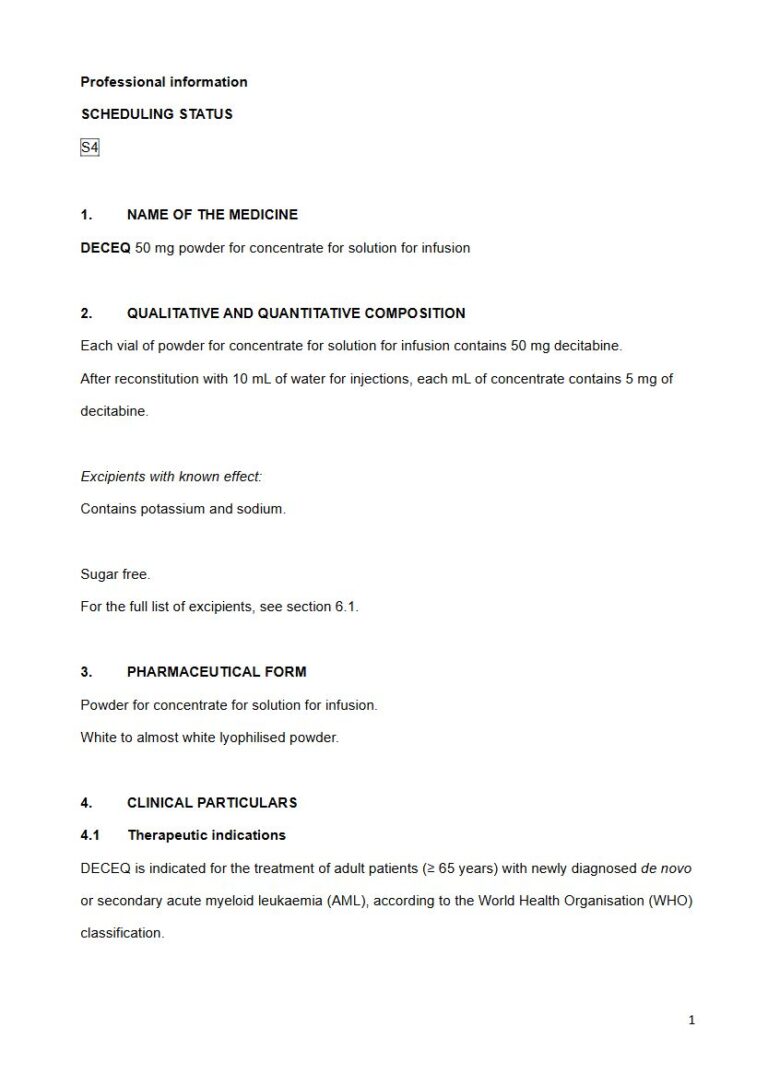
DECEQ is indicated for the treatment of adult patients (u2265 65 years) with newly diagnosed de novo or secondary acute myeloid leukaemia (AML), according to the World Health Organisation (WHO) classification.
4.2 Posology and method of administration
DECEQ must be administered under the supervision of a medical practitioner experienced in the use of chemotherapeutic medicines. Posology: Dosing regimen: A 5-Day dosing regimen in the treatment of AML is recommended. It is recommended that patients be treated for a minimum of 4 cycles; however, a response may take longer than 4 cycles to be obtained. Treatment may be continued as long as the patient shows response, continues to benefit or exhibits stable disease, i.e., in the absence of overt progression. If after 4 cycles, the patientu2019s haematological values (e.g., platelet counts or absolute neutrophil count), have not returned to pre-treatment levels, or if disease progression occurs (peripheral blast counts are increasing or bone marrow blast counts are worsening), the patient should be considered to be a non-responder and alternative therapeutic options to DECEQ should be considered. Pre-medication for the prevention of nausea and vomiting is not routinely recommended but may be administered if required. Treatment regimen: In a treatment cycle, DECEQ is administered at a dose of 20 mg/m2 body surface area by intravenous infusion over 1 hour repeated daily for 5 consecutive days (i.e., a total of 5 doses per treatment cycle). The total daily dose must not exceed 20 mg/m2 and the total dose per treatment cycle must not exceed 100 mg/m2. The cycle should be repeated every 4 weeks depending on the patient's clinical response and observed toxicity. If a dose is missed, treatment should be resumed as soon as possible. It is possible to use this regimen in an outpatient setting. Myelosuppression and associated complications: Myelosuppression and adverse events related to myelosuppression (thrombocytopenia, anaemia, neutropenia, and febrile neutropenia) are common in both treated and untreated patients. Complications of myelosuppression include infections and bleeding. Treatment may be modified in patients experiencing myelosuppression and associated complications as described below: Treatment may be delayed at the discretion of the treating medical practitioner, if the patient experiences myelosuppression-associated complications, such as: u2022 Febrile neutropenia (temperature u2265 38,5 u00b0C and absolute neutrophil count < 1 000/u03bcL). u2022 Active viral, bacterial or fungal infection (i.e., requiring intravenous anti-infectives or extensive supportive care). u2022 Haemorrhage (gastrointestinal, genito- urinary, pulmonary with platelets < 25 000/u03bcL or any central nervous system (CNS)). Treatment with DECEQ may be resumed once these conditions have improved or have been stabilised with adequate treatment (anti-infective therapy, transfusions, or growth factors). Method of administration: DECEQ is administered by intravenous infusion. A central venous catheter is not required. DECEQ is for single use only. Skin contact with the solution should be avoided and protective gloves must be worn. Standard procedures for dealing with anticancer medicines should be adopted. For instructions on reconstitution of DECEQ before administration, see section 6.6.
4.3 Contraindications
- Hypersensitivity to decitabine or to any of the excipients listed in section 6.1.
- Breastfeeding (see section 4.6).
4.4 Special warnings and precautions for use
Myelosuppression: Myelosuppression and complications of myelosuppression, including infections and bleeding that occur in patients with AML may be exacerbated with DECEQ treatment. Therefore, patients are at increased risk for severe infections (due to any pathogen such as bacterial, fungal and viral), with potentially fatal outcome (see section 4.8). Patients should be monitored for signs and symptoms of infection and treated promptly. Myelosuppression caused by DECEQ is reversible. Complete blood and platelet counts should be performed regularly, as clinically indicated and prior to each treatment cycle. In the presence of myelosuppression or its complications, treatment with DECEQ may be interrupted and/or supportive measures instituted (see sections 4.2 and 4.8). Haematological adverse medicine reactions should be managed by routine monitoring of complete blood counts and supportive treatments as required. Supportive treatments include administration of prophylactic antibiotics and/or growth factor support (e.g. G-CSF) for neutropenia and transfusions for anaemia or thrombocytopaenia according to institutional guidelines. For situations where DECEQ administration should be delayed (section 4.2). Respiratory, thoracic and mediastinal disorders: Cases of interstitial lung disease (ILD) (including pulmonary infiltrates, organising pneumonia and pulmonary fibrosis) without signs of infectious aetiology have been reported in patients receiving decitabine. Careful assessment of patients with an acute onset or unexplained worsening of pulmonary symptoms should be performed to exclude ILD. If ILD is confirmed, appropriate treatment should be initiated (see section 4.8). Hepatic impairment: Use in patients with hepatic impairment has not been established. Caution should be exercised in the administration of DECEQ to patients with hepatic impairment and in patients who develop signs or symptoms of hepatic impairment. Liver function tests should be performed prior to initiation of therapy and prior to each treatment cycle, and as clinically indicated (see sections 4.8 and 5.2). Renal impairment: Use in patients with severe renal impairment has not been studied. Caution should be exercised in the administration of DECEQ to patients with severe renal impairment (Creatinine Clearance [CrCl] < 30 mL/min). Renal function tests should be performed prior to initiation of therapy and prior to each treatment cycle, and as clinically indicated. Cardiac disease: Patients with a history of severe congestive heart failure or clinically unstable cardiac disease were excluded from clinical studies and therefore, the safety and efficacy of DECEQ in these patients has not been established. Cases of cardiomyopathy with cardiac decompensation, in some cases reversible after treatment discontinuation, dose reduction or corrective treatment, have been reported in the post-marketing setting. Patients, especially those with a history of cardiac disease, should be monitored for signs and symptoms of heart failure. DECEQ contains potassium and sodium. This medicine contains less than 1 mmol of potassium (39 mg) and sodium (23 mg) per dose, i.e it is essentially u2018potassium-freeu2019 and u2018sodium-freeu2019. Paediatric patients: The safety and effectiveness in paediatric patients have not been established.
4.5 Interaction with other medicines and other forms of interaction
No formal clinical interaction studies with decitabine have been conducted. There is the potential for an interaction with other medicines which are also activated by sequential phosphorylation (via intracellular phosphokinase activities) and/or metabolised by enzymes implicated in the inactivation of decitabine (e.g., cytidine deaminase). Therefore, caution should be exercised if these active substances are combined with DECEQ. Impact of co-administered medicines on DECEQ: Cytochrome (CYP) 450-mediated metabolic interactions are not anticipated as decitabine metabolism is not mediated by this system but by oxidative deamination. Displacement of DECEQ from its plasma protein binding by co-administered medicines is unlikely given the negligible in vitro plasma protein binding (< 1 %) of DECEQ. In vitro data indicated that DECEQ is a poor P-glycoprotein (P-gp) substrate and is therefore not prone to interaction with P-gp inhibitors. Impact of DECEQ on co-administered medicines: Given its low in vitro plasma protein binding (< 1 %), DECEQ is unlikely to displace co-administered medicines from their plasma protein binding. In vitro studies show that DECEQ does not inhibit nor induce CYP 450 enzymes up to more than 20-fold of the therapeutic maximum observed plasma concentration (C max). Thus, CYP-mediated metabolic medicine interactions are not anticipated and is unlikely to interact with medicines metabolised through these pathways. Decitabine has been shown to be a weak inhibitor of P-gp mediated transport in vitro and is therefore, also not expected to affect P-gp mediated transport of co-administered medicines (see section 5.2).
4.6 Fertility, pregnancy and lactation
Women of childbearing potential/ contraception in males and females: Women of childbearing potential must use effective contraceptive measures and avoid becoming pregnant while being treated with DECEQ. The time period following treatment with DECEQ where it is safe to become pregnant is unknown. Men should use effective contraceptive measures and be advised to not father a child while receiving DECEQ, and for 3 months following completion of treatment. The use of decitabine with hormonal contraceptives has not been studied. Pregnancy: There are no adequate data on the use of DECEQ in pregnant women. Studies have shown that decitabine is teratogenic in rats and mice. The potential risk for humans is unknown. Based on results from animal studies and its mechanism of action, DECEQ should not be used during pregnancy and in women of childbearing potential not using effective contraception. If DECEQ is used during pregnancy, or if a patient becomes pregnant while receiving DECEQ, the patient should be apprised of the potential hazard to the foetus. Breastfeeding: It is not known whether decitabine or its metabolites are excreted in breast milk. DECEQ is contraindicated during breastfeeding; therefore, if treatment with DECEQ is required, breastfeeding must be discontinued (see section 4.3). Fertility: No human data on the effect of decitabine on fertility are available. In non-clinical animal studies, decitabine alters male fertility and is mutagenic. Because of the possibility of infertility as a consequence of DECEQ therapy, men should seek advice on conservation of sperm and female patients of childbearing potential should seek consultation regarding oocyte cryopreservation prior to initiation of treatment.
4.7 Effects on ability to drive and use machines
No studies of the effects on the ability to drive or use machines with DECEQ have been performed. Patients should be advised that they may experience undesirable effects such as anaemia during treatment. Therefore, caution should be recommended when driving a car or operating machines.
4.8 Undesirable effects
Summary of the safety profile: The most important and frequently occurring adverse medicine reactions are myelosuppression and those occurring as a consequence of myelosuppression. Infections and infestations: Frequent: pneumonia, urinary tract infection, septic shock*, sepsis*, sinusitis, all other infections (viral, bacterial, fungal)*. Blood and the lymphatic system disorders: Frequent: febrile neutropenia*, neutropenia, thrombocytopenia a, anaemia, leukopenia, panctocytopenia. Immune system disorders: Frequent: hypersensitivity including anaphylactic reaction. Metabolism and nutrition disorders: Frequent: hyperglycaemia. Nervous system disorders: Frequent: headache. Cardiac disorders: Less frequent: cardiomyopathy. Respiratory, thoracic and mediastinal disorders: Frequent: epistaxis. Gastrointestinal disorders: Frequent: diarrhoea, vomiting, stomatitis, nausea. Hepatobiliary disorders: Frequent: abnormal hepatic function, hyperbilirubinaemia. Skin and subcutaneous tissue disorders: Less frequent: acute febrile neutrophilic dermatosis (Sweet's syndrome). General disorders and administration site conditions: Less frequent: pyrexia. Post-marketing experience: Respiratory, thoracic and mediastinal disorders: Interstitial lung disease. Gastrointestinal disorders: Enterocolitis, including neutropenic colitis, cecitis* a Including haemorrhage associated with thrombocytopaenia, including fatal cases. b Including enterocolitis infectious. * Includes events with a fatal outcome.
4.9 Overdose
There is no direct experience of human overdose and no specific antidote. However, early clinical study data in published literature at doses greater than 20 times higher than the current therapeutic dose, reported increased myelosuppression including prolonged neutropenia and thrombocytopenia. Toxicity is likely to manifest as exacerbations of adverse reactions, primarily myelosuppression. Treatment for overdose should be supportive.
