
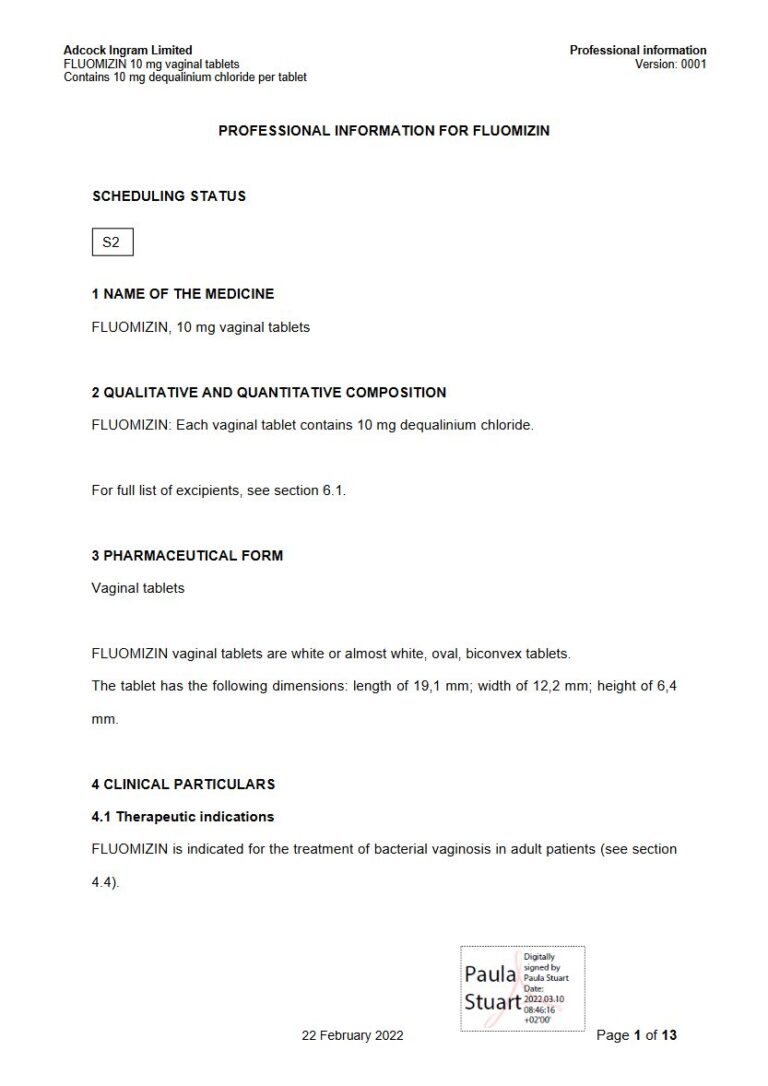
Fluomizin Vaginal 10 mg Tablets
PDF Leaflet Revision Date: 22 February 2022
Clinical Summary
Quick overview from the medicine insert
Indication
Treatment of bacterial vaginosis in adults.
Dosage (summary)
One vaginal tablet daily for six days, inserted deeply in the evening.
Onset of Action / Duration
Onset: 24-72 hours, Duration: 6 days
Special Populations
- Elderly >55 years
- Children <18 years
Pregnancy & Breastfeeding
Use in pregnancy only if necessary; safe during lactation.
Key Drug Interactions
- Anionic substances (soaps, detergents) reduce efficacy
Contraindications
- Hypersensitivity to dequalinium chloride
- Vaginal ulceration
- Pre-menarchal girls
Common side effects
- Vaginal candidiasis
- Headache
- Nausea
- Vaginal discharge
Counselling Points
- Insert tablet deeply before bed
- Use sanitary protection
- Continue treatment even if symptoms improve
Serious warnings
- Do not use within 12 hours before birth
- Risk of vaginal ulcerations with higher doses
Important Disclaimer
The Fluomizin Vaginal 10 mg Tablets professional information leaflet below is the property of Adcock Ingram and is provided on Medinsert exactly as issued, with no.. alterations or editorial changes. We make every effort to keep content current by updating documents as soon as new versions become available. Medinsert serves as a trusted access point for healthcare professionals, but does not replace official sources or clinical judgement. For more details, please read our full disclaimer. read more>>
 Healthcare Professionals Only
This content is for registered healthcare professionals
Sign in or create a free account to read the full package insert.
Free for HPCSA-registered professionals. Powered by Medinsert.
Clinical Particulars
Section 4 of the official insert — extracted exactly as issued, no alterations
4.1 Therapeutic indications
FLUOMIZIN is indicated for the treatment of bacterial vaginosis in adult patients (see section 4.4).
Consideration should be given to official guidance on the appropriate use of antibacterial medicines.
4.2 Posology and method of administration
Posology
One vaginal tablet daily for six days. The vaginal tablets should be inserted deeply into the vagina in the evenings before retiring. This is best performed in a reclining position with the legs slightly bent. The treatment should be interrupted during menstruation and resumed afterwards. Although relief of discharge and inflammation generally occurs within 24 to 72 hours, the treatment should be continued even when there is no subjective discomfort (itching, discharge, smell) anymore. A treatment less than six days could result in a relapse. FLUOMIZIN contains excipients which do not dissolve completely, such that remains of the tablet are occasionally found on underwear. This will not affect the efficacy of FLUOMIZIN. In rare cases of a very dry vagina, it is possible that the vaginal tablet does not dissolve and is discharged by the vagina as intact tablet. As consequence, the treatment is not optimal. For prevention, the vaginal tablet can be moistened with a drop of clean water before insertion into a very dry vagina. Patients should use a sanitary towel or panty liner. The tablet will not discolour the underwear.
Women more than 55 years and elderly
There is a lack of data on the efficacy and safety of FLUOMIZIN in women above 55 years of age.
Paediatric population
There is a lack of data on the efficacy and safety of FLUOMIZIN in children below 18 years of age.
Method of administration
For vaginal use.
4.3 Contraindications
- Hypersensitivity to dequalinium chloride or to any of the excipients listed in section 6.1.
- Ulceration of the vaginal epithelium and the vaginal portion of the cervix.
- Young girls who have not yet had their first menstruation, and thus did not reach sexual maturity must not use FLUOMIZIN.
4.4 Special warnings and precautions for use
To minimise exposure of the newborn to dequalinium chloride, vaginal tablets should not be used within 12 hours before birth. There are no efficacy and safety data available on the re-treatment of patients who did not respond to or relapsed immediately after initial therapy with FLUOMIZIN. Patients should be advised to consult their medical practitioner if the symptoms persist at the end of the treatment or in case of recurrence. Using a higher daily dose or increasing the recommended treatment duration might increase the risk of vaginal ulcerations. No efficacy and safety data on the treatment of bacterial vaginosis in women aged less than 18 years or more than 55 years are available.
4.5 Interaction with other medicines and other forms of interaction
Anionic substances such as soaps, detergents and surfactants can reduce the antimicrobial activity of dequalinium chloride. Thus, concomitant intravaginal use of soaps, spermicides or vaginal douches (vaginal washes) is not recommended. FLUOMIZIN vaginal tablets do not impair the functionality of latex condoms. There are no data on the interaction with non-latex condoms and other intravaginal devices such as diaphragms. Thus, concomitant use of non-latex condoms and other intravaginal devices is not recommended for at least 12 hours following the treatment.
4.6 Fertility, pregnancy and lactation
Pregnancy
Limited data from four clinical studies in 181 pregnant patients did not suggest adverse effects on the pregnancy or on the foetus / neonate. No reproductive toxicity studies have been conducted in animals because of the expected low systemic exposure to dequalinium chloride after vaginal administration. FLUOMIZIN should only be used in pregnancy if clearly necessary.
Breastfeeding
Systemic exposure of the breastfeeding women to FLUOMIZIN is negligible. Therefore, no harmful effects on the breastfed newborn/infant are anticipated. FLUOMIZIN can be used during lactation if clinically needed. To minimise exposure of the newborn to dequalinium chloride, vaginal tablets should not be used within 12 hours before birth.
Fertility
No studies on effects on fertility have been conducted in animals.
4.7 Effects on ability to drive and use machines
No studies on the effects on the ability to drive and use machines have been performed.
4.8 Undesirable effects
The following undesirable effects possibly or probably related to dequalinum chloride (e.g. FLUOMIZIN) have been reported. Within each frequency grouping, undesirable effects are presented in order of decreasing seriousness.
Tabulated list of adverse reactions
| System Organ Class | Common (u22651/100 to <1/10) | Uncommon (u22651/1,000 to <1/100) | Not known (cannot be estimated from the available data) |
|---|---|---|---|
| Infections and infestations | vaginal candidiasis | bacterial vaginitis, fungal skin infection, vulvitis, vulvovaginitis | cystitis |
| Nervous system disorders | headache | ||
| Gastrointestinal disorders | nausea | ||
| Reproductive system and breast disorders | vaginal discharge, vulvovaginal pruritus, vulvovaginal burning sensation | vaginal haemorrhage, vaginal pain | ulceration and maceration of vaginal epithelium, uterine bleeding, redness, vaginal dryness |
| General disorders and administration site conditions | allergic reactions with symptoms like urticaria, erythema, exanthema, swelling, rash or pruritus, fever |
Reporting of suspected adverse reactions
Reporting suspected adverse reactions after authorisation of the medicine is important. It allows continued monitoring of the benefit/risk balance of the medicine. Healthcare providers are asked to report any suspected adverse reactions to SAHPRA via the u201c6.04 Adverse Drug Reactions Reporting Formu201d, found online under SAHPRAu2019s publications: https://www.sahpra.org.za/publications/index/8.
4.9 Overdose
No case of overdose has been reported. However, use of a higher daily dose might result in vaginal ulcerations. In case of overdose with adverse events, a vaginal lavage can be performed.
