
Dehrin Solution 2,5 mg Oral Solution
PDF Leaflet Revision Date: 12 March 2025
Clinical Summary
Quick overview from the medicine insert
Indication
Symptomatic relief of seasonal allergic rhinitis.
Dosage (summary)
Adults: 10 ml (5 mg) once daily; Children 6-11 years: 5 ml (2.5 mg) once daily; 2-5 years: 2.5 ml (1.25 mg) once daily.
Onset of Action / Duration
Onset: 30 mins, Duration: up to 24 hours
Special Populations
- Hepatic impairment
- Renal impairment
- Elderly
Pregnancy & Breastfeeding
Not recommended during pregnancy or lactation; safety not established.
Key Drug Interactions
- Alcohol
- Ketoconazole
- Erythromycin
- Fluoxetine
Contraindications
- Hypersensitivity to desloratadine
- Cross sensitivity to antihistamines
Common side effects
- Fatigue
- Dry mouth
- Headache
- Increased appetite
Counselling Points
- Monitor for sedation or dizziness
- Discontinue before skin tests
- Report any adverse reactions
Serious warnings
- Caution in patients with a history of seizures
- Use with caution in children under 2 years
Important Disclaimer
The Dehrin Solution 2,5 mg Oral Solution professional information leaflet below is the property of Abex Pharmaceutica and is provided on Medinsert exactly as issued, with no.. alterations or editorial changes. We make every effort to keep content current by updating documents as soon as new versions become available. Medinsert serves as a trusted access point for healthcare professionals, but does not replace official sources or clinical judgement. For more details, please read our full disclaimer. read more>>
 Healthcare Professionals Only
This content is for registered healthcare professionals
Sign in or create a free account to read the full package insert.
Free for HPCSA-registered professionals. Powered by Medinsert.
Clinical Particulars
Section 4 of the official insert — extracted exactly as issued, no alterations
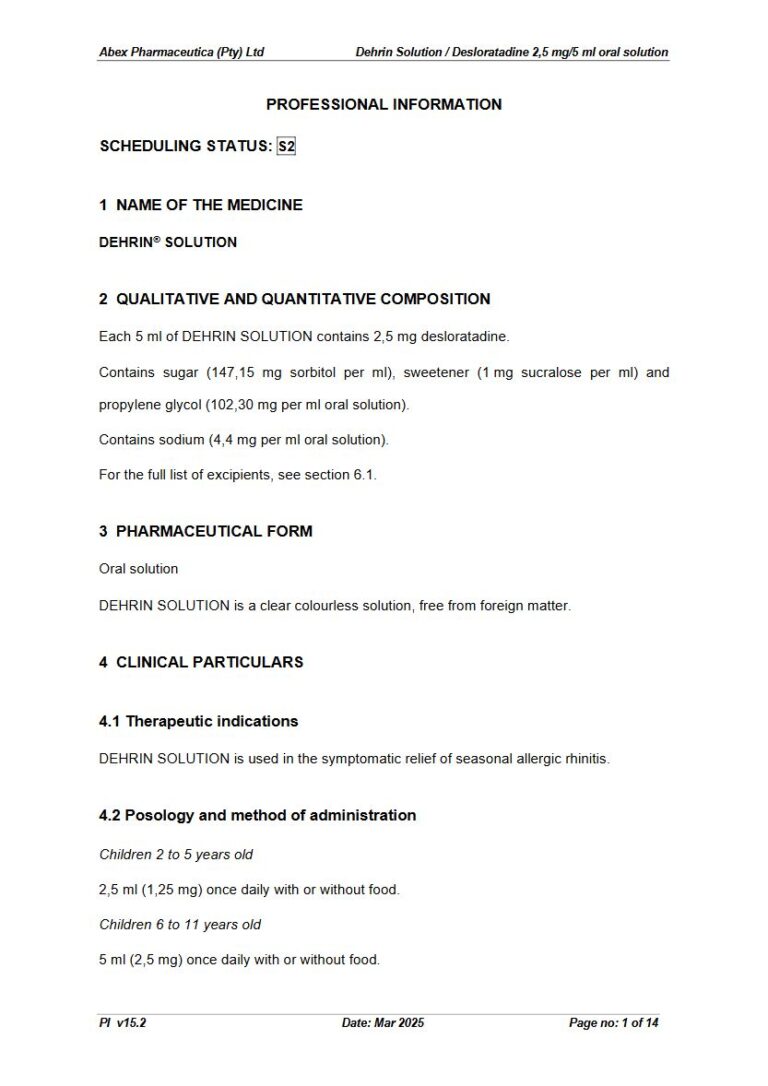
4.1 Therapeutic indications
DEHRIN SOLUTION is used in the symptomatic relief of seasonal allergic rhinitis.
4.2 Posology and method of administration
Children 2 to 5 years old: 2,5 ml (1,25 mg) once daily with or without food.
Children 6 to 11 years old: 5 ml (2,5 mg) once daily with or without food.
Adults and children 12 years of age and older: 10 ml (5 mg) once daily with or without food.
Patients with mild to moderate hepatic impairment or renal impairment should initially receive the recommended dose every other day. Safety and efficacy have not been established for treatment periods in excess of 4 weeks.
4.3 Contraindications
- Hypersensitivity to desloratadine, loratadine or any of the excipients of DEHRIN SOLUTION (see section 6.1).
- Cross sensitivity to other antihistamines.
4.4 Special warnings and precautions for use
Seizures: DEHRIN SOLUTION should be used with caution in patients with a medical or familial history of seizures, and mainly young children (see section 4.8), being more susceptible to develop new seizures under DEHRIN SOLUTION treatment. Healthcare providers may consider discontinuing DEHRIN SOLUTION in patients who experience a seizure while on treatment.
Efficacy and safety of DEHRIN SOLUTION in children under 2 years of age have not been reported to be established. Safety and efficacy of DEHRIN SOLUTION have not been reported to be established for treatment periods in excess of 4 weeks for allergic rhinitis.
Hepatic function and/or renal function impairment: Dosage adjustment is recommended for patients with hepatic or renal function impairment. In the case of severe renal insufficiency, DEHRIN SOLUTION should be used with caution.
Impaired metabolism of desloratadine: Patients that are slow metabolisers of desloratadine may be more susceptible to dose-related adverse events.
Weight gain: Increased appetite and weight gain have been reported (see section 4.8).
Use in the elderly: In general, dose selection for an elderly patient should be cautious, reflecting the greater frequency of decreased hepatic, renal, or cardiac function, and of concomitant disease or with concomitant medicines.
Paediatric population: In children under 2 years of age, the diagnosis of allergic rhinitis is particularly difficult to distinguish from other forms of rhinitis. The absence of upper respiratory tract infection or structural abnormalities, as well as patient history, physical examinations, and appropriate laboratory and skin tests should be considered. Approximately 6 % of adults and children 2 to 11 years of age are reported to be phenotypic poor metabolisers of desloratadine and exhibit a higher exposure. The safety of desloratadine (contained in DEHRIN SOUTION) in children 2 to 11 years of age who are poor metabolisers is reported to be the same as in children who are normal metabolisers. The effects of desloratadine in poor metabolisers < 2 years of age have not been reported. Increased appetite and weight gain have been reported in children (see section 4.8). Weight should be monitored, and cardiovascular effects assessed from time to time.
Skin tests: DEHRIN SOLUTION should be discontinued prior to skin tests using allergen extracts as it may inhibit the cutaneous histamine response, thus producing false negative results. DEHRIN SOLUTION should be discontinued at least 48 hours before the test.
Excipients: Sucralose: DEHRIN SOLUTION contains 1 mg sucralose per ml solution. Sorbitol: DEHRIN SOLUTION contains 147,15 mg sorbitol in each ml of solution. Sorbitol is a source of fructose. Patients with rare hereditary fructose intolerance (HFI) should not take DEHRIN SOLUTION. The additive effect of concomitantly administered products containing sorbitol (or fructose) and dietary intake of sorbitol (or fructose) should be considered. The content of sorbitol in medicines for oral use may affect the bioavailability of other medicines for oral use administered concomitantly.
Propylene glycol: DEHRIN SOLUTION contains 102,3 mg propylene glycol in each ml of oral solution. Co-administration with any substrate for alcohol dehydrogenase, such as ethanol, may induce adverse effects in children less than 5 years old.
Sodium: DEHRIN SOLUTION contains 4,4 mg sodium per 1 ml oral solution. This is less than 1 mmol sodium per ml oral solution, that is to say essentially u2018sodium-freeu2019.
4.5 Interaction with other medicines and other forms of interaction
Laboratory test interactions: DEHRIN SOLUTION may suppress the cutaneous histamine response to allergen extracts and should be stopped several days before skin testing.
Other interactions: Desloratadine taken concomitantly with alcohol reportedly did not potentiate the performance impairing effects of alcohol. However, cases of alcohol intolerance and intoxication have been reported during post-marketing use. Therefore, caution is recommended if alcohol is taken concomitantly. There was no effect of food or grapefruit juice reported on the disposition of desloratadine. It is reported that co-administration of desloratadine with ketoconazole increases the maximum desloratadine concentration (C max) by 45 % and the area under the time concentration curve (AUC) by 37 %. It is reported that co-administration of desloratadine with erythromycin increased the C max of desloratadine by 24 % and the AUC by 14 %. Co-administration of desloratadine with azithromycin reportedly resulted in an increase of both C max (31 %) and AUC (12 %) of azithromycin. The increase in C max and AUC of desloratadine when co-administered with either ketoconazole or erythromycin reportedly did not cause any clinically relevant adverse events in the populations studied. Co-administration of cimetidine with desloratadine reportedly did not significantly affect the pharmacokinetics of desloratadine. Co-administration of fluoxetine with desloratadine reportedly caused an increase in the C max of desloratadine by 15 % and an increase of 13 % in AUC and 17 % in C max of 3-0H desloratadine respectively. The C max and AUC of fluoxetine were reportedly reduced by 9 % and 11 % respectively. The corresponding mean parameters of norfluoxetine increased by 23 % and 18 % respectively with co-administration of desloratadine and fluoxetine. No clinically relevant changes in desloratadine plasma concentrations were reported in multiple-dose ketoconazole, erythromycin, azithromycin, fluoxetine and cimetidine interaction trials. Paediatric population: Interaction studies have only been reported in adults.
4.6 Fertility, pregnancy and lactation
Pregnancy: DEHRIN SOLUTION should not be used during pregnancy. Safety and efficacy in pregnancy have not been established.
Breastfeeding: Desloratadine and its metabolites have been detected in breast milk. Small amounts of DEHRIN SOLUTION entering the breast milk may cause drowsiness or excitement in infants. DEHRIN SOLUTION should not be used during lactation. Safety and efficacy in lactation have not been established.
Fertility: There are no data reported on male and female fertility.
4.7 Effects on ability to drive and use machines
DEHRIN SOLUTION lacks significant sedative effects. Patients should however be warned that a small number of individuals may experience sedation and dizziness. It is therefore advisable to determine individual response before driving or performing complicated tasks.
4.8 Undesirable effects
The following undesirable effects have been observed during treatment with DEHRIN SOLUTION:
Summary of the safety profile
Paediatric population: In reported clinical trials in a paediatric population, the desloratadine as in DEHRIN SOLUTION formulation was administered to children aged 6 months through 11 years. The overall incidence of adverse events in children 2 through 11 years of age was similar for the desloratadine and the placebo groups. In infants and toddlers aged 6 to 23 months, the most frequent adverse reactions reported in excess of placebo were diarrhoea, fever and insomnia. In an additional reported study, no adverse events were seen in persons between 6 and 11 years of age following a single 2,5 mg dose of desloratadine oral solution. In a reported clinical trial with adolescent patients, 12 through 17 years of age, the most common adverse event was headache; this occurred in 5,9 % of patients treated with desloratadine and 6,9 % of patients receiving placebo.
Adults and adolescents: At the recommended dose, in reported clinical trials involving adults and adolescents in a range of indications including allergic rhinitis, undesirable effects with desloratadine were reported in 3 % of patients in excess of those treated with placebo. The most frequent adverse events reported in excess of placebo were fatigue, dry mouth and headache.
Tabulated summary of adverse reactions:
Blood and the lymphatic system disorders: Less frequent: Blood disorders, including agranulocytosis, leucopenia, haemolytic anaemia, thrombocytopenia.
Immune system disorders: Less frequent: Hypersensitivity reactions including bronchospasm, anaphylaxis, angioedema, dyspnoea, pruritus, rash and urticaria.
Metabolism and nutrition disorders: Frequency unknown: Increased appetite (see section 4.4).
Psychiatric disorders: Less frequent: Hallucinations. Frequency unknown: Depression, abnormal behaviour, aggression.
Nervous system disorders: Frequent: Headache. Insomnia (frequent in children less than 2 years) Less frequent: Dizziness, somnolence, insomnia, psychomotor hyperactivity, seizures. Frequency unknown: Paraesthesia, extrapyramidal effects, tremor.
Eye disorders: Less frequent: Blurred vision.
Ear and labyrinth disorders: Frequency unknown: Tinnitus.
Cardiac disorders: Less frequent: Tachycardia, palpitations, dysrhythmia. Frequency unknown: QT prolongation, bradycardia.
Vascular disorders: Less frequent: Hypotension.
Respiratory, thoracic and mediastinal disorders: Frequent: Pharyngitis. Frequency unknown: Dyspnoea.
Gastrointestinal disorders: Frequent: Dry mouth, diarrhoea (frequent in children less than 2 years). Less frequent: Abdominal or stomach pain, dyspepsia, nausea, vomiting, diarrhoea, anorexia.
Hepatobiliary disorders: Less frequent: Elevations in liver enzymes, increased bilirubin, hepatitis. Frequency unknown: Jaundice.
Skin and subcutaneous tissue disorders: Less frequent: Urticaria, pruritus, rash, alopecia. Frequency unknown: Photosensitivity.
Musculoskeletal, connective tissue and bone disorders: Less frequent: Myalgia.
Reproductive system and breast disorders: Less frequent: Dysmenorrhoea.
General disorders and administrative site conditions: Frequent: Fatigue, fever (frequent in children less than 2 years). Frequency unknown: Oedema, sweating, asthenia.
Investigations: Frequency unknown: Increased weight.
Paediatric population: Other undesirable effects reported during the post-marketing period in paediatric patients with an unknown frequency included QT prolongation, dysrhythmia, bradycardia, abnormal behaviour, and aggression. A reported retrospective observational safety study indicated an increased incidence of new-onset seizure in patients 0 to 19 years of age when receiving desloratadine as in DEHRIN SOLUTION compared with periods not receiving desloratadine. Among children 0 to 4 years old, the adjusted absolute increase was 37,5 (95 % Confidence Interval (CI) 10,5 - 64,5) per 100 000 person years (PY) with a background rate of new-onset seizure of 80,3 per 100 000 PY. Among patients 5 to 19 years of age, the adjusted absolute increase was 11,3 (95 % CI 2,3 - 20,2) per 100 000 PY with a background rate of 3,4 per 100 000 PY.
Reporting of suspected adverse reactions: Reporting suspected adverse reactions after authorisation of the medicine is important. It allows continued monitoring of the benefit/risk balance of the medicine. Healthcare providers are requested to report any suspected adverse drug reactions to SAHPRA via the Med Safety APP (Medsafety X SAHPRA) and e-Reporting platform (who-umc.org) found on the SAHPRA website.
4.9 Overdose
Symptoms: Increase in mean heart rate, tachycardia, somnolence. In children, extrapyramidal manifestations and palpitations have been reported.
Treatment: Desloratadine and 3-hydroxydesloratadine are not eliminated by haemodialysis. It is not known if desloratadine is eliminated by peritoneal dialysis.
Supportive care: Treatment should be symptomatic and supportive. Patients in whom intentional overdose is confirmed or suspected should be referred for psychiatric consultation.
