
Spersadex Compa. 5mg/mL. Sterile eye drops. Solution
PDF Leaflet Revision Date: 16 February 2022
Clinical Summary
Quick overview from the medicine insert
Indication
Acute purulent conjunctivitis and other eye inflammations.
Dosage (summary)
1 drop, 1 to 4 times daily into the lower eyelid.
Special Populations
- Infants under 2 years
Pregnancy & Breastfeeding
Safety in pregnancy not established; not recommended in breastfeeding.
Key Drug Interactions
- CYP3A4 inhibitors
- Bactericidal antibiotics
- Anticholinergics
Contraindications
- Hypersensitivity
- Fresh herpes simplex
- Glaucoma
- Newborn infants
Common side effects
- Burning
- Stinging
- Blurred vision
- Cataract
- Glaucoma
Counselling Points
- Do not use with soft contact lenses
- Report visual disturbances
- Avoid driving until vision is clear
Serious warnings
- Prolonged use may cause glaucoma
- Monitor intraocular pressure
Important Disclaimer
The Spersadex Compa. 5mg/mL. Sterile eye drops. Solution professional information leaflet below is the property of Adcock Ingram and is provided on Medinsert exactly as issued, with no.. alterations or editorial changes. We make every effort to keep content current by updating documents as soon as new versions become available. Medinsert serves as a trusted access point for healthcare professionals, but does not replace official sources or clinical judgement. For more details, please read our full disclaimer. read more>>
 Healthcare Professionals Only
This content is for registered healthcare professionals
Sign in or create a free account to read the full package insert.
Free for HPCSA-registered professionals. Powered by Medinsert.
Clinical Particulars
Section 4 of the official insert — extracted exactly as issued, no alterations
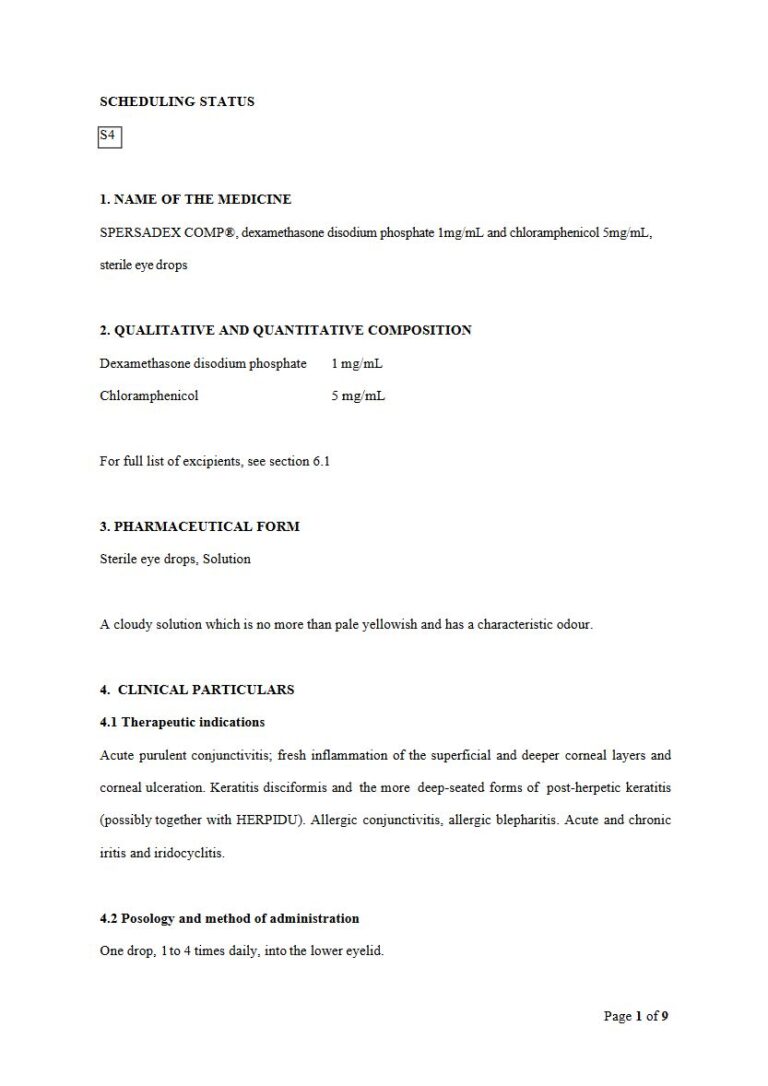
4.1 Therapeutic indications
Acute purulent conjunctivitis; fresh inflammation of the superficial and deeper corneal layers and corneal ulceration. Keratitis disciformis and the more deep-seated forms of post-herpetic keratitis (possibly together with HERPIDU). Allergic conjunctivitis, allergic blepharitis. Acute and chronic iritis and iridocyclitis.
4.2 Posology and method of administration
One drop, 1 to 4 times daily, into the lower eyelid.
Method of administration
Topical
4.3 Contraindications
- Hypersensitivity to the active substances, chloramphenicol, or dexamethasone or to any of the excipients of SPERSADEX COMPu00ae listed in section 6.1
- Fresh herpes simplex cornealis
- Tubercular processes involving the conjunctiva, the cornea and the anterior uvea
- Mycoses
- Glaucoma
- Severe blood disorders due to bone marrow depression and hepatic dysfunctions (see section 4.8)
- Family history of bone marrow depression
- Newborn infants (0 to 27 days old).
4.4 Special warnings and precautions for use
The local use of dexamethasone over a prolonged period may lead in some cases to secondary glaucoma and the development of complicated cataract (see section 4.3). To be used, therefore, under strict medical supervision. Because of the possibility of inducing corneal abscess, fungal keratopathy or glaucoma, the patient should be referred to an ophthalmologist if the eye has not responded within 48 hours.
Long term use of glucocorticoids as contained in SPERSADEX COMPu00ae can cause an increase in the intraocular pressure (IOP). IOP should therefore be monitored regularly.
Soft contact lenses should be removed at instillation and should not be reinserted after 15 minutes.
In general, caution is required when administering corticosteroids such as SPERSADEX COMPu00ae to infants under 2 years of age.
In severe infections topical use of chloramphenicol such as SPERSADEX COMPu00ae, should be supplemented with appropriate systemic treatment.
Aplastic anaemia has, rarely, followed topical use of chloramphenicol as contained in SPERSADEX COMPu00ae eye drops and, whilst this hazard is an uncommon one, it should be borne in mind when the benefits of SPERSADEX COMPu00ae are assessed.
Systemic absorption of SPERSADEX COMPu00ae may be reduced by compressing the lacrimal sac at the medial canthus for a minute during and following the instillation of the drops. (This blocks the passage of the drops via the naso lacrimal duct to the wide absorptive area of the nasal and pharyngeal mucosa. It is especially advisable in children).
Care should be taken to ensure that the eye is not infected before SPERSADEX COMPu00ae is used.
Cushing's syndrome and/or adrenal suppression associated with systemic absorption of ocular dexamethasone as contained in SPERSADEX COMPu00ae, may occur after intensive or long-term continuous therapy in predisposed patients, including children and patients treated with CYP3A4 inhibitors (including ritonavir). In these cases, treatment should be progressively discontinued.
Visual disturbance may occur with systemic and topical corticosteroid (e.g., SPERSADEX COMPu00ae) use. If a patient presents with symptoms such as blurred vision or other visual disturbances, the patient should be considered for referral to an ophthalmologist for evaluation of possible causes which may include cataract, glaucoma or rare diseases such as central serous chorioretinopathy (CSCR) which have been reported after use of systemic and topical corticosteroids.
SPERSADEX COMPu00ae contains phosphates which may lead to corneal deposits or corneal opacity when topically administered. It should be used with caution in patients presenting with compromised cornea and in instances where the patient is receiving polypharmacy with other phosphate containing eye medications (see section 4.5 and 4.8).
4.5 Interaction with other medicines and other forms of interaction
SPERSADEX COMPu00ae should not be administered simultaneously with bactericidal substances which may inhibit bacteriostatic antibiotics (penicillins, cephalosporins, gentamicin, tetracyclines, polymyxin B, vancomycin, sulphadiazine), nor during concomitant systemic therapy with medicines that impair haematopoiesis, sulphonylureas, coumarin derivatives, hydantoins or methotrexate (precautionary measure).
The risk of increased intraocular pressure associated with prolonged corticosteroid therapy (e.g., SPERSADEX COMPu00ae) may be more likely to occur with concomitant use of anticholinergics, especially atropine and related compounds, in patients predisposed to acute angle closure.
The risk of corneal deposits or corneal opacity may be more likely to occur in patients presenting with compromised cornea and receiving polypharmacy with other phosphate containing eye medicines.
The therapeutic efficacy of dexamethasone as in SPERSADEX COMPu00ae may be reduced by phenytoin, phenobarbitone, ephedrine and rifampicin.
Glucocorticoids may increase the need for salicylates as plasma salicylate clearance is increased.
CYP3A4 inhibitors (including ritonavir): may decrease dexamethasone clearance resulting in increased defects and adrenal suppression/Cushing's syndrome. The combination should be avoided unless the benefit outweighs the increased risk of systemic corticosteroid side-effects, in which case patients should be monitored for systemic corticosteroid effects.
Not to be used with soft contact lenses.
4.6 Fertility, pregnancy and lactation
Pregnancy
Safety for use in pregnancy has not been established.
Breastfeeding
Topically applied dexamethasone as contained in SPERSADEX COMPu00ae is not recommended in breastfeeding mothers, as it is possible that traces of dexamethasone may enter the breast milk. Safety for use in lactation has not been established.
4.7 Effects on ability to drive and use machines
May cause transient blurring of vision on installation. Patients should not drive or operate hazardous machinery unless vision is clear.
4.8 Undesirable effects
MedDRA Systems Organ Class Frequency Description
Blood and lymphatic system disorders Unknown frequency Bone marrow depression, aplastic anaemia and death, pale skin, weakness, increased heart rate, out of breath, headache, pain, fever, infection, bruises may be a sign a severe blood disorder.
Endocrine disorders Unknown frequency Cushing's syndrome, adrenal suppression may occur due to the use of ocular dexamethasone (see section 4.4), systemic effects with excessive use of steroid eye drops.
Eye disorders Unknown frequency Contact allergy, cataract, perforation of cornea and glaucoma, blurred vision, perforations of the globe have been known to occur Unknown frequency Cases of corneal calcification have been reported very rarely in association with the use of phosphate containing eye drops in some patients with significantly damaged corneas.
General disorders and administration site conditions Unknown frequency Burning upon instillation, stinging, redness or watering of the eyes, transient irritation, itching and dermatitis.
Reporting of suspected adverse reactions Reporting suspected adverse reactions after authorisation of the medicine is important. It allows continued monitoring of the benefit/risk balance of the medicine. Healthcare providers are asked to report any suspected adverse reactions to SAHPRA via the u201c6.04 Adverse Drug Reactions Reporting Formu201d, found online under SAHPRAu2019s publications: https://www.sahpra.org.za/Publications/Index/8.
4.9 Overdose
If a rise of intraocular pressure occurs, the treatment has to be discontinued (see section 4.3).
