
Dexagel 0,985mg/g Eye Gel
PDF Leaflet Revision Date: 27 October 2022
Clinical Summary
Quick overview from the medicine insert
Indication
To reduce ocular inflammation after cataract surgery.
Dosage (summary)
Initially, 1 drop every 4 hours; then 3-4 times daily for up to 4 weeks.
Special Populations
- Elderly
- Children
Pregnancy & Breastfeeding
Use in pregnancy is not established; avoid unless necessary. Safe in breastfeeding if used cautiously.
Key Drug Interactions
- CYP3A4 inhibitors
- Phenytoin
- Phenobarbitone
- Ephedrine
- Rifampicin
Contraindications
- Hypersensitivity
- Herpes simplex keratitis
- Bacterial infections
- Ocular mycoses
- Glaucoma
Common side effects
- Cataract
- Increased intraocular pressure
- Blurred vision
- Eye irritation
Counselling Points
- Do not wear contact lenses during treatment.
- Monitor for visual disturbances.
- Report any signs of infection.
Serious warnings
- Risk of Cushingu2019s syndrome
- Visual disturbances
- Delayed wound healing
Important Disclaimer
The Dexagel 0,985mg/g Eye Gel professional information leaflet below is the property of Soflens and is provided on Medinsert exactly as issued, with no.. alterations or editorial changes. We make every effort to keep content current by updating documents as soon as new versions become available. Medinsert serves as a trusted access point for healthcare professionals, but does not replace official sources or clinical judgement. For more details, please read our full disclaimer. read more>>
 Healthcare Professionals Only
This content is for registered healthcare professionals
Sign in or create a free account to read the full package insert.
Free for HPCSA-registered professionals. Powered by Medinsert.
Clinical Particulars
Section 4 of the official insert — extracted exactly as issued, no alterations
4.1 Therapeutic indications
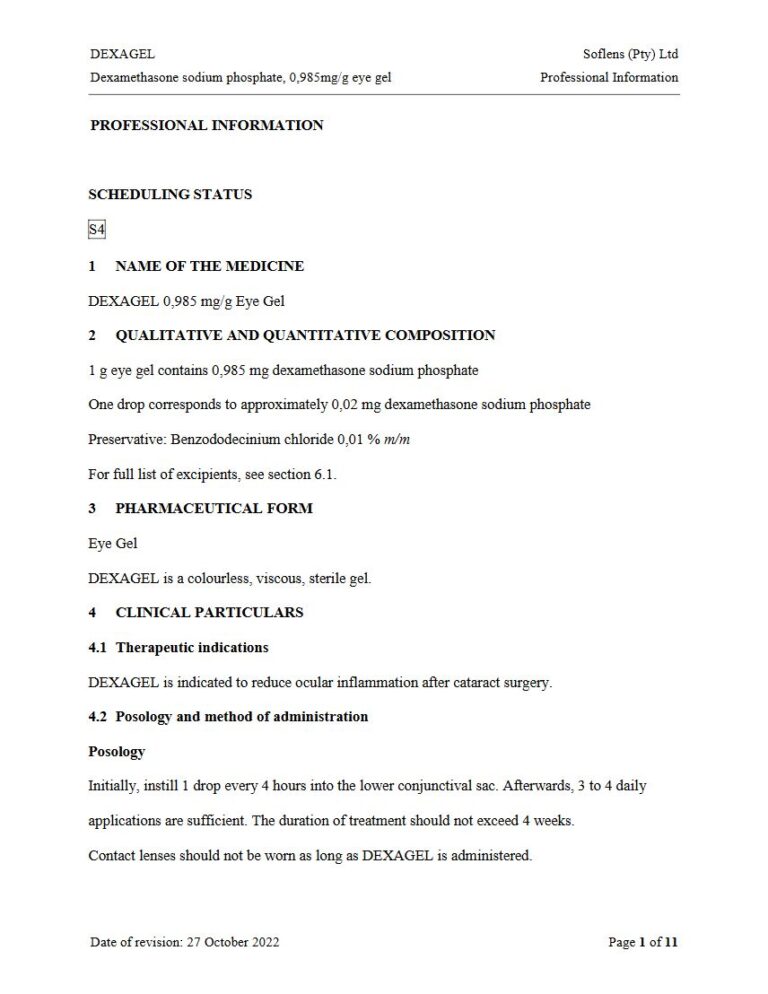
DEXAGEL is indicated to reduce ocular inflammation after cataract surgery.
4.2 Posology and method of administration
Posology
Initially, instill 1 drop every 4 hours into the lower conjunctival sac. Afterwards, 3 to 4 daily applications are sufficient. The duration of treatment should not exceed 4 weeks. Contact lenses should not be worn as long as DEXAGEL is administered.
Method of administration
For ocular use.
Paediatric population
The safety and efficacy in children have not been established.
4.3 Contraindications
Hypersensitivity to dexamethasone sodium phosphate or any other ingredients (see 6.1 List of excipients). The use of DEXAGEL is also contraindicated in:
- herpes simplex keratitis,
- herpes cornea superficialis,
- bacterial and viral infections without concomitant anti-infective basic therapy,
- ocular mycoses,
- ocular tuberculosis,
- corneal damage or ulcerous processes of the cornea,
- closed-angle and wide-angle glaucoma, or
- known glucocorticosteroid-induced ocular hypertension.
4.4 Special warnings and precautions for use
Visual disturbance
Visual disturbance may be reported with systemic and topical corticosteroid use, such as DEXAGEL. If a patient presents with symptoms such as blurred vision or other visual disturbances, the patient should be considered for referral to an ophthalmologist for evaluation of possible causes which may be glaucoma, or rare diseases such as central serous chorioretinopathy (CSCR) which have been reported after use of systemic and topical corticosteroids.
Cushingu2019s syndrome and/or adrenal suppression associated with systemic absorption of ocular dexamethasone may occur after intensive or long-term continuous therapy in predisposed patients, including children and patients treated with CYP3A4 inhibitors (including ritonavir and cobicistat). In these cases, treatment should be progressively discontinued.
Fungal infections of the cornea may occur under long-term local corticosteroid treatment. Therefore, in case of persistent corneal ulcers, the possibility of a fungal infection under corticoid treatment should be considered. If suspicion is present, samples should be taken. If symptoms do not improve within 2 days, a discontinuation of DEXAGEL therapy should be considered.
Use of contact lenses is not recommended in patients receiving treatment with ophthalmic corticosteroids, including DEXAGEL.
Patients on topical ocular corticosteroids are at risk of opportunistic eye infections. Delayed wound healing forms an additional risk factor for opportunistic infections. In addition, topical ocular corticosteroids, including DEXAGEL, may promote, aggravate or mask signs and symptoms of opportunistic eye infections.
Patients with a pre-existing eye infection should only receive DEXAGEL when the infection is controlled effectively by an antibiotic treatment. Such patients should be monitored carefully and regularly by an ophthalmologist.
Patients with a history of herpetic disease and needing an anti-inflammatory treatment with dexamethasone, as contained in DEXAGEL, should receive simultaneously an effective anti-herpetic treatment.
Patients with corneal ulcer should generally not receive topical ocular corticosteroids like DEXAGEL except when inflammation is the main cause of healing delay and when the appropriate etiological treatment is in place. Such patients should be monitored carefully and regularly by an ophthalmologist.
Thinning of the cornea and sclera may increase the risk of perforations with the use of topical ocular corticosteroids, including DEXAGEL. Patients should be monitored at frequent intervals during treatment for increased intraocular pressure, secondary glaucoma, opportunistic infections and occurrence of cataract. The dose, dosing frequency and duration of treatment should be limited to the minimum.
Patients who have previously reacted with increased intraocular pressure are at risk of developing increased intraocular pressure if treated again. Patients with pre-existing increased intraocular pressure (primary open angle glaucoma, primary angle-closure glaucoma, secondary glaucoma) who need DEXAGEL should be extra monitored for a further increase in intraocular pressure.
DEXAGEL should be used with caution and only when necessary in patients with glaucoma.
The use of DEXAGEL after cataract operation may delay healing and increase the occurrence of bullae. Therefore, the cornea and the ocular pressure should be regularly checked.
Posterior subcapsular cataract might occur at cumulative doses of dexamethasone, as contained in DEXAGEL.
The elderly are more prone to develop an ocular-hypertensive response and/or steroid-induced cataract. A more frequent monitoring is recommended.
Diabetics are also more prone to develop subcapsular cataracts following topical steroid administration.
DEXAGEL should never be given for undiagnosed red eye as inappropriate use is potentially blinding.
The use of DEXAGEL in allergic conjunctivitis is only recommended for sever forms of allergic conjunctivitis not responding to standard therapy, and only for a short period of time.
4.5 Interaction with other medicines and other forms of interaction
If more than one topical ophthalmic medicinal product is being used, the medicines must be administered at least 15 minutes apart. DEXAGEL should be administered last.
Co-treatment with CYP3A inhibitors, including ritonavir and cobicistat-containing products, may decrease dexamethasone clearance resulting in an increased risk of systemic side-effects and adrenal suppression/Cushingu2019s syndrome. The combination should be avoided unless the benefit outweighs the increased risk of systemic corticosteroid side-effects in which case patients should be monitored for systemic corticosteroid side-effects.
The therapeutic efficacy of dexamethasone may be reduced by phenytoin, phenobarbitone, ephedrine and rifampicin.
Glucocorticoids may increase the need for salicylates as plasma salicylate clearance is increased.
The risk of increased intraocular pressure associated with prolonged corticosteroid therapy may be more likely to occur with concomitant use of anticholinergics, especially atropine and related compounds, in patients predisposed to acute angle closure.
Concomitant use of topical steroids, including DEXAGEL, and topical NSAIDs may increase the potential for corneal healing problems.
4.6 Fertility, pregnancy and lactation
The safety in pregnancy and lactation has not been established.
Pregnancy
There are no adequate or well-controlled studies in pregnant women. Synthetic glucocorticoids such as dexamethasone might pose a risk to the foetus. The increased risk of oral fissures in human foetuses following administration of glucocorticoids during the first trimester is unknown. Long-term treatment with glucocorticoids during pregnancy may retard intrauterine growth of the foetus. If glucocorticoids, including DEXAGEL, are administered at the end of a pregnancy, there is a risk of atrophy of the foetal adrenal cortex which may require a gradual replacement therapy in the newborn. Studies in animals have shown reproductive toxicity including formation of cleft palates.
Furthermore, epidemiological studies in connection with animal experiments indicated an association between prenatal exposure to glucocorticoids and an increased risk of metabolic and cardiovascular diseases during adulthood. Since a relevant systemic exposure cannot be excluded even after use of glucocorticoids in the eye, the use of DEXAGEL should be avoided during pregnancy. If administration of DEXAGEL is clearly necessary, it should be applied at the lowest possible dose for the shortest possible time period.
Breastfeeding
There is no evidence of harm to the breastfeeding infant with ophthalmic use of dexamethasone, as contained in DEXAGEL. Nevertheless, it should only be used during lactation if clearly necessary. If higher doses are required for severe inflammation, breastfeeding must be stopped.
Fertility
Studies have not been performed to evaluate the effect of topical administration of dexamethasone on human fertility.
4.7 Effects on ability to drive and use machines
DEXAGEL may cause transient blurring of vision or other visual disturbances which may affect the ability to drive or use machines. The patient should be advised that if blurred vision occurs upon instillation, he / she must wait until the vision clears before driving or using machinery.
4.8 Undesirable effects
Tabulated list of adverse reactions
Adverse reactions are listed by system organ class and frequency. The following convention has been used for the classification of frequencies: very common (u22651/10); common (u22651/100 to <1/10); uncommon (u22651/1 000 to <1/100); rare (u22651/10 000 to <1/1 000); very rare (<1/10 000); not known (cannot be estimated from the available data).
MedDRA SOC
Frequency
Adverse reaction(s)
Infections and infestations
Uncommon
Opportunistic infection
Rare
Conjunctivitis
Not known
Eye infection
Immune system disorders
Rare
Hypersensitivity
Endocrine disorders
Uncommon
Adrenal suppression (following systemic absorption)
Not known
Adrenal suppression, Cushingu2019s syndrome
Eye disorders
Very common
Cataract
Rare
Corneal oedema, corneal thinning, eye irritation, eyelid ptosis, eye pain, eye pruritus, foreign body sensation in the eye, keratitis, mydriasis, ocular discomfort, ulcerative keratitis
Very rare
Corneal deposits
Not known
Blurred vision (see section 4.4)
General disorders and administration site conditions
Very rare
Facial oedema
Investigations
Very common
Increased intraocular pressure (with long term use)
Not known
Increased blood glucose
Reporting of suspected adverse reactions
Reporting suspected adverse reactions after authorisation of the medicine is important. It allows continued monitoring of the benefit-risk of the medicine. Health care providers are asked to report any suspected adverse reactions to SAHPRA via the u201c6.04 Adverse Drug Reactions Reporting Formu201d, found online under SAHPRAu2019s publications: https://www.sahpra.org.za/Publications/Index/8 Suspected adverse reactions may also be reported directly to the Holder of the Certificate of registration using the following e-mail address: [email protected]
4.9 Overdose
Overdosing due to frequent instillation increases the risk of side-effects such as elevated intraocular pressure and the development of opacities of the lens. There is no information regarding overdose from case reports.
