
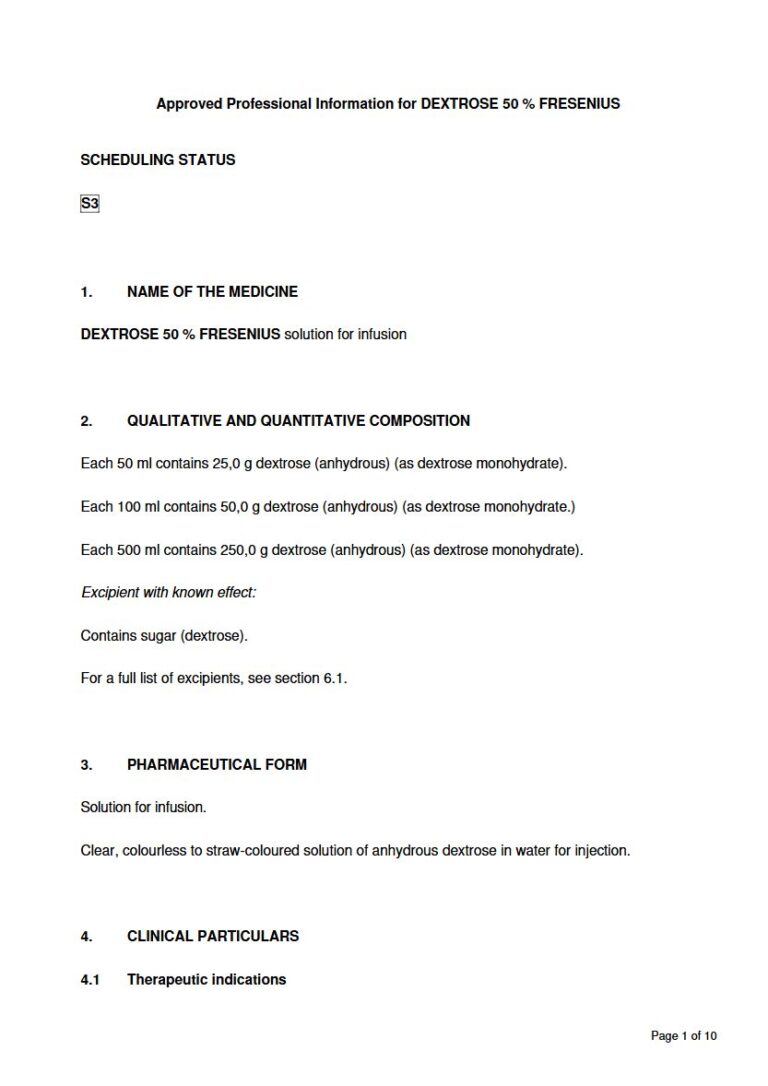
Dextrose 50 % Fresenius 50 ml Solution for infusion
PDF Leaflet Revision Date: 13 May 2022
Clinical Summary
Quick overview from the medicine insert
Indication
Blood volume expander for shock, hemorrhage, and dehydration.
Dosage (summary)
Dosage determined by patient observation; monitor systemic arterial and venous pressures.
Special Populations
- Diabetes insipidus
- Renal failure
Pregnancy & Breastfeeding
Safety not established; caution in labor due to risk of fetal insulin production.
Key Drug Interactions
- NSAIDs
- Diuretics
- Carbamazepine
- Vincristine
Contraindications
- Hypersensitivity
- Anuria
- Intracranial hemorrhage
- Delirium tremens
- Glucose-galactose malabsorption
Common side effects
- Hyperglycemia
- Hyponatraemia
- Pain at injection site
Counselling Points
- Monitor blood glucose levels
- Administer via large central vein
- Report any adverse reactions
Serious warnings
- Risk of hyperglycemia
- Monitor for mental confusion
- Potential for acute hyponatraemic encephalopathy
Important Disclaimer
The Dextrose 50 % Fresenius 50 ml Solution for infusion professional information leaflet below is the property of Fresenius Kabi Manufacturing Sa and is provided on Medinsert exactly as issued, with no.. alterations or editorial changes. We make every effort to keep content current by updating documents as soon as new versions become available. Medinsert serves as a trusted access point for healthcare professionals, but does not replace official sources or clinical judgement. For more details, please read our full disclaimer. read more>>
 Healthcare Professionals Only
This content is for registered healthcare professionals
Sign in or create a free account to read the full package insert.
Free for HPCSA-registered professionals. Powered by Medinsert.
Clinical Particulars
Section 4 of the official insert — extracted exactly as issued, no alterations
4.1 Therapeutic indications
A blood volume expander for use in cases of shock and haemorrhage and to counteract dehydration.
4.2 Posology and method of administration
The amount required can be determined only by continued observation of the patient and repeated checking of the indicators (systemic arterial and venous pressures, urinary output, etc). Dosage may (where time permits) be estimated by measuring the concentration of one of the extracellular fluid constituents (e.g. serum protein) and taking the increment over the normal value as an indication of the water deficit. DEXTROSE 50 % FRESENIUS should not be administered through the same infusion equipment as whole blood as haemodialysis and clumping can occur.
4.3 Contraindications
DEXTROSE 50 % FRESENIUS is contraindicated in patients with:
- hypersensitivity to the active substance or to any excipients listed in section 6.1, or known allergy to maize or maize products
- anuria
- intracranial or intraspinal haemorrhage
- delirium tremens where there is dehydration
- glucose-galactose malabsorption syndrome.
DEXTROSE 50 % FRESENIUS should be administered with care to patients with diabetes insipidus. DEXTROSE 50 % FRESENIUS tolerance may be impaired in patients with renal failure.
4.4 Special warnings and precautions for use
It has been suggested that glucose (dextrose) solutions should not be used after acute ischaemic strokes as hyperglycaemia has been implicated in increasing cerebral ischaemic brain damage and in impairing recovery. DEXTROSE 50 % FRESENIUS should be administered via a large central vein to minimise damage at the site of injection (see section 4.2). DEXTROSE 50 % FRESENIUS should be used with caution in patients with overt or known subclinical diabetes mellitus, carbohydrate intolerance for any reason, severe undernutrition, thiamine (vitamin B1) deficiency, hypophosphataemia, haemodilution, sepsis, trauma, shock, metabolic acidosis or severe dehydration. Rapid administration of DEXTROSE 50 % FRESENIUS may produce substantial hyperglycaemia and hyperosmolar syndrome; patients should be observed for signs of mental confusion and loss of consciousness, especially those patients with chronic uraemia or carbohydrate intolerance. Prolonged use in parenteral nutrition may affect insulin production; therefore, blood and urine glucose should be monitored. DEXTROSE 50 % FRESENIUS intravenous infusion is a hypertonic solution (in vitro, in a container). In the body, however, glucose-containing fluids can become extremely physiologically hypotonic due to rapid glucose metabolism (see sections 4.2 and 5.2).
Depending on the tonicity of the solution, the volume and rate of infusion and depending on a patient's underlying clinical condition and capability to metabolise glucose, intravenous administration of DEXTROSE 50 % FRESENIUS can cause electrolyte disturbances, most importantly hypo- or hyperosmotic hyponatraemia. Hyponatraemia: Patients with non-osmotic vasopressin release (e.g. in acute illness, pain, post-operative stress, infections, burns and central nervous system (CNS) disease), patients with heart-, liver- and kidney diseases and patients exposed to vasopressin agonists (see section 4.5) are at risk of acute hyponatraemia upon infusion of hypotonic fluids. Acute hyponatraemia can lead to acute hyponatraemic encephalopathy (brain oedema) characterised by headache, nausea, seizures, lethargy and vomiting. Patients with brain oedema are at particular risk of severe, irreversible and life-threatening brain injury. Children, women of childbearing potential and patients with reduced cerebral compliance (e.g. meningitis, intracranial bleeding and cerebral contusion) are at particular risk of the severe and life-threatening brain swelling caused by acute hyponatraemia. Intravenous administration of DEXTROSE 50 % FRESENIUS may result in other electrolyte disturbances such as: hypokalaemia, hypophosphataemia and hypomagnesaemia (see sections 4.2 and 4.8).
4.5 Interaction with other medicines and other forms of interaction
DEXTROSE 50 % FRESENIUS should not be administered through the same infusion equipment as whole blood, as haemodialysis and clumping can occur.
Medicines increasing the vasopressin effect, listed below, lead to reduced renal electrolyte free water excretion and increase the risk of hospital-acquired hyponatraemia following inappropriately balanced treatment with IV fluids (see sections 4.2, 4.4 and 4.8):
- medicines stimulating vasopressin release, e.g. carbamazepine, vincristine, selective serotonin reuptake inhibitors, 3,4-methylenedioxy-N-methamphetamine, ifosfamide, antipsychotics, narcotics
- medicines potentiating vasopressin action, e.g. NSAIDs (nonsteroidal anti-inflammatory drugs), cyclophosphamide
- vasopressin analogues, e.g. desmopressin, oxytocin, vasopressin, terlipressin.
Other medicines increasing the risk of hyponatraemia also include diuretics in general and antiepileptics such as oxcarbazepine.
4.6 Fertility, pregnancy and lactation
Safety in pregnancy and lactation has not been established. Intravenous DEXTROSE 50 % FRESENIUS may result in fetal insulin production, with an associated risk of rebound hypoglycaemia in the neonate. Infusions of glucose administered during a Caesarean section and labour should not exceed 5 u2013 10 g dextrose/hour. DEXTROSE 50 % FRESENIUS should be administered with special caution to pregnant women during labour, particularly if administered in combination with oxytocin, due to the risk of hyponatraemia (see sections 4.4, 4.5 and 4.8).
4.7 Effects on ability to drive and use machines
There is no information on the effects of DEXTROSE 50 % FRESENIUS on the ability to drive a vehicle or operate heavy machinery.
4.8 Undesirable effects
Prolonged or rapid intravenous administration of hyperosmotic solutions of glucose may lead to dehydration and glycosuria as a consequence of the induced hyperglycaemia.
System organ class (SOC) Adverse reaction (MedDRA term) Frequency
Metabolism and nutrition disorders Hospital-acquired hyponatraemia*, hyperglycaemia**, hypokalaemia, hypophosphataemia, hypomagnesaemia, fluid and electrolyte imbalance Not known***
Nervous system disorders Hyponatraemic encephalopathy* Not known
General disorders and administration site conditions Pain at the injection site, vein irritation, venous thrombosis, phlebitis Not known
* Hospital-acquired hyponatraemia may cause irreversible brain injury and death due to development of acute hyponatraemic encephalopathy (see sections 4.2 and 4.4).
** Hyperglycaemia (possibly indicated by mental confusion or loss of consciousness) and glycosuria may occur as a result of the rate of administration or metabolic insufficiency. If undetected and untreated hyperglycaemia can lead to dehydration, hyperosmolar coma and death.
*** Frequency unknown cannot be estimated from the available data.
The administration of DEXTROSE 50 % FRESENIUS without adequate levels of thiamine may precipitate overt deficiency states, e.g. Wernicke's encephalopathy. Sodium retention, oedema, pulmonary oedema and congestive heart failure may be induced in patients with severe undernutrition.
Reporting of suspected adverse reactions
Reporting suspected adverse reactions after authorisation of DEXTROSE 50 % FRESENIUS is important. It allows continued monitoring of the benefit/risk balance of DEXTROSE 50 % FRESENIUS. Health care providers are asked to report any suspected adverse reactions to SAHPRA via the u201c6.04 Adverse Drug Reactions Reporting Formu201d, found online under SAHPRAu2019s publications: https://www.sahpra.org.za/Publications/Index/8. Health care providers are asked to report any suspected adverse drug reactions to the Holder of the Certificate of Registration at the following email address: [email protected] and to the relevant medicineu2019s regulatory authority in the country where the product is marketed.
4.9 Overdose
Overdose of DEXTROSE 50 % FRESENIUS may lead to hyperglycaemia and glycosuria, leading to dehydration, hyperosmolar coma and death. See sections 4.4 and 4.8. In these cases DEXTROSE 50 % FRESENIUS must be withdrawn.
