
Dextrose Fresenius 10 %/100 g/000 ml Solution
PDF Leaflet Revision Date: 17 May 2022
Clinical Summary
Quick overview from the medicine insert
Indication
Source of calories and hydration.
Dosage (summary)
Dosage directed by a doctor; monitor glucose and electrolytes.
Special Populations
- Elderly
- Paediatric population
Pregnancy & Breastfeeding
Use with caution during pregnancy and labor; safety in breastfeeding not established.
Key Drug Interactions
- Catecholamines
- Steroids
- Diuretics
Contraindications
- Hypersensitivity to dextrose
- Uncompensated diabetes
- Hyperosmolar coma
- Severe renal insufficiency
- Uncompensated cardiac failure
Common side effects
- Fluid and electrolyte disturbances
- Hyperglycaemia
- Vein irritation
- Infusion site reactions
Counselling Points
- Monitor blood glucose and electrolytes closely.
- Infuse slowly to minimize irritation.
- Avoid mixing with blood products.
Serious warnings
- Risk of hyperglycaemia
- Refeeding syndrome
- Hypersensitivity reactions
Important Disclaimer
The Dextrose Fresenius 10 %/100 g/000 ml Solution professional information leaflet below is the property of Fresenius Kabi Manufacturing Sa and is provided on Medinsert exactly as issued, with no.. alterations or editorial changes. We make every effort to keep content current by updating documents as soon as new versions become available. Medinsert serves as a trusted access point for healthcare professionals, but does not replace official sources or clinical judgement. For more details, please read our full disclaimer. read more>>
 Healthcare Professionals Only
This content is for registered healthcare professionals
Sign in or create a free account to read the full package insert.
Free for HPCSA-registered professionals. Powered by Medinsert.
Clinical Particulars
Section 4 of the official insert — extracted exactly as issued, no alterations
4.1 Therapeutic indications
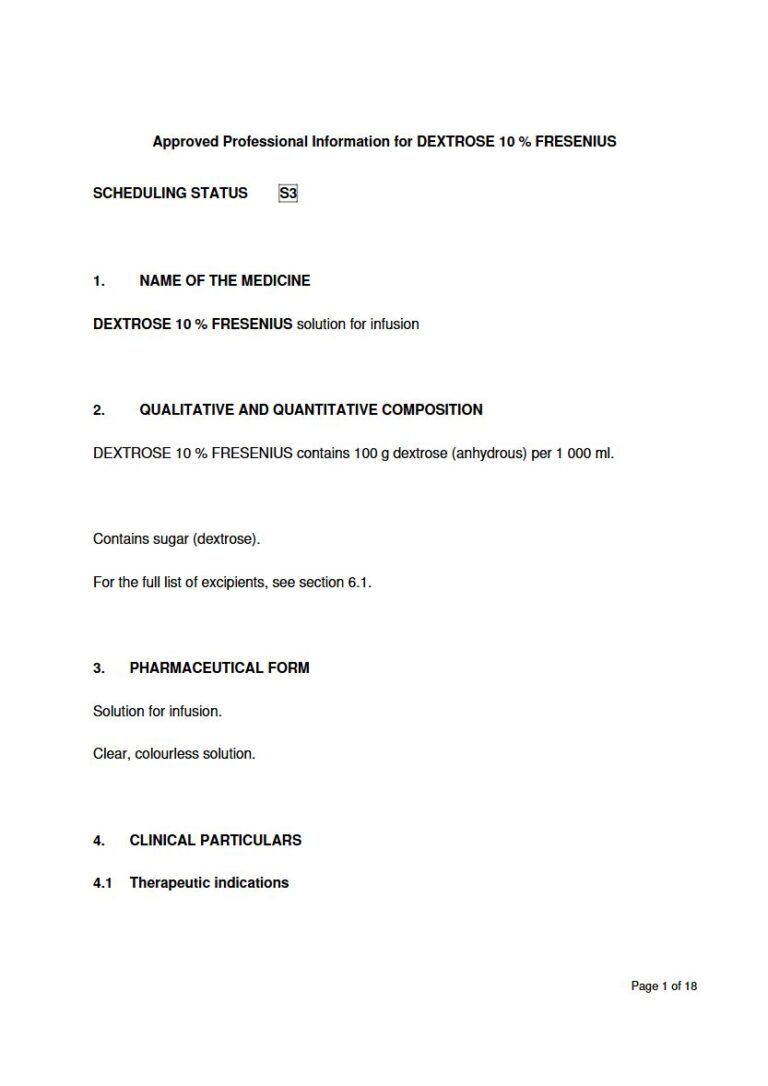
DEXTROSE 10 % FRESENIUS is indicated for use in adults and paediatric patients as a source of calories (energy) and water for hydration.
4.2 Posology and method of administration
Posology
The dosage is to be directed by a medical doctor and is dependent upon age, weight, clinical condition of the patient and laboratory determinations. Frequent laboratory determinations and clinical evaluations are essential to monitor changes in blood glucose and electrolyte concentrations, and fluid and electrolyte balance during prolonged parenteral therapy. Fluid balance, serum glucose, serum sodium and other electrolytes may need to be monitored before and during administration, especially in patients with increased non-osmotic vasopressin release (syndrome of inappropriate antidiuretic hormone secretion, SIADH) and in patients co-medicated with vasopressin agonist medicines due to the risk of hyponatraemia. Monitoring of serum sodium is particularly important for physiologically hypotonic fluids. DEXTROSE 10 % FRESENIUS may become extremely hypotonic after administration due to glucose metabolisation in the body (see sections 4.4, 4.5 and 4.8).
Special populations
Elderly patients
Dose selection for an elderly patient should be cautious, usually starting at the low end of the dosing range, reflecting the greater frequency of decreased hepatic, renal or cardiac function and of concomitant disease or other medicine therapy. Because elderly patients are more likely to have decreased renal function, care should be taken in dose selection, and it may be useful to monitor renal function (see section 4.4).
Paediatric population
There is no specific paediatric dose. The dose is dependent on weight, clinical condition and laboratory results (see section 4.4).
Method of administration
For intravenous use only. Use only if the solution is clear and container seals are intact. When DEXTROSE 10 % FRESENIUS is to be administered peripherally, it should be slowly infused through a small bore needle, placed well within the lumen of a large vein to minimise venous irritation. Carefully avoid infiltration. Fluid administration should be based on calculated maintenance or replacement fluid requirements for each patient.
4.3 Contraindications
The use of DEXTROSE 10 % FRESENIUS is contraindicated in patients with:
u2022 hypersensitivity to dextrose (see sections 4.4 and 4.8 for maize allergies)
u2022 uncompensated diabetes and diabetes insipidus
u2022 hyperosmolar coma
u2022 haemodilution and extracellular hyperhydration or hypervolaemia
u2022 hyperglycaemia and hyperlactataemia
u2022 severe renal insufficiency (with oliguria/anuria)
u2022 uncompensated cardiac failure
u2022 general oedema (including pulmonary and brain oedema) and ascitic cirrhosis
u2022 other known glucose intolerances (such as metabolic stress situations)
u2022 intracranial or intraspinal haemorrhage
u2022 delirium tremens and where there is dehydration
u2022 glucose-galactose malabsorption syndrome.
The contraindications related to any medicine that is added to DEXTROSE 10 % FRESENIUS should be considered.
4.4 Special warnings and precautions for use
DEXTROSE 10 % FRESENIUS should be used with care in patients with renal insufficiency, urinary tract obstruction, or impending or frank cardiac decompensation.
Hyperglycaemia
DEXTROSE 10 % FRESENIUS should be used with caution in patients with diabetes mellitus, as rapid infusion can lead to hyperglycaemia and a hyperosmolar syndrome. To reduce the risk of hyperglycaemia-associated complications, the infusion rate must be adjusted and/or insulin administered. DEXTROSE 10 % FRESENIUS should be administered with caution in patients with, for example:
u2022 Impaired glucose tolerance (such as in patients with renal failure or diabetes mellitus or in the presence of sepsis, trauma or shock).
u2022 Severe malnutrition (risk of precipitating a refeeding syndrome).
u2022 Thiamine deficiency, e.g. in patients with chronic alcoholism (risk of severe lactic acidosis due to impaired oxidative metabolisation of pyruvate).
u2022 Patients with ischaemic stroke or severe traumatic brain injury. Avoid infusion within the first 24 hours following head trauma. Monitor blood glucose closely as early hyperglycaemia has been associated with poor outcomes in patients with severe traumatic brain injury.
u2022 Newborns.
Effects on insulin secretion
Prolonged intravenous administration of DEXTROSE 10 % FRESENIUS and associated hyperglycaemia may result in decreased rates of glucose-stimulated insulin secretion.
Hypersensitivity reactions
u2022 Hypersensitivity/infusion reactions, including anaphylactic/ anaphylactoid reactions, have been reported with DEXTROSE 10 % FRESENIUS solution (see section 4.8). DEXTROSE 10 % FRESENIUS solution should therefore be used with caution, if at all, in patients with known allergy to maize or maize products (see section 4.3).
u2022 DEXTROSE 10 % FRESENIUS solution must be stopped immediately, if any signs or symptoms of a suspected hypersensitivity reaction develop. Appropriate therapeutic countermeasures must be instituted as clinically indicated.
Refeeding syndrome
Refeeding severely undernourished patients may result in the refeeding syndrome that is characterised by the shift of potassium, phosphorus and magnesium intracellularly as the patient becomes anabolic. Thiamine deficiency and fluid retention may also develop. Careful monitoring and slowly increasing nutrient intakes while avoiding overfeeding can prevent these complications.
Paediatric glycaemia-related issues
Newborns (especially those born premature and with low birth mass) are at increased risk of developing hypo- or hyperglycaemia and therefore, need close monitoring during treatment with intravenous glucose solutions to ensure adequate glycaemic control in order to avoid potential long-term adverse effects. Hypoglycaemia in the newborn can cause prolonged seizures, coma and cerebral injury. Hyperglycaemia has been associated with intraventricular haemorrhage, late-onset bacterial and fungal infection, retinopathy of prematurity, necrotising enterocolitis, bronchopulmonary dysplasia, prolonged length of hospital stays and death.
Paediatric hyponatraemia-related issues
u2022 In very low birth mass infants, excessive or rapid administration of DEXTROSE 10 % FRESENIUS may result in increased serum osmolality and possible intracerebral haemorrhage.
u2022 In neonates and very small infants, even small volumes of fluid may affect fluid and electrolyte balance.
u2022 Care must be exercised in treatment of neonates, especially pre-term neonates, whose renal function may be immature and whose ability to excrete fluid and solute loads may be limited.
u2022 Fluid intake, urine output, and serum electrolytes should be monitored closely.
u2022 Serum glucose concentrations should be monitored frequently when DEXTROSE 10 % FRESENIUS is prescribed to paediatric patients, particularly infants, neonates and low birth mass infants.
u2022 Children (including neonates and older children) are at increased risk of developing hypoosmotic hyponatraemia as well as for developing hyponatraemic encephalopathy.
u2022 Plasma electrolyte concentrations should be monitored closely in the paediatric population.
u2022 Rapid correction of hypoosmotic hyponatraemia is potentially dangerous (risk of serious neurological complications). Dosage, rate, and duration of administration should be determined by a medical practitioner experienced in paediatric intravenous fluid therapy.
Blood
DEXTROSE 10 % FRESENIUS should not be administered simultaneously with blood through the same infusion set, as haemolysis and pseudoagglutination can occur.
Glucose intravenous infusions are usually isotonic solutions. In the body, however, glucose containing fluids can become extremely physiologically hypotonic due to rapid glucose metabolisation (see section 4.2).
Dilution and other effects on serum electrolytes
Depending on the tonicity of the solution, the volume and rate of infusion and depending on a patient's underlying clinical condition and capability to metabolise glucose, intravenous administration of DEXTROSE 10 % FRESENIUS can cause:
u2022 hyperosmolality, osmotic diuresis and dehydration
u2022 hypo-osmolality
u2022 electrolyte disturbances such as:
- hypo- or hyperosmotic hyponatraemia (see below)
- hypokalaemia
- hypophosphataemia
- hypomagnesaemia
- overhydration/hypervolaemia and, for example, congested states, including pulmonary congestion and oedema.
The above effects do not only result from the administration of electrolyte-free fluid but also from glucose administration.
Hyponatraemia:
Patients with non-osmotic vasopressin release (e.g. in acute illness, pain, post-operative stress, infections, burns and CNS diseases), patients with heart, liver and kidney diseases and patients exposed to vasopressin agonists (see section 4.5) are at particular risk of acute hyponatraemia upon infusion of hypotonic fluids. Acute hyponatraemia can lead to acute hyponatraemic encephalopathy (brain oedema) characterised by headache, nausea, seizures, lethargy and vomiting. Patients with brain oedema are at particular risk of severe, irreversible and life-threatening brain injury. Children, women of childbearing potential, and patients with reduced cerebral compliance (e.g. meningitis, intracranial bleeding and cerebral contusion) are at particular risk of the severe and life-threatening brain swelling caused by acute hyponatraemia. Clinical evaluation and periodic laboratory determinations are necessary to monitor changes in the fluid balance, electrolyte concentrations, and acid-base balance during prolonged parenteral therapy or whenever the condition of the patient warrants such evaluation. Caution is advised in patients at increased risk of water and electrolyte disturbances that could be aggravated by increased free water load, hyperglycaemia or possibly required insulin administration (see below). In case of prolonged administration or high dose of DEXTROSE 10 % FRESENIUS, care should be taken to avoid hypokalaemia by monitoring plasma potassium levels and administering a potassium supplement as required. Special clinical monitoring is required at the beginning of any intravenous infusion.
4.5 Interaction with other medicines and other forms of interaction
Hypokalaemia and hyponatraemia may develop during parenteral administration of hypertonic dextrose solutions, such as DEXTROSE 10 % FRESENIUS. Sufficient amounts of potassium should be added to DEXTROSE 10 % FRESENIUS solutions administered to fasting patients with good renal function, especially those on digoxin therapy. To minimise the risk of possible incompatibilities arising from mixing DEXTROSE 10 % FRESENIUS with other additives that may be prescribed, the final infusate should be inspected for cloudiness or precipitation immediately after mixing, prior to administration, and periodically during administration. Both the glycaemic effects of DEXTROSE 10 % FRESENIUS and its effects on water and electrolyte balance should be considered when using DEXTROSE 10 % FRESENIUS in patients treated with other medicines that affect glycaemic control, or fluid and/or electrolyte balance. Concomitant administration of catecholamines and steroids decreases the glucose uptake. Medicines leading to an increased vasopressin effect The below listed medicines increase the vasopressin effect, leading to reduced renal electrolyte free water excretion and increase the risk of hospital-acquired hyponatraemia, following inappropriately balanced treatment with IV fluids (see sections 4.2, 4.4 and 4.8).
u2022 Medicines stimulating vasopressin release, e.g. chlorpropamide, clofibrate, carbamazepine, vincristine, selective serotonin reuptake inhibitors, 3,4-methylenedioxy- N -methamphetamine, ifosfamide, antipsychotics, narcotics.
u2022 Medicines potentiating vasopressin action, e.g. chlorpropamide, NSAIDs, cyclophosphamide.
u2022 Vasopressin analogues, e.g. desmopressin, oxytocin, terlipressin.
Other medicines increasing the risk of hyponatraemia also include diuretics in general and antiepileptics such as oxcarbazepine. No interaction studies have been performed.
4.6 Fertility, pregnancy and lactation
Safety during pregnancy and lactation has not been established. DEXTROSE 10 % FRESENIUS solutions are commonly used as hydrating fluids and as vehicles for other medicines. If given during labour, it has been suggested that the dextrose load on the mother may lead to fetal hyperglycaemia, hyperinsulinaemia, and acidosis, with subsequent neonatal hypoglycaemia and jaundice. When a medicine is added, the nature of the medicine and its use during pregnancy and lactation have to be considered separately.
Pregnancy
DEXTROSE 10 % FRESENIUS solution can be used during pregnancy. However, caution should be exercised when DEXTROSE 10 % FRESENIUS solution is used intrapartum. DEXTROSE 10 % FRESENIUS should be administrated with special caution to pregnant women during labour, particularly if administered in combination with oxytocin, due to the risk of hyponatraemia (see sections 4.4, 4.5 and 4.8).
Breastfeeding
There are no adequate data of using DEXTROSE 10 % FRESENIUS solution during breastfeeding. However, no effect on breastfeeding is expected. DEXTROSE 10 % FRESENIUS can be used during lactation.
4.7 Effects on ability to drive and use machines
None known.
4.8 Undesirable effects
Immune system disorders
Frequency not known*: anaphylactic reaction**, hypersensitivity reaction**
Metabolism and nutrition disorders
Frequency not known*: fluid and electrolyte disturbances (including hypokalaemia, hyponatraemia, hypomagnesaemia, hypophosphataemia), oedema, water intoxication and hyperglycaemia (due to prolonged or rapid infusion of large volumes of DEXTROSE 10 % FRESENIUS), hyperglycaemia (may cause an osmotic diuresis, which may result in fluid and electrolyte losses), haemodilution, hypervolaemia, hospital-acquired hyponatraemia***
Nervous system disorders
Frequency not known: hyponatraemic encephalopathy***
Skin and subcutaneous tissue disorders
Frequency not known*: sweating, rash
Vascular disorders
Frequency not known*: vein irritation, thrombophlebitis, tissue necrosis (if extravasation occurs)
General disorders and administration site conditions
Frequency not known*: local pain, chills, shivering, pyrexia, febrile reaction, fever, infusion site infection, infusion site reactions (including infusion site phlebitis and infusion site erythema)
Investigations
Frequency not known*: glycosuria.
* Cannot be estimated from the available data.
** Potential manifestation in patients with allergy to maize, see section 4.4.
*** Hospital-acquired hyponatraemia may cause irreversible brain injury and death, due to the development of acute hyponatraemic encephalopathy (see sections 4.2 and 4.4).
4.9 Overdose
See under section 4.8. In these cases, DEXTROSE 10 % FRESENIUS must be withdrawn. Prolonged administration or rapid infusion of large volumes of DEXTROSE 10 % FRESENIUS may cause hyperosmolarity, hyponatraemia, dehydration, hyperglycaemia, hyperglycosuria, osmotic diuresis (due to hyperglycaemia), water intoxication and oedema. Severe hyperglycaemia and hyponatraemia may be fatal (see sections 4.4 and 4.8). In case of suspected overdose, treatment with DEXTROSE 10 % FRESENIUS must be stopped immediately. Management of overdose is symptomatic and supportive, with appropriate monitoring.
