
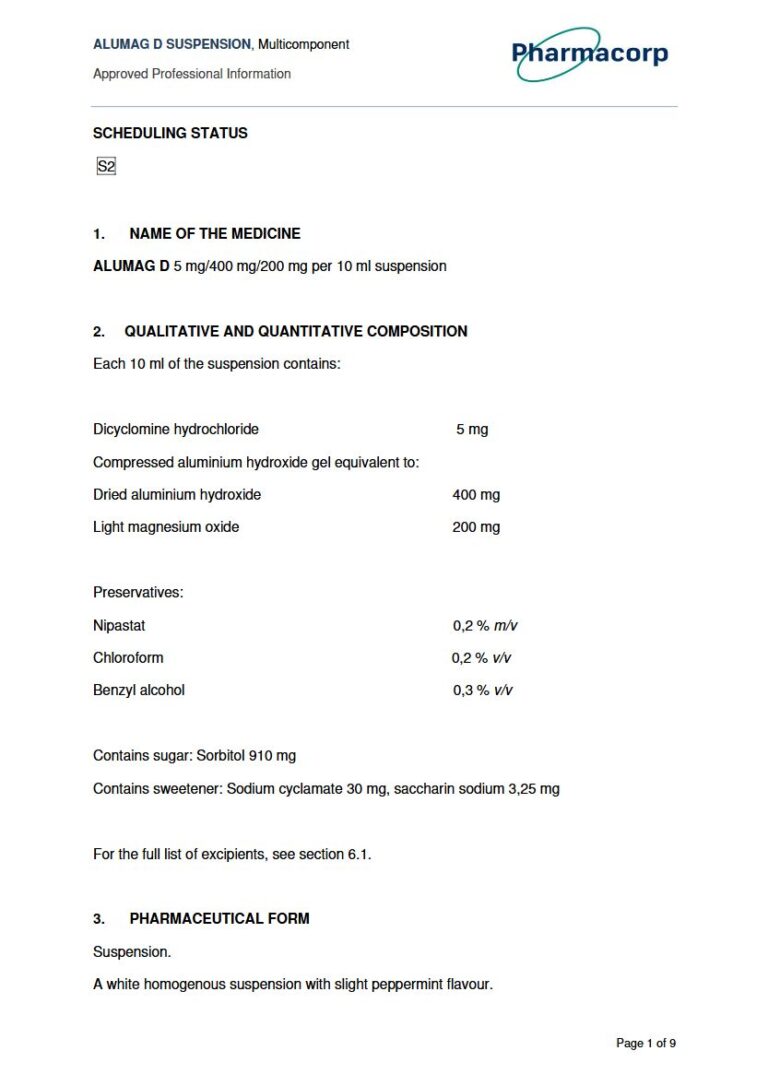
Alumag D Suspension
PDF Leaflet Revision Date: 08 August 2022
Clinical Summary
Quick overview from the medicine insert
Indication
Antacid.
Dosage (summary)
Adults: 10-20 ml 3-4 times daily; Children >2 years: 5-10 ml 3-4 times daily.
Special Populations
- Elderly men
- Children under 2 years
- Renal impairment
Pregnancy & Breastfeeding
Safety in pregnancy and lactation not established; contains benzyl alcohol.
Key Drug Interactions
- Anticholinergic drugs
- Tetracyclines
- Warfarin
Contraindications
- Hypersensitivity
- Prostatic enlargement
- Paralytic ileus
- Severe ulcerative colitis
- Myasthenia gravis
- Glaucoma
- Renal failure
- Obstructive uropathy
- Thyrotoxicosis
- Cardiac failure
Common side effects
- Hypersensitivity
- Blurred vision
- Tachycardia
- Dry mouth
- Constipation
- Diarrhoea
Counselling Points
- Avoid driving if affected
- Do not exceed recommended dosage
- Monitor for allergic reactions
Serious warnings
- Use with caution in tachycardia
- Risk of metabolic acidosis in young children
- Potential for neurological impairment in renal impairment
Important Disclaimer
The Alumag D Suspension professional information leaflet below is the property of Pharmacorp and is provided on Medinsert exactly as issued, with no.. alterations or editorial changes. We make every effort to keep content current by updating documents as soon as new versions become available. Medinsert serves as a trusted access point for healthcare professionals, but does not replace official sources or clinical judgement. For more details, please read our full disclaimer. read more>>
 Healthcare Professionals Only
This content is for registered healthcare professionals
Sign in or create a free account to read the full package insert.
Free for HPCSA-registered professionals. Powered by Medinsert.
Clinical Particulars
Section 4 of the official insert — extracted exactly as issued, no alterations
4.1 Therapeutic indications
ALUMAG D is indicated as an antacid.
4.2 Posology and method of administration
Posology
Adults: Two to four medicine measures (10 - 20 ml) three to four times daily.
Children over 2 years of age: One to two medicine measures (5 - 10 ml) three to four times daily.
Method of administration
For oral administration.
4.3 Contraindications
- Hypersensitivity to dicyclomine hydrochloride, dried aluminium hydroxide, light magnesium oxide or to any of the excipients listed in section 6.1.
- Prostatic enlargement.
- Paralytic ileus or pyloric stenosis where its use may lead to obstruction.
- Severe ulcerative colitis.
- Myasthenia gravis.
- Glaucoma.
- Renal failure.
- Obstructive uropathy.
- Thyrotoxicosis.
- Cardiac failure.
- Should not be given to children under two years.
4.4 Special warnings and precautions for use
ALUMAG D should be used with caution in conditions characterised by tachycardia. Hypersensitivity may appear as conjunctivitis or a skin rash. Preparations containing dicyclomine should be used with caution in elderly men. Mucosal irritation and absorption of magnesium may occur if there is gastrointestinal atony or obstruction. 5 - 10 % of magnesium is absorbed, and retention in patients with impaired renal function may lead to neurological, neuromuscular and cardiovascular impairment. The urine of normal persons may become alkaline which decreases excretion of medicines that are weak bases. Use with care in patients with hiatal hernia associated with reflux oesophagitis because anticholinergic medicines may aggravate the condition.
Excipients with known effect
ALUMAG D contains nipastat, a mixture of parahydroxybenzoate esters. It may cause allergic reactions (possibly delayed) and exceptionally, bronchospasm. ALUMAG D contains benzyl alcohol, 0,03 ml/10 ml, equivalent to 0,3 % v/v. Benzyl alcohol may cause allergic reactions. Benzyl alcohol has been linked with the risk of severe side effects including breathing problems (called u201cgasping syndromeu201d) in young children. Do not use for more than a week in young children (between 2 and 3 years old), unless advised by your doctor or pharmacist. High volumes of benzyl alcohol should be used with caution, especially in patients with liver or kidney impairment because of the risk of accumulation and toxicity (metabolic acidosis). ALUMAG D contains sorbitol 70 % equivalent to 910 mg/10 ml sorbitol. The additive effect of concomitantly administered products containing sorbitol (or fructose) and dietary intake of sorbitol (or fructose) should be taken into account. Patients with hereditary fructose intolerance (HFI) should not take/be given ALUMAG D. Sorbitol may cause gastrointestinal discomfort and mild laxative effect. ALUMAG D contains ethanol 0,34 % v/v. The amount in 10 ml of ALUMAG D is equivalent to less than 0,17 ml beer or 0,43 ml wine. The small amount of alcohol in ALUMAG D will not have any noticeable effects. ALUMAG D contains less than 1 mmol sodium (23 mg) per 10 ml, that is to say essentially u2018sodium - freeu2019.
4.5 Interaction with other medicines and other forms of interaction
The effects of ALUMAG D may be enhanced by other medicines with anticholinergic properties such as antihistamines, amantadine, butyrophenones, phenothiazines and tricyclic antidepressants. Magnesium may interfere with the absorption of tetracyclines. Aluminium hydroxide absorbs phosphates and excessive doses or normal doses with a low phosphate diet may lead to phosphate depletion with renal rickets or osteomalacia.
It reduces the absorption of medicines such as tetracyclines, vitamins, warfarin, quinidine, quinine, anticholinergic medicines, barbiturates and digoxin. The content of sorbitol in medicines for oral use may affect the bioavailability of other medicines for oral use administered concomitantly.
4.6 Pregnancy and lactation
The safety of ALUMAG D in pregnancy and lactation has not been established. ALUMAG D contains benzyl alcohol. Large amounts of benzyl alcohol can build-up in the body and may cause metabolic acidosis.
4.7 Effects on ability to drive and use machines
Since adverse reactions such as fatigue, sedation, dizziness and blurred vision have been reported in patients receiving ALUMAG D, patients should not drive, use machinery or perform any tasks that require concentration, until they are certain that ALUMAG D does not adversely affect their ability to do so (see section 4.8).
4.8 Undesirable effects
Tabulated list of adverse reactions
System organ class Frequency unknown (cannot be estimated from the available data)
- Immune system disorders Hypersensitivity
- Metabolism and nutrition disorders Phosphate depletion
- Eye disorders Blurred vision* Conjunctivitis
- Cardiac disorders Tachycardia* Palpitations* Arrhythmias*
- Respiratory, thoracic and mediastinal disorders Dry mouth* Thirst Bronchospasm Breathing problems (called u201cgasping syndromeu201d) in young children
- Gastrointestinal disorders Constipation * / ** Diarrhoea*** Nausea** Vomiting** Gastrointestinal discomfort
- Skin and subcutaneous tissue disorders Flushing and dryness of skin* Rash
- Renal and urinary disorders Urinary retention* Urine becomes alkaline
* Side effects that may occur because of dicyclomine.
** Side effects that may occur because of aluminium hydroxide.
*** Side effects that may occur because of magnesium oxide.
Reporting of suspected adverse reactions
Reporting suspected adverse reactions after authorisation of ALUMAG D is important. It allows continued monitoring of the benefit/risk balance of ALUMAG D. Healthcare providers are asked to report any suspected adverse reactions to SAHPRA online: https://www.sahpra.org.za/Publications/Index/8
4.9 Overdose
Toxic doses of dicyclomine cause tachycardia, rapid or stertorous respiration, hyperpyrexia, restlessness, confusion and excitement, and hallucinations passing into delirium. A rash may appear on the face and upper trunk. In severe intoxication, depression of the central nervous system may occur with hypertension or circulatory failure and respiratory depression. Treatment includes pilocarpine to counteract the effect of dicyclomine. Further treatment is symptomatic. Large doses of aluminium hydroxide may cause intestinal obstruction.
