
Antabuse 400 mg Dispergettes
PDF Leaflet Revision Date: 24 May 2022
Clinical Summary
Quick overview from the medicine insert
Indication
Adjunct in the treatment of chronic alcoholism.
Dosage (summary)
u00bd - 1 dispergette daily or as directed; can be given every two days.
Onset of Action / Duration
Onset: 10 mins, Duration: up to 14 days post-treatment.
Special Populations
- Elderly
- Renal impairment
- Hepatic impairment
Pregnancy & Breastfeeding
Contraindicated in pregnancy and breastfeeding.
Key Drug Interactions
- Alcohol
- Amitriptyline
- Chlorpromazine
- Benzodiazepines
- Metronidazole
Contraindications
- Hypersensitivity to disulfiram
- Uncompensated cardiac failure
- Coronary artery disease
- Pregnancy
- Psychosis
Common side effects
- Drowsiness
- Nausea
- Vomiting
- Fatigue
- Hepatotoxicity
Counselling Points
- Avoid alcohol during treatment and 14 days after
- Monitor liver function
- Inform about potential severe reactions
Serious warnings
- Severe disulfiram-alcohol reaction
- Potential for drug-induced liver injury
Important Disclaimer
The Antabuse 400 mg Dispergettes professional information leaflet below is the property of Teva Pharmaceuticals and is provided on Medinsert exactly as issued, with no.. alterations or editorial changes. We make every effort to keep content current by updating documents as soon as new versions become available. Medinsert serves as a trusted access point for healthcare professionals, but does not replace official sources or clinical judgement. For more details, please read our full disclaimer. read more>>
 Healthcare Professionals Only
This content is for registered healthcare professionals
Sign in or create a free account to read the full package insert.
Free for HPCSA-registered professionals. Powered by Medinsert.
Clinical Particulars
Section 4 of the official insert — extracted exactly as issued, no alterations
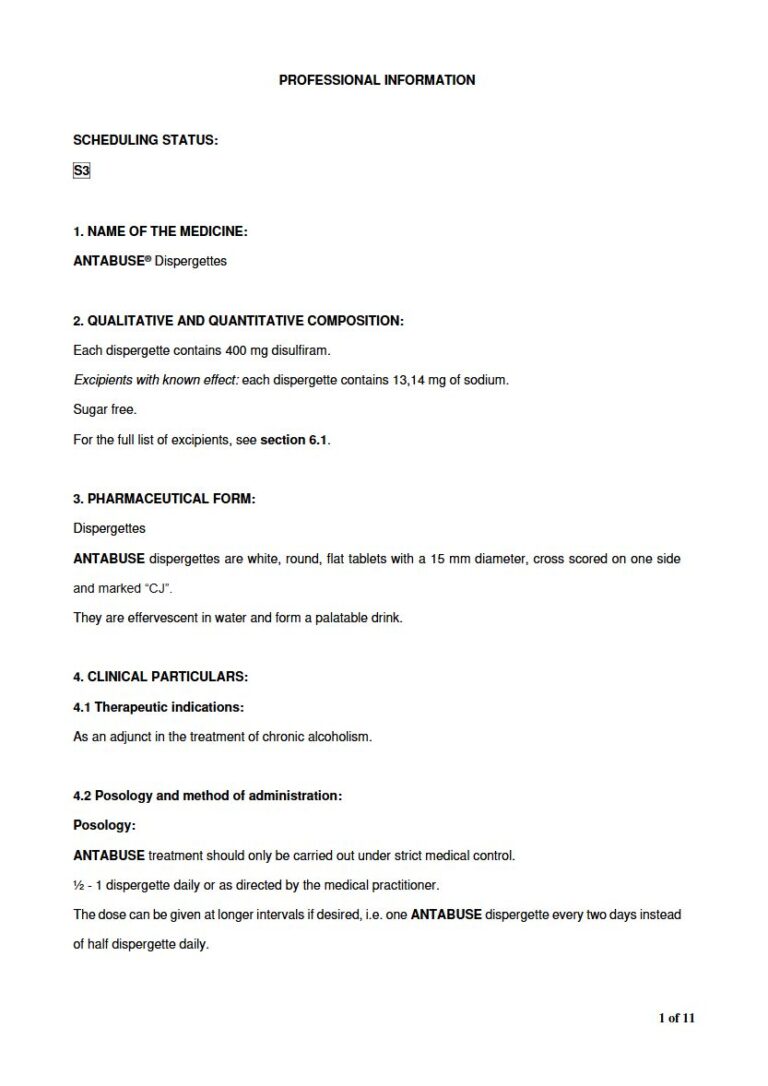
4.1 Therapeutic indications
As an adjunct in the treatment of chronic alcoholism.
4.2 Posology and method of administration
Posology: ANTABUSE treatment should only be carried out under strict medical control. u00bd - 1 dispergette daily or as directed by the medical practitioner. The dose can be given at longer intervals if desired, i.e. one ANTABUSE dispergette every two days instead of half dispergette daily.
Method of administration: ANTABUSE is for oral use. The whole or part dispergette should be dropped into a quarter glass of water or other liquid. It will effervesce at once and, after stirring for a few seconds, will form a palatable suspension. The suspension should be drunk before it has had time to settle. Alternatively, ANTABUSE dispergettes can be swallowed without chewing as normal tablets.
4.3 Contraindications
- ANTABUSE should not be administered until the patient has abstained from alcohol for at least 12 hours and the blood alcohol level is zero (see sections 4.4, 4.5 and 4.8).
- ANTABUSE is contraindicated in patients known to be hypersensitive to disulfiram or to any of the excipients listed in section 6.1
- in patients hypersensitive to other thiuram compounds, such as those used in rubber compounds, pesticides or fungicides, isoniazid and metronidazole.
- uncompensated cardiac failure
- coronary artery disease
- previous history of CVA
- hypertension
- pregnancy (see section 4.6)
- psychosis
- severe personality disorders and drug addiction
- suicidal risk
- Phenothiazine antiemetics, i.e. chlorpromazine are contraindicated in association with disulfiram-alcohol reaction.
- Cerebral damage
- Presence of cardiovascular disease.
4.4 Special warnings and precautions for use
Alcohol must not be consumed during treatment and for up to 14 days after discontinuation, as disulfiram prevents the metabolism of ethanol, causing acetaldehyde to accumulate in the body. This can result in a u201cdisulfiram - alcohol reactionu201d causing adverse effects as listed in section 4.8.
ANTABUSE should not be given without the patientu2019s knowledge unless the prescriber deems it fit. Before initiating treatment it is advisable that appropriate examinations should be carried out to establish the suitability of the patient for treatment. Patients must be warned of the unpredictable and potentially severe nature of disulfiram-alcohol reaction, as cases of deaths have been reported following the drinking of alcohol by patients receiving disulfiram. Patients should not use aftershave lotions, colognes or any other toilet preparations containing alcohol. Foods and medicines containing alcohol should also be avoided, e.g. cough syrups, fermented vinegar, sauces. Caution should also be exercised with low alcohol and u201cnon - alcoholu201d or u201calcohol - freeu201d beers and wines, which may provoke a reaction when consumed in sufficient quantities. All personnel involved in the administration of ANTABUSE to the patient know that ANTABUSE should not be given during a drinking episode. The liver function of patients with liver damage should also be closely monitored. ANTABUSE treatment may cause drug-induced liver injury. Fatal cases have been reported (see section 4.8). Liver function should be monitored before initiation of treatment and periodically thereafter; caution should be taken in patients with known reduced hepatic function. Consider medicine discontinuation if symptoms or signs of liver injury associated with jaundice occur. Concentrations of metals, particularly nickel, in the blood rise progressively during treatment with ANTABUSE. Since accumulation of metals in the brain is also promoted, the use of ANTABUSE should be avoided in those patients who are apt to encounter them in their environment. Caution should be exercised in administering ANTABUSE to patients with impaired renal or hepatic function, respiratory disorders, hypothyroidism, or diabetes mellitus and in patients with a history of epilepsy or other seizure disorders. No information is available on the relationship of age to the effects of disulfiram as in ANTABUSE. Safety and efficacy in children have not been established. However, elderly patients are more likely to have age related renal function impairment. In addition, elderly patients with cardiac or cerebrovascular disease may not tolerate the disulfiram-alcohol reaction, as well as younger patients. See section 4.3. Blood cell counts and blood chemistry profiles and liver function tests should be performed every 6 months during treatment. ANTABUSE contains less than 1 mmol sodium (23 mg) per dispergette. ANTABUSE contains 13,14 mg sodium per dose, equivalent to approximately 0,7 % of the WHO recommended maximum daily intake for sodium. This medicinal product is considered low in sodium.
4.5 Interaction with other medicines and other forms of interaction
Disulfiram as in ANTABUSE may inhibit the metabolism of paraldehyde leading to an accumulation of acetaldehyde and these medicines should not be given concomitantly. For full details of the disulfiram-alcohol reaction please refer to section 4.8. The intensity of the disulfiram-alcohol reaction may be increased by amitriptyline. Chlorpromazine while decreasing certain components of the disulfiram-alcohol reaction may increase the overall intensity of the reaction. Disulfiram as contained in ANTABUSE inhibits the metabolism of certain benzodiazepines such as chlordiazepoxide and diazepam enhancing their sedative effect. The interaction is not indicated for oxazepam. Benzodiazepines may reduce the disulfiram-alcohol reaction. The use of alcohol or alcohol-containing products within 14 days of disulfiram therapy will result in a disulfiram-alcohol reaction. Disulfiram as in ANTABUSE inhibits hepatic enzymes and may interfere with the metabolism of other medicines taken at the same time e.g. monoamine oxidase inhibitors, barbiturates and alfentanil. Disulfiram as in ANTABUSE inhibits the metabolism and excretion of rifampicin and may similarly affect pethidine, morphine, amphetamines and other centrally active medicines mediated by noradrenaline or dopamine. Cases of increase in confusion and changes in affective behaviour have been reported with the concurrent administration of metronidazole, isoniazid or paraldehyde. There have been occasional reports of choreoathetosis in patients receiving disulfiram as in ANTABUSE and pimozide. Disulfiram as in ANTABUSE enhances the effects of anticonvulsants. Hydantoin, especially phenytoin and coumarin or indandione anticoagulants and their dosage may need to be reduced. Disulfiram as in ANTABUSE inhibits the metabolism of many drugs which are converted in the liver (such as phenytoin, theophylline and warfarin) and thereby enhances efficacy. Dose adjustment may be necessary. Laboratory/physiological test values: Serum cholesterol concentrations may be increased. Vanillylmandelic acid (VMA) concentrations in urine may be decreased.
4.6 Fertility, pregnancy and lactation
Use in Pregnancy and Lactation: see section 4.3. Pregnancy: There have been rare reports of congenital abnormalities in infants whose mothers have received disulfiram as in ANTABUSE in conjunction with other medicines. ANTABUSE should not be used in pregnancy. Breast-feeding: ANTABUSE should not be used. No information is available on whether disulfiram is excreted in breast milk. Its use during breastfeeding is not advised especially where there is a possibility of interaction with medicines that the baby may be taking.
Fertility: No data available.
4.7 Effects on ability to drive and use machines
ANTABUSE may cause side effects such as drowsiness or fatigue. Patients should make sure they are not drive or operate machinery until they know hot treatment with ANTABUSE affects them.
4.8 Undesirable effects
MedDRA SOC Frequency Description
Blood and lymphatic system disorders Less frequent Blood dyscrasias
Psychiatric disorders Frequency unknown Psychotic reactions; depression, paranoia, schizophrenia, mania, reduction in libido
Nervous system disorders Frequent Somnolence Frequency unknown Drowsiness (during initial treatment), peripheral neuritis, optic neuritis, encephalopathy, headache, restlessness, dizziness
Eye disorders Less frequent Optic atrophy
Gastrointestinal disorders Frequency unknown Nausea, vomiting, unpleasant taste, body odour
Hepato-biliary disorders Frequency unknown Hepatotoxicity (including hepatitis consistent with a hypersensitivity reaction), hepatic cell damage, drug induced liver injury (fatal cases have been reported)
Skin and subcutaneous tissue disorders Frequency unknown Allergic dermatitis, rash
General disorders and administration site conditions Frequency unknown Fatigue (during initial treatment), halitosis, acetonaemia
Disulfiram-alcohol reaction: Disulfiram irreversibly inhibits acetaldehyde dehydrogenase. Intake of ethanol during ANTABUSE therapy will lead to accumulation of acetaldehyde, which is considered the main contributing factor to the disulfiram-alcohol reaction. Disulfiram-ethanol reactions often develop within 15 minutes after exposure to ethanol; symptoms usually peak within 30 minutes to 1 hour, and then gradually subside over the next few hours. Symptoms may be severe and life-threatening. The disulfiram-alcohol reaction is characterised by:
- Intense vasodilation of the face and neck causing flushing, increased body temperature, sweating, nausea, vomiting, pruritis, urticaria, anxiety, dizziness, headache, blurred vision, dyspnoea, palpitations and hyperventilation.
- In severe cases tachycardia, hypotension, respiratory depression, chest pain, QT prolongation, ST depression, dysrhythmias, coma and convulsions may occur.
- Rare complications include hypertension, bronchospasm and methaemoglobinaemia.
4.9 Overdose
Treatment is symptomatic and supportive. The syndrome of disulfiram intoxication in children, with sequelae of brain damage or death, is distinct from the disulfiram-alcohol interaction or acute disulfiram intoxication in adults. It is characterised by lethargy or somnolence, weakness, hypotonia and vomiting, beginning approximately 12 hours after ingestion and progressing to stupor or coma. Dehydration, moderate tachycardia and marked tachypnea occur frequently, muscle tone is greatly decreased and deep-tendon reflexes may be weak or absent. A severe reaction is likely to occur when an overdose of ANTABUSE and alcohol is taken.
Psychotic reactions, such as depressive psychosis (with suicidal tendencies), paranoia, paranoid Schizophrenia, mania and Korsakoffu2019s psychosis have been reported as well as a few fatalities. No specific treatment for severe ANTABUSE-alcohol reactions has yet been developed. In severe disulfiram-alcohol reactions, supportive measures to restore blood pressure and treat shock should be instituted. Other recommendations include: administration of supplemental oxygen, monitoring of serum potassium levels; and monitoring of ECG tracings.
