
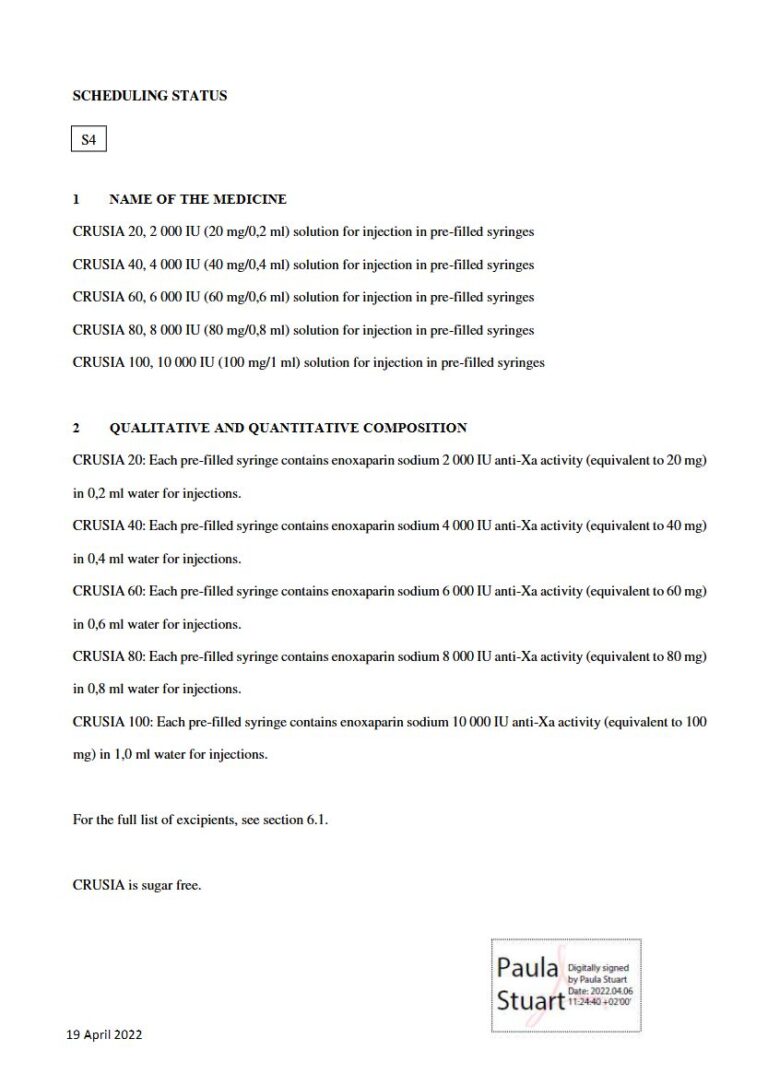
Crusia 20 mg/40 mg/60 mg/80 mg/100 mg Solution
PDF Leaflet Revision Date: 19 April 2022
Clinical Summary
Quick overview from the medicine insert
Indication
Prevention and treatment of venous thromboembolism.
Dosage (summary)
40 mg once daily for high-risk surgery; 20 mg once daily for moderate-risk surgery.
Special Populations
- Elderly
- Renal impairment
- Hepatic impairment
Pregnancy & Breastfeeding
Use with caution in pregnancy; not known if excreted in breast milk.
Key Drug Interactions
- NSAIDs
- Thrombolytics
- Anticoagulants
Contraindications
- Hypersensitivity to enoxaparin
- Active bleeding
- History of heparin-induced thrombocytopenia
Common side effects
- Haemorrhage
- Thrombocytopenia
- Injection site reactions
Counselling Points
- Monitor for signs of bleeding
- Avoid NSAIDs unless prescribed
- Report any unusual bruising or bleeding
Serious warnings
- Risk of spinal/epidural haematomas
- Increased bleeding risk in renal impairment
Important Disclaimer
The Crusia 20 mg/40 mg/60 mg/80 mg/100 mg Solution professional information leaflet below is the property of Adcock Ingram and is provided on Medinsert exactly as issued, with no.. alterations or editorial changes. We make every effort to keep content current by updating documents as soon as new versions become available. Medinsert serves as a trusted access point for healthcare professionals, but does not replace official sources or clinical judgement. For more details, please read our full disclaimer. read more>>
 Healthcare Professionals Only
This content is for registered healthcare professionals
Sign in or create a free account to read the full package insert.
Free for HPCSA-registered professionals. Powered by Medinsert.
Clinical Particulars
Section 4 of the official insert — extracted exactly as issued, no alterations
4.1 Therapeutic indications
- To reduce the risk of post-operative venous thrombosis and embolism in high-risk patients (e.g., orthopaedic surgery) and moderate-risk patients (e.g., abdominal surgery).
- To reduce the risk of venous thromboembolism in patients bedridden due to debilitating medical illnesses.
- Treatment of deep venous thrombosis with or without pulmonary embolism. Safety of home treatment for this indication has not been established.
- To reduce the risk of ischaemic complications of unstable angina or non-Q-wave myocardial infarction, within 24 hours of onset, combined with aspirin (100-325 mg daily) for 8 days, or until stabilisation, revascularisation or discharge from hospital.
- To reduce the risk of thrombus formation in extracorporeal circulation during haemodialysis.
- Treatment of acute ST-segment Elevation Myocardial Infarction (STEMI) including patients to be managed medically or with subsequent Percutaneous Coronary Intervention (PCI).
4.2 Posology and method of administration
To reduce the risk of post-operative venous thrombosis and embolism:
High Risk Patients: In orthopaedic surgery, 40 mg (0,4 ml) once daily by subcutaneous injection. The first injection should be given, 12 hours pre-operatively. Treatment is continued for as long as the risk of thromboembolism persists; in general, from 7 to 10 days after surgery or as long as there is a risk of venous thromboembolism until the patient is ambulatory. Continued therapy with 40 mg once daily for 3 weeks following the initial therapy has been proven to be beneficial in total hip replacement.
Moderate Risk Patients: In general surgery, 20 mg (0,2 ml) once daily by subcutaneous injection. The first injection should be given 2 hours pre-operatively. Treatment is continued for as long as the risk of thromboembolism persists; in general, from 7 to 10 days after surgery or as long as there is a risk of venous thromboembolism and until the patient is ambulatory. For special recommendations concerning dosing intervals for spinal/epidural anaesthesia and percutaneous coronary revascularisation procedures (see section 4.4).
To reduce the risk of venous thromboembolism in medical patients: The recommended dose of CRUSIA is 40 mg once daily by subcutaneous injection. CRUSIA treatment is prescribed for a minimum of 6 days and continued until the return to full ambulation, for a maximum of 14 days.
Treatment of deep vein thrombosis with or without pulmonary embolism: A dose of 1 mg/kg should be given subcutaneously every 12 hours. Oral anticoagulant therapy should be initiated when appropriate and CRUSIA treatment should be continued until a therapeutic anticoagulant effect has been achieved (International Normalised Ratio 2 to 3). CRUSIA treatment is usually prescribed for between 5 and 10 days.
To reduce the risk of ischaemic complications of unstable angina or non-Q-wave myocardial infarction: The recommended dose of CRUSIA is 1 mg/kg every 12 hours by subcutaneous injection, administered concurrently with aspirin (100 to 325 mg once daily). Treatment with CRUSIA in these patients should be prescribed for a minimum of 2 days and continued until clinical stabilisation. The usual duration of treatment is 2 to 8 days.
To reduce the risk of extracorporeal thrombus during haemodialysis: The recommended dose is 1 mg/kg of CRUSIA. For patients with a high risk of haemorrhage, the dose should be reduced to 0,5 mg/kg for double vascular access or 0,75 mg/kg for single vascular access. During haemodialysis, CRUSIA should be introduced into the arterial line of the circuit at the beginning of the dialysis session. The effect of this dose is usually sufficient for a 4 hour session; however, if fibrin rings are found, for example after a longer than normal session, a further dose of 0,5 to 1 mg/kg may be given.
Treatment of acute ST-segment Elevation Myocardial Infarction: The recommended dose of enoxaparin is a single IV bolus of 30 mg plus a 1 mg/kg subcutaneous dose, followed by 1 mg/kg, administered subcutaneously every 12 hours (maximum 100 mg for the first two doses only, followed by 1 mg/kg dosing for the remaining doses). For dosage in patients > 75 years of age; refer to the section on the elderly. When administered in conjunction with a thrombolytic (fibrin specific or non-fibrin specific), CRUSIA should be given between 15 minutes before and 30 minutes after the start of fibrinolytic therapy. All patients should receive aspirin as soon as they are identified as having STEMI and maintained on an appropriate dose once daily, unless contraindicated. The recommended duration of CRUSIA treatment is 8 days or until hospital discharge, whichever comes first.
For patients managed with Percutaneous Coronary Intervention (PCI): If the last CRUSIA subcutaneous administration was given less than 8 hours before balloon inflation, no additional dosing is needed. If the last subcutaneous administration was given more than 8 hours before balloon inflation, an IV bolus of 0,3 mg/kg of CRUSIA should be administered.
Special populations
Elderly: For treatment of acute ST-segment Elevation Myocardial Infarction in elderly patients > 75 years of age, do not use an initial IV bolus. Initiate dosing with 0,75 mg/kg subcutaneous every 12 hours (maximum 75 mg for the first two doses only, followed by 0,75 mg/kg dosing for the remaining doses). For other indications, no dose reduction is necessary in the elderly, unless kidney function is impaired (see sections 4.4 (haemorrhage in the elderly); and 4.2 (renal impairment), 5.1 (Elderly). The efficacy of CRUSIA injection in the elderly (> 65 years) was similar to that seen in younger patients (< 65 years). The incidence of bleeding complications was similar between elderly and younger patients when 30 mg every 12 hours or 40 mg once a day doses of CRUSIA injection were employed. The incidence of bleeding complications was higher in elderly patients as compared to younger patients when CRUSIA injection was administered at doses of 1,5 mg/kg once a day or 1 mg/kg every 12 hours. The risk of CRUSIA injection-associated bleeding increased with age. Serious adverse events increased with age for patients receiving CRUSIA injection. Other clinical experience (including post-marketing surveillance and literature reports) has not revealed additional differences in the safety of CRUSIA injection between elderly and younger patients. Careful attention to dosing intervals and concomitant medications (especially anti-platelet medications) is advised. Monitoring of geriatric patients with low body weight (< 45 kg) and those predisposed to decreased renal function should be considered (see sections 5.1 and 4.4).
Impaired renal function: In the absence of safety data on dosages more than 80 mg daily and delayed elimination in patients with severe renal impairment, dosages of more than 60 mg daily should be used with caution. Special safety vigilance is warranted in patients with severe renal impairment, as there may be an increased bleeding tendency due to the renal failure.
Renal impairment: See section 4.4 ( Special warnings and precautions for use ) and 5.1 (Pharmacological properties). Severe renal impairment: A dosage adjustment is required for patients with severe renal impairment (creatinine clearance < 30 ml/min), according to the following tables since CRUSIA exposure is significantly increased in this patient population. The following dosage adjustments are recommended for therapeutic dosage ranges:
Standard dosing:
- Severe renal impairment: 1 mg/kg SC twice daily
- 1 mg/kg SC once daily
- 1,5 mg/kg SC once daily
- 1 mg/kg SC once daily
- 30 mg single IV bolus plus a 1 mg/kg SC dose followed by 1 mg/kg SC twice daily
- 30 mg single IV bolus plus a 1 mg/kg SC dose followed by 1 mg/kg SC once daily
Elderly patients > 75 years of age (for acute STEM/ indication only):
- 0,75 mg/kg SC twice daily without initial bolus
- 1 mg/kg SC once daily without initial bolus
The following dosage adjustments are recommended for prophylactic dosage ranges:
Standard dosing:
- Severe renal impairment: 40 mg SC once daily
- 20 mg SC once daily
- 20 mg SC once daily
- 20 mg SC once daily
The recommended dosage adjustments do not apply to the haemodialysis indication. Moderate and mild renal impairment: Although no dose adjustment is recommended in patients with moderate (creatinine clearance 30-50 ml/min) and mild (creatinine clearance 50-80 ml/min) renal impairment, careful clinical monitoring is advised.
Subcutaneous injection: CRUSIA is administered by subcutaneous injection for the prevention of venous thromboembolic disease; treatment of deep vein thrombosis; treatment of unstable angina and non-Q-wave myocardial infarction and treatment of acute ST-segment Elevation Myocardial Infarction.
IV bolus injection: For acute ST-segment Elevation Myocardial Infarction, treatment is to be initiated with a single IV bolus injection immediately followed by a subcutaneous injection.
Arterial line injection: It is administered through the arterial line of a dialysis circuit for the prevention of thrombus formation in the extra-corporeal circulation during haemodialysis.
Method of administration: CRUSIA must never be injected intramuscularly. The prefilled disposable syringe is ready for immediate use.
Subcutaneous injection technique: Injections should be made preferably when the patient is lying down. CRUSIA is administered by deep subcutaneous injection. Do not expel the air bubble from the syringe before injecting to avoid the loss of medicine, when using the 20 mg and 40 mg prefilled syringes. The administration should be alternated between the left and right anterolateral or posterolateral abdominal wall.
Safety device: The prefilled syringes fitted with an automatic safety device avoid accidental needle pricks after injecting. When the protective cap is removed off the needle, a drop may appear at the end of the needle. If so, remove it before injecting the medicine by lightly tapping the body of the syringe with the needle pointing down. The prefilled syringe is ready to use. Do not press on the plunger to expel any air bubbles before administering the injection. The injection must be given with the patient preferably lying down. The whole length of the needle should be introduced perpendicularly, not from the side, into a skin fold held between the thumb and index finger. This skin fold should be held throughout the injection. Do not rub the injection site after administration. The safety device is automatically activated once the plunger is fully depressed, thus completely protecting the used needle and without causing discomfort to the patient. Activation of the safety device is only possible if the plunger is fully depressed. The safety device can only be activated once the syringe is completely empty.
4.3 Contraindications
CRUSIA is contraindicated in patients with:
- Hypersensitivity to enoxaparin sodium, heparin or its derivatives, including other low molecular weight heparins (LMWH) or to any of the excipients listed in section 6.1;
- History of immune mediated heparin-induced thrombocytopenia (HIT) within the past 100 days or in the presence of circulating antibodies (see also section 4.4 );
- Active clinically significant bleeding and conditions with a high risk of haemorrhage, including recent haemorrhagic stroke, gastrointestinal ulcer, presence of malignant neoplasm at high risk of bleeding, recent brain, spinal, or ophthalmic surgery, known or suspected oesophageal varices, arteriovenous malformations, vascular aneurysms or major intraspinal or intracerebral vascular abnormalities;
- Spinal or epidural anaesthesia or loco-regional anaesthesia when enoxaparin sodium (e.g., CRUSIA) is used for treatment in the previous 24 hours (see section 4.4).
4.4 Special warnings and precautions for use
Spinal/Epidural anaesthesia: Spinal/epidural anaesthesia or lumbar puncture must not be performed within 24 hours of administration of CRUSIA at therapeutic doses (see also section 4.3). There have been cases of intraspinal haematomas, reported with the concurrent use of CRUSIA and spinal/epidural anaesthesia resulting in long-term or permanent paralysis. The risk is greater with higher CRUSIA dosage regimens, use of post-operative indwelling catheters or the concomitant use of additional medicines affecting haemostasis such as NSAIDs (refer to interactions with other medicines or other forms of interaction). The risk also appears to be increased by traumatic or repeated neuraxial puncture. Placement and removal of the catheter is best performed when the anticoagulant effect of CRUSIA is low, however, the exact timing to reach a sufficiently low anticoagulant effect in each patient is not known. For patients with creatinine clearance [15-30 ml/minute], additional considerations are necessary because elimination of enoxaparin sodium is more prolonged (see section 4.2). Neuraxial techniques should be avoided in patients administered a dose of CRUSIA 2 hours pre-operatively (general surgery). Placement or removal of a catheter should be delayed for 10-12 hours after administration of DVT prophylactic doses of CRUSIA, whereas patients receiving higher doses of CRUSIA (1 mg/kg twice daily or 1,5 mg/kg once daily) will require longer delays (24 hours). The subsequent CRUSIA dose should be given no sooner than 2 hours after catheter removal. Should the medical practitioner decide to administer anticoagulation in the context of epidural/spinal anaesthesia, extreme vigilance and frequent monitoring must be exercised to detect any signs and symptoms of neurological impairment such as midline back pain, sensory and motor deficits (numbness or weakness in lower limbs), bowel and/or bladder dysfunction. Patients should be instructed to inform their medical practitioner immediately if they experience any of the above signs or symptoms. If signs or symptoms of spinal haematoma are suspected, urgent diagnosis and treatment including spinal cord decompression should be initiated.
General: CRUSIA cannot be used interchangeably (unit for unit) with other LMWHs. These medicines differ in their manufacturing process, molecular weights, specific anti-Xa and anti-IIa activities, units, dosage and clinical efficacy and safety. This results in differences in pharmacokinetics and associated biological activities (e.g., anti-thrombin activity, and platelet interactions). Special attention and compliance with the instructions for use specific to each proprietary medicine are therefore required.
History of HIT (>100 days): Heparin-induced thrombocytopenia: Use of enoxaparin sodium as contained in CRUSIA in patients with a history of immune mediated HIT (heparin-induced thrombocytopenia) within the past 100 days or in the presence of circulating antibodies is contraindicated (see section 4.3). Circulating antibodies may persist several years. CRUSIA is to be used with extreme caution in patients with a history (>100 days) of heparin-induced thrombocytopenia without circulating antibodies. The decision to use CRUSIA in such a case must be made only in consultation with an expert in the field and after non-heparin alternative treatments are considered (e.g., danaparoid sodium or lepirudin).
Monitoring of platelet counts: The risk of antibody-mediated HIT also exists with LMWHs. Should thrombocytopenia occur, it usually appears between the 5th and the 21st day following the beginning of CRUSIA treatment. The risk of HIT is higher in postoperative patients and mainly after cardiac surgery and in patients with cancer. Therefore, it is recommended that the platelet counts be measured before the initiation of therapy with CRUSIA and then regularly thereafter during the treatment. If there are clinical symptoms suggestive of HIT (any new episode of arterial and/or venous thromboembolism, any painful skin lesion at the injection site, any allergic or anaphylactoid reactions on treatment), platelet count should be measured. Patients must be aware that these symptoms may occur and if so, that they should inform their primary care medical practitioner. In practice, if a confirmed significant decrease of the platelet count is observed (30 to 50 % of the initial value), CRUSIA treatment must be immediately discontinued, and the patient switched to another non-heparin anticoagulant alternative treatment.
Haemorrhage: Bleeding may occur at any site because of the anticoagulant effects. If bleeding occurs, the origin of the haemorrhage should be investigated, and appropriate treatment instituted. CRUSIA should be used with caution in conditions with increased potential for bleeding, such as:
- impaired haemostasis,
- history of peptic ulcer,
- recent ischemic stroke,
- severe arterial hypertension,
- recent diabetic retinopathy,
- neuro- or ophthalmologic surgery,
- concomitant use of medications affecting haemostasis (see section 4.5).
Laboratory tests: At doses used for prophylaxis of venous thromboembolism, CRUSIA does not influence bleeding time and global blood coagulation tests significantly, nor does it affect platelet aggregation or binding of fibrinogen to platelets. At higher doses, increases in activated partial thromboplastin time (aPTT), and activated clotting time (ACT) may occur. Increases in aPTT and ACT are not linearly correlated with increasing enoxaparin sodium antithrombotic activity and therefore, are unsuitable and unreliable for monitoring enoxaparin sodium activity.
Skin necrosis / cutaneous vasculitis: Skin necrosis and cutaneous vasculitis have been reported with LMWHs and should lead to prompt treatment discontinuation.
Percutaneous coronary revascularisation procedures: To minimise the risk of bleeding following the vascular instrumentation during the treatment of unstable angina, NSTEMI and acute STEMI, adhere precisely to the intervals recommended between CRUSIA injection doses. It is important to achieve haemostasis at the puncture site after PCI. In case a closure device is used, the sheath can be removed immediately. If a manual compression method is used, sheath should be removed 6 hours after the last IV/SC CRUSIA injection. If the treatment with CRUSIA is to be continued, the next scheduled dose should be given no sooner than 6 to 8 hours after sheath removal.
Acute infective endocarditis: Use of heparin is usually not recommended in patients with acute infective endocarditis due to the risk of cerebral haemorrhage. If such use is considered absolutely necessary, the decision must be made only after a careful individual benefit risk assessment.
Mechanical prosthetic heart valves: The use of CRUSIA has not been adequately studied for thromboprophylaxis in patients with mechanical prosthetic heart valves. Isolated cases of prosthetic heart valve thrombosis have been reported in patients with mechanical prosthetic heart valves who have received CRUSIA for thromboprophylaxis. Confounding factors, including underlying disease and insufficient clinical data, limit the evaluation of these cases. Some of these cases were pregnant women in whom thrombosis led to maternal and foetal death.
Pregnant women with mechanical prosthetic heart valves: The use of CRUSIA for thromboprophylaxis in pregnant women with mechanical prosthetic heart valves has not been adequately studied. In a clinical study of pregnant women with mechanical prosthetic heart valves given enoxaparin sodium (100 IU/kg (1 mg/kg) twice daily) to reduce the risk of thromboembolism, 2 of 8 women developed clots resulting in blockage of the valve and leading to maternal and foetal death. There have been isolated post-marketing reports of valve thrombosis in pregnant women with mechanical prosthetic heart valves while receiving enoxaparin sodium for thromboprophylaxis. Pregnant women with mechanical prosthetic heart valves may be at higher risk for thromboembolism.
Elderly: No increased bleeding tendency is observed in the elderly with the prophylactic dosage ranges. Elderly patients (especially patients eighty years of age and older) may be at an increased risk for bleeding complications with the therapeutic dosage ranges. Careful clinical monitoring is advised, and dose reduction might be considered in patients older than 75 years treated for STEMI (see sections 4.2 and 5.2).
Renal impairment: In patients with renal impairment, there is an increase in exposure of enoxaparin sodium as contained in CRUSIA which increases the risk of bleeding. In these patients, careful clinical monitoring is advised, and biological monitoring by anti-Xa activity measurement might be considered (see sections 4.2 and 5.2).
CRUSIA is not recommended for patients with end stage renal disease (creatinine clearance <15 ml/min) due to lack of data in this population outside the prevention of thrombus formation in extracorporeal circulation during haemodialysis. In patients with severe renal impairment (creatinine clearance 15-30 ml/min), since exposure of enoxaparin sodium is significantly increased, a dosage adjustment is recommended for therapeutic and prophylactic dosage ranges (see section 4.2). No dose adjustment is recommended in patients with moderate (creatinine clearance 30-50 ml/min) and mild (creatinine clearance 50-80 ml/min) renal impairment.
4.5 Interactions with other medicines
Concomitant use not recommended:
- Medicines affecting haemostasis (see section 4.4) It is recommended that some medicines which affect haemostasis should be discontinued prior to CRUSIA therapy unless strictly indicated. If the combination is indicated, CRUSIA should be used with careful clinical and laboratory monitoring when appropriate. These medicines include medicines such as:
- Systemic salicylates, acetylsalicylic acid at anti-inflammatory doses, and NSAIDs including ketorolac,
- Other thrombolytics (e.g., alteplase, reteplase, streptokinase, tenecteplase, urokinase) and anticoagulants (see section 4.2).
Concomitant use with caution:
- The following medicines may be administered with caution concomitantly with CRUSIA:
- Other medicines affecting haemostasis such as:
- Platelet aggregation inhibitors including acetylsalicylic acid used at antiaggregant dose (cardio protection), clopidogrel, ticlopidine, and glycoprotein IIb/IIIa antagonists indicated in acute coronary syndrome due to the risk of bleeding,
- Dextran 40,
- Systemic glucocorticoids.
- Medicines increasing potassium levels: Medicines that increase serum potassium levels may be administered concurrently with CRUSIA under careful clinical and laboratory monitoring (see sections 4.4 and 4.8).
4.6 Fertility, pregnancy and lactation
Pregnancy: In humans, there is no evidence that enoxaparin crosses the placental barrier during the second and third trimester of pregnancy. There is no information available concerning the first trimester. Animal studies have not shown any evidence of fetotoxicity or teratogenicity (see section 5.3). Animal data have shown that enoxaparin passage through the placenta is minimal. CRUSIA should be used during pregnancy only if the medical practitioner has established a clear need. Pregnant women receiving CRUSIA should be carefully monitored for evidence of bleeding or excessive anticoagulation and should be warned of the haemorrhagic risk. Overall, the data suggest that there is no evidence for an increased risk of haemorrhage, thrombocytopenia or osteoporosis with respect to the risk observed in non-pregnant women, other than that observed in pregnant women with prosthetic heart valves (see section 4.4). If an epidural anaesthesia is planned, it is recommended to withdraw CRUSIA treatment before (see section 4.4).
Breastfeeding: It is not known whether unchanged enoxaparin is excreted in human breast milk. In lactating rats, the passage of enoxaparin or its metabolites in milk is very low. The oral absorption of CRUSIA is unlikely. CRUSIA syringes can be used during breastfeeding.
Fertility: There are no clinical data for CRUSIA in fertility. Animal studies did not show any effect on fertility (see section 5.3).
4.7 Effects on ability to drive and use machines
CRUSIA has no or negligible influence on the ability to drive and use machines.
4.8 Undesirable effects
Summary of the safety profile: It has been reported during clinical trials with enoxaparin sodium, that the enoxaparin sodium regimen administered varied depending on indications. The enoxaparin sodium dose was 4 000 IU (40 mg) SC once daily for prophylaxis of deep vein thrombosis following surgery or in acutely ill medical patients with severely restricted mobility. In treatment of DVT with or without PE, patients receiving enoxaparin sodium were treated with either a 100 IU/kg (1 mg/kg) SC dose every 12 hours or a 150 IU/kg (1,5 mg/kg) SC dose once a day. Reports have shown in the clinical studies for treatment of unstable angina and non-Q-wave myocardial infarction, doses were 100 IU/kg (1 mg/kg) SC every 12 hours, and in the clinical study for treatment of acute STEMI enoxaparin sodium regimen was a 3 000 IU (30 mg) IV bolus followed by 100 IU/kg (1 mg/kg) SC every 12 hours. It has been reported that in clinical studies, haemorrhages, thrombocytopenia and thrombocytosis were the most commonly reported reactions (see section 4.4 and 'Description of selected adverse reactions' below).
Tabulated list of adverse reactions: Other adverse reactions observed in reported clinical studies and reported in post-marketing experience (* indicates reactions from post-marketing experience) are detailed below.
Blood and lymphatic system disorders:
- Frequent: Haemorrhage, haemorrhagic anaemia*, thrombocytopenia, thrombocytosis.
- Less frequent: Eosinophilia*, cases of immuno-allergic thrombocytopenia with thrombosis; in some of them thrombosis was complicated by organ infarction or limb ischaemia (see section 4.4), neutropenia, leukopenia.
Immune system disorders:
- Frequent: Allergic reaction.
- Less frequent: Anaphylactic/Anaphylactoid reactions including shock*.
Nervous system disorders:
- Frequent: Headache*.
Vascular disorders:
- Less frequent: Spinal haematoma* (or neuraxial haematoma). These reactions have resulted in varying degrees of neurologic injuries including long-term or permanent paralysis (see section 4.4).
Hepato-biliary disorders:
- Frequent: Hepatic enzyme increases (mainly transaminases > 3 times the upper limit of normality).
- Less frequent: Hepatocellular liver injury *, cholestatic liver injury*, hepatitis.
Skin and subcutaneous tissue disorders:
- Frequent: Urticaria, pruritus, erythema.
- Less frequent: Bullous dermatitis, alopecia*, cutaneous vasculitis*, skin necrosis* usually occurring at the injection site (these phenomena have been usually preceded by purpura or erythematous plaques, infiltrated and painful). Injection site nodules* (inflammatory nodules, which were not cystic enclosure of enoxaparin). They resolve after a few days and should not cause treatment discontinuation.
Musculoskeletal, connective tissue and bone disorders:
- Less frequent: Osteoporosis* following long term therapy (greater than 3 months).
General disorders and administration site conditions:
- Frequent: Injection site haematoma, injection site pain, other injection site reaction (such as oedema, haemorrhage, hypersensitivity, inflammation, mass, pain, or reaction).
- Less frequent: Local irritation, skin necrosis at injection site.
Investigations:
- Less frequent: Hyperkalaemia* (see sections 4.4 and 4.5).
Description of selected adverse reactions: Haemorrhages: These included major haemorrhages, reported at most in 4,2 % of the patients (surgical patients). Some of these cases have been fatal. In surgical patients, haemorrhage complications were considered major: (1) if the haemorrhage caused a significant clinical event, or (2) if accompanied by haemoglobin decrease u2265 2 g/dL or transfusion of 2 or more units of blood products. Retroperitoneal and intracranial haemorrhages were always considered major. Haemorrhage may occur in the presence of associated risk factors such as: organic lesions liable to bleed, invasive procedures or the concomitant use of medications affecting haemostasis (see sections 4.4 and 4.5).
Blood and lymphatic system disorders:
Prophylaxis in surgical patients
Prophylaxis in medical patients
Treatment in patients with DVT with or without PE
Treatment in patients with unstable angina and non-Q-wave MI
Treatment in patients with acute STEMI
- Frequent: Haemorrhage u03b1
- Frequent: Haemorrhage u03b1
- Frequent: Haemorrhage u03b1
- Frequent: Haemorrhage u03b1
- Frequent: Haemorrhage u03b1
- Less frequent: Retroperitoneal haemorrhage
- Less frequent: Intracranial haemorrhage, Retroperitoneal haemorrhage
- Less frequent: Retroperitoneal haemorrhage
- Less frequent: Intracranial haemorrhage, Retroperitoneal haemorrhage
u03b1 : such as haematoma, ecchymosis other than at injection site, wound haematoma, haematuria, epistaxis and gastrointestinal haemorrhage.
Thrombocytopenia and thrombocytosis:
Blood and lymphatic system disorders
Prophylaxis in surgical patients
Prophylaxis in medical patients
Treatment in patients with DVT with or without PE
Treatment in patients with unstable angina and non-Q-wave MI
Treatment in patients with acute STEMI
- Frequent: Thrombo-cytosis u03b2
- Frequent: Thrombo-cytopenia
- Less frequent: Thrombo-cytopenia
- Frequent: Thrombo-cytosis u03b2
- Frequent: Thrombo-cytopenia
- Less frequent: Thrombo-cytopenia
- Frequent: Thrombo-cytosis u03b2
- Frequent: Thrombo-cytopenia
- Less frequent: Immuno-allergic thrombo-cytopenia
u03b2 : Platelet increased > 400 G/L
Paediatric population: The safety and efficacy of CRUSIA in children have not been established (see section 4.2).
Reporting of suspected adverse reactions: Reporting suspected adverse reactions after authorisation of the medicine is important. It allows continued monitoring of the benefit/risk balance of the medicine. Healthcare providers are asked to report any suspected adverse reactions to SAHPRA via the u201c6.04 Adverse Drug Reactions Reporting Formu201d, found online under SAHPRAu2019s publications: https://www.sahpra.org.za/Publications/Index/8
4.9 Overdose
Signs and symptoms: Accidental overdose with enoxaparin sodium after IV, extracorporeal or SC administration may lead to haemorrhagic complications. Following oral administration of even large doses, it is unlikely that CRUSIA will be absorbed.
Management: The anticoagulant effects can be largely neutralised by the slow IV injection of protamine. The dose of protamine depends on the dose of CRUSIA injected; 1 mg protamine neutralises the anticoagulant effect of 100 IU (1 mg) of enoxaparin sodium, if CRUSIA was administered in the previous 8 hours. An infusion of 0,5 mg protamine per 100 IU (1 mg) of enoxaparin sodium may be administered if enoxaparin sodium was administered greater than 8 hours previous to the protamine administration, or if it has been determined that a second dose of protamine is required. After 12 hours of the CRUSIA injection, protamine administration may not be required. However, even with high doses of protamine, the anti-Xa activity of CRUSIA is never completely neutralised (maximum about 60 %) (see the prescribing information for protamine salts).
