
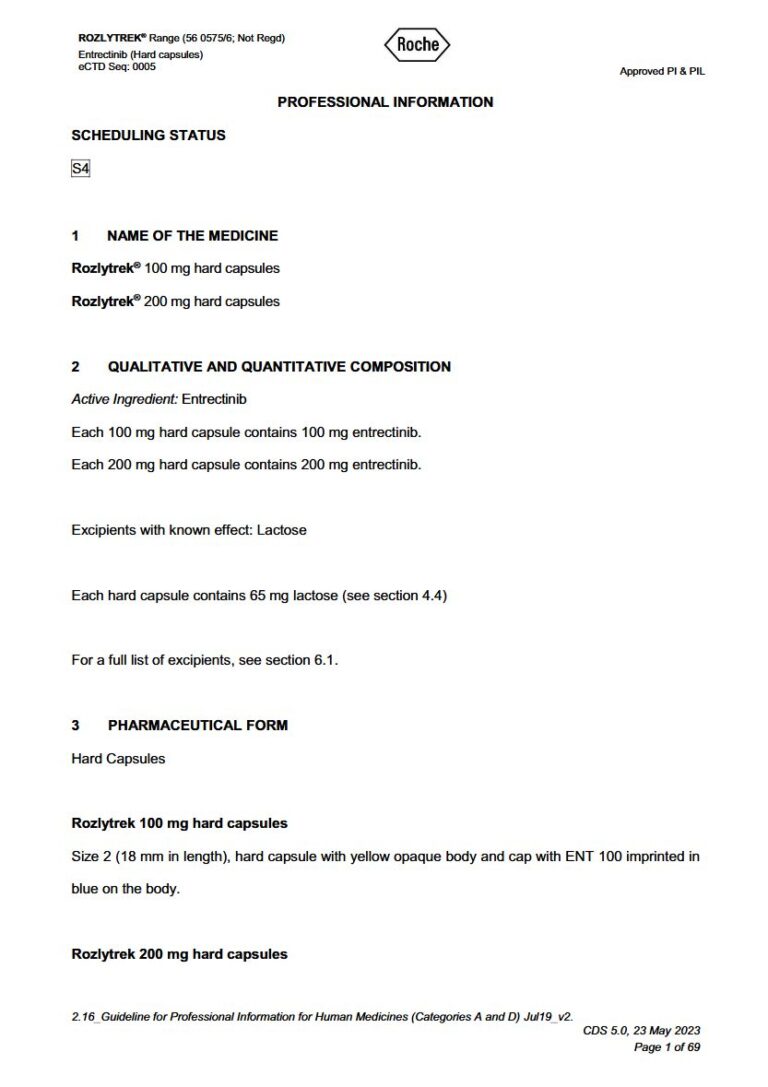
Rozlytrek Range 100 mg, 200 mg Hard Capsules
PDF Leaflet Revision Date: 23 May 2023
Clinical Summary
Quick overview from the medicine insert
Indication
Treatment of NTRK fusion-positive solid tumours and ROS1-positive NSCLC.
Dosage (summary)
Adults: 600 mg once daily; Paediatrics: 300 mg/mu00b2 once daily.
Special Populations
- Elderly
- Renal impairment
- Hepatic impairment
Pregnancy & Breastfeeding
May cause foetal harm; avoid breastfeeding during treatment.
Key Drug Interactions
- Strong CYP3A inhibitors
- Moderate CYP3A inhibitors
- CYP3A inducers
Contraindications
- Hypersensitivity to entrectinib or excipients
Common side effects
- Fatigue
- Nausea
- Diarrhoea
- Cognitive disorders
- Fractures
Counselling Points
- Avoid pregnancy during treatment
- Monitor for cognitive changes
- Do not drive if experiencing cognitive effects
Serious warnings
- Congestive heart failure
- QT interval prolongation
- Cognitive changes
Important Disclaimer
The Rozlytrek Range 100 mg, 200 mg Hard Capsules professional information leaflet below is the property of Roche Products and is provided on Medinsert exactly as issued, with no.. alterations or editorial changes. We make every effort to keep content current by updating documents as soon as new versions become available. Medinsert serves as a trusted access point for healthcare professionals, but does not replace official sources or clinical judgement. For more details, please read our full disclaimer. read more>>
 Healthcare Professionals Only
This content is for registered healthcare professionals
Sign in or create a free account to read the full package insert.
Free for HPCSA-registered professionals. Powered by Medinsert.
Clinical Particulars
Section 4 of the official insert — extracted exactly as issued, no alterations
4.1 Therapeutic Indications
Solid tumours
nRozlytrek is indicated for the treatment of adult and paediatric patients with neurotrophic tyrosine receptor kinase (NTRK) fusion-positive locally advanced or metastatic solid tumours, who have progressed following prior therapies, or as initial therapy when there are no acceptable standard therapies.
nNon-small cell lung cancer (NSCLC)
nRozlytrek is indicated for the treatment of patients with ROS1-positive, locally advanced or metastatic NSCLC.
4.2 Posology and method of administration
General
nTreatment with Rozlytrek should be initiated by a physician experienced in the use of anticancer medicinal products.
nPatient Selection
nNTRK gene fusion-positive solid tumours
nA validated assay is required for the selection of patients with NTRK fusion-positive locally advanced or metastatic solid tumours. NTRK fusion-positive status should be established prior to initiation of Rozlytrek therapy.
nROS1-positive non-small cell lung cancer
nA validated assay is required for the selection of patients with ROS1-positive locally advanced or metastatic NSCLC. ROS1-positive status should be established prior to initiation of Rozlytrek therapy.
nRecommended Dosage
nRozlytrek hard capsules can be taken with or without food, swallowed whole and must not be opened or dissolved.
nAdults
nThe recommended dose of Rozlytrek for adults is 600 mg given orally, once daily (see section 5.2).
nPaediatric patients
nThe recommended dose of Rozlytrek for paediatric patients 12 years and older who have the ability to swallow capsules is 300 mg/m2 orally, once daily (see Table 1). (See section 5.2).
nTable 1: Recommended dosing for Paediatric patients
n- n
- Body surface area (BSA) n
- Once daily dose n
- 0.43 - 0.50 m2 100 mg n
- 0.51 - 0.80 m2 200 mg n
- 0.81 - 1.10 m2 300 mg n
- 1.11 - 1.50 m2 400 mg n
- u2265 1.51m2 600 mg n
Duration of Treatment
nIt is recommended that patients are treated with Rozlytrek until disease progression or unacceptable toxicity.
nDelayed or Missed Doses
nIf a planned dose of Rozlytrek is missed, patients can make up that dose unless the next dose is due within 12 hours. If vomiting occurs immediately after taking a dose of Rozlytrek, patients may repeat that dose.
nDose Modifications
nManagement of adverse events may require temporary interruption, dose reduction, or discontinuation of treatment with Rozlytrek, based on the prescriberu2019s assessment of the patientu2019s safety or tolerability.
nAdults
nFor adults, the dose of Rozlytrek may be reduced up to 2 times, based on tolerability. Table 2 provides general dose reduction advice for adult patients. Rozlytrek treatment should be permanently discontinued if patients are unable to tolerate a dose of 200 mg once daily.
nTable 2: Dose Reduction Schedule for Adult patients
n- n
- Starting Dose 600 mg once daily n
- First dose reduction 400 mg once daily n
- Second dose reduction 200 mg once daily n
Paediatric Patients
nTable 3 provides specific dose reduction advice for paediatric patients. For paediatric patients, the dose of Rozlytrek may be reduced up to 2 times, based on tolerability. For some patients an intermittent dosing schedule is required to achieve the recommended reduced total weekly paediatric dose. Rozlytrek treatment should be permanently discontinued if patients are unable to tolerate the lowest reduced dose.
nTable 3: Dose Reduction Schedule for paediatric patients
n- n
- Starting Dose once daily n
- First dose reduction n
- Second dose reduction n
- 100 mg 100 mg, once/day for 5 days each week * n
- 100 mg, once/day for 3 days each week ** n
- 200 mg 200 mg, once/day for 5 days each week * n
- 100 mg, once/day for 5 days each week* n
- 300 mg 200 mg once daily n
- 100 mg once daily n
- 400 mg 300 mg once daily n
- 200 mg, once/day for 5 days each week* n
- 600 mg 400 mg once daily n
- 200 mg once daily n
*5 days each week: Monday, Wednesday, Friday, Saturday, and Sunday
n**3 days each week: Monday, Thursday and Saturday
nDose Modifications for Specific Adverse Reactions
nRecommendations for Rozlytrek dose modifications for adults and paediatric patients for specific adverse reactions are provided in Table 4. (See section 4.4 and section 4.8).
nTable 4 Recommended dose modifications for specified Adverse Drug Reactions for Adult and Paediatric Patients
n- n
- Adverse Drug Reaction Severity * n
- u00b7 Dose modification n
- Anemia or Neutropenia Grade 3 or Grade 4 n
- u00b7 Withhold Rozlytrek until recovery to u2264 Grade 2 or to baseline, then resume treatment at same dose level or reduced dose, as clinically needed. n
- Cognitive Disorders Grade u2265 2 n
- u00b7 Withhold Rozlytrek until recovery to u2264 Grade 1 or to baseline, then resume treatment at reduced dose. n
- u00b7 If event recurs, further reduce dose. n
4.3 Contraindications
Rozlytrek is contraindicated in patients with a known hypersensitivity to entrectinib or any of the excipients.
4.4 Special Warnings and precautions for use
Congestive Heart Failure
nCongestive heart failure (CHF) has been reported across clinical trials with Rozlytrek (see Table 5 in section 4.8). These reactions were observed in patients with or without a history of cardiac disease and resolved upon treatment with diuretics and/or dose reduction/interruption of Rozlytrek. For patients with symptoms or known risk factors of CHF, left ventricular ejection fraction (LVEF) should be assessed prior to initiation of Rozlytrek treatment. Patients receiving Rozlytrek should be carefully monitored and those with clinical signs and symptoms of CHF, including shortness of breath or edema, should be evaluated and treated as clinically appropriate. Based on the severity of CHF, Rozlytrek treatment should be modified as described in Table 4 in section 4.2.
nCognitive Disorders
nCognitive disorders, including confusion, mental status changes, memory impairment, and hallucinations, were reported in clinical trials with Rozlytrek, (see section 4.8). Patients should be monitored for signs of cognitive changes. Based on the severity of the cognitive disorder, Rozlytrek treatment should be modified as described in Table 4 in section 4.2. Patients should be counselled on the potential for cognitive changes with Rozlytrek treatment. Patients should be instructed not to drive or use machines until symptoms resolve, if they experience symptoms of cognitive disorders. (See section 4.7).
nFractures
nRozlytrek increases the risk of fractures (see description of selected ADRs). Patients with signs or symptoms (e.g., pain, changes in mobility, deformity) of fractures should be evaluated promptly. In adult patients, some fractures occurred in the setting of a fall or other trauma to the affected area, while in paediatric patientsu2019 fractures occurred in patients with minimal or no trauma. There are no data on the effects of Rozlytrek on healing of known fractures and the risk of occurrence of future fractures. In the majority of paediatric patients treatment was continued with Rozlytrek and the fracture healed.
nQTc Interval Prolongation
nQT interval prolongation has been observed in patients treated with Rozlytrek in clinical trials (see section 4.8). Use of Rozlytrek should be avoided in patients with congenital long QT syndrome and in patients taking medications that are known to prolong QT interval. Assessment of ECG at baseline and periodic monitoring of ECGs and electrolytes are recommended. Based on the severity of QTc prolongation, Rozlytrek treatment should be modified as described in Table 4 in section 4.2.
nEmbryo-foetal toxicity
nBased on the findings in animal studies, Rozlytrek may cause foetal harm when administered to a pregnant woman. When administrated to pregnant rats, Rozlytrek caused maternal toxicity and developmental toxicities at exposures 2.3-fold the human exposure by AUC at the recommended dose. (See section 4.6). Female patients receiving Rozlytrek should be advised of the potential harm to the foetus. Female patients of reproductive potential, must use highly effective contraceptive methods during treatment and for 5 weeks following the last dose of Rozlytrek. (See section 4.6).
4.5 Interactions with other medicines
Effects of entrectinib on others drugs
nCYP substrates
nBased on the in vitro studies in human liver microsomes, entrectinib exhibits inhibitory potential toward CYP3A. In vitro studies indicate that entrectinib and its major active metabolite, M5, do not inhibit CYP1A2, CYP2B6, CYP2C8, CYP2C9, CYP2C19 and CYP2D6 at clinically relevant concentrations. In vitro results indicate entrectinib has weak induction potential toward CYP3A and CYP2C8/9. In a clinical study, co-administration of multiple doses of entrectinib and midazolam, a sensitive CYP3A substrate, increased the systemic exposure of midazolam by approximately 50% indicating a weak inhibitory effect of entrectinib on the metabolism of midazolam (Geometric mean ratio (GMR) with/without entrectinib for AUC inf (90% CI) was 150% (129%, 173%)). Therefore, no dose adjustment is required when Rozlytrek is co-administered with CYP3A substrates.
nP-gp substrates
nIn vitro data suggest that entrectinib has inhibitory potential towards P-gp. In a clinical study, co-administration of a single oral dose of entrectinib with a sensitive P-gp substrate, digoxin, increased the digoxin C max by approximately 28% and overall exposure by approximately 18% (GMR with/without entrectinib for C max (90% CI) was 128% (98.2%, 167%) and AUC inf (90% CI) was 118% (106%, 132%)). The renal clearance of digoxin was similar between treatments of digoxin alone and digoxin co-administered with entrectinib, indicating minimal effect of entrectinib on renal clearance of digoxin. These results indicate that entrectinib is a weak P-gp inhibitor and that no clinically significant interaction exists between digoxin, as a P-gp substrate, and entrectinib. Therefore, no dose adjustment is required when Rozlytrek is co-administered with P-gp substrates.
nBCRP substrates
nAs with P-gp, a mild inhibition of BCRP was observed in in vitro studies. Given that no clinically significant interaction was observed with the P-gp substrate digoxin, an interaction with BCRP is not predicted. No dose adjustment is required when Rozlytrek is co-administered with BCRP substrates.
nOther transporter substrates
nIn vitro data indicate that entrectinib has weak inhibitory potential toward organic anion-transporting polypeptide (OATP) 1B1 and multidrug and toxin extrusion protein 1 (MATE1).
nOral Contraceptive
nPhysiologically-based pharmacokinetic simulation of the effects of co-administration of multiple oral doses of entrectinib with ethinyl estradiol, an oral contraceptive, predicted no drug-drug interaction. GMR with/without entrectinib for AUC inf (90% CI) of 112% (111%, 113%) and C max (90% CI) was 112% (111%, 113%). Therefore Rozlytrek can be co-administered with an oral contraceptive.
nEffects of other drugs on entrectinib
nBased on in vitro data, CYP3A4 is the predominant enzyme mediating the metabolism of entrectinib and formation of its major active metabolite M5. CYP3A inducers co-administration of multiple oral doses of rifampin, a strong CYP3A inducer, with a single oral dose of entrectinib reduced the systemic exposure of entrectinib by 77%. GMR with/without rifampin for AUC inf (90% CI) was 23.3% (18.4%, 29.5%) and C max (90% CI) was 44.4% (35.3%, 55.9%).
4.6 Fertility, pregnancy and lactation
Pregnancy
nFemale patients of reproductive potential must be advised to avoid pregnancy while receiving Rozlytrek (see section 4.4). There is no available data on the use of Rozlytrek in pregnant women. Based on animal studies with entrectinib (see section 5.3) and its mechanism of action, Rozlytrek may cause foetal harm when administered to a pregnant woman. Patients receiving Rozlytrek should be advised of the potential harm to the foetus. Female patients should be advised to contact the medical practitioner, should pregnancy occur.
nBreastfeeding
nMothers should not breastfeed their infants when taking Rozlytrek.
nFertility
nNo fertility studies in animals have been performed to evaluate the effect of entrectinib. With the exception of dose dependent decreases in prostate weight in male dogs, no effects of entrectinib on reproductive organs were observed in the repeat-dose toxicology studies in rats and dogs at approximately 2.4-fold and 0.6-fold, respectively, the human exposure by AUC at the recommended human dose.
4.7 Effects on ability to drive and use machines
Rozlytrek may influence the ability to drive and use machines. Patients should be instructed not to drive or use machines until the symptoms resolve, if they experience cognitive adverse reactions, syncope, blurred vision, or dizziness, during treatment with Rozlytrek. (See section 4.4 and section 4.8).
4.8 Undesirable effects
Clinical Trials
nSummary of the safety profile
nFor the clinical development program of Rozlytrek, a total of 504 patients have received Rozlytrek in 4 clinical trials (ALKA, STARTRK-1, STARTRK-2 and STARTRK-NG). The safety of Rozlytrek was evaluated as integrated analyses of these 4 clinical trials. The median duration of exposure to Rozlytrek was 5.5 months. The safety of Rozlytrek in adult patients has been evaluated in a total of 475 patients with NTRK-fusion positive, ROS1-positive or ALK-positive solid tumours, in studies ALKA, STARTRK-1, STARTRK-2. The safety of Rozlytrek has been evaluated in 29 paediatric patients with solid tumours (27 patients enrolled in STARTRK-NG, and 2 patients enrolled in STARTRK-2). Of these, 1 patient was less than 1 year old, 21 patients were 2 to 11 years old, 7 patients were 12 to 17 years old.
nTabulated summary of adverse drug reactions from clinical trials
nTable 5 summarizes the adverse drug reactions (ADRs) occurring in adult and paediatric patients treated with Rozlytrek. ADRs from clinical trials (Table 5) are listed by MedDRA system organ class. The corresponding frequency category for each adverse drug reaction is based on the following convention: very common (u2265 1/10), common (u2265 1/100 to < 1/10), uncommon (u2265 1/1,000 to < 1/100), rare (u2265 1/10,000 to < 1/1000), very rare (< 1/10,000).
nTable 5 Summary of adverse drug reactions occurring in patients treated with Rozlytrek in clinical trials (integrated safety population)
n- n
- System Organ Class n
- Adverse Reaction n
- Rozlytrek N=504 n
- Frequency Category (All Grades) n
- All Grades (%) n
- Grade u2265 3 (%) n
- General Disorders and Administration Site Conditions n
- Fatigue 14 n
- 45.0 n
- 5.0 n
- very common n
- Edema n
- 6 n
- 37.3 n
- 1.4 n
- very common n
- Pain n
- 7 n
- 24.4 n
- 1.6 n
- very common n
- Pyrexia n
- 20.0 n
- 0.8 n
- very common n
- Gastrointestinal Disorders n
- Constipation n
- 42.9 n
- 0.4 n
- very common n
- Diarrhoea n
- 33.5 n
- 2.6 n
- very common n
- Nausea n
- 32.1 n
- 0.8 n
- very common n
- Vomiting n
- 23.2 n
- 1.2 n
- very common n
- Abdominal pain n
- 11.1 n
- 0.6 n
- very common n
- Dysphagia n
- 10.1 n
- 0.4 n
- very common n
- Nervous System Disorders n
- Dysgeusia n
- 42.3 n
- 0.4 n
- very common n
- Dizziness n
- 5 n
- 39.7 n
- 1.2 n
- very common n
- Dysasthesia n
- 3 n
- 29.0 n
- 0.2 n
- very common n
- Cognitive Disorders n
- 1 n
- 24.2 n
- 4.4 n
- very common n
- Headache n
- 17.5 n
- 1.0 n
- very common n
- Peripheral Sensory Neuropathy n
- 2 n
- 15.7 n
- 1.0 n
- very common n
- Ataxia n
- 4 n
- 15.7 n
- 0.8 n
- very common n
- Sleep disturbances n
- 16 n
- 13.5 n
- 0.4 n
- very common n
- Mood disorders n
- 17 n
- 9.1 n
- 0.6 n
- common n
- Syncope n
- 4.6 n
- 3.0 n
- common n
- Respiratory Disorders n
- Dyspnea n
- 27.0 n
- 5.8 * n
- very common n
- Cough n
- 21.4 n
- 0.6 n
- very common n
- Blood Disorders n
- Anemia n
- 28.2 n
- 9.7 n
- very common n
- Neutropenia n
- 10 n
- 11.3 n
- 4.4 n
- very common n
- Metabolism and Nutritional Disorders n
- Weight increased n
- 26.4 n
- 7.3 n
- very common n
- Decreased appetite n
- 11.9 n
- 0.2 n
- very common n
- Hyperuricemia n
- 9.1 n
- 1.8 n
- common n
- Dehydration n
- 7.9 n
- 1.0 n
- common n
- Tumour lysis syndrome n
- 0.2 n
- 0.2 * n
- uncommon n
- Renal and urinary disorders n
- Blood creatinine increased n
- 25.4 n
- 0.6 n
- very common n
- Musculoskeletal Disorders n
- Myalgia n
- 19.6 n
- 0.6 n
- very common n
- Arthralgia n
- 19.0 n
- 0.6 n
- very common n
- Muscular weakness n
- 12.3 n
- 1.2 n
- very common n
- Fractures n
- 11 n
- 6.2 n
- 2.4 n
- common n
- Hepatobiliary Disorders n
- AST increased n
- 17.5 n
- 3.6 n
- very common n
- ALT increased n
- 16.1 n
- 3.4 n
- very common n
- Infections and Infestations n
- Lung infection n
- 8 n
- 13.1 n
- 6.0 * n
- very common n
- Urinary tract infection n
- 12.7 n
- 2.6 n
- very common n
- Eye Disorders n
- Vision Blurred n
- 13 n
- 11.9 n
- 0.4 n
- very common n
- Skin and Subcutaneous Tissue Disorders n
- Rash n
- 12 n
- 11.5 n
- 1.4 n
- very common n
- Vascular Disorders n
- Hypotension n
- 15 n
- 16.5 n
- 2.4 n
- very common n
- Cardiac Disorders n
- Congestive Heart Failure n
- 9 n
- 3.0 n
- 2.2 n
- common n
- Electrocardiogram QT prolonged n
- 2.0 n
- 0.6 n
- common n
- ALT: Alanine aminotransferase n
- AST: Aspartate aminotransferase n
- * Grades 3 to 5, inclusive of fatal adverse reactions (including 2 reactions of pneumonia, 2 reactions of dyspnea, and 1 reaction of tumour lysis syndrome) n
- 1 Includes preferred terms: cognitive disorder, confusional state, disturbance in attention, memory impairment, amnesia, mental status changes, hallucination, delirium, u2018hallucination visualu2019 and mental disorder. n
- 2 Includes the preferred terms: neuralgia, neuropathy peripheral, peripheral motor neuropathy, peripheral sensory neuropathy n
- 3 Includes the preferred terms: paresthesia, hyperesthesia, hypoesthesia, dysesthesia n
- 4 Includes the preferred terms: ataxia, balance disorder, gait disturbances n
- 5 Includes the preferred terms: dizziness, vertigo, dizziness postural n
- 6 Includes the preferred terms: face edema, fluid retention, generalized edema, localized edema, edema, edema peripheral, peripheral swelling n
- 7 Includes the preferred terms: back pain, neck pain, musculoskeletal chest pain, musculoskeletal pain, pain in extremity n
- 8 Includes the preferred terms: bronchitis, lower respiratory tract infection, lung infection, pneumonia, respiratory tract infection, upper respiratory tract infection n
- 9 Includes the preferred terms: acute right ventricular failure, cardiac failure, cardiac failure congestive, chronic right ventricular failure, ejection fraction decreased, pulmonary edema n
- 10 Includes the preferred terms: neutropenia, neutrophil count decreased n
- 11 Includes the preferred terms: humerus fracture, foot fracture, ankle fracture, femoral neck fracture, stress fracture, fibula fracture, fracture, rib fracture, spinal fracture, wrist fracture, femur fracture, pathological fracture n
- 12 Includes the preferred terms: rash, rash maculopapular, rash pruritic, rash erythematous, rash papular n
- 13 Includes the preferred terms: diplopia, vision blurred, visual impairment n
- 14 Includes the preferred terms: fatigue, asthenia n
- 15 Includes the preferred terms: hypotension, orthostatic hypotension n
- 16 Includes the preferred terms: hypersomnia, insomnia, sleep disorder, somnolence n
- 17 Includes the preferred terms: anxiety, affect lability, affective disorder, agitation, depressed mood, euphoric mood, mood altered, mood swings, irritability, depression, persistent depressive disorder, psychomotor retardation n
4.9 Overdose
There is no experience with overdose in clinical trials with Rozlytrek. Patients who experience overdose should be closely supervised and supportive care instituted. There are no known antidotes for Rozlytrek.
