
Tarceva 25mg. 100mg. 150mg Tablet
PDF Leaflet Revision Date: 07 March 2022
Clinical Summary
Quick overview from the medicine insert
Indication
Treatment of non-small cell lung cancer, bronchial adenocarcinoma, and pancreatic cancer.
Dosage (summary)
150 mg daily for NSCLC and bronchial adenocarcinoma; 100 mg daily with gemcitabine for pancreatic cancer.
Special Populations
- Hepatic impairment
- Renal impairment
- Paediatric use
Pregnancy & Breastfeeding
Avoid in pregnancy and breastfeeding; potential risks unknown.
Key Drug Interactions
- CYP3A4 inducers/inhibitors
- Warfarin
- Proton pump inhibitors
Contraindications
- Severe hypersensitivity to erlotinib
- Galactose intolerance
Common side effects
- Rash
- Diarrhoea
- Fatigue
- Anorexia
Counselling Points
- Take on an empty stomach
- Monitor for severe skin reactions
- Advise against smoking
Serious warnings
- Interstitial lung disease
- Gastrointestinal perforation
- Hepatic failure
Important Disclaimer
The Tarceva 25mg. 100mg. 150mg Tablet professional information leaflet below is the property of Roche and is provided on Medinsert exactly as issued, with no.. alterations or editorial changes. We make every effort to keep content current by updating documents as soon as new versions become available. Medinsert serves as a trusted access point for healthcare professionals, but does not replace official sources or clinical judgement. For more details, please read our full disclaimer. read more>>
 Healthcare Professionals Only
This content is for registered healthcare professionals
Sign in or create a free account to read the full package insert.
Free for HPCSA-registered professionals. Powered by Medinsert.
Clinical Particulars
Section 4 of the official insert — extracted exactly as issued, no alterations
4.1 Therapeutic Indications
Non-Small Cell Lung Cancer (NSCLC)
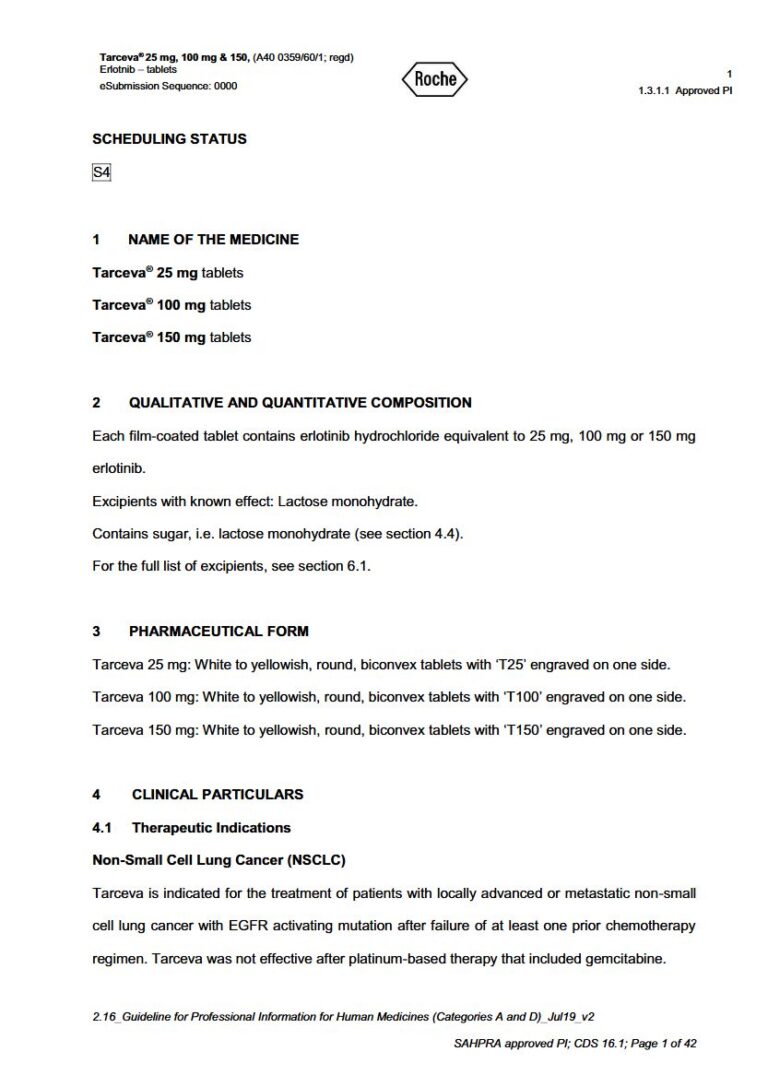
Tarceva is indicated for the treatment of patients with locally advanced or metastatic non-small cell lung cancer with EGFR activating mutation after failure of at least one prior chemotherapy regimen. Tarceva was not effective after platinum-based therapy that included gemcitabine.
Tarceva monotherapy is indicated for the maintenance treatment of patients having received first-line platinum-based (other than gemcitabine + cisplatin) doublets chemotherapy for locally advanced or metastatic NSCLC. No survival benefit or other clinically relevant effects of the treatment have been demonstrated in patients with EGFR-negative tumours. See section 5.1.
Bronchial Adenocarcinoma
Tarceva is indicated for the first-line treatment of patients with locally advanced or metastatic (stage 4) bronchial adenocarcinoma whose tumours have demonstrated EGFR activating mutations and who have never smoked and had ECOG performance status of 0 u2013 1. When prescribing Tarceva, factors associated with prolonged survival should be taken into account. No survival benefit or other clinically relevant effects of the treatment have been demonstrated in patients with EGFR-negative tumours. See section 5.1).
Pancreatic Cancer
Tarceva in combination with gemcitabine is indicated for the first-line treatment of patients with locally advanced, unresectable or metastatic pancreatic cancer.
4.2 Posology and method of administration
Tarceva treatment should be supervised by a medical practitioner experienced in the use of anticancer therapies. Concomitant use of CYP3A4 substrates and modulators may require dose adjustment. See section 4.5. Where dose adjustment is necessary, reduce in 50 mg steps.
Non-Small Cell Lung Cancer and Bronchial Adenocarcinoma:
EGFR mutation testing should be performed prior to initiation of Tarceva therapy in chemo-naive patients with advanced or metastatic NSCLC and bronchial adenocarcinoma. The recommended dose is 150 mg daily taken at least 1 hour before or two hours after the ingestion of food. Where dose adjustment is necessary, reduce in 50 mg steps.
Pancreatic Cancer:
The recommended daily dose of Tarceva is 100 mg taken at least one hour before or two hours after the ingestion of food, in combination with gemcitabine (see gemcitabine package insert for pancreatic cancer indication).
Hepatic impairment:
Erlotinib is eliminated by hepatic metabolism and biliary excretion. Although erlotinib exposure was similar in patients with moderately impaired hepatic function (Child-Pugh score 7 u2013 9) compared with patients with adequate hepatic function, caution should be used when administering Tarceva to patients with hepatic impairment. See section 5.2. Tarceva should not be used in patients with severe hepatic dysfunction (AST/SGOT and ALT/SGPT > 5 x ULN). Dose reduction or interruption of Tarceva should be considered if severe adverse reactions occur. Safety and efficacy have not been studied in patients with severe hepatic dysfunction.
Renal impairment:
The safety and efficacy of Tarceva has not been studied in patients with renal impairment. See section 5.2. Tarceva should not be used in patients with severe renal impairment.
Paediatric use:
The safety and efficacy of Tarceva has not been established in patients under the age of 18 years.
Smokers:
Cigarette smoking has been shown to reduce erlotinib exposure by 50 - 60 %. The maximum tolerated dose of Tarceva in NSCLC and bronchial adenocarcinoma patients who currently smoke cigarettes was 300 mg. The 300 mg dose did not show improved efficacy in second line treatment after failure of chemotherapy compared to the recommended 150 mg dose in patients who continue to smoke cigarettes.
4.3 Contraindications
Severe hypersensitivity to erlotinib or to any of the excipients. Patients with a history of or hereditary galactose intolerance e.g. galactosaemia, Lapp lactase deficiency or glucose-galactose malabsorption.
4.4 Special warnings and precautions for use
Interstitial Lung Disease: Cases of interstitial lung disease (ILD)-like events, including fatalities, have been reported uncommonly in patients receiving Tarceva for treatment of non-small cell lung cancer (NSCLC), pancreatic cancer or other advanced solid tumours. In the pivotal study BR.21 in NSCLC, the incidence of ILD-like events was (0,8 %) the same in both the placebo and the Tarceva groups. In the pancreatic cancer study in combination with gemcitabine, the incidence of ILD-like events was 2,5 % in the Tarceva plus gemcitabine group versus 0,4 % in the placebo plus gemcitabine-treated group. The overall incidence in Tarceva-treated patients from all studies (including uncontrolled studies and studies with concurrent chemotherapy) is approximately 0,6 %. Some examples of reported diagnoses in patients suspected of having ILD-like events, included pneumonitis, radiation pneumonitis, hypersensitivity pneumonitis, interstitial pneumonia, interstitial lung disease, obliterative bronchiolitis, pulmonary fibrosis, Acute Respiratory Distress Syndrome, alveolitis and lung infiltration. These ILD-like events started from a few days to several months after initiating Tarceva therapy. Most of the cases were associated with confounding or contributing factors such as concomitant or prior chemotherapy, prior radiotherapy, pre-existing parenchymal lung disease, metastatic lung disease or pulmonary infections. In patients who develop acute onset of new or progressive unexplained pulmonary symptoms, such as dyspnoea, cough and fever, Tarceva therapy should be interrupted pending diagnostic evaluation. If ILD is diagnosed, Tarceva should be discontinued and appropriate treatment administered as necessary. See section 4.8.
Diarrhoea, Dehydration, Electrolyte Imbalance and Renal Failure: Diarrhoea has occurred in approximately 50 % of patients on Tarceva and moderate or severe diarrhoea should be treated, e.g. with loperamide. In some cases dose reduction may be necessary. In the event of severe or persistent diarrhoea, nausea, anorexia, or vomiting associated with dehydration, Tarceva therapy should be interrupted and appropriate measures should be taken to treat the dehydration. See section 4.8. There have been reports of hypokalaemia and renal failure (including fatalities). Some reports of renal failure were secondary to severe dehydration due to diarrhoea, vomiting and/or anorexia while others were confounded by concomitant chemotherapy. In more severe or persistent cases of diarrhoea, or cases leading to dehydration, particularly in patients with aggravating risk factors (concomitant medications, symptoms or diseases or other predisposing conditions including advanced age), Tarceva therapy should be interrupted and appropriate measures should be taken to intensively rehydrate the patients intravenously. In addition, renal function and serum electrolytes including potassium should be monitored in patients at risk of dehydration.
Hepatitis, hepatic failure: Cases of hepatic failure (including fatalities) have been reported during use of Tarceva. Confounding factors have included pre-existing liver disease or concomitant hepatotoxic medicines. Therefore, in such patients, periodic liver function testing should be considered. Tarceva dosing should be interrupted if changes in liver function are severe. Tarceva is not recommended for use in patients with severe hepatic dysfunction.
Gastrointestinal Perforation: Patients receiving Tarceva are at increased risk of developing gastrointestinal perforation (including some cases with a fatal outcome). Patients receiving concomitant anti-angiogenic agents, corticosteroids, NSAIDs, and/or taxane based chemotherapy, or who have prior history of peptic ulceration or diverticular disease are at increased risk. Tarceva should be permanently discontinued in patients who develop gastrointestinal perforation.
Bullous and exfoliative skin disorders: Bullous, blistering and exfoliative skin conditions have been reported, including cases of Stevens-Johnson syndrome/toxic epidermal necrolysis, which in some cases were fatal. Tarceva treatment should be interrupted or discontinued if the patient develops severe bullous, blistering or exfoliating conditions. For patients who are exposed to sun, protective clothing, and/or use of sun screen (e.g. mineral-containing) may be advisable.
Ocular Disorders: Cases of corneal perforation or ulceration, uveitis, iridocyclitis and iritis have been reported during use of Tarceva. Other ocular disorders including abnormal eyelash growth, keratoconjunctivitis sicca or keratitis have been observed with Tarceva treatment which are also risk factors for corneal perforation/ulceration. Tarceva therapy should be interrupted or discontinued if patients present with acute/worsening ocular disorders such as eye pain.
Smokers: Current smokers should be advised to stop smoking, as plasma concentrations of erlotinib in smokers as compared to non-smokers are reduced. The degree of reduction is likely to be clinically significant (see sections 4.2, 4.5, 5.1 and 5.2).
4.5 Interactions with other medicines
Potential inducers of CYP3A4 may reduce the efficacy of erlotinib whereas potent inhibitors of CYP3A4 may lead to increased toxicity. Concomitant treatment with these types of agents should be avoided (see section 4.5). Other forms of interactions: Erlotinib is characterised by a decrease in solubility above 5. Medicines that alter pH of the upper gastrointestinal tract (GI) tract, like proton pump inhibitors, H2 antagonists and antacids, may alter the solubility of erlotinib and hence its bioavailability. Increasing the dose of Tarceva when co-administered with such agents is not likely to compensate for the loss of exposure. Combination of erlotinib with proton pump inhibitors should be avoided. The effects of concomitant administration of erlotinib with H2 antagonists and antacids are unknown; however, reduced bioavailability is likely. Therefore, concomitant administration of these combinations should be avoided (see section 4.5). If the use of antacids is considered necessary during treatment with Tarceva, they should be taken at least 4 hours before or 2 hours after the daily dose of Tarceva. Tarceva tablets contain lactose and should not be administered to patients with a history of or hereditary, galactose intolerance e.g. galactosaemia, Lapp lactase deficiency or glucose-galactose malabsorption. See section 4.3. In order to improve traceability of biological medicines, the Tarceva should be clearly recorded in the patient file. Substitution by any other biological medicine requires the consent of the prescribing doctor, and the substitute medicine to be recorded in the files. Information as set forth in this package insert only applies to Tarceva.
4.6 Fertility, pregnancy and lactation
Women of childbearing potential/Contraception in males and females
Women of childbearing potential must be advised to avoid pregnancy while on Tarceva. Adequate contraceptive methods should be used during therapy, and for at least 2 weeks after completing therapy. Women who are pregnant and/or breastfeeding should not receive Tarceva.
Pregnancy
There are no studies in pregnant and/or breastfeeding women using Tarceva. Studies in animals have shown no evidence of teratogenicity or abnormal parturition. However, an adverse effect on the pregnancy can not be excluded as rat and rabbit studies have shown increased embryo/foetal lethality. The potential risk for humans is unknown.
Breastfeeding
It is not known whether erlotinib is excreted in human milk. No studies have been conducted to assess the impact of Tarceva on milk production or its presence in breast milk. As the potential harm to the nursing infant is unknown, mothers should be advised against breastfeeding while receiving Tarceva and for at least 2 weeks after the final dose.
Fertility
Studies in animals have shown no evidence of impaired fertility. However, an adverse effect on the fertility cannot be excluded as animal studies have shown effects on reproductive parameters. The potential risk for humans is unknown.
4.7 Effects on ability to drive and use machines
No studies on the effects on the ability to drive and use machines have been performed, however, Tarceva is not associated with impairment of mental ability.
4.8 Undesirable effects
Tarceva monotherapy: The following side effects/adverse events have been observed in clinical studies with bronchial adenocarcinoma. In a randomised, double-blind study (BR.21: Tarceva administered as second-line therapy), rash (75 %) and diarrhoea (54 %) were the most frequent side effects regardless of causality. Most were Grade 1/2 in severity and manageable without intervention. Grade 3/4 rash and diarrhoea occurred in 9 % and 6 %, respectively in Tarceva-treated patients and each resulted in study discontinuation in 1 % of patients. Dose reduction for rash and diarrhoea was needed in 6 and 1 % of patients, respectively. In study BR.21 the median time to onset of rash was 8 days and the median time to onset of diarrhoea was 12 days.
In general, rash manifests as a mild or moderate erythematous and papulopustular rash, which may occur or worsen in sun exposed areas. For patients who are exposed to sun, protective clothing, and/or use of sun screen (e.g. mineral-containing) may be advisable. Skin fissures, mostly non-serious, were reported, most were associated with rash and dry skin. Side effects occurring more frequently (u2265 3 %) in Tarceva-treated patients than in the placebo group, and in at least 10 % of patients in the Tarceva group, are summarised by National Cancer Institute-Common Toxicity Criteria (NCI-CTC) Grade in Table 1 below.
4.9 Overdose
Single oral doses of Tarceva up to 1 000 mg in healthy subjects, and up to 1 600 mg in given as a single dose once weekly cancer patients have been tolerated. Repeated twice daily doses of 200 mg in healthy subjects were poorly tolerated after only a few days of dosing. Based on the data from these studies, severe adverse events such as diarrhoea, rash and possibly liver transaminase elevation may occur above the recommended dose. In case of suspected overdose Tarceva should be withheld and symptomatic treatment initiated.
