
Evorel Sequi 3,1 mg/ 3,2 mg Patch
PDF Leaflet Revision Date: 17 December 2021
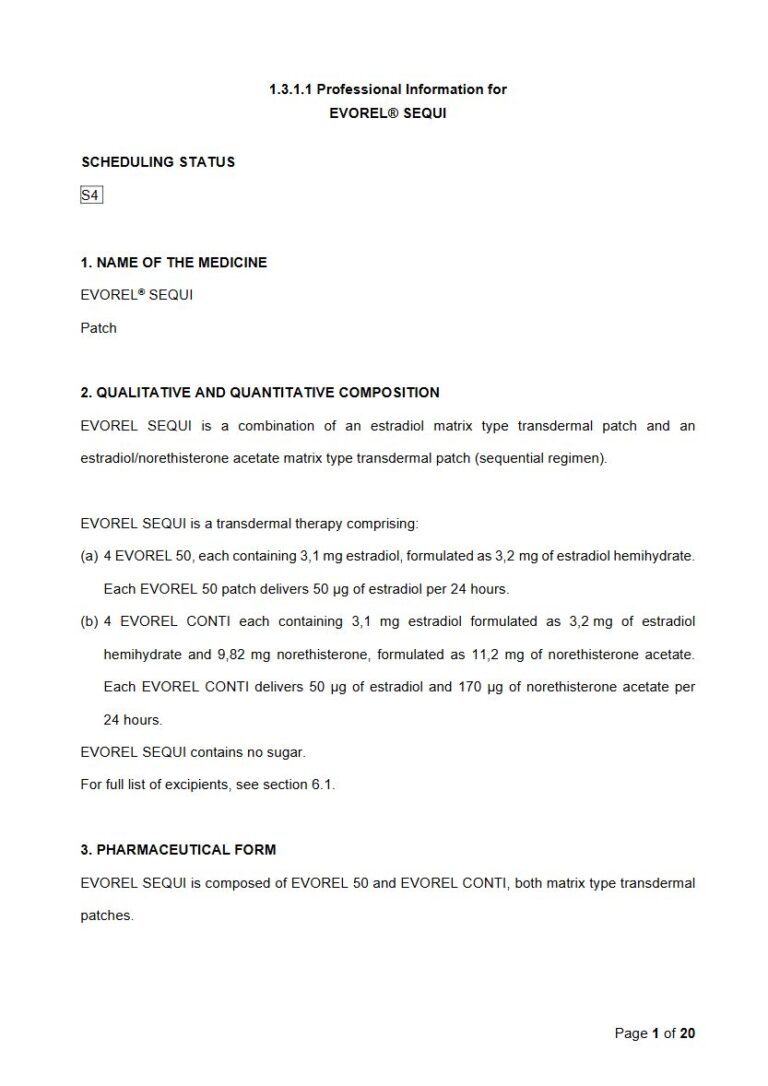
Clinical Summary
Quick overview from the medicine insert
Indication
Hormone replacement therapy for menopausal symptoms.
Dosage (summary)
Apply 4 EVOREL 50 patches followed by 4 EVOREL CONTI patches, twice weekly.
Special Populations
- Elderly
- Liver impairment
- Kidney impairment
Pregnancy & Breastfeeding
Contraindicated in pregnancy and lactation.
Key Drug Interactions
- Barbiturates
- Carbamazepine
- Rifampicin
- St. John's wort
Contraindications
- Hypersensitivity to components
- Breast cancer
- Active liver disease
- Venous thromboembolism
Common side effects
- Depression
- Headache
- Hypertension
- Nausea
Counselling Points
- Apply to clean, dry skin
- Do not use as contraception
- Report any unusual bleeding or mood changes
Serious warnings
- Increased risk of breast cancer
- Risk of venous thromboembolism
- Monitor for mood changes
Important Disclaimer
The Evorel Sequi 3,1 mg/ 3,2 mg Patch professional information leaflet below is the property of Adcock Ingram and is provided on Medinsert exactly as issued, with no.. alterations or editorial changes. We make every effort to keep content current by updating documents as soon as new versions become available. Medinsert serves as a trusted access point for healthcare professionals, but does not replace official sources or clinical judgement. For more details, please read our full disclaimer. read more>>
 Healthcare Professionals Only
This content is for registered healthcare professionals
Sign in or create a free account to read the full package insert.
Free for HPCSA-registered professionals. Powered by Medinsert.
Clinical Particulars
Section 4 of the official insert — extracted exactly as issued, no alterations
4.1 Therapeutic indications
Hormone replacement therapy [HRT] for the relief of menopausal symptoms (vasomotor symptoms such as hot flushes and atrophic vaginitis/vulvitis) for women with an intact uterus.
4.2 Posology and method of administration
Posology
ADULTS: EVOREL 50 and EVOREL CONTI should be applied individually in the following sequence: four EVOREL 50 followed by four EVOREL CONTI. The cycle should be repeated without interruption. Patches should be applied twice weekly, every three to four days, to the trunk below the waist. EVOREL SEQUI should not be continued for longer than 5 years. It is important that the patch be used in the correct sequence to ensure regular cyclic bleeding. Most patients will experience vaginal bleeding after the start of the progestogen therapy. Should a patch fall off, it should be replaced immediately with a new equivalent EVOREL 50 or EVOREL CONTI patch. However, the usual day of changing patches should be maintained. It is not necessary to remove the patch during bathing or showering. It is recommended, however, that the patch be removed prior to a sauna bath, and that a new patch is applied immediately thereafter.
If a patch change is missed, the missed patch should be applied as soon as remembered. However, the usual day of changing patches should be maintained. Forgetting a dose may increase the likelihood of break-through bleeding and spotting.
Special populations
LIVER OR KIDNEY FUNCTION IMPAIRMENT: Insufficient data are available to guide dose adjustments for patients with severe liver or kidney function impairment.
ELDERLY: Data are insufficient in regard to the use of EVOREL SEQUI in the elderly (> 65 years old).
Method of administration
Transdermal use. Directions for use/handling: The EVOREL SEQUI should be placed on a clean, dry, healthy, intact area of skin, on the trunk of the body below the waist. Creams, lotions or powders may interfere with the adhesive properties of the patch. The patch should not be applied on or near the breasts. The area of application should be changed, with an interval of at least one week allowed between applications to a particular site. The skin area selected should not be damaged or irritated. The waistline should not be used because excessive rubbing of the patch may occur. The patch should be used immediately after opening the sachet. Remove one part of the protecting foil. Apply the exposed part of adhesive to the application site from the edge to the middle; avoid wrinkling of the patch.
The second part of the protective foil should now be removed and the freshly exposed adhesive applied. Wrinkling should again be avoided and the palm of the hand used to press the patch onto the skin and to bring the patch to skin temperature at which the adhesive effect is optimised. The patient should avoid contact between fingers and the adhesive part of the patch during application. Should a patch fall off, it should be replaced immediately with a new equivalent EVOREL 50 or EVOREL CONTI patch. However, the usual day of changing patches should be maintained. It is not necessary to remove the patch during bathing or showering. It is recommended, however, that the patch be removed prior to a sauna bath, and that a new patch is applied immediately thereafter. When using EVOREL SEQUI for the first two weeks, one of the EVOREL 50 patches should be applied and changed twice weekly. During the following two weeks of EVOREL SEQUI, one of the EVOREL CONTI patches should be applied, also to be changed twice weekly. The patient then starts again with a new box of EVOREL SEQUI. To remove the EVOREL patch, peel away an edge of the patch and pull smoothly away from the skin. The EVOREL patch should be disposed of in household waste (do not flush down the toilet). Any adhesive that remains on the skin after removal of EVOREL patch may be removed by washing with soap and water or rubbing it off with the fingers.
4.3 Contraindications
- Known hypersensitivity to estradiol, norethisterone acetate or any other component of this product listed in section 6.1.
- Known current, past or suspected breast cancer.
- Family history of breast cancer.
- Known or suspected estrogen-dependent malignant tumours (e.g. endometrial cancer) or pre-malignant tumours (e.g. untreated atypical endometrial hyperplasia).
- Undiagnosed genital bleeding.
- Pregnancy and lactation (see section 4.6).
- Active liver disease, or a history of liver disease as long as liver function tests have failed to return to normal.
- Previous or current venous thromboembolism (deep venous thrombosis, pulmonary embolism).
- Known thrombophilic conditions.
- Inherited thrombophilia.
- Active or past arterial thromboembolic disease (e.g. cerebrovascular accident, myocardial infarction).
- Porphyria.
- Patients known with inherited genetic mutations: BRCA 1 and BRCA 2 genes.
- Early menstrual periods (before age 12 years).
- History of non-cancerous breast diseases (atypical hyperplasia or lobular carcinoma in situ).
- Previous treatment using radiation therapy to the chest or breast.
- Previous treatment with diethylstilboestrol (DES).
- Depression not well controlled with treatment.
- A history of depression with the use of estrogen and/or progesterone/progestogen containing medicines irrespective of the indication, dosage formulation and route of administration.
4.4 Special warnings and precautions for use
Prior to commencing, and periodically during, it is recommended that the patient be given a thorough physical and gynaecological examination. A complete medical and family history of thrombophlebitis or thromboembolic disorders should be taken. Repeated breakthrough bleeding, unexplained vaginal bleeding, and changes noticed during breast examination require further evaluation.
A careful appraisal of the risk/benefit ratio should be undertaken before the initiation of treatment. Conditions which need supervision: If any of the following conditions are present, have occurred previously, and/or have been aggravated during pregnancy or previous hormone treatment, the patient should be closely supervised. It should be taken into account that these conditions may recur or be aggravated during treatment with EVOREL SEQUI in particular:
- Leiomyoma (uterine fibroids) or endometriosis.
- Risk factors for thromboembolic disorders (see below).
- Risk factors for estrogen dependent tumours, e.g. first degree relative with breast cancer.
- Hypertension.
- Liver disorders.
- Diabetes mellitus.
- Cholelithiasis.
- Migraine or severe headache.
- Systemic lupus erythematosus.
- A history of endometrial hyperplasia (see below).
- Epilepsy.
- Mastopathy.
Conditions which require monitoring while on EVOREL SEQUI therapy:
- Estrogens such as in EVOREL SEQUI may cause fluid retention.
- Cardiac or renal dysfunction should be carefully observed.
- Disturbances of liver function.
- History of cholestatic jaundice.
- Pre-existing hypertriglyceridaemia. Cases of large increases of plasma triglycerides leading to pancreatitis have been reported in this condition.
Reasons for immediate withdrawal of therapy:
Therapy should be discontinued in case a contraindication is discovered and in the following situations:
- Jaundice or deterioration in liver function.
- Increase in blood pressure.
- New onset of migraine-type headache.
- Pregnancy.
Breast cancer EVOREL SEQUI contains estrogen only which, on prolonged use, may increase the risk of developing breast cancer. A meta-analysis of prospective epidemiological studies from 1992 to 2018 reported a significant increase in the risk of developing breast cancer in 55 575 women 40 u2013 59 years of age who used menopausal hormone therapy (MHT). The risk increased steadily with duration of use and was slightly greater for estrogen-progestogen than estrogen only preparations, and the risk persisted for more than 10 years after stopping the treatment. The relative risk (RR) to develop breast cancer for estrogen-progestogen preparations was 1,60 at 1 u2013 4 years and RR = 2,08 at 5 u2013 14 years, while that for estrogen only preparations was 1,17 at 1 u2013 4 years and 1,33 at 5 u2013 14 years. There was no risk to develop breast cancer in women who started MHT at 60 years of age. All women on EVOREL SEQUI should receive yearly breast examinations by a healthcare provider and perform monthly breast self-examinations. Mammography evaluations should be done on patient age, risk factors and prior mammogram results.
4.5 Interactions with other medicines and other forms of interaction
Medicines, which induce microsomal liver enzyme activity, may alter estrogen and progestogen metabolism and reduce the therapeutic effect of EVOREL SEQUI. Examples of such medicines are barbiturates, hydantoins, carbamazepine, meprobamate, phenylbutazone, rifampicin, rifabutin, bosentan and certain non-nucleoside reverse transcriptase inhibitors (e.g. nevirapine and efavirenz) used in the treatment of HIV/AIDs infections. Ritonavir and nelfinavir, although known as strong inhibitors of the cytochrome P450 isoenzymes, by contrast exhibit inducing properties when used concomitantly with steroid hormones. Metabolism may be affected by St. Johnu2019s wort preparations (Hypericum perforatum), which induce certain cytochrome P450 isoenzymes in the liver (e.g. CYP 3A4) as well as P-glycoprotein. The induction of the P450 isoenzymes may reduce plasma concentrations of the estrogen component of EVOREL SEQUI possibly resulting in a decrease in therapeutic effects and increased vaginal bleeding.
The induction of these same isoenzymes may also reduce circulating concentrations of the progestin component of EVOREL SEQUI which could result in a diminished effect against estrogen-induced endometrial hyperplasia. Estrogen-containing oral contraceptives have been shown to significantly decrease plasma concentrations of lamotrigine when co-administered due to induction of lamotrigine glucuronidation. This may reduce seizure control. Although the potential interaction between EVOREL SEQUI therapy and lamotrigine has not been studied, it is expected that a similar interaction exists, which may lead to a reduction in seizure control among women taking both medicines together. Therefore, dosage adjustment of lamotrigine may be necessary (see section 4.4).
4.6 Fertility, pregnancy and lactation
Pregnancy
The use of EVOREL SEQUI is contraindicated in pregnancy (see section 4.3). If pregnancy occurs during medication with EVOREL SEQUI, treatment should be withdrawn immediately.
Breastfeeding
The use of EVOREL SEQUI is contraindicated during lactation (see section 4.3).
4.7 Effects on ability to drive and use machines
No information available.
4.8 Undesirable effects
Tabulated summary of adverse reactions Clinical Trial Data The safety of EVOREL SEQUI was evaluated in 165 subjects in 2 active controlled clinical trials. Adverse drug reactions (ADRs) reported for u2265 1 % of EVOREL SEQUI-treated subjects are shown in Table 1. Table 1. Adverse Drug Reactions Reported by u2265 1 % of EVOREL SEQUI - treated Subjects in 2 Clinical Trials of EVOREL SEQUI System/Organ Class Adverse reaction EVOREL SEQUI % (N=165) Psychiatric Disorders Depression Insomnia Nervousness Affect lability 5,5 3,6 2,4 1,2 Nervous System Disorders Headache 7,9 Vascular Disorders Hypertension 4,2 Gastrointestinal Disorders Abdominal pain Gastrointestinal Disorder Nausea 4,9 1,8 1,8 Skin and Subcutaneous Tissue Disorders Pruritus Rash erythematous 1,2 1,2 Musculoskeletal and Connective Tissue Disorders Arthralgia 2,4 Reproductive System and Breast Disorders Breast pain Menorrhagia Dysmenorrhoea Menstrual disorder 6,1 3,0 1,2 1,2 General Disorders and Administration Site Conditions Application site reaction Oedema Malaise 14,6 2,4 1,8 Investigations Increased weight 3,0 ADRs reported by < 1 % of treated subjects (N = 165) in the above clinical trial dataset are shown in Table 2. Table 2. Adverse Drug Reactions Reported by < 1 % treated Subjects in 2 Clinical Trials of EVOREL SEQUI System/Organ Class Side effect Neoplasms Benign, Malignant and Unspecified (Incl Cysts and Polyps) Breast cancer female, fibroadenoma of breast Psychiatric Disorders Decreased libido, increased libido. Nervous System Disorders Disturbance in attention, dizziness Reproductive System and Breast Disorders Endometrial hyperplasia, metrorrhagia General Disorders and Administration Site Conditions Fatigue Additional ADRs reported in clinical trials with an estradiol patch alone in postmenopausal women are shown in Table 3. Table 3. Adverse Drug Reactions Reported by EVOREL-treated Subjects in 15 Clinical Trials (N = 2 584) of EVOREL System/Organ Class Adverse Reaction Infections and Infestations Genital candidiasis Neoplasms Benign, Malignant and Unspecified (Incl. Cysts and Polyps) Breast cancer Immune System Disorders Hypersensitivity Nervous System Disorders Epilepsy Cardiac Disorders Palpitations Vascular Disorders Venous and Arterial Thrombosis and embolism Gastrointestinal Disorders Diarrhoea, flatulence Skin and Subcutaneous Tissue Disorders Rash Musculoskeletal and Connective Tissue Disorders Myalgia General Disorders and Administration Site Conditions Application site rash,* application site pruritus,* application site erythema,* application site oedema,* peripheral oedema, pain * Solicited signs/symptoms (recorded as yes/no) in 8 clinical trials of EVOREL (N = 1 739). Post marketing Data Adverse drug reactions first identified during post-marketing experience with estradiol are included in Table 4. Table 4. Adverse Drug Reactions Identified During Post-Marketing Experience with EVOREL SEQUI Estimated from Spontaneous Reporting Rates Infections and Infestations Candidiasis Neoplasms Benign, Malignant and Unspecified (Incl. Cysts and Polyps) Endometrial cancer Immune System Disorders Hypersensitivity Psychiatric Disorders Mood swings Severe depression with a higher risk of suicidal thoughts/behavior and suicide Nervous System Disorders Cerebrovascular accident, migraine, paraesthesia Cardiac Disorders Palpitations Vascular Disorders Deep vein thrombosis Respiratory, Thoracic and Mediastinal Disorders Pulmonary embolism Gastrointestinal Disorders Abdominal distension Hepatobiliary Disorders Cholelithiasis Skin and Subcutaneous Tissue Disorders Stevens-Johnson Syndrome Musculoskeletal, Connective Tissue, and Bone Disorders Back pain Reproductive System and Breast Disorders Breast enlargement General Disorders and Administration Site Conditions Application site erythema, application site pruritus, application site rash
4.9 Overdose
Symptoms of overdose of EVOREL SEQUI therapy may include nausea, break-through bleeding, breast tenderness, abdominal cramps and/or bloating. These symptoms can be reversed by removing the transdermal patch.
