
Gynoflor 1×10⁸ CFU, 0,03 mg Vaginal Tablet
PDF Leaflet Revision Date: 15 August 2023
Clinical Summary
Quick overview from the medicine insert
Indication
Atrophic vaginitis and symptomatic vaginal atrophy due to oestrogen deficiency.
Dosage (summary)
1 vaginal tablet daily for at least 12 days, then 1 tablet 2-3 times per week.
Onset of Action / Duration
Onset: 6-12 days, Duration: Not specified
Special Populations
- Elderly patients
- Renal insufficiency
- Hepatic insufficiency
Pregnancy & Breastfeeding
May be used during pregnancy after risk assessment; safe during lactation.
Key Drug Interactions
- Anti-infective medicines may reduce efficacy
Contraindications
- Hypersensitivity to active substances
- Breast cancer
- Oestrogen-dependent tumors
- Endometriosis
- Unexplained genital bleeding
- Severe venous thromboembolic disease
- Severe hepatic insufficiency
- Girls before menarche
Common side effects
- Vulvovaginal burning sensation
- Vulvovaginal pruritus
- Vaginitis
Counselling Points
- Insert tablet deeply in the evening
- Report any unexpected bleeding or breast changes
- Use alternative contraception during treatment
Serious warnings
- Monitor for abnormal vaginal bleeding
- Careful assessment of risks and benefits annually
- Discontinue if jaundice or liver function worsens
Important Disclaimer
The Gynoflor 1×10⁸ CFU, 0,03 mg Vaginal Tablet professional information leaflet below is the property of Adcock Ingram and is provided on Medinsert exactly as issued, with no.. alterations or editorial changes. We make every effort to keep content current by updating documents as soon as new versions become available. Medinsert serves as a trusted access point for healthcare professionals, but does not replace official sources or clinical judgement. For more details, please read our full disclaimer. read more>>
 Healthcare Professionals Only
This content is for registered healthcare professionals
Sign in or create a free account to read the full package insert.
Free for HPCSA-registered professionals. Powered by Medinsert.
Clinical Particulars
Section 4 of the official insert — extracted exactly as issued, no alterations
4.1 Therapeutic indications
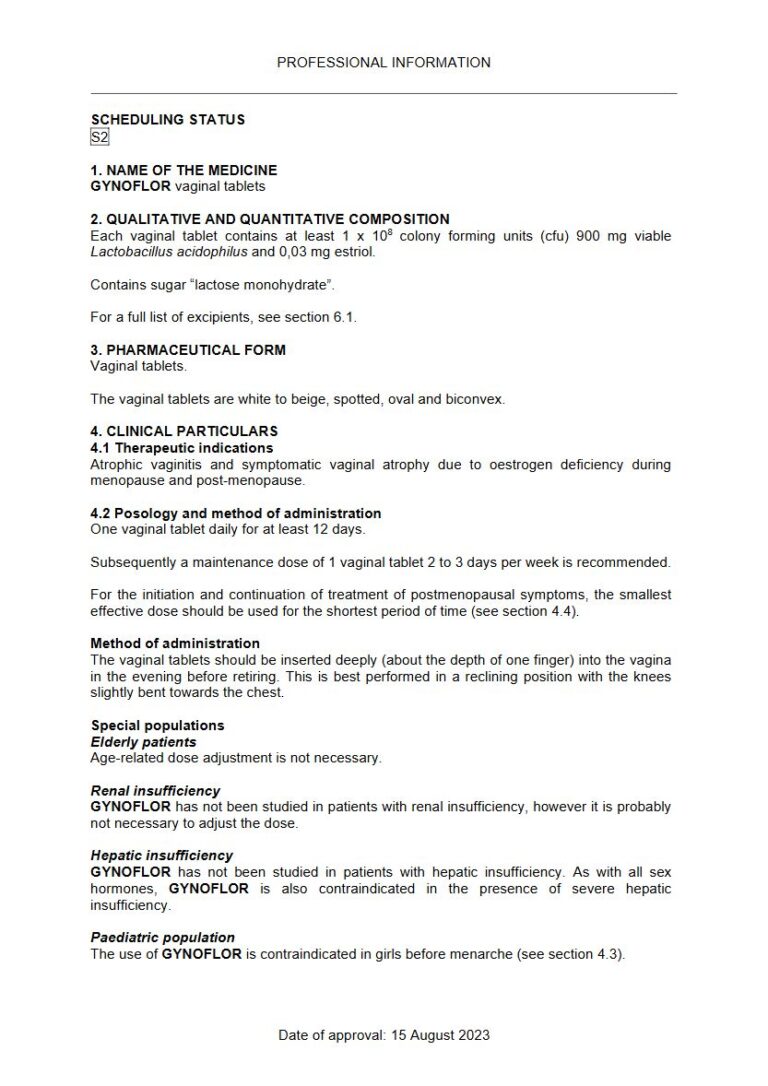
Atrophic vaginitis and symptomatic vaginal atrophy due to oestrogen deficiency during menopause and post-menopause.
4.2 Posology and method of administration
One vaginal tablet daily for at least 12 days. Subsequently a maintenance dose of 1 vaginal tablet 2 to 3 days per week is recommended. For the initiation and continuation of treatment of postmenopausal symptoms, the smallest effective dose should be used for the shortest period of time (see section 4.4).
Method of administration
The vaginal tablets should be inserted deeply (about the depth of one finger) into the vagina in the evening before retiring. This is best performed in a reclining position with the knees slightly bent towards the chest.
Special populations
Elderly patients
Age-related dose adjustment is not necessary.
Renal insufficiency
GYNOFLOR has not been studied in patients with renal insufficiency, however it is probably not necessary to adjust the dose.
Hepatic insufficiency
GYNOFLOR has not been studied in patients with hepatic insufficiency. As with all sex hormones, GYNOFLOR is also contraindicated in the presence of severe hepatic insufficiency.
Paediatric population
The use of GYNOFLOR is contraindicated in girls before menarche (see section 4.3).
If indicated for adolescents who have had their first period, the same dose is recommended as for adults.
4.3 Contraindications
- Hypersensitivity to the active substances or to any of the excipients listed in section 6.1.
- Existing or suspected breast cancer or a history of breast cancer.
- Known or suspected oestrogen-dependent malignant tumours (especially endometrial carcinoma).
- Known or suspected endometriosis.
- Untreated endometrial hyperplasia.
- Unexplained bleeding in the genital area.
- Vaginitis with severe inflammation and purulent infiltrates.
- Previous idiopathic or existing venous thromboembolic disease (especially deep vein thrombosis, pulmonary embolism).
- Known thrombophilia (e.g. protein C, protein S or antithrombin deficiency).
- Existing or recent arterial embolic disease (especially angina pectoris, myocardial infarction).
- Acute liver disease or a history of liver disease if the relevant liver enzyme values have not returned to normal.
- Porphyria.
- GYNOFLOR should not be used in girls before puberty (see section 4.2).
4.4 Special warnings and precautions for use
GYNOFLOR contains only a small amount of estriol of which only a small amount is absorbed. Only slight risks exist during short-term use of this medicine (i.e. over a period of 6 u2013 12 days) in the presence of severe impairment of hepatic, renal and cardiac function, epilepsy or migraine (or history thereof), hypertension, diabetes mellitus, porphyria and hyperlipidaemia. This also applies to patients with severe pruritus, gestational herpes or exacerbation of otosclerosis during early pregnancy and those with a history of thromboembolic events. In the event of a deterioration in any of these conditions, treatment with GYNOFLOR should be discontinued. This also applies if abnormal vaginal bleeding occurs during use.
The following warnings are applicable during long-term treatment with GYNOFLOR. Topical oestrogen therapy should be started only in order to treat postmenopausal symptoms that have a negative impact on quality of life. As with all oestrogen-based medicinal products, there should be a careful assessment of the risks and benefits at least once a year. Treatment should be continued only while the benefits outweigh the risks.
Medical/follow-up examinations
Before the start/resumption of treatment, a complete personal and family history must be obtained from the patient. Furthermore, the patient should undergo a thorough physical and gynaecological examination at regular intervals during treatment with GYNOFLOR. The frequency and nature of the examination should be based on the patientu2019s individual risk situation. Patients should be made aware of what types of changes (e.g. unexpected genital bleeding or changes in the breast) they must report to their doctor.
The examinations, including imaging procedures such as mammography, must be carried out in accordance with currently standard screening practice and the clinical needs of the individual patient.
Situations in which special medical surveillance is required
Postmenopausal patients with vaginal atrophy receiving maintenance therapy with GYNOFLOR should be monitored closely if any of the following situations/conditions are present or existed in the past or got worse during a pregnancy or previous hormone therapy. This also applies where one of the situations or conditions mentioned below occurs or deteriorates during the current course of treatment with GYNOFLOR:
- Risk factors for oestrogen-dependent tumours, e.g. occurrence of breast cancer in a first-degree relative.
- History of endometrial hyperplasia.
- Leiomyoma (fibroids) or endometriosis.
- Risk factors for thromboembolic disorders.
- Migraine or severe headaches.
- Systemic lupus erythematosus.
- Liver disease (e.g. hepatic adenoma).
- Diabetes mellitus with or without vascular involvement.
- Cholelithiasis.
- Hypertension.
- Epilepsy.
- Asthma.
- Otosclerosis.
Reasons for immediate withdrawal of maintenance therapy
Treatment must be discontinued in the presence of a contraindication (see section 4.3) and in the following situations:
- Jaundice or deterioration in liver function.
- Significant increase in blood pressure.
- First-time occurrence of migraine-like headaches or more frequent occurrence of severe headaches.
Endometrial hyperplasia
The risk of endometrial hyperplasia and carcinoma is increased under oral oestrogen monotherapy depending on the duration of treatment and on the oestrogen dose. An increased risk of endometrial hyperplasia or uterine cancer has not been established for monotherapy with vaginal estriol. If long-term treatment is necessary, regular examinations are recommended, with particular attention being paid to symptoms suggestive of endometrial hyperplasia or a malignant disease of the endometrium. If breakthrough bleeding occurs during treatment or persists after the end of treatment, the causes must be investigated. In order to rule out malignant degeneration, an endometrial biopsy may be necessary. Unhindered oestrogen stimulation can lead to premalignant transformation of residual endometrial lesions. This medicine should therefore be used with caution in women who have undergone a hysterectomy because of endometriosis and in whom residual endometriosis is present.
Breast, uterine and ovarian cancer
Systemic oestrogen treatment may increase the risk of certain cancers, especially uterine, ovarian and breast cancer. GYNOFLOR vaginal tablets are administered topically, contain a low dose of estriol, and systemic absorption of estriol after administration of GYNOFLOR is minimal and transient. Therefore, the risk of cancer is not expected to increase as a result of GYNOFLOR therapy.
Venous thromboembolic disease, stroke and coronary artery disease
Hormone replacement therapy with systemic effects is associated with an increased risk of venous thromboembolism (VTE), stroke and coronary artery disease. GYNOFLOR vaginal tablets, which contain a low dose of estriol and are administered topically, should not increase the risk of VTE, stroke or coronary artery disease. The generally acknowledged risk factors for VTE include a personal or family history of VTE, being significantly overweight (BMI > 30 kg/m2) and systemic lupus erythematosus (SLE). There is no consensus regarding the possible role of varicose veins in VTE. Close monitoring of these patients is recommended.
Other disease states
Oestrogens with systemic effects may cause fluid retention or lead to an increase in plasma triglyceride levels. Patients with heart disease, renal impairment or pre-existing hypertriglyceridaemia should be monitored closely during the first few weeks of treatment. GYNOFLOR vaginal tablets contain a low dose of estriol for topical treatment. Systemic effects are therefore not expected. Patients with severe renal insufficiency should be monitored closely because this may result in increased levels of estriol in the blood.
4.5 Interaction with other medicines and other forms of interaction
Lactobacillus acidophilus is sensitive to various anti-infective medicines (local or systemic). Simultaneous treatment with such medicines may lead to a reduction in the efficacy of GYNOFLOR. Because of the very low estriol content in GYNOFLOR and the topical method of administration, clinically relevant interactions are unlikely. No studies are available on possible interactions between GYNOFLOR vaginal tablets and latex products (e.g. condoms, diaphragms, etc.). As a precaution, other methods of contraception should be used during GYNOFLOR use and for the first few days after discontinuation of treatment.
4.6 Fertility, pregnancy and lactation
Pregnancy
There are limited data from studies on the use of GYNOFLOR in pregnancy. They provide no evidence of negative effects on the pregnancy or the health of the foetus/new-born child. Endogenous production by the placenta itself results in a significant increase in estriol levels during pregnancy, about 1 000 times as compared to non-pregnant women. Because estriol is present in a very low dose in GYNOFLOR and undergoes only limited absorption (see section 5.2), adverse effects on the foetus/new-born are unlikely following use of this medicine during pregnancy. Pharmacovigilance data compiled over many years also fail to show any increased risk. Animal studies show adverse effects on the foetus after oral administration of estriol. However, these can be extrapolated to humans only to a limited extent (see section 5.3).
GYNOFLOR may be used during pregnancy after careful assessment of the risks and benefits by a medical practitioner.
Breastfeeding
Estriol is secreted in breast milk. Because of the small quantity and the low vaginal absorption rate of estriol in GYNOFLOR (see section 5.2), GYNOFLOR may be used during lactation.
Fertility
No studies on effects on fertility have been conducted in animals.
4.7 Effects on ability to drive and use machines
No studies have been conducted on the effect of GYNOFLOR on the ability to drive and use machines.
4.8 Undesirable effects
In clinical studies, no serious adverse reactions have been observed. Most of the adverse reactions were local reactions and were experienced shortly after the administration of GYNOFLOR. The most commonly reported adverse reactions during treatment are vulvovaginal burning sensation and vulvovaginal pruritus, both occurring in slightly less than 1 % of patients.
The adverse effects observed in clinical trials involving GYNOFLOR and in the course of post-marketing surveillance are listed below according to organ system and frequency, with frequency being defined as follows: Uncommon (u2265 1/1 000, < 1/100), rare (u2265 1/10 000, < 1/1 000).
Infections and infestations
Uncommon: Vaginitis.
Immune system
Rare: Allergic reaction with redness and pruritus.
Reproductive system and breast disorders
Uncommon: Vulvovaginal pruritus, vaginal discharge, vulvovaginal burning sensation (especially at the start of treatment).
Reporting of suspected adverse reactions
Reporting suspected adverse reactions after authorisation of the medicine is important. It allows continued monitoring of the benefit/risk balance of the medicine. Healthcare providers are asked to report any suspected adverse reactions to SAHPRA via the u201c6.04 Adverse Drug Reactions Reporting Formu201d, found online under SAHPRAu2019s publications: http://www.sahpra.org.za/Publications/Index/8.
4.9 Overdose
No adverse effects occur following a vaginal overdose. There is simply an increase in the number of lactobacilli in the environment of the vagina which is the desired effect of the product. With regards to estriol, a transient increase in serum concentrations is possible. Systemic effects do not usually occur.
