
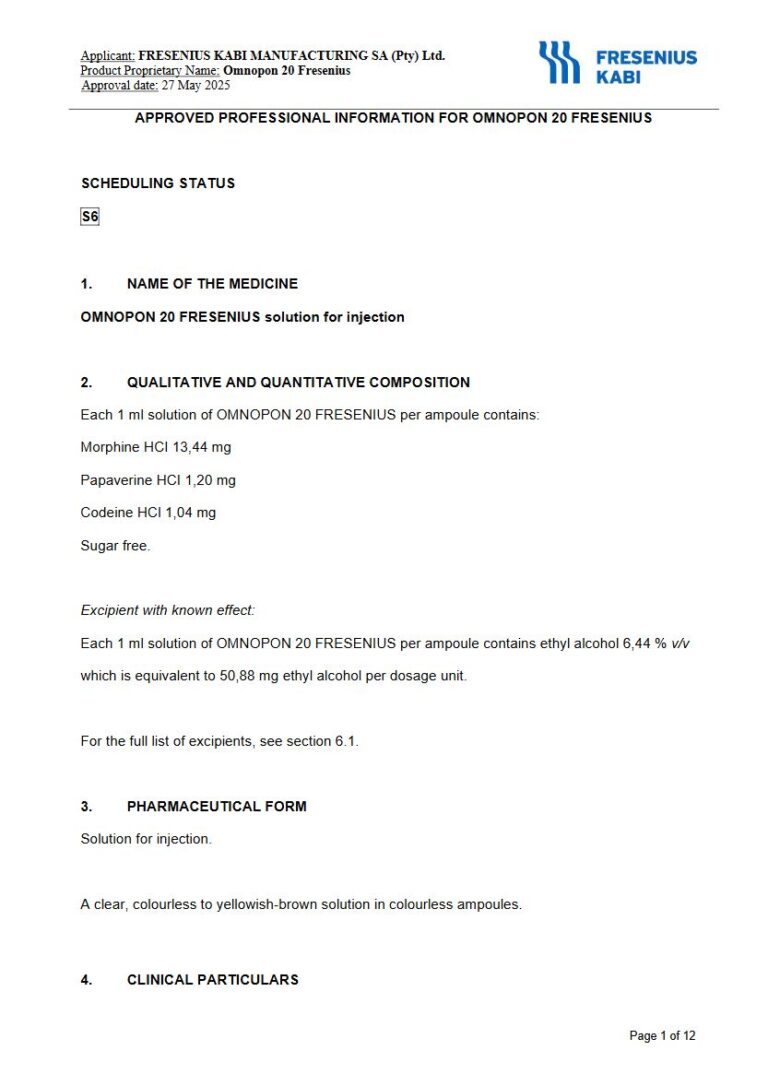
Omnopon 20 Fresenius 1ml Solution for injection.
PDF Leaflet Revision Date: 27 May 2025
Clinical Summary
Quick overview from the medicine insert
Indication
Severe or intractable pain, pre- and post-operative medication.
Dosage (summary)
Adults: 0.5-1.0 ml every 4 hours; Elderly: initial dose not exceeding 0.5 ml.
Special Populations
- Elderly
- Renal impairment
- Hepatic impairment
Pregnancy & Breastfeeding
Crosses placenta and excreted in breast milk; caution advised.
Key Drug Interactions
- CNS depressants
- Monoamine oxidase inhibitors
- Benzodiazepines
Contraindications
- Hypersensitivity to components
- Respiratory depression
- Acute asthma attack
Common side effects
- Nausea
- Constipation
- Drowsiness
- Confusion
Counselling Points
- Avoid driving until effects are known
- Monitor for signs of addiction
- Do not exceed prescribed dose
Serious warnings
- Addiction liability
- Respiratory depression in newborns
- Risk of overdose
Important Disclaimer
The Omnopon 20 Fresenius 1ml Solution for injection. professional information leaflet below is the property of Fresenius Kabi Manufacturing Sa and is provided on Medinsert exactly as issued, with no.. alterations or editorial changes. We make every effort to keep content current by updating documents as soon as new versions become available. Medinsert serves as a trusted access point for healthcare professionals, but does not replace official sources or clinical judgement. For more details, please read our full disclaimer. read more>>
 Healthcare Professionals Only
This content is for registered healthcare professionals
Sign in or create a free account to read the full package insert.
Free for HPCSA-registered professionals. Powered by Medinsert.
Clinical Particulars
Section 4 of the official insert — extracted exactly as issued, no alterations
4.1 Therapeutic indications
OMNOPON 20 FRESENIUS may be used in all cases in which morphine or opium is indicated. 1 ml of OMNOPON 20 FRESENIUS is clinically equivalent to 10 u2013 15 mg of morphine. Indications include the following: Pre- and post-operative medication; severe or intractable pain; cardiac asthma; pulmonary oedema; coronary occlusion; pulmonary embolism.
4.2 Posology and method of administration
Adults: 0,5 u2013 1,0 ml OMNOPON 20 FRESENIUS by subcutaneous or intramuscular injection, usually not given more often than four-hourly. Children 1 u2013 12 years: Usual dose 0,01 u2013 0,015 ml/kg OMNOPON 20 FRESENIUS as maximum single dose Age Approx. body mass: Quantity of OMNOPON 20 FRESENIUS solution required: 1 year 10 kg 0,1 u2013 0,15 ml 12 years 40 kg 0,4 u2013 0,6 ml OMNOPON 20 FRESENIUS may also be administered intravenously in doses of one-quarter to one-half the corresponding subcutaneous or intramuscular dose. A slow rate of intravenous or intramuscular injection is recommended. The use of a small, graduated syringe is recommended for the accurate administration of dosages given to children. In the absence of graduated syringes, OMNOPON 20 FRESENIUS ampoule should be diluted with water for injections before measuring the dose. Maintenance of stability cannot be guaranteed when OMNOPON 20 FRESENIUS ampoule solution is diluted. OMNOPON 20 FRESENIUS ampoules are not recommended for use in babies under one year of age. Elderly: Elderly patients are more sensitive to the actions of narcotic analgesics: the initial dose of OMNOPON 20 FRESENIUS should not exceed 0,5 ml.
4.3 Contraindications
OMNOPON 20 FRESENIUS is contraindicated in:
- Patients that are hypersensitive to morphine, papaverine, codeine or any of the excipients of OMNOPON 20 FRESENIUS, listed in section 6.1.
- Patients with a history of idiosyncratic response to opium alkaloids.
- Respiratory depression, obstructive airway disease and in comatose patients.
- Severe, acute asthma attack.
- Acute alcoholism, convulsive disorders, head injuries and conditions in which intracranial pressure is raised.
- Biliary colic.
- Heart failure secondary to lung disease.
- Phaeochromocytoma.
- Risk of paralytic ileus.
- Patients taking monoamine oxidase inhibitors (including moclobemide) or within 14 days of stopping such treatment.
- Intravenous administration of OMNOPON 20 FRESENIUS is contraindicated in patients with complete atrioventricular block.
4.4 Special warnings and precautions for use
Exceeding the prescribed dose, together with prolonged and continuous use of OMNOPON 20 FRESENIUS, may lead to dependency and addiction. OMNOPON 20 FRESENIUS is an addictive medicine with an addiction liability equal to morphine. OMNOPON 20 FRESENIUS should be given with caution or in reduced doses to old or debilitated patients and to patients with hypothyroidism, hyperthyroidism, adrenocortical insufficiency, impaired kidney or liver function, prostatic hyperplasia, hypotension, shock, inflammatory or obstructive bowel disorders, myasthenia gravis, depressed respiratory reserve or supraventricular tachycardia. Caution is advised in the presence of cardiac conduction disorders or unstable cardiovascular disease. Administration during labour may cause respiratory depression in the newborn infant. Administration to the mother during Caesarean section should only be performed after clamping of the umbilical cord. Great care is required when OMNOPON 20 FRESENIUS is administered to infants, especially neonates, as they may be more sensitive to respiratory depression. Opioid Use Disorder (abuse and dependence). Tolerance and physical and/or psychological dependence may develop upon repeated administration of opioids such as OMNOPON 20 FRESENIUS. Repeated use of OMNOPON 20 FRESENIUS can lead to Opioid Use Disorder (OUD). A higher dose and longer duration of opioid treatment can increase the risk of developing OUD. Abuse or intentional misuse of OMNOPON 20 FRESENIUS may result in overdose and/or death. The risk of developing OUD is increased in patients with a personal or a family history (parents or siblings) of substance use disorders (including alcohol use disorder), in current tobacco users or in patients with a personal history of other mental health disorders (e.g., major depression, anxiety and personality disorders). Before initiating treatment with OMNOPON 20 FRESENIUS and during the treatment, treatment goals and a discontinuation plan should be agreed with the patient (see section 4.2). Before and during treatment the patient should also be informed about the risks and signs of OUD. If these signs occur, patients should be advised to contact their physician. Patients will require monitoring for signs of drug-seeking behaviour (e.g., too early requests for refills). This includes the review of concomitant opioids and psycho-active medicine (like benzodiazepines). For patients with signs and symptoms of OUD, consultation with an addiction specialist should be considered. Treatment goals and discontinuation Before initiating treatment with OMNOPON 20 FRESENIUS, a treatment strategy including treatment duration and treatment goals, and a plan for end of the treatment, should be agreed together with the patient, in accordance with pain management guidelines. During treatment, there should be frequent contact between the physician and the patient to evaluate the need for continued treatment, consider discontinuation and to adjust dosages if needed. When a patient no longer requires therapy with OMNOPON 20 FRESENIUS it may be advisable to taper the dose gradually to prevent symptoms of withdrawal. In absence of adequate pain control, the possibility of hyperalgesia, tolerance and progression of underlying disease should be considered (see section 4.4). Risk from concomitant use of sedative medicines such as benzodiazepines or related medicines: Concomitant use of OMNOPON 20 FRESENIUS and sedative medicines such as benzodiazepines or related medicines may result in sedation, respiratory depression, coma and death. Because of these risks, concomitant prescribing with these sedative medicines should be reserved for patients for whom alternative treatment options are not possible. If a decision is made to prescribe OMNOPON 20 FRESENIUS concomitantly with sedative medicines, the lowest effective dose should be used, and the duration of treatment should be as short as possible. The patients should be followed closely for signs and symptoms of respiratory depression and sedation. In this respect, it is strongly recommended to inform patients and their caregivers to be aware of these symptoms (see section 4.5). Ethyl alcohol content: OMNOPON 20 FRESENIUS contains 50,88 mg ethyl alcohol per dosage unit.
4.5 Interaction with other medicines and other forms of interaction
OMNOPON 20 FRESENIUS must not be administered within two weeks of administration of monoamine oxidase inhibitors (see section 4.3). The concomitant use of opioids as in OMNOPON 20 FRESENIUS with sedative medicines such as benzodiazepines or related medicines increases the risk of sedation, respiratory depression, coma and death because of additive CNS depressant effect. The dose and duration of concomitant use should be limited (see section 4.4). The depressant effects are enhanced by CNS depressants such as alcohol, anaesthetics, hypnotics and sedatives, tricyclic antidepressants and phenothiazines. Cyclizine may counteract the haemodynamic benefits of OMNOPON 20 FRESENIUS. OMNOPON 20 FRESENIUS may enhance the sedative and hypotensive effects of antipsychotics. The sedative effects of anxiolytics may be enhanced by the simultaneous use of OMNOPON 20 FRESENIUS. The gastrointestinal effects of OMNOPON 20 FRESENIUS may delay the absorption of other compounds or may be counteractive as with metoclopramide. OMNOPON 20 FRESENIUS should not be used as premedication when ciprofloxacin is used for surgical prophylaxis as serum levels of ciprofloxacin are reduced and adequate cover may not be obtained during surgery.
4.6 Fertility, pregnancy and lactation
OMNOPON 20 FRESENIUS crosses the placenta and is also excreted in breast milk. This should be borne in mind when considering its use in patients during pregnancy or breastfeeding (see section 4.4).
4.7 Effects on ability to drive and use machines
OMNOPON 20 FRESENIUS may cause drowsiness. OMNOPON 20 FRESENIUS may modify patientsu2019 reactions (driving ability, behaviour in traffic, etc.) to a varying extent depending on the dosage administered and individual susceptibility. Patients should be warned not to drive a vehicle and use machinery until any effects have worn off.
4.8 Undesirable effects
In normal doses the most common side effects are nausea, anorexia, constipation, confusion, sweating and occasionally vomiting. Adverse reactions are listed below as MedDRA preferred term by system organ class and frequency. Frequencies are defined as: very common (>1/10), common (u22651/100 and <1/10), uncommon (u22651/1 000 and <1/100), rare (u22651/10 000 to <1/1 000), very rare (<1/10 000), frequency not known (cannot be estimated from the available data). The following side effects may occur (some of these effects occur more commonly in ambulant patients than in those at rest in bed):
- Immune system disorders: Rare: Anaphylactic reactions. Common: Dose-related histamine-releasing effect which may be responsible in part for reactions such as urticaria, pruritis, hypotension and flushing.
- Psychiatric disorders: Very common: Hallucinations, dysphoria, tolerance*. Common: Mood changes. Frequency not known: Dependence*.
- Nervous system disorders: Very common: Drowsiness. Common: Dry mouth, headache, vertigo, raised intracranial pressure, convulsions (especially in infants and children), hypothermia. Frequency not known: Dizziness, restlessness.
- Eye disorders: Common: Miosis.
- Cardiac disorders: Common: Bradycardia, tachycardia. Frequency not known: Palpitations.
- Vascular disorders: Common: Facial flushes, orthostatic hypotension, hypotension (following larger doses).
- Respiratory, thoracic and mediastinal disorders: Very common: Respiratory depression (following larger doses), with circulatory failure and deepening coma. Death may occur from respiratory failure.
- Hepato-biliary disorders: Frequency not known: Jaundice, eosinophilia and signs of altered liver function may occur.
- Musculoskeletal and connective tissue disorders: Frequency not known: Muscle rigidity has been reported following high doses.
- Renal and urinary disorders: Frequency not known: Micturition may be difficult and there may be ureteric or biliary spasm; an antidiuretic effect is also possible.
- Reproductive system and breast disorders: Common: Decreased libido or potency.
- General disorders and administration site conditions: Common: Contact dermatitis has been reported and pain and irritation may occur on injection.
4.9 Overdose
Signs and symptoms of overdosage:
- Coma.
- Depressed respiration.
- Pinpoint pupils.
- Cold, clammy skin.
- Muscle flaccidity.
- Nausea and vomiting.
- Hypotension.
- Dilatation of the pupils occurs as hypoxia develops.
- Pulmonary oedema.
- Convulsions (especially in children).
- Rhabdomyolysis leading to renal failure.
- Circulatory failure may occur in severe cases.
- Maintain respiratory status by suitable means such as establishing a patent airway and ventilating the patient.
- Narcotic antagonists such as naloxone should be administered to reverse severe narcotic induced respiratory depression. If naloxone is not available, nalorphine or levallorphan should be used. It should be borne in mind that the half-life of OMNOPON 20 FRESENIUS is significantly longer than the duration of action of naloxone. Ventilatory depression may recur and further ventilatory support and/or repeat doses of naloxone may be necessary.
