
Fml Liquifilm 1,0 mg/ml Sterile Eye Suspension
PDF Leaflet Revision Date: 30 March 2022
Clinical Summary
Quick overview from the medicine insert
Indication
Steroid responsive inflammation of the eye.
Dosage (summary)
1-2 drops into the conjunctival sac 2-4 times daily; may increase to 2 drops hourly for the first 48 hours.
Special Populations
- Children under 2 years
- Patients with extensive ocular surface disease
Pregnancy & Breastfeeding
Not established as safe in pregnancy; not recommended during breastfeeding.
Key Drug Interactions
- CYP3A inhibitors may increase systemic corticosteroid effects
Contraindications
- Hypersensitivity to fluorometholone
- Viral diseases of the eye
- Fungal infections of ocular structures
Common side effects
- Increased intraocular pressure
- Eye irritation
- Blurred vision
- Eye pain
Counselling Points
- Remove contact lenses before use
- Wait 15 mins before reinserting lenses
- Report any visual disturbances
Serious warnings
- Prolonged use may cause glaucoma
- Regular ophthalmologic examination required
- Caution in herpes simplex keratitis
Important Disclaimer
The Fml Liquifilm 1,0 mg/ml Sterile Eye Suspension professional information leaflet below is the property of AbbVie and is provided on Medinsert exactly as issued, with no.. alterations or editorial changes. We make every effort to keep content current by updating documents as soon as new versions become available. Medinsert serves as a trusted access point for healthcare professionals, but does not replace official sources or clinical judgement. For more details, please read our full disclaimer. read more>>
 Healthcare Professionals Only
This content is for registered healthcare professionals
Sign in or create a free account to read the full package insert.
Free for HPCSA-registered professionals. Powered by Medinsert.
Clinical Particulars
Section 4 of the official insert — extracted exactly as issued, no alterations
4.1 Therapeutic indications
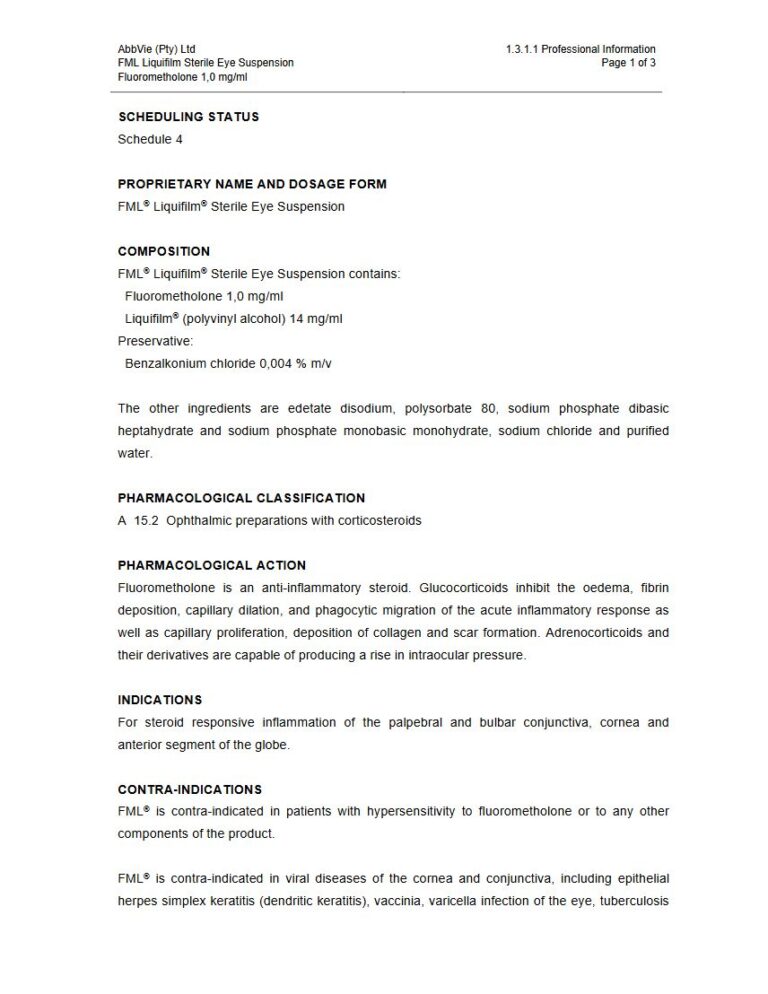
For steroid responsive inflammation of the palpebral and bulbar conjunctiva, cornea and anterior segment of the globe.
4.2 Posology and method of administration
1 to 2 drops instilled into the conjunctival sac two to four times daily. During the initial 24 to 48 hours the dosage may be safely increased to 2 drops every hour. Care should be taken not to discontinue therapy prematurely. Shake well before use. Apply the eye drops in the following way:
- Tilt your head back and look upward.
- Gently pull the lower eyelid down until there is a small pocket.
- Squeeze the upturned dropper bottle to release a drop into your eye.
- Release the lower lid and close your eye for 30 seconds.
4.3 Contraindications
FML u00ae is contra-indicated in patients with hypersensitivity to fluorometholone or to any other components of the product. FML u00ae is contra-indicated in viral diseases of the cornea and conjunctiva, including epithelial herpes simplex keratitis (dendritic keratitis), vaccinia, varicella infection of the eye, tuberculosis of the eye and fungal diseases of ocular structures.
4.4 Special warnings and precautions for use
As the possibility of adverse effects on the corneal permeability and the danger of disruption of the corneal epithelium with prolonged or repeated usage of benzalkonium chloride preserved ophthalmologic preparations cannot be excluded, regular ophthalmologic examination is required. Caution should be exercised in the use of benzalkonium chloride preserved topical medication over an extended period in patients with extensive ocular surface disease. Use of intraocular steroids may prolong the course and may exacerbate the severity of many viral infections of the eye (including herpes simplex). Steroid medication in the treatment of herpes simplex keratitis requires great caution: frequent slit-lamp microscopy is mandatory. Prolonged use may result in elevated intraocular pressure (IOP), glaucoma, damage to the optic nerve, defects in visual acuity and fields of vision, posterior subcapsular cataract formation, and delayed wound healing; or may aid in the establishment of secondary ocular infections from fungi or viruses liberated from ocular tissue. Steroids should be used with caution in the presence of glaucoma. Intraocular pressure should be checked frequently. In those diseases causing thinning of the cornea or sclera, perforation has been known to occur with use of topical steroids. Acute untreated infection of the eye may be masked or activity enhanced by presence of steroid medication. Safety and effectiveness have not been demonstrated in children of the age group two years or below. The preservative in FML u00ae , benzalkonium chloride, may be absorbed by, and cause discolouration of soft contact lenses. Patients wearing soft contact lenses should be instructed to remove contact lenses prior to administration of the solution and wait at least 15 minutes after instilling FML u00ae before reinserting soft contact lenses. As fungal infections of the cornea are particularly prone to develop coincidentally with long term local steroid applications, fungus invasion must be suspected in any persistent corneal ulceration where a steroid has been or is in use. Fungal cultures should be taken when appropriate. FML u00ae , containing corticosteroids should not be used for more than 10 days except under strict ophthalmic supervision with regular checks for intraocular pressure. To prevent eye injury or contamination, care should be taken to avoid touching the bottle tip to the eye or to any other surface. The use of the bottle by more than one person may spread infection. Keep bottle tightly closed when not in use. Visual disturbance may be reported with systemic and topical corticosteroid use. If a patient presents with symptoms such as blurred vision or other visual disturbances, consider evaluating for possible causes which may include cataract, glaucoma or rare diseases such as central serous chorioretinopathy (CSCR) which have been reported after use of systemic and topical corticosteroids.
4.5 Interactions with other medicines
Although the systemic exposure is expected to be low with topical ophthalmic corticosteroid administration, co-treatment with CYP3A inhibitors may increase the risk of systemic corticosteroid-related side effects.
4.6 Fertility, pregnancy and lactation
The safe use of FML u00ae has not been established in humans during pregnancy. Administration of corticosteroids to pregnant animals has been associated with abnormalities of foetal development. FML u00ae has been shown to be embryocidal, foetotoxic, and teratogenic in rabbits when administered by ocular instillation. It is not known whether topical ophthalmic administration of FML u00ae could result in sufficient systemic absorption to produce detectable quantities in human breast milk, therefore, FML u00ae is not recommended for breastfeeding women.
4.7 Effects on ability to drive and use machines
Transient blurred vision may occur at instillation. The patient should wait until the vision clears before driving or using machinery.
4.8 Undesirable effects
Although systemic effects are uncommon, there have been reports of systemic hypercorticoidism after the use of topical steroids, such as FML u00ae. Post-marketing experience The following side effects have been identified during post-marketing use of FML u00ae. Because post-marketing reporting is voluntary and from a population of uncertain size, it is not possible to reliably estimate the frequency of these reactions:
Eye disorders: Intraocular pressure increased. Eye irritation, conjunctival/ocular hyperaemia, eye pain, visual disturbance, foreign body sensation, eyelid oedema, blurred vision, eye discharge, eye pruritus, lacrimation increased, eye oedema / eye swelling, mydriasis, cataract (including subcapsular), ulcerative keratitis, ocular infection (including bacterial, fungal, and viral infections), visual field defect, punctate keratitis. Increased intraocular pressure with optic nerve damage, including glaucoma, resulting in decrease of visual acuity or field defects.
Immune system disorders: Hypersensitivity
Nervous system disorders: Dysgeusia
Skin and subcutaneous tissue disorders: Rash
4.9 Overdose
Refer to u2018Side Effects and Special Precautionsu2019 listed above. Administer symptomatic treatment, if necessary. If accidentally ingested, drink fluids to dilute.
