
Rekovelle 12 micrograms/0,36 ml/36 micrograms/1,08 ml
PDF Leaflet Revision Date: 18 May 2021
Clinical Summary
Quick overview from the medicine insert
Indication
Controlled ovarian stimulation in women undergoing ART.
Dosage (summary)
Individualized based on AMH and body weight; max 24 micrograms.
Onset of Action / Duration
Onset: 5-20 days for follicular development.
Special Populations
- Renal impairment
- Hepatic impairment
- Elderly
- Paediatric population
Pregnancy & Breastfeeding
Contraindicated in pregnancy and breastfeeding.
Contraindications
- Hypersensitivity to active substance
- Tumours of hypothalamus or pituitary gland
- Ovarian enlargement or cysts not due to PCOS
- Gynaecological haemorrhages of unknown aetiology
- Ovarian, uterine or mammary carcinoma
- Pregnancy and lactation
- Not for use in males
Common side effects
- Headache
- Pelvic discomfort
- Ovarian hyperstimulation syndrome (OHSS)
- Pelvic pain
- Nausea
- Fatigue
Counselling Points
- Monitor for OHSS symptoms.
- Educate on injection technique.
- Discuss risks of multiple pregnancies.
- Avoid pregnancy during treatment.
Serious warnings
- Risk of OHSS
- Thromboembolic events
- Ovarian torsion
- Multiple pregnancy risk
- Pregnancy loss risk
- Ectopic pregnancy risk
Important Disclaimer
The Rekovelle 12 micrograms/0,36 ml/36 micrograms/1,08 ml professional information leaflet below is the property of Ferring and is provided on Medinsert exactly as issued, with no.. alterations or editorial changes. We make every effort to keep content current by updating documents as soon as new versions become available. Medinsert serves as a trusted access point for healthcare professionals, but does not replace official sources or clinical judgement. For more details, please read our full disclaimer. read more>>
 Healthcare Professionals Only
This content is for registered healthcare professionals
Sign in or create a free account to read the full package insert.
Free for HPCSA-registered professionals. Powered by Medinsert.
Clinical Particulars
Section 4 of the official insert — extracted exactly as issued, no alterations
4.1 Therapeutic indications
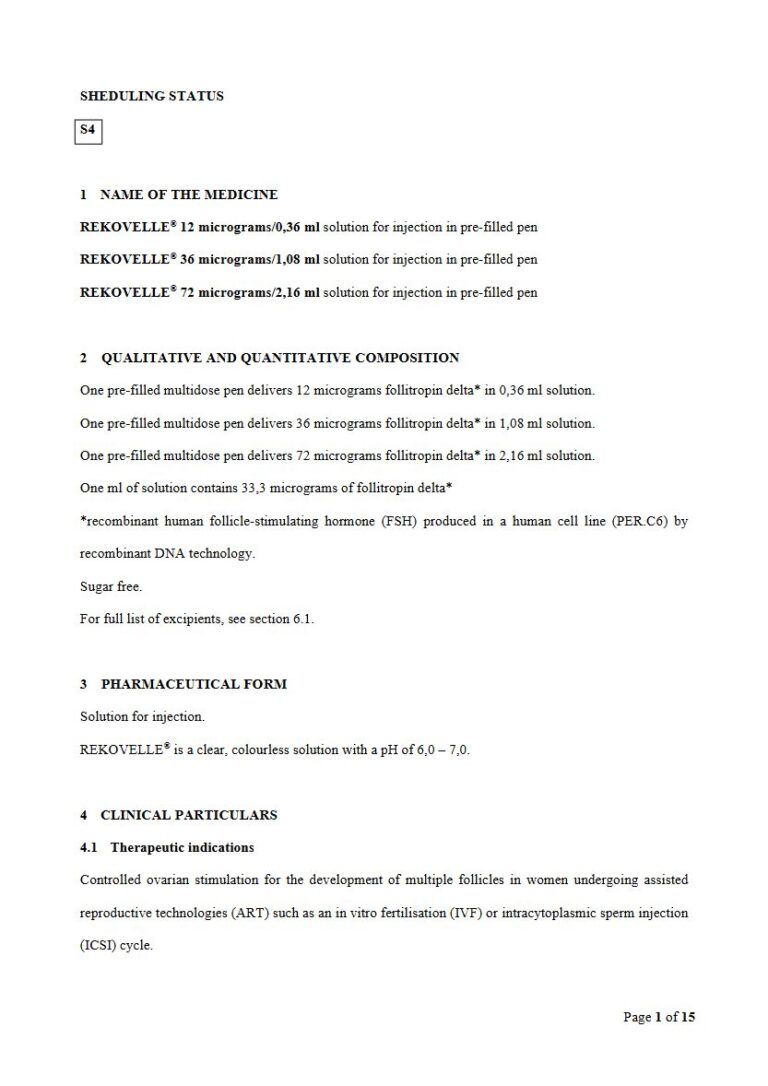
Controlled ovarian stimulation for the development of multiple follicles in women undergoing assisted reproductive technologies (ART) such as an in vitro fertilisation (IVF) or intracytoplasmic sperm injection (ICSI) cycle.
4.2 Posology and method of administration
Treatment with REKOVELLE should be initiated under the supervision of a medical practitioner experienced in the treatment of fertility problems. Pregnancy should be excluded before initiation of treatment.
Posology
The posology of REKOVELLE is individualised for each patient and aims to obtain an ovarian response which is associated with a favourable safety/efficacy profile i.e. aims to achieve an adequate number of oocytes retrieved and reduce the interventions to prevent ovarian hyperstimulation syndrome (OHSS). REKOVELLE is dosed in micrograms (see section 5.1). The dosing regimen is specific for REKOVELLE and the microgram dose cannot be applied to other gonadotropins. For the first treatment cycle, the individual daily dose will be determined on the basis of the womanu2019s serum anti-Mu00fcllerian hormone (AMH) concentration and her body weight. The dose should be based on a recent determination of AMH (i.e. within the last 12 months) measured by the following diagnostic test from Roche: ELECSYS AMH Plus immunoassay (see section 4.4 Special warnings and Precautions for use). The individual daily dose is to be maintained throughout the stimulation period. For women with AMH <15 pmol/L the daily dose is 12 micrograms, irrespective of body weight. For women with AMH u2265 15 pmol/L the daily dose decreases from 0,19 to 0,10 micrograms/kg by increasing AMH concentration (Table 4). The dose is to be rounded off to the nearest 0,33 micrograms to match the dosing scale on the injection pen. The maximum daily dose for the first treatment cycle is 12 micrograms. For calculation of the REKOVELLE dose, the body weight is to be measured without shoes and overcoat just prior to start of stimulation.
Table 4 Dosing regimen for first treatment cycle with REKOVELLE
AMH (pmol/L) <15 15-16 17 18 19-20 21-22 23-24 25-27 28-32 33-39 u2265 40
Fixed daily dose of REKOVELLE 12 0,19 0,18 0,17 0,16 0,15 0,14 0,13 0,12 0,11 0,10 mcg mcg/kg
The AMH concentration is to be expressed in pmol/L and is to be rounded off to the nearest integer. If the AMH concentration is in ng/ml, the concentration should be converted to pmol/L by multiplying with 7,14 (ng/ml x 7,14 = pmol/L) before use. mcg: micrograms
Treatment with REKOVELLE should be initiated day 2 or 3 after start of menstrual bleeding, and continue until adequate follicular development (u2265 3 follicles u2265 17 mm) has been achieved, which on average is by the ninth day of treatment (range 5 to 20 days). A single injection of 250 micrograms recombinant human chorionic gonadotropin (hCG) or 5,000 IU hCG is administered to induce final follicular maturation. In patients with excessive follicular development (of u2265 25 follicles u2265 12 mm), treatment with REKOVELLE should be stopped and triggering of final follicular maturation with hCG should not be performed. In these patients, administration of a GnRH agonist instead of hCG could be considered for triggering of final follicular maturation. Administration of GnRH agonist can reduce, but not eliminate, the risk for OHSS and is applicable only for GnRH antagonist cycles. In case of GnRH agonist administration, embryos should not be replaced in the fresh cycle but cryopreserved for later use. In patients with excessive ovarian response of >35 follicles with a diameter u2265 12 mm, triggering of final follicular maturation should not be performed and the cycle cancelled. For subsequent treatment cycles, the daily dose of REKOVELLE should be maintained or modified according to the patientu2019s ovarian response in the previous cycle. If the patient had adequate ovarian response in the previous cycle without developing OHSS, the same daily dose should be used. In case of ovarian hypo-response in the previous cycle, the daily dose in the subsequent cycle should be increased by 25 % or 50 %, according to the extent of response observed. In case of ovarian hyper-response in the previous cycle, the daily dose in the subsequent cycle should be decreased by 20 % or 33 %, according to the extent of response observed. In patients who developed OHSS or were at risk of OHSS in a previous cycle, the daily dose for the subsequent cycle is 33 % lower than the dose used in the cycle where OHSS or risk of OHSS occurred. The maximum daily dose is 24 micrograms.
Special populations
Patients with renal and hepatic impairment
Safety, efficacy and pharmacokinetics of REKOVELLEu00ae in patients with renal or hepatic impairment have not been specifically studied in clinical trials. Although limited, data did not indicate a need for a different dosing regimen of REKOVELLEu00ae in this patient population (see section 4.4 Special Warnings and Precautions for use).
Patients with polycystic ovaries
Anovulatory patients with polycystic ovarian syndrome have not been studied. Ovulatory patients with polycystic ovaries have been included in clinical trials (see section 5.1 Pharmacodynamic properties).
Elderly
There is no relevant use of REKOVELLEu00ae in the elderly population.
Paediatric population
There is no relevant use of REKOVELLEu00ae in the paediatric population.
Method of administration
REKOVELLEu00ae is intended for subcutaneous use, preferably in the abdominal wall. The first injection should be performed under direct medical supervision. Patients must be educated on how to use the REKOVELLEu00ae injection pen and to perform injections. Self-administration should only be performed by patients who are well motivated, adequately trained and have access to expert advice.
4.3 Contraindications
- hypersensitivity to the active substance or to any of the excipients
- tumours of the hypothalamus or pituitary gland
- ovarian enlargement or ovarian cyst not due to polycystic ovarian syndrome
- gynaecological haemorrhages of unknown aetiology
- ovarian, uterine or mammary carcinoma
- pregnancy and lactation (see section 4.6 Fertility, pregnancy and lactation)
- not for use in males
In the following situations, treatment outcome is unlikely to be favourable, and therefore REKOVELLEu00ae should not be administered:
- primary ovarian failure
- malformations of sexual organs incompatible with pregnancy
- fibroid tumours of the uterus incompatible with pregnancy
4.4 Special warnings and precautions for use
REKOVELLEu00ae contains a potent gonadotropic substance capable of causing adverse reactions, and should only be used by medical practitioners who are thoroughly familiar with infertility problems and their management. Gonadotropin therapy requires time commitment by medical practitioners and supportive healthcare professionals, as well as the availability of appropriate monitoring facilities. Safe and effective use of REKOVELLEu00ae calls for monitoring of ovarian response with ultrasound alone, or in combination with measurement of serum estradiol levels, on a regular basis. The dose of REKOVELLE is individualised for each patient to obtain an ovarian response with favourable safety/efficacy profile.
There is limited experience of safety and efficacy in women above 40 years of age. Safety and efficacy in use for more than 3 cycles has not been established. There may be a degree of interpatient variability in response to FSH administration, with poor response to FSH in some patients and exaggerated response in others. Before starting treatment, the coupleu2019s infertility should be assessed as appropriate and putative contraindications for pregnancy evaluated. In particular, patients should be evaluated for hypothyroidism and hyperprolactinaemia, and the appropriate specific treatment should be given. Use of results obtained with other assays than the ELECSYS AMH Plus immunoassay from Roche for REKOVELLEu00ae dose determination is not recommended, as there currently is no standardisation of available AMH assays. Patients undergoing stimulation of follicular growth may experience ovarian enlargement and may be at risk of developing OHSS. Adherence to the REKOVELLEu00ae dose and regimen of administration and careful monitoring of therapy will minimise the incidence of such events.
Ovarian Hyperstimulation Syndrome (OHSS)
A certain degree of ovarian enlargement is an expected effect of controlled ovarian stimulation. It is more commonly seen in patients with polycystic ovarian syndrome and usually regresses without treatment. In distinction to uncomplicated ovarian enlargement, OHSS is a condition that can manifest itself with increasing degrees of severity. It comprises marked ovarian enlargement, high serum sex steroids, and an increase in vascular permeability which can result in an accumulation of fluid in the peritoneal, pleural and in the pericardial cavities.
It is important to stress the value of careful and frequent monitoring of follicular development in order to reduce the risk of OHSS. The following symptoms may be observed in severe cases of OHSS: abdominal pain, discomfort and distension, severe ovarian enlargement, weight gain, dyspnoea, oliguria and gastrointestinal symptoms including nausea, vomiting and diarrhoea. Clinical evaluation may reveal hypovolaemia, haemoconcentration, electrolyte imbalances, ascites, haemoperitoneum, pleural effusions, hydrothorax, or acute pulmonary distress. Severe OHSS may be complicated by ovarian torsion or thromboembolic events such as pulmonary embolism, ischaemic stroke or myocardial infarction. Excessive ovarian response to gonadotropin treatment seldom gives rise to OHSS unless hCG is administered to trigger final follicular maturation. Furthermore, the syndrome may be more severe and more protracted if pregnancy occurs. Therefore, in cases of ovarian hyperstimulation it is prudent to withhold hCG and advise the patient to refrain from coitus or to use barrier contraceptive methods for at least 4 days. Other measures to be considered to reduce the risk of OHSS include administration of GnRH agonist instead of hCG for triggering of final follicular maturation. Administration of GnRH agonist can reduce, but not eliminate, the risk for OHSS and is applicable only for GnRH antagonist cycles. OHSS may progress rapidly (within 24 hours to several days) to become a serious medical event. It most often occurs after hormonal treatment has been discontinued. Also, as a consequence of the hormonal changes during pregnancy, late development of OHSS can occur. Because of the risk of developing OHSS patients should be followed for at least two weeks after triggering of final follicular maturation.
Thromboembolic events
Women with recent or ongoing thromboembolic disease or women with generally recognised risk factors for thromboembolic events, such as personal or family history, severe obesity (body mass index >30 kg/m2) or thrombophilia may have an increased risk of venous or arterial thromboembolic events, during or following treatment with gonadotropins. Treatment with gonadotropins may further increase the risk for aggravation or occurrence of such events.
Ovarian torsion
Occurrence of ovarian torsion has been reported for ART cycles. It may be associated with other risk factors such as OHSS, pregnancy, previous abdominal surgery, past history of ovarian torsion, previous or current ovarian cyst and polycystic ovaries. Damage to the ovary due to reduced blood supply can be limited by early diagnosis and immediate detorsion.
Multiple pregnancy
Multiple pregnancy carries an increased risk of adverse maternal and perinatal outcomes. In patients undergoing ART procedures the risk of multiple pregnancy is related mainly to the number of embryos replaced, their quality and the patient age, although twin pregnancy can in rare occasions develop from single embryo transfers. The patients should be advised of the potential risk of multiple births before starting treatment.
Pregnancy loss
The incidence of pregnancy loss by miscarriage or abortion is higher in patients undergoing controlled ovarian stimulation for ART than following natural conception.
Ectopic pregnancy
Women with a history of tubal disease are at risk of ectopic pregnancy. The prevalence of ectopic pregnancy after ART has been reported to be higher than in the general population.
Reproductive system neoplasms
There have been reports of ovarian and other reproductive system neoplasms, both benign and malignant, in women who have undergone multiple treatment regimens for infertility treatment. It is not established whether or not treatment with gonadotropins increases the risk of these tumors in infertile women.
Congenital malformation
The prevalence of congenital malformations after ART may be higher than after spontaneous conceptions. This is thought to be due to differences in parental characteristics (e.g. maternal age, sperm characteristics) and multiple pregnancy.
Other medical conditions
Medical conditions that contraindicate pregnancy should also be evaluated before starting treatment with REKOVELLEu00ae.
Immunogenicity
Anti-FSH antibodies were measured pre-dosing and post-dosing in patients undergoing up to three repeated treatment cycles with follitropin delta (665 patients in cycle 1 in the ESTHER 1 trial as well as 252 patients in cycle 2 and 95 patients in cycle 3 in the ESTHER 2 trial). The incidence of anti-FSH antibodies after treatment with follitropin delta was 1,1 % in cycle 1, 0,8 % in cycle 2 and 1,1 % in cycle 3. In all patients with anti-FSH antibodies, titres were undetectable or very low and without neutralising capacity. Repeated treatment with follitropin delta of patients with pre-existing or treatment-induced anti-FSH antibodies did not increase the antibody titre, was not associated with decreased ovarian response, and did not induce immune-related adverse events.
Sodium content
REKOVELLEu00ae contains less than 1 mmol sodium (23 mg) per dose, i.e. essentially u201csodium freeu201d.
4.5 Interaction with other medicines and other forms of interaction
No interaction studies have been performed with REKOVELLEu00ae.
4.6 Fertility, pregnancy and lactation
Pregnancy
REKOVELLEu00ae must not be used during pregnancy (see section 4.3 Contraindications).
Breastfeeding
REKOVELLEu00ae must not be used by mothers who are breastfeeding their infants (see section 4.3 Contraindications).
Fertility
REKOVELLEu00ae is indicated for use in infertility (see section 4.1 Therapeutic indications).
4.7 Effects on ability to drive and use machines
REKOVELLEu00ae has no or negligible influence on the ability to drive and use machines.
4.8 Undesirable effects
Summary of safety profile
The most frequently reported adverse drug reactions (ADR) during treatment with REKOVELLEu00ae are headache, pelvic discomfort, ovarian hyperstimulation syndrome, pelvic pain, nausea, adnexa uteri pain and fatigue. None of these ADRs have been reported with an incidence rate of more than 5 %.
Tabulated list of adverse reactions
The table below (Table 5) displays the adverse drug reactions in patients treated with REKOVELLEu00ae in the pivotal clinical trials according to MedDRA system organ class and frequency as follows: common (u2265 1/100 to <1/10) and uncommon (u2265 1/1,000 to <1/100). Within each frequency grouping, adverse reactions are presented in order of decreasing seriousness.
Table 5 Adverse drug reactions in pivotal clinical trials
System Organ Class Common (u2265 1/100 to <1/10) Uncommon (u2265 1/1,000 to <1/100)
Psychiatric disorders Mood swings
Nervous system disorders Headache Somnolence
Dizziness
Gastrointestinal disorders Nausea Diarrhoea Vomiting Constipation Abdominal discomfort
Reproductive system and breast disorders OHSS* Pelvic pain Adnexa uteri pain Pelvic discomfort Vaginal haemorrhage Breast pain Breast tenderness
General disorders and administration site conditions Fatigue
* Ovarian hyperstimulation syndrome OHSS is an intrinsic risk of the ovarian stimulation. Known gastrointestinal symptoms associated with OHSS include abdominal pain, discomfort, and distension, nausea, vomiting and diarrhoea. Ovarian torsion and thromboembolic events are known to be rare complications of ovarian stimulation treatment (see section 4.4 Special warnings and precautions for use).
4.9 Overdose
Treatment should be symptomatic and supportive. OHSS may occur and should be monitored for.
