
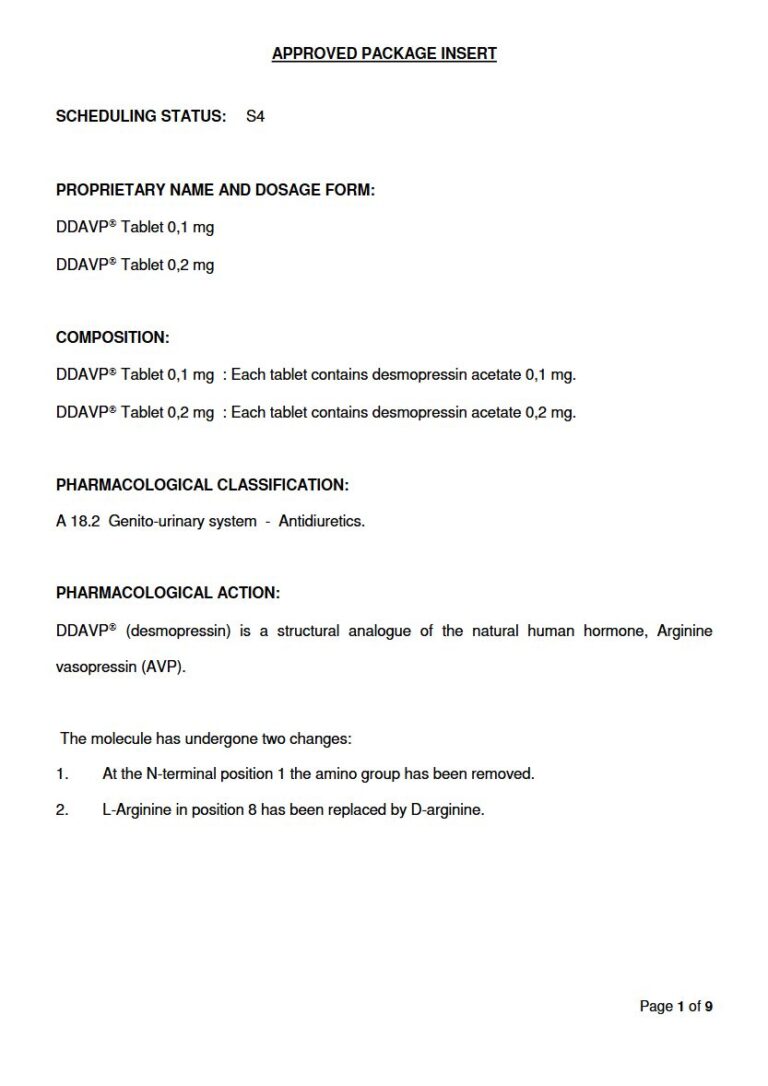
Ddavp Tablets 0.1mg. 0.2mg Tablet
PDF Leaflet Revision Date: 5 June 2002
Clinical Summary
Quick overview from the medicine insert
Indication
Management of central diabetes insipidus and primary nocturnal enuresis in children.
Dosage (summary)
0.1 mg three times daily for diabetes insipidus; 0.2 mg at bedtime for enuresis.
Onset of Action / Duration
Onset: 30 mins, Duration: 8-12 hours
Special Populations
- Elderly
- Children
Pregnancy & Breastfeeding
Safety during pregnancy and lactation not established.
Key Drug Interactions
- Tricyclic antidepressants
- SSRIs
- Chlorpromazine
- Carbamazepine
- Glibenclamide
Contraindications
- Nephrogenic diabetes insipidus
- Hypersensitivity
- Pregnancy
- Cardiac failure
- Cirrhosis
- Hypertension
Common side effects
- Headache
- Hyponatraemia
- Nausea
- Flushing
Counselling Points
- Limit fluid intake before and after administration
- Monitor for signs of hyponatraemia
- Adjust dosage based on response
Serious warnings
- Risk of water retention and hyponatraemia
- Monitor fluid intake in children
Important Disclaimer
The Ddavp Tablets 0.1mg. 0.2mg Tablet professional information leaflet below is the property of Ferring and is provided on Medinsert exactly as issued, with no.. alterations or editorial changes. We make every effort to keep content current by updating documents as soon as new versions become available. Medinsert serves as a trusted access point for healthcare professionals, but does not replace official sources or clinical judgement. For more details, please read our full disclaimer. read more>>
 Healthcare Professionals Only
This content is for registered healthcare professionals
Sign in or create a free account to read the full package insert.
Free for HPCSA-registered professionals. Powered by Medinsert.
Clinical Particulars
Section 4 of the official insert — extracted exactly as issued, no alterations
4.1 Therapeutic indications
1. Management of central diabetes insipidus.
2. DDAVP u00ae is indicated for the symptomatic short term (4 - 8 weeks) treatment of primary nocturnal enuresis in children older than 5 years who have normal ability to concentrate urine.
4.2 Posology and method of administration
Optimal dose of DDAVP u00ae tablets is individually adjusted until the patient is stabilised, including those instances where a patient is switched from any other DDAVP u00ae dosage form to the tablet.
1. Central diabetes insipidus : A suitable starting dose for adults and children is 0,1 mg three times daily. The dosage regimen should be adjusted in accordance with the patient's response in order to ensure an optimum dose. The total daily dose varies between 0,2 and 1,2 mg. For the majority of the patients the optimal dosage regimen is 0,1 - 0,2 mg three times daily.
2. Nocturnal Enuresis: A suitable initial dose is 0,2 mg at bedtime. The dose may be increased up to 0,4 mg if the lower dose is not sufficiently effective. A short term treatment period of four to eight weeks is recommended. The recommended dosage may only be administered once in every 24 hours. The 0,1 mg and 0,2 mg should not be used interchangeably.
4.3 Contraindications
1. Nephrogenic diabetes insipidus.
2. Hypersensitivity to desmopressin or any of the excipients of DDAVP tablets.
3. Pregnancy.
4. Peripheral vascular disease.
5. Cardiac failure or decompensated cardiac insufficiency.
6. Cirrhosis.
7. Nephrotic syndrome and all forms of chronic renal disease.
8. All oedematous states.
9. Hypertension.
10. Cerebral vascular disease.
11. Habitual and psychogenic polydipsia.
12. Patients receiving diuretics.
13. Known hyponatraemia.
14. DDAVP u00ae should not be used for enuresis in patients with abnormal renal function.
4.4 Special warnings and precautions for use
Children should be closely observed to avoid overingestion of fluid. When used for primary nocturnal enuresis the fluid intake must be limited and only to satisfy thirst from 1 hour before until 8 hours after administration. Treatment without concomitant reduction of fluid intake may lead to water retention and/or hyponatraemia with or without accompanying warning signs and symptoms (headache, nausea, vomiting, weight gain, and, in severe cases, convulsions).
4.5 Interactions with other medicines
Substances which are known to release antidiuretic hormone, e.g. tricyclic antidepressants, selective serotonine reuptake inhibitors, chlorpromazine and carbamazepine may cause an additive antidiuretic effect and increase the risk of water retention. Chlorpropamide and clofibrate may prolong the action of DDAVP u00ae. The dosage of DDAVP u00ae may need to be adjusted to avoid hyponatraemia during the concurrent administration of these agents. Carbamazepine may also prolong the action of DDAVP u00ae. Non-steroid anti-inflammatory drugs may induce water retention/hyponatraemia. Glibenclamide: The antidiuretic response induced by DDAVP u00ae has been shown to be significantly reduced by Glibenclamide. In addition the antidiuretic effect of DDAVP u00ae was of significantly shorter duration. Pressor agents: Large doses of DDAVP u00ae together with other pressor agents should only be given with careful monitoring. Concomitant treatment with loperamide may result in a 3-fold increase of desmopressin plasma concentrations, which may lead to an increased risk of water retention/hyponatraemia. Desmopressin does not undergo significant liver metabolism in in vitro studies with human microsomes and are therefore unlikely to interact with drugs affecting hepatic metabolism. Formal in vivo studies have however not been performed. A standardised 27 % fat meal significantly decreased absorption (rate and extent) of oral desmopressin. No significant effect was observed with respect to pharmacodynamics (urine production or osmolality) hence desmopressin may be taken with food if desired.
4.6 Fertility, pregnancy and lactation
Safety during pregnancy and lactation has not been established.
4.7 Effects on ability to drive and use machines
Not provided in the text.
4.8 Undesirable effects
Side-effects: Immune system disorders Less frequent: Severe allergic reaction. Nervous system disorders Less frequent: Headache. Cases of emotional disturbances in children have been reported, but the frequency is unknown. Cardiac disorders Less frequent: Hypertension, transient hypotension and tachycardia. Gastrointestinal disorders Less frequent: Abdominal or stomach cramps, nausea. Skin and Subcutaneous Tissue Disorders Less frequent: Flushing or redness of skin, pain in vulva. Renal and urinary disorders Less frequent: Hyponatraemia or water intoxication. Pressor effects: Large doses may produce pressor effects in patients and especially in those who are anaesthetised, or who are taking ganglion or adrenergic neurone blockers, or who have defects in sympathetic outflow. Patients with a history of heart disease or hypertension should be treated with caution, and their blood pressure should be monitored.
4.9 Overdose
There is no known specific antidote for DDAVP u00ae. Treatment is symptomatic and supportive. Overdosage leads to a prolonged duration of action with an increased risk of fluid retention and hyponatraemia. Although the treatment of hyponatraemia should be individualised, the following general recommendations can be given. Hyponatraemia is treated by discontinuing the desmopressin treatment, fluid restrictions and symptomatic treatment if needed. Note: Laboratory tests for monitoring the patient include urine volume and osmolality. In some cases plasma osmolality may be required.
