
Urizone 3 g Granules
PDF Leaflet Revision Date: 25 July 2025
Clinical Summary
Quick overview from the medicine insert
Indication
Treatment of acute uncomplicated lower urinary tract infections and prophylaxis in transurethral procedures.
Dosage (summary)
Single 3 g dose for UTIs in women; two doses of 3 g for prophylaxis in men.
Special Populations
- Renal impairment
- Elderly
Pregnancy & Breastfeeding
Limited safety data in pregnancy; not recommended during breastfeeding.
Key Drug Interactions
- Metoclopramide
- Food may delay absorption
Contraindications
- Hypersensitivity to fosfomycin
- Severe renal insufficiency
Common side effects
- Diarrhoea
- Dizziness
- Abdominal pain
Counselling Points
- Take on an empty stomach
- Report any severe gastrointestinal symptoms
Serious warnings
- Serious hypersensitivity reactions
- Clostridioides difficile-associated diarrhoea
Important Disclaimer
The Urizone 3 g Granules professional information leaflet below is the property of Adcock Ingram and is provided on Medinsert exactly as issued, with no.. alterations or editorial changes. We make every effort to keep content current by updating documents as soon as new versions become available. Medinsert serves as a trusted access point for healthcare professionals, but does not replace official sources or clinical judgement. For more details, please read our full disclaimer. read more>>
 Healthcare Professionals Only
This content is for registered healthcare professionals
Sign in or create a free account to read the full package insert.
Free for HPCSA-registered professionals. Powered by Medinsert.
Clinical Particulars
Section 4 of the official insert — extracted exactly as issued, no alterations
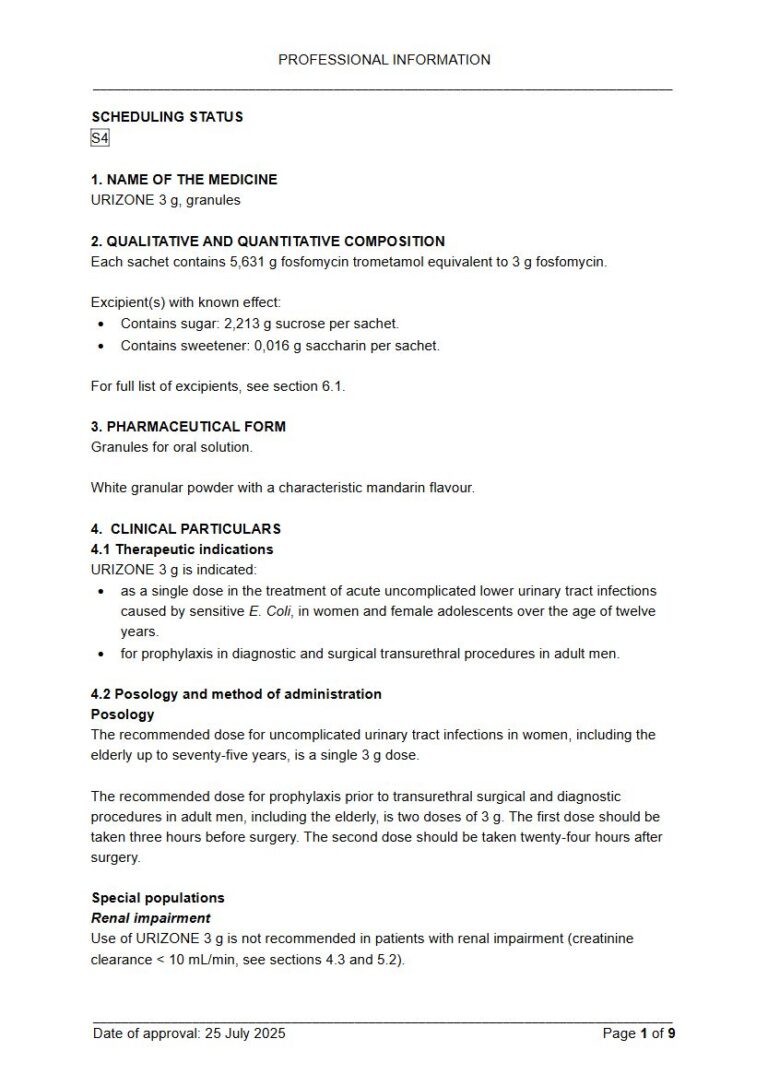
4.1 Therapeutic indications
URIZONE 3 g is indicated:
- as a single dose in the treatment of acute uncomplicated lower urinary tract infections caused by sensitive E. Coli, in women and female adolescents over the age of twelve years.
- for prophylaxis in diagnostic and surgical transurethral procedures in adult men.
4.2 Posology and method of administration
Posology
The recommended dose for uncomplicated urinary tract infections in women, including the elderly up to seventy-five years, is a single 3 g dose. The recommended dose for prophylaxis prior to transurethral surgical and diagnostic procedures in adult men, including the elderly, is two doses of 3 g. The first dose should be taken three hours before surgery. The second dose should be taken twenty-four hours after surgery.
Special populations
Renal impairment
Use of URIZONE 3 g is not recommended in patients with renal impairment (creatinine clearance < 10 mL/min, see sections 4.3 and 5.2).
Paediatric population
The safety and efficacy of URIZONE 3 g in children below 12 years of age have not been established.
Method of administration
For oral administration. URIZONE 3 g should be taken on an empty stomach (about 2-3 hours before or 2-3 hours after a meal), preferably before bedtime, and after emptying the bladder. The dose should be dissolved in a glass of water and taken immediately after its preparation (see section 6.6).
4.3 Contraindications
- Known hypersensitivity to fosfomycin trometamol or to any of the excipients listed in section 6.1.
- Severe renal insufficiency (creatinine clearance < 10 mL/min).
4.4 Special warnings and precautions for use
Hypersensitivity reactions
Serious and occasionally fatal hypersensitivity reactions, including anaphylaxis and anaphylactic shock, may occur during fosfomycin treatment (see sections 4.3 and 4.8). If such reaction occurs, treatment with fosfomycin must be discontinued immediately and adequate emergency measures must be initiated.
Clostridioides difficile -associated diarrhoea
Clostridioides difficile -associated colitis and pseudo-membranous colitis have been reported with fosfomycin and may range in severity from mild to life-threatening (see section 4.8). Therefore, it is important to consider this diagnosis in patients who present with diarrhoea during or subsequent to the administration of fosfomycin. Discontinuation of therapy with fosfomycin and the administration of specific treatment for Clostridioides difficile should be considered. Medicines that inhibit peristalsis should not be given.
Persistent infections and male patients
In case of persistent infections, a thorough examination and a re-evaluation of the diagnosis is recommended as this is often due to complicated urinary tract infections or the prevalence of resistant pathogens (e.g., Staphylococcus saprophyticus, see section 5.1). In general, urinary tract infections in male patients have to be considered as complicated UTIs for which this medicine is not indicated (see section 4.1).
URIZONE 3 g contains sucrose
Patients with rare hereditary problems of fructose intolerance, glucose-galactose malabsorption or sucrase-isomaltase insufficiency should not take URIZONE 3 g.
4.5 Interactions with other medicines and other forms of interaction
Metoclopramide
Concomitant administration of metoclopramide has been shown to lower serum and urinary concentrations and should be avoided. Other medicines that increase gastrointestinal motility may produce similar effects.
Food effect
Food may delay the absorption of fosfomycin, with consequent slight decrease in peak plasma levels and urinary concentrations. It is therefore preferable to take the medicine on an empty stomach or about 2 u2013 3 hours after meals.
Specific problems concerning the alteration in International Normalized Ratio (INR)
Numerous cases of increased oral anticoagulant activity have been reported in patients receiving antibiotic therapy. Risk factors include severe infection or inflammation, age and poor general health. Under these circumstances, it is difficult to determinate whether the alteration in INR is due to the infectious disease or its treatment.
Paediatric population
Interaction studies have only been performed in adults.
4.6 Fertility, pregnancy and lactation
Pregnancy
The safety and efficacy of single-dose therapy have not been established for URIZONE 3 g in pregnancy. There is limited data on the safety of fosfomycin treatment during 1st trimester of pregnancy. Fosfomycin crosses the placenta. Animal studies do not indicate direct or indirect harmful effects with respect to reproductive toxicity (see section 5.3).
Breastfeeding
URIZONE 3 g should not be given to lactating women. Fosfomycin has been shown to cross into breast milk in low quantities.
Fertility
No data in humans are available. In male and female rats, oral administration of fosfomycin up to 1000 mg/kg/d did not impair fertility.
4.7 Effects on ability to drive and use machines
No specific studies have been performed. URIZONE 3 g may cause dizziness which can affect the ability to drive a vehicle and use machines (see section 4.8).
4.8 Undesirable effects
a. Summary of the safety profile
URIZONE 3 g is generally well-tolerated. The most common adverse reactions following the single-dose administration of fosfomycin trometamol involve the gastrointestinal tract, mainly diarrhoea. These events are usually self-limited in duration and resolve spontaneously.
b. Tabulated summary of adverse reactions
The following convention is used to define the frequency of side effects: Very common (u2265 1/10); common (u2265 1/100, < 1/10); uncommon (u2265 1/1000, < 1/100); rare (u2265 1/10 000, < 1/1000); Very rare (< 1/10 000); not known (cannot be estimated form the available data).
SYSTEM ORGAN CLASS FREQUENCY ADVERSE REACTIONS
- Infections and infestations Common Vulvovaginitis
- Immune system disorders Not known Anaphylactic reactions including anaphylactic shock, hypersensitivity (see section 4.4).
- Nervous system disorders Common Dizziness, headache.
- Respiratory, thoracic and mediastinal disorders Common Pharyngitis (sore throat), rhinitis (runny or stuffy nose).
- Gastrointestinal disorders Common Abdominal pain, dyspepsia (heartburn, indigestion), diarrhoea, nausea. Uncommon Vomiting. Not known Antibiotic-associated colitis (see section 4.4).
- Skin and subcutaneous tissue disorders Uncommon Skin rash, urticaria, pruritus. Not known Angioedema
- Musculoskeletal and connective tissue disorders Common Back pain.
- Reproductive system and breast disorders Common Vaginitis, dysmenorrhoea.
- General disorders and administration site conditions Common Pain (non-localised), asthenia.
Reporting of suspected adverse reactions
Reporting suspected adverse reactions after authorisation of URIZONE 3 g is important. It allows continued monitoring of the benefit/risk balance of URIZONE 3 g. Healthcare providers are requested to report any suspected adverse drug reactions to SAHPRA via the Med Safety APP (Medsafety X SAHPRA) and eReporting platform (who-umc.org) found on SAHPRA website. Alternatively, adverse reactions may also be reported directly to Adcock Ingram Limited via email at [email protected].
4.9 Overdose
Experience regarding the overdose of oral fosfomycin is limited. Cases of hypotonia, somnolence, electrolytes disturbances, thrombocytopenia and hypoprothrombinaemia have been reported with parenteral use of fosfomycin. In the event of overdose, the patient must be monitored (particularly for plasma/serum electrolyte levels), and treatment should be symptomatic and supportive. Urinary elimination of URIZONE 3 g can be accelerated through adequate administration of oral fluids. Fosfomycin is effectively cleared from the body by haemodialysis with a mean elimination half-life of approximately 4 hours. In overdose, side effects can be precipitated and/or be of increased severity (see section 4.8).
