
Columvi 2,5 Mg/2,5 Ml/10 Mg/10 Ml Solution
PDF Leaflet Revision Date: 04 February 2025
Clinical Summary
Quick overview from the medicine insert
Indication
Treatment of adult patients with relapsed or refractory DLBCL and PMBCL after two or more lines of systemic therapy.
Dosage (summary)
Step-up dosing: 2.5 mg on Day 8, 10 mg on Day 15, then 30 mg on Day 1 of Cycle 2 and thereafter every 21 days.
Special Populations
- Geriatric use
- Renal impairment
- Hepatic impairment
Pregnancy & Breastfeeding
Avoid pregnancy during treatment; potential harm to fetus; unknown if excreted in breast milk.
Key Drug Interactions
- Monitor for toxicity with CYP450 substrates
Contraindications
- Hypersensitivity to COLUMVI or excipients
Common side effects
- Cytokine release syndrome
- Neutropenia
- Anemia
- Thrombocytopenia
- Pyrexia
Counselling Points
- Premedicate to reduce CRS risk
- Monitor for CRS symptoms
- Seek immediate medical attention for CRS signs
Serious warnings
- Risk of serious infections
- Cytokine release syndrome can be life-threatening
Important Disclaimer
The Columvi 2,5 Mg/2,5 Ml/10 Mg/10 Ml Solution professional information leaflet below is the property of Roche Products and is provided on Medinsert exactly as issued, with no.. alterations or editorial changes. We make every effort to keep content current by updating documents as soon as new versions become available. Medinsert serves as a trusted access point for healthcare professionals, but does not replace official sources or clinical judgement. For more details, please read our full disclaimer. read more>>
 Healthcare Professionals Only
This content is for registered healthcare professionals
Sign in or create a free account to read the full package insert.
Free for HPCSA-registered professionals. Powered by Medinsert.
Clinical Particulars
Section 4 of the official insert — extracted exactly as issued, no alterations
4.1 Therapeutic Indications
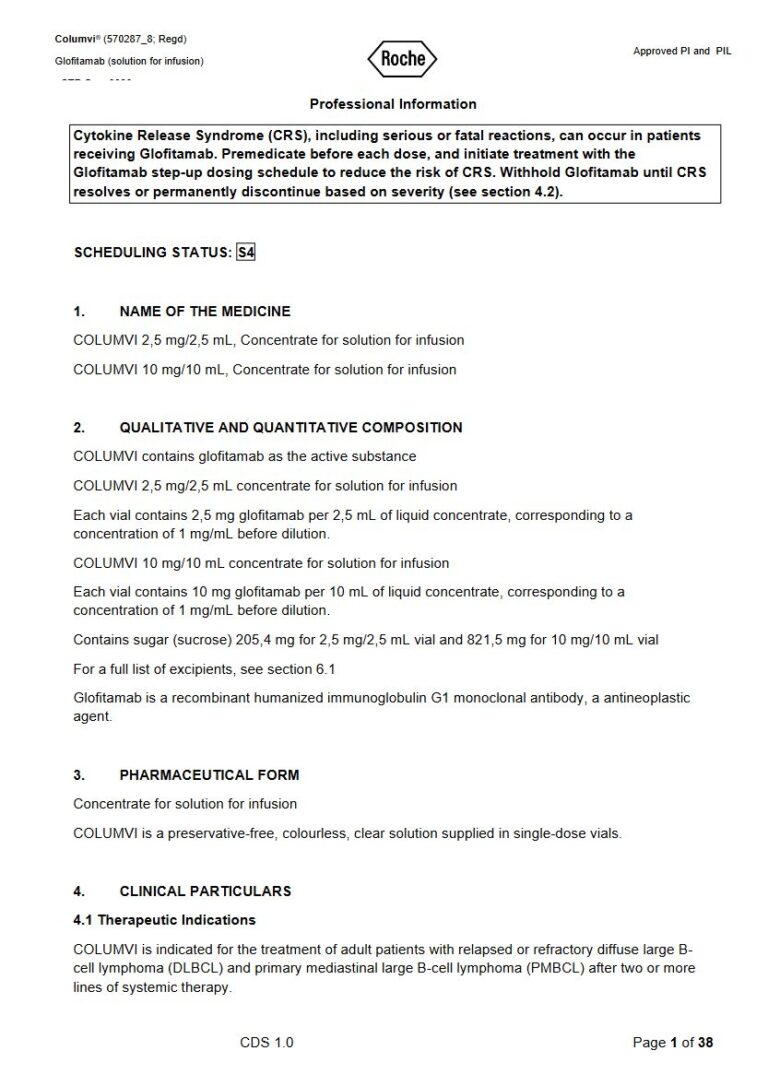
COLUMVI is indicated for the treatment of adult patients with relapsed or refractory diffuse large B-cell lymphoma (DLBCL) and primary mediastinal large B-cell lymphoma (PMBCL) after two or more lines of systemic therapy.
4.2 Posology and method of administration
Substitution by any other biological medicinal product requires the consent of the prescribing physician. COLUMVI therapy should only be administered under the supervision of a healthcare professional experienced in the treatment of cancer patients and who has access to appropriate medical support to manage severe reactions associated with cytokine release syndrome (CRS). At least 1 dose of tocilizumab for use in the event of CRS must be available prior to COLUMVI infusion at Cycles 1 and 2. Access to an additional dose of tocilizumab within 8 hours of use of the previous tocilizumab dose must be ensured. See Section 4.4 Special warnings and precautions for use.
Posology
Pre-treatment with Obinutuzumab
All patients must receive a single 1000 mg dose of obinutuzumab on Cycle 1 Day 1 (7 days prior to initiation of COLUMVI treatment); see Table 2 and Delayed or Missed Doses. This is to deplete circulating B cells and thereby reduce the frequency and severity of CRS.
Obinutuzumab should be administered as an intravenous infusion at 50 mg/h. The rate of infusion can be escalated in 50 mg/h increments every 30 minutes to a maximum of 400 mg/h. Refer to the obinutuzumab prescribing information for complete information on premedication, preparation, administration, and management of adverse reactions of obinutuzumab.
Premedication and Prophylactic Medications
Cytokine release syndrome prophylaxis
COLUMVI should be administered to well-hydrated patients. Premedication to reduce the risk of CRS (see Section 4.4) is outlined in Table 1.
Table 1 Premedication Before COLUMVI Infusion to Reduce the Risk of Cytokine Release Syndrome
Treatment Cycle (Day) Patients requiring premedication Premedication Administration
- Intravenous glucocorticoid a Completed at least 1 hour prior to COLUMVI infusion.
- Oral analgesic / anti-pyretic b Cycle 1 (Day 8, Day 15); Cycle 2 (Day 1); Cycle 3 (Day 1) All patients
- Anti-histamine c At least 30 minutes before COLUMVI infusion.
- Oral analgesic / anti-pyretic b All patients
- Anti-histamine c At least 30 minutes before COLUMVI infusion.
- Intravenous glucocorticoid a Completed at least 1 hour prior to COLUMVI infusion.
- Oral analgesic / anti-pyretic b All subsequent infusions Patients who experienced CRS with previous dose
- Anti-histamine c At least 30 minutes before COLUMVI infusion.
a 20 mg dexamethasone or 100 mg prednisone/prednisolone or 80 mg methylprednisolone.
b For example, 1000 mg acetaminophen/paracetamol.
c For example, 50 mg diphenhydramine.
Recommended Dosage
COLUMVI dosing begins with a step-up dosing schedule (which is designed to decrease the risk of CRS), leading to the recommended dose of 30 mg.
COLUMVI Dose Step-up Schedule
COLUMVI must be administered as an intravenous infusion according to the dose step-up schedule leading to the recommended dosage of 30 mg (as shown in Table 2), after completion of pre-treatment with obinutuzumab on Cycle 1 Day 1. Each cycle is 21 days.
Table 2 COLUMVI Monotherapy Dose Step-Up Schedule for Patients with Relapsed or Refractory DLBCL
Treatment Cycle, Day Dose of COLUMVI Duration of infusion
- Day 1 Pre-treatment with obinutuzumab a
- Day 8 2.5 mg
- Cycle 1 (Pre-treatment and step-up dose) Day 15 10 mg
- Cycle 2 Day 1 30 mg 4 hours b
- Cycle 3 to 12 Day 1 30 mg 2 hours c
a Refer to Pre-treatment with obinutuzumab described above.
b For patients who experience CRS with their previous dose of COLUMVI, the duration of infusion may be extended up to 8 hours (see Table 3 and Section 2.4.1 Warnings and Precautions ).
c At the discretion of the treating physician, if the previous infusion was well tolerated. If the patient experienced CRS with a previous dose, the duration of infusion should be maintained at 4 hours.
Monitoring after infusion
All patients must be monitored for signs and symptoms of potential CRS during infusion and for at least 10 hours after completion of the infusion of the first COLUMVI dose (2,5 mg on Cycle 1 Day 8). Patients who experienced Grade uf0b3 2 CRS with their previous infusion should be monitored after completion of the infusion. See Table 3. All patients must be counselled on the risk, signs, and symptoms of CRS and advised to contact the healthcare provider immediately should they experience signs and symptoms of CRS.
Duration of Treatment
Treatment with COLUMVI is recommended for a maximum of 12 cycles or until disease progression or unmanageable toxicity.
Dose Modifications
No dose reductions of COLUMVI are recommended.
Delayed or Missed Doses
During step-up dosing (weekly dosing):
- Following pre-treatment with obinutuzumab, if the COLUMVI 2,5 mg dose is delayed by more than 1 week, then repeat pre-treatment with obinutuzumab.
- Following COLUMVI 2,5 mg dose or 10 mg dose, if there is a COLUMVI treatment-free interval of 2 weeks to 6 weeks, then repeat the last tolerated COLUMVI dose and resume the planned step-up dosing.
- Following COLUMVI 2,5 mg dose or 10 mg dose, if there is a COLUMVI treatment-free interval of more than 6 weeks, then repeat pre-treatment with obinutuzumab and COLUMVI step-up dosing (see Cycle 1 in Table 2).
After Cycle 2 (30 mg dose):
- If there is a COLUMVI treatment-free interval of more than 6 weeks between cycles, then repeat pre-treatment with obinutuzumab and COLUMVI step-up dosing (see Cycle 1 in Table 2), and then resume the planned treatment cycle (30 mg dose).
Management of Cytokine Release Syndrome
Cytokine release syndrome should be identified based on the clinical presentation (see Section 4.4 ). Patients should be evaluated for other causes of fever, hypoxia, and hypotension, such as infections or sepsis. If CRS is suspected, it should be managed according to the CRS management recommendations based on American Society for Transplantation and Cellular Therapy [ASTCT] consensus grading in Table 3.
4.3 Contraindications
COLUMVI is contraindicated in patients with a known hypersensitivity to COLUMVI or any of the excipients. Refer to obinutuzumab-specific contraindications in the obinutuzumab prescribing information.
4.4 Special Warnings and Precautions for Use
General
Refer to obinutuzumab-specific warnings and precautions in the obinutuzumab prescribing information. In order to improve traceability of biological medicinal products, the trade name and the batch number of the administered product should be clearly recorded (or stated) in the patient file.
Cytokine Release Syndrome
CRS, including life-threatening reactions, has been reported in patients receiving COLUMVI. The most common manifestations of CRS were pyrexia, tachycardia, hypotension, chills, and hypoxia. Infusion-related reactions may be clinically indistinguishable from manifestations of CRS. CRS of any grade (ASTCT criteria) occurred in 61,8 % of patients in study NP30179. Grade 3 or 4 CRS occurred in 3,9 % of patients. There were no fatal cases of CRS. Most CRS events occurred following the first dose of COLUMVI. See Section 4.8, under Description of adverse reactions .
To reduce the occurrence of CRS, patients must be pre-treated with obinutuzumab, 7 days prior to initiation of COLUMVI, and should be premedicated with an anti-pyretic, anti-histamine, and a glucocorticoid. See Section 4.2 . At least 1 dose of tocilizumab for use in the event of CRS must be available prior to COLUMVI infusion at Cycles 1 and 2. Access to an additional dose of tocilizumab within 8 hours of use of the previous tocilizumab dose must be ensured.
Patients must be monitored during all COLUMVI infusions and for at least 10 hours after completion of the first infusion. For complete information on monitoring, see Section 4.2 . The prescriber must counsel patients to seek immediate medical attention should signs or symptoms of CRS occur at any time. Patients should be evaluated for other causes of fever, hypoxia, and hypotension, such as infections or sepsis. CRS should be managed based on the patientu2019s clinical presentation and according to the CRS management guidance provided in Table 3 (see Section 4.2 ).
Serious Infections
Serious infections (such as sepsis and pneumonia) have occurred in patients treated with COLUMVI (see Section 4.8 ). COLUMVI must not be administered to patients with an active infection. Caution should be exercised when considering the use of COLUMVI in patients with a history of chronic or recurrent infection, those with underlying conditions that may predispose them to infections, or those who have had significant prior immunosuppressive treatment. Patients should be monitored before and during COLUMVI treatment for the emergence of possible bacterial, fungal, and new or reactivated viral infections and treated appropriately. COLUMVI should be temporarily withheld in the presence of an active infection until the infection has resolved. Patients should be instructed to seek medical advice if signs and symptoms suggestive of an infection occur.
Febrile neutropenia has been reported during treatment with COLUMVI. Patients with febrile neutropenia should be evaluated for infection and treated promptly.
Tumour Lysis Syndrome
Tumour lysis syndrome (TLS) has been reported in patients receiving COLUMVI (see Section 4.8 ). Patients with high tumour burden, rapidly proliferative tumours, renal dysfunction, or dehydration are at greater risk of TLS. Patients at risk should be monitored closely by appropriate clinical and laboratory tests for electrolyte status, hydration, and renal function. Appropriate prophylactic measures with anti-hyperuricemics (e.g., allopurinol or rasburicase) and adequate hydration should be considered prior to COLUMVI infusion. Management of TLS may include aggressive hydration, correction of electrolyte abnormalities, anti-hyperuricemic therapy, and supportive care.
Drug Abuse and Dependence
COLUMVI does not have the potential for abuse and dependence.
4.5 Interaction with other medicines and other forms of interaction
No clinical drug-drug interaction studies have been performed. No drug interactions with COLUMVI are expected via the cytochrome P450 enzymes, other metabolizing enzymes, or transporters. Physiologically based pharmacokinetic modelling was performed to estimate the magnitude of potential drug interactions caused by the COLUMVI-induced transient increase in interleukin-6 (IL-6) levels which may impact CYP activity. The modelling demonstrates that the magnitude of the suppressive effect of transient IL-6 increase on CYP activities is uf03c 50 %. In addition, the changes in exposures to substrates of CYP3A4, CYP1A2, and CYP2C9 are expected to be less than or equal to twofold. Based on these data, on initiation of COLUMVI therapy in patients being treated with CYP450 substrates with a narrow therapeutic index, monitoring for toxicity (e.g., warfarin) or for drug concentrations (e.g., cyclosporine) of the concomitant drug should be considered.
4.6 Fertility, pregnancy and lactation
Contraception in females
Women of childbearing potential should use highly effective contraceptive methods during treatment and for at least 2 months following the last dose of COLUMVI.
Labour and Delivery
The safe use of COLUMVI during labour and delivery has not been established.
Pregnancy
Women of childbearing potential must be advised to avoid pregnancy while receiving COLUMVI. There are no available data on the use of COLUMVI in pregnant women. COLUMVI is an immunoglobulin G (IgG). IgG is known to cross the placenta. Based on its mechanism of action, COLUMVI is likely to cause foetal B-cell depletion when administered to a pregnant woman. Female patients receiving COLUMVI should be advised of the potential harm to the foetus. Female patients should be advised to contact the treating physician, should pregnancy occur.
Lactation
It is not known whether COLUMVI is excreted in human milk. No studies have been conducted to assess the impact of COLUMVI on milk production or its presence in human milk. Human IgG is known to be present in human milk. The potential for absorption of COLUMVI and the potential for adverse reactions in the nursing infant is unknown. Women should be advised to discontinue breastfeeding during treatment with COLUMVI and for 2 months after the last dose of COLUMVI.
4.7 Effects on ability to drive and use machines
COLUMVI has no or negligible influence on the ability to drive and use machines. Patients experiencing symptoms of CRS (pyrexia, tachycardia, hypotension, chills, and hypoxia) should be advised not to drive or use machines until symptoms resolve.
4.8 Undesirable effects
Clinical Trials
a. Summary of the Safety Profile
COLUMVI monotherapy Approximately 424 patients with relapsed or refractory non-Hodgkinu2019s lymphoma have received COLUMVI as monotherapy in the clinical development program of COLUMVI. The adverse drug reactions described below were identified from 152 patients with relapsed or refractory DLBCL, who had received at least two prior lines of systemic therapy, including DLBCL arising from follicular lymphoma, high-grade B-cell lymphoma (HGBCL), and PMBCL, treated with COLUMVI monotherapy in study NP30179, an open-label multicentre clinical trial.
b. Tabulated list of adverse reactions
Adverse medicine reactions from clinical trials (Table 4) are listed by MedDRA system organ class. The corresponding frequency category for each adverse medicine reaction is based on the following convention: very common (u22651/10), common (u22651/100 to <1/10), uncommon (u22651/1,000 to <1/100), rare (u22651/10,000 to <1/1,000), very rare (<1/10,000).
Table 4 Adverse Drug Reactions Occurring in Patients with Relapsed or Refractory DLBCL Treated with COLUMVI Monotherapy
COLUMVI N=152 System Organ Class Adverse Reaction All Grades (frequency category) All Grades (%) Grade 3 uf02d 4 (%)
- Immune system disorders Cytokine release syndrome a Very common 61,8 3,9
- Blood and lymphatic system disorders Neutropenia b Very common 34,2 23,7
- Anaemia c Very common 28,3 6,6
- Thrombocytopenia d Very common 23,7 5,9
- Lymphopenia e Common 3,9 3,9
- Febrile neutropenia f Common 3,3 2,6
- General disorders and administration site conditions Pyrexia Very common 18,4 0
- Metabolism and nutrition disorders Hypophosphataemia Very common 17,8 5,9
- Hypomagnesaemia Very common 13,2 0
- Hypocalcaemia Very common 12,5 0
- Hypokalaemia Very common 10,5 0,7
- Hyponatraemia Common 7,9 0,7
- Tumour lysis syndrome Common 1,3 1,3
- Skin and subcutaneous tissue disorders Rash g Very common 13,8 1,3
- Gastrointestinal disorders Constipation Very common 11,8 0
- Diarrhoea Common 9,9 0
- Nausea Common 9,2 0
- Gastrointestinal haemorrhage h Common 2,6 2,6
- Vomiting Common 2,6 0
- Neoplasms benign, malignant and unspecified (incl cysts and polyps) Tumour flare Very common 11,2 2,6
- Nervous system disorders Headache Common 9,2 0
- Somnolence Common 1,3 0,7
- Tremor Common 1,3 0
- Myelitis i Uncommon 0,7 0,7
- Infections and infestations Viral infections j Common 8,6 2,6 * Bacterial infections k Common 6,6 2,0
- Upper respiratory tract infections l Common 5,3 0
- Sepsis Common 3,9 2,6 * Lower respiratory tract infections m Common 2,0 0
- Pneumonia Common 2,6 1,3
- Urinary tract infection Common 1,3 0
- Fungal infections n Uncommon 0,7 0
- Investigations Alanine aminotransferase increased Common 7,9 2,6
- Aspartate aminotransferase increased Common 7,2 2,6
- Blood alkaline phosphatase increased Common 7,2 1,3
- Gamma-glutamyltransferase increased Common 5,9 2,6
- Blood bilirubin increased Common 3,3 0,7
- Hepatic enzyme increased Common 1,3 1,3
* Grade 5 reactions reported include sepsis (1,3 %), COVID-19 pneumonia (2,0 %), and COVID-19 (0,7 %).
a Based on ASTCT consensus grading.
b Includes neutropenia and neutrophil count decreased.
c Includes anaemia and haemoglobin decreased.
d Includes thrombocytopenia and platelet count decreased.
e Includes lymphopenia and lymphocyte count decreased.
f Includes febrile neutropenia and neutropenic infection.
g Includes rash, rash pruritic, rash maculo-papular, dermatitis, dermatitis acneiform, dermatitis exfoliative, erythema, and palmar erythema.
h Includes gastrointestinal haemorrhage, large intestinal haemorrhage, and gastric haemorrhage.
i Myelitis occurred concurrently with CRS.
j Includes COVID-19, COVID-19 pneumonia, herpes zoster, and ophthalmic herpes zoster.
k Includes vascular device infection, bacterial infection, Campylobacter infection, biliary tract infection bacterial, urinary tract infection bacterial, Clostridium difficile infection, Escherichia infection, and peritonitis.
l Includes upper respiratory tract infection, sinusitis, nasopharyngitis, chronic sinusitis, and rhinitis.
m Includes lower respiratory tract infection and bronchitis.
n Includes oesophageal candidiasis.
c. Description of selected adverse reactions
Cytokine Release Syndrome
In study NP30179, any grade CRS (by ASTCT criteria) occurred in 61,8 % of patients, with Grade 1 CRS being reported in 45,4 % of patients, Grade 2 CRS in 12,5 % patients, Grade 3 CRS in 2,6 % of patients, and Grade 4 CRS in 1,3 % of patients. There were no fatal cases of CRS. CRS resolved in all patients except one. One patient discontinued COLUMVI due to CRS.
In patients with CRS, the most common manifestations of CRS included pyrexia (98,9 %), tachycardia (27,7 %), hypotension (25,5 %), chills (13,8 %), and hypoxia (12,8 %). Grade 3 or higher events associated with CRS included hypotension (3,2 %), hypoxia (3,2 %), pyrexia (3,2 %), and tachycardia (2,1 %).
CRS of any grade occurred in 53.9% of patients following the 2,5 mg dose of COLUMVI at Cycle 1 Day 8 with median time to onset of 13,4 hours (range: 2,5 to 51,8 hours); in 32,5 % of patients following the 10 mg dose at Cycle 1 Day 15 with median time to onset of 28,7 hours (range: 7,7 to 126,0 hours); and in 28,4 % of patients following the 30 mg dose at Cycle 2 Day 1 with median time to onset of 29,1 hours (range: 15,9 to 45,1 hours). CRS was reported in 1,1 % of patients at Cycle 3 and in 2,4 % of patients beyond Cycle 3.
Grade uf0b3 2 CRS occurred in 12,8 % of patients following the first COLUMVI dose (2,5 mg), with median time to onset of 10.5 hours (range: 2,5 to 14 hours) and median duration of 40,8 hours (range: 6,5 to 316,7 hours). Following COLUMVI 10 mg dose at Cycle 1 Day 15, the incidence of Grade uf0b3 2 CRS decreased to 5,6 % of patients, with median time to onset of 27,2 hours (range: 7,7 to 145,2 hours) and median duration of 30,9 hours (range: 3,1 to 227,2 hours). Grade uf0b3 2 CRS following COLUMVI 30 mg dose at Cycle 2 Day 1 occurred in one patient (0,9 %) with time to onset of 16,0 hours and duration of 44,8 hours. No Grade uf0b3 2 CRS was reported beyond Cycle 2.
Among the 25 patients who experienced Grade 2 or higher CRS after COLUMVI, 22 (88 %) received tocilizumab, 15 (60 %) received corticosteroids, and 14 (56 %) received both tocilizumab and corticosteroids. Ten patients (40 %) received oxygen. All 6 patients (24,0 %) with Grade 3 uf02d 4 CRS received a single vasopressor.
Serious Infections
In study NP30179, serious infections were reported in 17,1% of patients. The most frequent serious infections reported in uf0b3 2 % patients were sepsis (3,9 %), COVID-19 pneumonia (3,3 %), and COVID- 19 (2 %). Infection-related deaths were reported in 3,9 % of patients (due to sepsis, COVID-19 pneumonia, and COVID-19). Three patients (2 %) experienced serious infections concurrently with Grade 3 uf02d 4 neutropenia.
Neutropenia
Neutropenia (including neutrophil count decreased) was reported in 34,2 % of patients and severe neutropenia (Grade 3 uf02d 4) was reported in 23,7 % of patients. The median time to onset of the first neutropenia event was 22,5 days (range: 1 to 183 days). Prolonged neutropenia (lasting longer than 30 days) occurred in 7,9 % of patients. The majority of patients with neutropenia (82,7 %) were treated with G-CSF. Febrile neutropenia was reported in 2,6 % of patients.
Tumour Flare
Tumour flare was reported in 11,2 % of patients, including Grade 2 tumour flare in 4,6 % of patients and Grade 3 tumour flare in 2.6% of patients. Tumour flare was reported involving lymph nodes in the head and neck presenting with pain, and involving lymph nodes in the thorax with symptoms of breathlessness due to development of pleural effusion. Most tumour flare events (16/17) occurred during Cycle 1, and no tumour flare events were reported beyond Cycle 2. The median time to onset of tumour flare of any grade was 2 days (range: 1 to 16 days), and the median duration was 3,5 days (range: 1 to 35 days). No patients discontinued COLUMVI due to tumour flare.
Tumour Lysis Syndrome
TLS was reported in 2 patients (1,3 %) and was Grade 3 in severity in both cases. The median time to TLS onset was 2 days, and the median duration was 4 days (range: 3 to 5 days).
Laboratory Abnormalities
Table 5 summarises treatment-emergent shifts from baseline in laboratory abnormalities in study NP30179.
Table 5 Laboratory Abnormalities Worsening from Baseline, with Grade 3 to 4 Occurring in uf0b3 10 % of Patients with Relapsed or Refractory DLBCL Treated with COLUMVI Monotherapy
COLUMVI NCI CTCAE Grade Laboratory Abnormality a All Grades (%) b Grade 3 or 4 (%) b,c
- Haematology Decreased lymphocytes 88,1 80,4
- Decreased neutrophils 50,0 23,6
- Decreased leukocytes 66,2 11,7
- Chemistry Hypophosphatemia 68,1 26,4
- Hyperglycaemia 12,1 12,1
- Hyperuricemia 20,9 20,9
a Percentages based on patients with a baseline and at least one post-baseline assessment for the specific laboratory parameter.
b N=143 for decreased lymphocytes; N=144 for decreased neutrophils; N=145 for decreased leukocytes; N=144 for hypophosphatemia; N=141 for hyperglycaemia; N=139 for hyperuricemia.
c Includes shifts from Grade 0 uf02d 2 at baseline to Grade uf0b3 3 post-baseline, and shifts from Grade 3 at baseline to Grade 4 post-baseline.
4.9 Overdose
There is no experience with overdosage of COLUMVI in clinical trials.
