
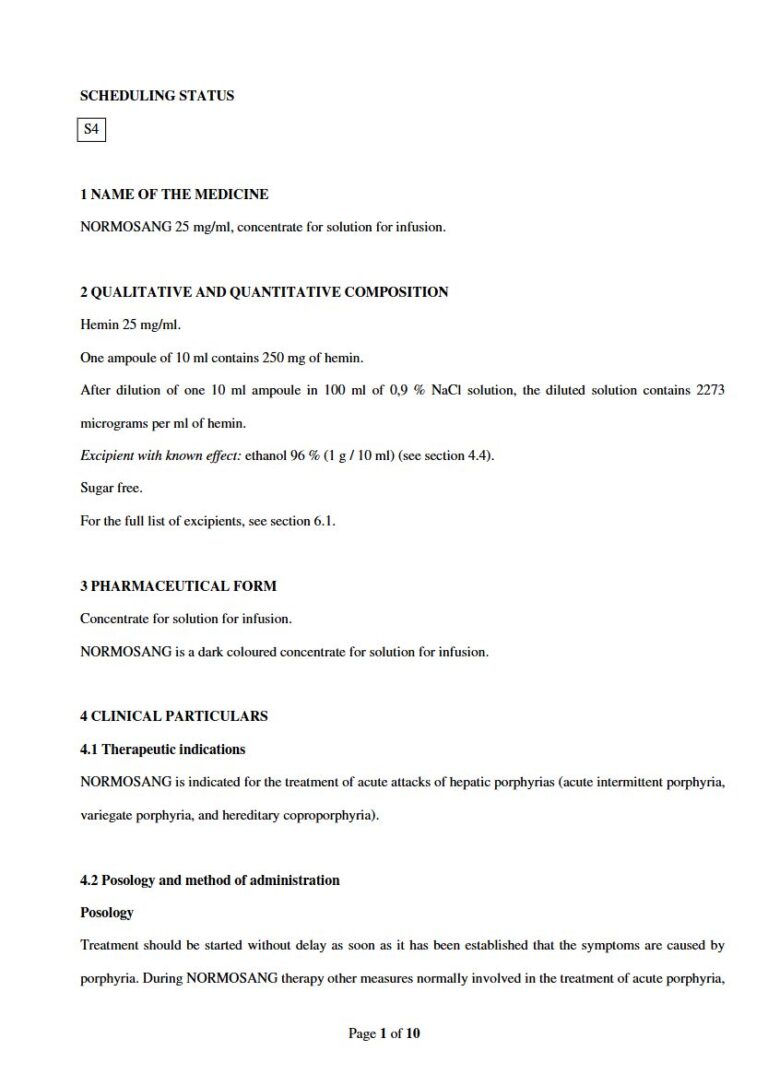
Normosang 25 mg/ml Concentrate for solution for infusion.
PDF Leaflet Revision Date: 02 June 2021
Clinical Summary
Quick overview from the medicine insert
Indication
Treatment of acute attacks of hepatic porphyrias.
Dosage (summary)
3 mg/kg once daily for 4 days, max 250 mg/day.
Special Populations
- Elderly patients
- Children and adolescents
Pregnancy & Breastfeeding
Limited data; not recommended during lactation.
Key Drug Interactions
- Oestrogens
- Barbiturates
- Steroids
Contraindications
- Hypersensitivity to hemin
- Safety not established in children and nursing women
Common side effects
- Infusion site pain
- Infusion site swelling
- Thrombophlebitis
Counselling Points
- Administer slowly over 30 mins
- Flush vein post-infusion
- Record product details for traceability
Serious warnings
- Risk of thrombosis
- Monitor for iron overload
- Potential for infection transmission
Important Disclaimer
The Normosang 25 mg/ml Concentrate for solution for infusion. professional information leaflet below is the property of Equity Pharmaceuticals and is provided on Medinsert exactly as issued, with no.. alterations or editorial changes. We make every effort to keep content current by updating documents as soon as new versions become available. Medinsert serves as a trusted access point for healthcare professionals, but does not replace official sources or clinical judgement. For more details, please read our full disclaimer. read more>>
 Healthcare Professionals Only
This content is for registered healthcare professionals
Sign in or create a free account to read the full package insert.
Free for HPCSA-registered professionals. Powered by Medinsert.
Clinical Particulars
Section 4 of the official insert — extracted exactly as issued, no alterations
4.1 Therapeutic indications
NORMOSANG is indicated for the treatment of acute attacks of hepatic porphyrias (acute intermittent porphyria, variegate porphyria, and hereditary coproporphyria).
4.2 Posology and method of administration
Posology
Treatment should be started without delay as soon as it has been established that the symptoms are caused by porphyria. During NORMOSANG therapy other measures normally involved in the treatment of acute porphyria, such as adequate nutrition and elimination of provocative factors, are still indicated. See section 4.4 Special warnings and precautions for use.
The recommended daily dose is 3 mg/kg once daily for four days, diluted in 100 ml of 0.9 % sodium chloride in a glass bottle and infused intravenously over at least 30 minutes into a large antebrachial or central vein using an inline filter. See table below. The dose should not exceed 250 mg (1 ampoule) per day. Exceptionally, the course of the treatment may be repeated under strict biochemical surveillance if there is inadequate response after the first course of treatment.
Dosage and administration according to body weight:
Weight, kg Amount haem, mg (kg x 3 mg/kg) NORMOSANG solution from the ampoule, ml NORMOSANG + saline solution infused, ml
40 120 4.8 104.8
45 135 5.4 105.4
50 150 6.0 106.0
55 165 6.6 106.6
60 180 7.2 107.2
65 195 7.8 107.8
70 210 8.4 108.4
75 225 9.0 109.0
80 240 9.6 109.6
Elderly patients
No dose adjustment is required.
Children and adolescents
Attacks of porphyria are rare in children. The safety and efficacy of NORMOSANG in children and adolescents have not been established.
Method of administration
The infusion is given in a large antebrachial or central vein over a period of at least 30 minutes. After the infusion, the vein should be rinsed with 100 ml of 0,9 % NaCl. It is recommended to flush the vein initially with 3 to 4 bolus injections of 10 ml 0,9 % NaCl after which the remaining volume of saline can be infused during 10 u2013 15 minutes. For instructions for the preparation of the solution, see section 6.6.
4.3 Contraindications
Hypersensitivity to hemin or to any of the excipients listed in section 6.1. The safety of NORMOSANG in children and nursing women have not been established.
4.4 Special warnings and precautions for use
Before treatment is started, it is necessary to confirm an attack of hepatic porphyria by a series of clinical and biological criteria:
u2022 suggestive family or personal history
u2022 suggestive clinical signs
u2022 quantitative determination of urinary delta-aminolaevulinic acid and porphobilinogen (in preference to the classical WATSON-SCHWARZT or HOESCH tests, which are considered to be less reliable).
The sooner NORMOSANG treatment is started after the onset of an attack, the greater its efficacy. As a result of NORMOSANG infusions, abdominal pain and other gastrointestinal symptoms generally disappear within 2-4 days. Neurological complications (paralysis and psychological disorders) are less affected by the treatment. As porphyric attacks are often associated with various cardiovascular and neurological manifestations, appropriate monitoring should be ensured. It is also important to warn patients of the risk of attacks being worsened or triggered by fasting or taking certain medicinal products (particularly oestrogens, barbiturates and steroids), because by increasing the haem demand of the liver they are capable of indirectly inducing the delta-aminolaevulinic acid synthase activity.
As the diluted solution is hypertonic, it should be administered by very slow intravenous infusion only. To prevent vein irritation, the infusion should be administered in at least 30 minutes in a large vein of the forearm or in a central vein. Venous thrombosis in the vein used for infusion may potentially occur following administration of NORMOSANG. There are a few cases describing thrombosis at the caval vessels and their major tributaries (iliac and subclavian veins). The risk of thrombosis at the caval vessels cannot be excluded. Peripheral venous alterations have been reported after repeated infusions and can prevent the use of the affected veins for further infusions, necessitating the use of a central venous line. It is therefore recommended to flush the vein with 100 ml 0,9 % NaCl after the infusion. If the intravenous cannula is in place for too long, due to mechanical irritation and also due to irritation by the injection fluid, vascular damage may occur which may lead to extravasation. Test the cannula before infusing NORMOSANG and also check it regularly during the infusion. In case of extravasation skin discoloration may occur. Increased serum ferritin concentrations have been reported after repeated infusions. It is therefore recommended that serum ferritin be measured at regular intervals to monitor body iron stores. If necessary other investigation methods and therapeutic measures should be undertaken. The dark NORMOSANG colour may give the plasma an unusual colouring. Standard measures to prevent infections resulting from the use of medicines prepared from human blood or plasma include selection of donors, screening of individual donations for specific markers of infections and the inclusion of effective manufacturing steps for the inactivation/ removal of viruses. Despite this, when medicines prepared from human blood or plasma are administered, the possibility of transmitting infective agents cannot be totally excluded. This also applies to unknown or emerging viruses and other pathogens. The measures taken are considered effective for enveloped viruses such as HIV, HBV and HCV. It is strongly recommended that every time that NORMOSANG is administered to a patient, the name and batch number of the product are recorded in order to maintain a link between the patient and the batch of the product. NORMOSANG contains 1 g of ethanol (96 %) per ampoule of 10 ml. This may be harmful for those suffering from liver disease, alcoholism, epilepsy, brain injury or disease as well as for pregnant woman and children. The ethanol content of NORMOSANG may modify or increase the effect of other medicines.
NORMOSANG should not be used as a preventive treatment since available data is too limited and long term administration of regular infusions carries the risk of iron overload (see section 4.8. Undesirable effects). In addition to treatment with NORMOSANG and other necessary measures such as the elimination of triggering factors, ensuring a sufficient supply of carbohydrates is recommended (see section 4.2 Posology).
4.5 Interaction with other medicines and other forms of interaction
During treatment with NORMOSANG the enzyme activity of the P450 enzymes increases. The metabolism of concomitantly administered medicines that are metabolised by cytochrome P450 enzymes (such as oestrogens, barbiturates and steroids) may increase during administration of NORMOSANG, leading to lower systemic exposure.
4.6 Fertility, pregnancy and lactation
Pregnancy
In the absence of specific experimental and clinical data, the risks during pregnancy are not defined; to date, however, no after-effects have been observed in new-born babies whose mothers were treated with NORMOSANG during their pregnancy.
Breastfeeding
NORMOSANG has not been studied during breastfeeding. Due to limited data the use of NORMOSANG cannot be recommended during lactation (see section 4.3).
Fertility
No fertility data is currently available.
4.7 Effects on ability to drive and use machines
There is no evidence to suggest that NORMOSANG affects adversely the ability to drive or use machines.
4.8 Undesirable effects
a) Summary of the safety profile
The most commonly reported ADRs are infusion site reactions, such as pain, swelling (common) and thrombophlebitis (common), especially occurring if infusion takes place into veins which are too small (see section 4.4. Special warnings and precautions for use).
Reported adverse reactions are listed below, by system organ class and by frequency. Frequencies are defined as: very common (u2265 1/10), common (u2265 1/100 to < 1/10), uncommon (u2265 1/1 000 to < 1/100), rare (u2265 1/10 000 to < 1/1 000), very rare (< 1/10 000), not known (cannot be estimated from the available data).
b) Tabulated list of adverse reactions
Immune system disorders
Rare: anaphylactoid reaction, hypersensitivity reactions (such as dermatitis medicamentosa, and tongue oedema)
Nervous system disorders
Not known: headache
Vascular disorders
Very common: poor venous access
Not known: injection site thrombosis, venous thrombosis
General disorders and administration site conditions
Common: infusion site phlebitis, infusion site pain, infusion site swelling
Rare: pyrexia
Not known: injection site erythema, injection site pruritus, extravasation, injection site necrosis
Investigations
Uncommon: serum ferritin increased
Not known: blood creatinine increase
Increased serum ferritin concentrations have also been reported after several years of treatment with repeated infusions, which may indicate an iron overload (see section 4.4. Special warnings and precautions for use)
Skin disorders
Not known: skin discoloration
4.9 Overdose
The major safety margin against overdose is the binding of haem by plasma proteins (haemopexin, albumin), which is normally saturated with about 2,5 g of hemin. Symptoms of overdose include vomiting, fulminant hepatic failure, hyperbilirubinaemia, anaemia, haemostasis, and a generalised haemorrhagic diathesis. NORMOSANG contains 4 000 mg of propylene glycol per 10 ml. Propylene glycol in high doses may cause central nervous system side-effects, lactic acidosis, kidney and liver toxicity, increase in plasma osmolarity, and haemolytic reactions. Blood coagulation parameters, hepatic, renal and pancreatic functions should be carefully monitored until their normalisation. Cardiovascular monitoring should also be performed (possibility of arrythmias).
Therapeutic measures:
The following strategy, based on theoretical calculations, may be followed:
u2022 Albumin infusions should be administered to bind the freely-circulating and potentially reactive hemin.
u2022 The administration of activated charcoal will enable the enterohepatic recirculation of the haem to be interrupted.
u2022 Haemodialysis is necessary to eliminate the propylene glycol. Treatment is symptomatic and supportive.
