
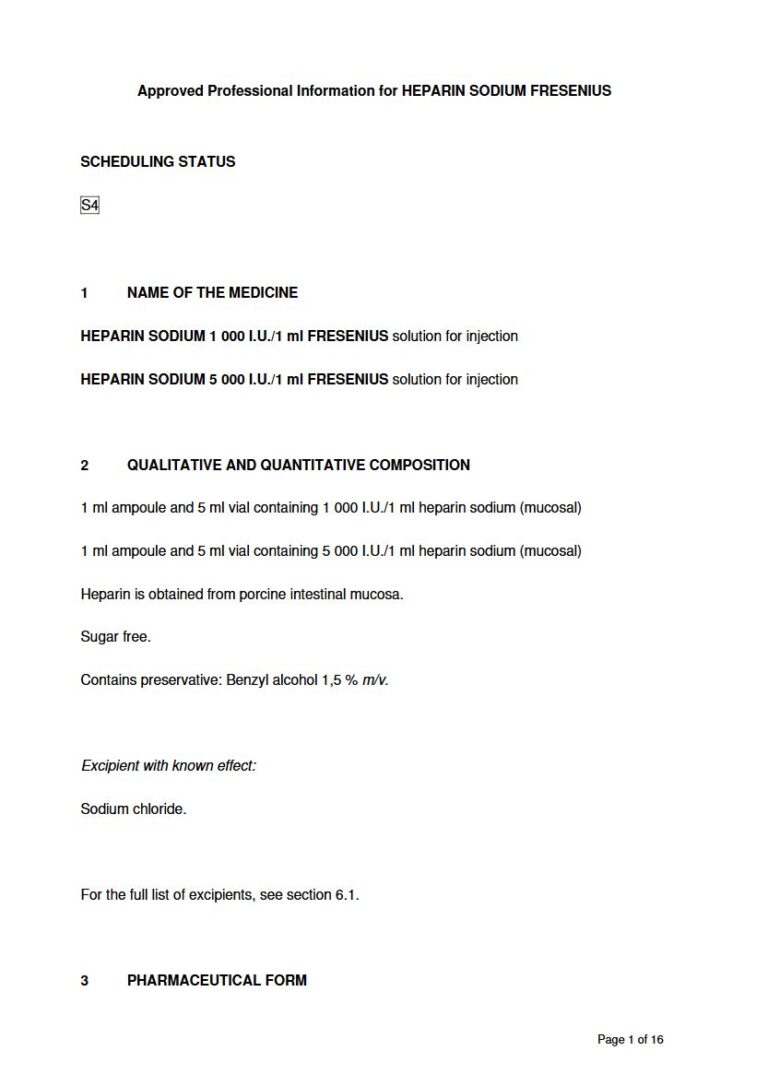
Heparin Sodium Fresenius 000 IU/1 ml Solution
PDF Leaflet Revision Date: 27 March 2023
Clinical Summary
Quick overview from the medicine insert
Indication
Anticoagulant for arterial and venous thrombosis treatment.
Dosage (summary)
IV: Initial 12,500 units, then 10,000 units every 4 hours; SC: 5,000 units every 8-12 hours for prophylaxis.
Special Populations
- Elderly
- Renal impairment
- Hepatic impairment
Pregnancy & Breastfeeding
Safer than warfarin in pregnancy; does not cross placenta or enter breast milk.
Key Drug Interactions
- Oral anticoagulants
- Aspirin
- NSAIDs
- Thrombolytics
Contraindications
- Hypersensitivity to heparin
- Active hemorrhage
- Severe hypertension
- Recent childbirth
Common side effects
- Haemorrhage
- Thrombocytopenia
- Hyperkalaemia
- Skin necrosis
Counselling Points
- Monitor for signs of bleeding
- Avoid IM injections
- Report any unusual bruising or bleeding
Serious warnings
- Risk of haemorrhage
- Thrombocytopenia monitoring required
- Caution in renal/hepatic impairment
Important Disclaimer
The Heparin Sodium Fresenius 000 IU/1 ml Solution professional information leaflet below is the property of Fresenius Kabi Manufacturing Sa and is provided on Medinsert exactly as issued, with no.. alterations or editorial changes. We make every effort to keep content current by updating documents as soon as new versions become available. Medinsert serves as a trusted access point for healthcare professionals, but does not replace official sources or clinical judgement. For more details, please read our full disclaimer. read more>>
 Healthcare Professionals Only
This content is for registered healthcare professionals
Sign in or create a free account to read the full package insert.
Free for HPCSA-registered professionals. Powered by Medinsert.
Clinical Particulars
Section 4 of the official insert — extracted exactly as issued, no alterations
4.1 Therapeutic indications
HEPARIN SODIUM FRESENIUS is used as an anticoagulant in vascular surgery and occasionally in blood transfusions, but its chief use is in the treatment of arterial and venous thrombosis. It may also be used prophylactically after surgery to prevent thromboembolic complications.
4.2 Posology and method of administration
It is recommended that a needle not larger than 21 gauge is used to reduce fragmentation of the rubber stopper. HEPARIN SODIUM FRESENIUS is given intravenously, preferably by continuous injection, or by deep subcutaneous injection. The subcutaneous doses of HEPARIN SODIUM FRESENIUS commonly used for prophylaxis (often termed u201clow doseu201d) do not require monitoring. The usual practice is to give an initial intravenous injection of 12 500 units of HEPARIN SODIUM FRESENIUS, followed by doses of 10 000 units every 4 hours to keep the clotting time, tested not less than 3 hours after the last injection, at about 3 times the pre-treatment figure. The dose for this purpose usually ranges from 6 000 to 12 000 units. For continuous infusion 10 000 to 20 000 units of HEPARIN SODIUM FRESENIUS is added to 1 litre of dextrose injection or sodium chloride 0,9 % injection and started at about 20 drops per minute.
A suggested initial dose for children is 50 units per kg body mass by intravenous infusion in dextrose injection 5 % increased to 100 units per kg every 4 hours to keep the clotting time at 20 to 30 minutes. If blood transfusions are required during anticoagulant therapy, 3 units of HEPARIN SODIUM FRESENIUS per ml may be added to the transfused blood in addition to the dose already being administered. Bleeding from the site of operation is unlikely if HEPARIN SODIUM FRESENIUS is started after the fourth postoperative day. For treatment of venous thromboembolism: An intravenous loading dose of 5 000 units (10 000 may be required in severe pulmonary embolism) is followed by continuous intravenous infusion of 1 000 to 2 000 units/hour or subcutaneous injection of 15 000 units every 12 hours. Alternatively, intermittent intravenous doses of 5 000 to 10 000 units every 4 to 6 hours undiluted or diluted in 50 to 100 ml of dextrose 5 % in water or sodium chloride 0,9 % is suggested. Children and small adults are given a lower intravenous dose followed by maintenance with continuous infusion of 15 to 25 units/kg per hour or subcutaneous injection of 250 units/kg every 12 hours. For prophylaxis of postoperative venous thromboembolism: Subcutaneous doses used are 5 000 units 2 hours before surgery, then every 8 to 12 hours for 7 days or until the patient is ambulant. Similar doses are used to prevent thromboembolism during pregnancy in women with history of deep vein thrombosis or pulmonary embolism; the dose may need to be increased to 10 000 units every 12 hours during the third trimester.
4.3 Contraindications
- Known hypersensitivity to heparin, especially when severe heparin-induced thrombocytopenia has occurred in recent months.
- Haemorrhagic blood disorders u2013 especially thrombocytopenia and haemophilia.
- Active or suspected haemorrhage u2013 especially cerebrovascular, gastrointestinal, except in disseminated intravascular coagulation.
- Conditions where haemorrhage is a particular risk:
- Cerebral or aortic aneurysm.
- Severe or uncontrolled hypertension.
- Threatened abortion.
- Recent childbirth.
- Subacute bacterial endocarditis.
- Pericarditis.
- Severe vasculitis.
- Active cavitating tuberculosis.
- Visceral carcinoma if there is a possibility of intracranial metastasis.
- Peptic ulceration.
- During or after eye, brain or spinal cord surgery or trauma.
- Prior to lumbar puncture or regional anaesthetic block.
- Surgical or traumatic wounds resulting in large open surfaces.
- Severe renal function impairment.
- Severe hepatic function impairment.
- Oesophageal varices.
4.4 Special warnings and precautions for use
Haemorrhage can occur at virtually any site in patients receiving HEPARIN SODIUM FRESENIUS. An unexplained fall in haematocrit, fall in blood pressure or any other unexplained symptom should lead to serious consideration of a haemorrhagic event. Rarely retroperitoneal haemorrhage can occur even if the clotting time is not prolonged. HEPARIN SODIUM FRESENIUS should be used with extreme caution in disease states in which there is increased danger of haemorrhage, e.g. some vascular purpuras, continuous tube drainage of the stomach or small intestine, menstruation.
Thrombocytopenia has been reported to occur in patients receiving HEPARIN SODIUM FRESENIUS with a reported incidence of 0 to 30 %. Platelet counts should be obtained at baseline and periodically during HEPARIN SODIUM FRESENIUS administration. Mild thrombocytopenia (count greater than 100 000 platelets/mm3) may remain stable or reverse even if HEPARIN SODIUM FRESENIUS is continued. However, thrombocytopenia of any degree should be monitored closely. If the count falls below 100 000 platelets/mm3 or if recurrent thrombosis develops (see Heparin-induced thrombocytopenia and heparin-induced thrombocytopenia and thrombosis), the HEPARIN SODIUM FRESENIUS should be discontinued and, if necessary, an alternative anticoagulant administered.
Heparin-induced thrombocytopenia (HIT) and heparin-induced thrombocytopenia and thrombosis (HITT) may occur. Heparin-induced thrombocytopenia (HIT) is a serious antibody-mediated reaction resulting from irreversible aggregation of platelets. HIT may progress to the development of venous and arterial thrombosis, a condition referred to as heparin-induced thrombocytopenia and thrombosis (HITT). Thrombotic events may also be the initial presentation for HITT. These serious thromboembolic events include deep vein thrombosis, pulmonary embolism, cerebral vein thrombosis, limb ischaemia, stroke, myocardial infarction, mesenteric thrombosis, renal arterial thrombosis, skin necrosis, gangrene of the extremities that may lead to amputation, and possibly death. Thrombocytopenia of any degree should be monitored closely. If the platelet count falls below 100 000/mm3 or if recurrent thrombosis develops, the HEPARIN SODIUM FRESENIUS should be promptly discontinued, and alternative anticoagulants considered if patients require continued anticoagulation.
Since HEPARIN SODIUM FRESENIUS has caused thrombocytopenia with severe thromboembolic complications, platelet counts should be monitored in patients receiving HEPARIN SODIUM FRESENIUS for more than a few days.
Delayed onset of HIT and HITT: Heparin-induced thrombocytopenia and heparin-induced thrombocytopenia and thrombosis can occur up to several weeks after the discontinuation of HEPARIN SODIUM FRESENIUS therapy. Patients presenting with thrombocytopenia or thrombosis after discontinuation of HEPARIN SODIUM FRESENIUS should be evaluated for HIT and HITT.
A test dose is recommended for patients with a history of allergy. HEPARIN SODIUM FRESENIUS inhibits the secretion of aldosterone which may cause hyperkalaemia. Plasma potassium levels should be monitored in those patients who are susceptible to hyperkalaemia, especially when receiving HEPARIN SODIUM FRESENIUS for more than 7 days. The problem is normally resolved with the discontinuation of HEPARIN SODIUM FRESENIUS.
Priapism has been associated with administration. HEPARIN SODIUM FRESENIUS should not be administered by intramuscular injection due to the risk of haematoma. Due to increased bleeding risk, care should be taken when giving concomitant intramuscular injections, lumbar puncture and similar procedures.
HEPARIN SODIUM FRESENIUS contains less than 1 mmol sodium (23 mg) per ampoule and per vial, that is to say essentially sodium free. HEPARIN SODIUM FRESENIUS contains benzyl alcohol (15 mg/ml). Caution should be used if prescribing HEPARIN SODIUM FRESENIUS to susceptible patients. Benzyl alcohol may cause allergic reactions. Patients with liver or kidney impairment and young children (less than 3 years old) are at the risk of accumulation and toxicity (metabolic acidosis). Intravenous administration of benzyl alcohol has been associated with serious adverse events and death in neonates (u201cgasping syndromeu201d).
Special populations: Dosage of HEPARIN SODIUM FRESENIUS may need to be reduced in old people; elderly women appear to be especially susceptible to haemorrhage after HEPARIN SODIUM FRESENIUS administration.
4.5 Interaction with other medicines and other forms of interaction
HEPARIN SODIUM FRESENIUS should be used with care in conjunction with oral anticoagulants or medicines like aspirin and dipyridamole, which effect platelet function. Nonsteroidal anti-inflammatory medicines may also increase the risk of haemorrhage. Other medicines which affect the coagulation process, and which may therefore increase the risk of haemorrhage include dextrans, thrombolytic enzymes such as streptokinase, high doses of penicillins, some cephalosporins, some contrast media, asparaginase and epoprostenol. Estimations of oral anticoagulant control may be modified by the action of HEPARIN SODIUM FRESENIUS on prothrombin.
Heparin may prolong the one stage prothrombin time. Accordingly, when HEPARIN SODIUM FRESENIUS is given with dicoumarol or warfarin sodium, a period of at least 5 hours after the last intravenous dose of heparin should elapse before blood is drawn, if a valid prothrombin time is to be obtained. The anticoagulant effect of heparin may be enhanced by concomitant medication with other medicines affecting platelet function or the coagulation system, e.g. platelet aggregation inhibitors, thrombolytic agents, salicylates, non-steroidal anti-inflammatory medicines, vitamin K antagonists, dextrans, activated protein C. Where such combination cannot be avoided, careful clinical and biological monitoring is required.
Combined use with ACE inhibitors or angiotensin II antagonists may increase the risk of hyperkalaemia. Nitrates: Reduced activity of heparin has been reported with simultaneous intravenous glyceryl trinitrate infusion. HEPARIN SODIUM FRESENIUS has been reported incompatible with alteplase, amikacin sulphate, amiodarone hydrochloride, ampicillin sodium, aprotinin, benzylpenicillin, cefalotin sodium, ciprofloxacin lactate, cytarabine, dacarbazine, daunorubicin hydrochloride, diazepam, dobutamine hydrochloride, doxorubicin hydrochloride, droperidol, erythromycin lactobionate, gentamicin sulphate, haloperidol lactate, hyaluronidase, hydrocortisone sodium succinate, kanamycin sulphate, meticillin sodium, netilmicin sulphate, some opioid analgesics, oxytetracycline hydrochloride, some phenothiazines, polymyxin B sulphate, streptomycin sulphate, tetracycline hydrochloride, tobramycin sulphate, vancomycin hydrochloride and vinblastine sulphate. HEPARIN SODIUM FRESENIUS has also been reported to be incompatible with cisatracurium besilate, labetalol hydrochloride, levofloxacin, nicardipine hydrochloride, reteplase and vinorelbine tartrate. Although visually compatible cefmetazole sodium is reported to inactivate heparin sodium.
4.6 Fertility, pregnancy and lactation
HEPARIN SODIUM FRESENIUS does not cross the placenta and therefore adverse effects on the fetus would not be expected. HEPARIN SODIUM FRESENIUS is considered safer to the fetus than warfarin when used during pregnancy. HEPARIN SODIUM FRESENIUS has not been shown to cause birth defects or bleeding problems in the baby. However, use during the last three months of pregnancy or during the month following the babyu2019s delivery may cause bleeding problems in the mother.
Breastfeeding: Heparin does not pass into the breast milk.
4.7 Effects on ability to drive and use machines
None stated.
4.8 Undesirable effects
Blood and the lymphatic system disorders: The following side effects have been reported and the frequencies are unknown: HEPARIN SODIUM FRESENIUS can give rise to haemorrhage as a consequence of its action. It can also cause thrombocytopenia, either through a direct effect or through an immune effect producing a platelet-aggregating antibody. Consequent platelet aggregation and thrombosis may therefore exacerbate the condition being treated.
Heparin-induced thrombocytopenia (HIT) and heparin-induced thrombocytopenia and thrombosis (HITT) and delayed onset of HIT and HITT may occur.
Immune system disorders: The following side effect has been reported and the frequency is unknown: Hypersensitivity reactions may occur.
Endocrine disorders: The following side effects have been reported and the frequency is unknown: Adrenal insufficiency, hypoaldosteronism.
Metabolism and nutrition disorders: The following side effects have been reported and the frequency is unknown: Rebound hyperlipidaemia, hyperkalaemia, hypokalaemia.
Vascular disorders: The following side effects have been reported and the frequency is unknown: Haemorrhage, epistaxis, contusion.
Skin and subcutaneous tissue disorders: The following side effect has been reported and the frequency is unknown: Skin necrosis and alopecia have occurred after prolonged use of HEPARIN SODIUM FRESENIUS.
Musculoskeletal, connective tissue and bone disorders: The following side effect has been reported and the frequency is unknown: Osteoporosis resulting in spontaneous fractures has occurred after prolonged use of HEPARIN SODIUM FRESENIUS.
Renal and urinary disorders: The following side effect has been reported and the frequency is unknown: Haematuria.
Reproductive system and breast disorders: The following side effect has been reported and the frequency is unknown: Priapism.
General disorders and administration site conditions: The following side effects have been reported and the frequencies are unknown: Local irritant effects. Injection site reaction.
Investigations: The following side effects have been reported and the frequencies are unknown: Increased alanine aminotransferase, increased aspartate aminotransferase.
Reporting of suspected adverse reactions: Reporting suspected adverse reactions after authorisation of the medicine is important. It allows continued monitoring of the benefit/risk balance of the medicine. Healthcare providers are asked to report any suspected adverse reactions to SAHPRA via the u201c6.04 Adverse Drug Reactions Reporting Formu201d, found online under SAHPRAu2019s publications: http://www.sahpra.org.za/Publications/Index/8. Health care providers are asked to report any suspected adverse reactions to the Holder of the Certificate of Registration at the following email address: [email protected], and to the relevant medicineu2019s regulatory authority in the country where the medicine is marketed.
4.9 Overdose
The main side effect of HEPARIN SODIUM FRESENIUS is haemorrhage. Careful laboratory control is necessary. Bleeding may be encountered from an unsuspected lesion, such as a peptic ulcer. The haemorrhagic complications recorded include haematuria, haemarthrosis, wound haematoma and gastrointestinal bleeding. The haemorrhage may produce a haematoma in the surgical wound, but this is rarely serious if infection is prevented, and larger accumulations of blood are aspirated. Mild effects of heparin overdosage usually respond to simple withdrawal of HEPARIN SODIUM FRESENIUS. In the event of major haemorrhage, the use of the specific heparin antagonist, protamine sulphate, is imperative.
