
Cosmofer 50 mg Solution for injection/infusion
PDF Leaflet Revision Date: 14 January 2025
Clinical Summary
Quick overview from the medicine insert
Indication
Severe iron deficiency in adults intolerant to or not responding to oral iron.
Dosage (summary)
100 to 200 mg iron (2 to 4 ml), 2-3 times a week based on hemoglobin level.
Special Populations
- Children under 14 years
- Elderly patients
- Renal impairment
- Hepatic impairment
Pregnancy & Breastfeeding
Use in pregnancy only if benefits outweigh risks; avoid during breastfeeding.
Key Drug Interactions
- Oral iron preparations reduce absorption of CosmoFer.
Contraindications
- Hypersensitivity to active substance
- Non-iron deficiency anemia
- Iron overload disorders
- Acute renal failure
- Decompensated liver cirrhosis
Common side effects
- Anaphylactoid reactions
- Nausea
- Rashes
- Injection site reactions
Counselling Points
- Observe for 60 mins post-injection for adverse effects.
- Do not mix with other medications.
- Use only in trained settings with resuscitation facilities.
Serious warnings
- Risk of serious anaphylactic reactions
- Monitor for hypersensitivity during administration
Important Disclaimer
The Cosmofer 50 mg Solution for injection/infusion professional information leaflet below is the property of Acino Pharma and is provided on Medinsert exactly as issued, with no.. alterations or editorial changes. We make every effort to keep content current by updating documents as soon as new versions become available. Medinsert serves as a trusted access point for healthcare professionals, but does not replace official sources or clinical judgement. For more details, please read our full disclaimer. read more>>
 Healthcare Professionals Only
This content is for registered healthcare professionals
Sign in or create a free account to read the full package insert.
Free for HPCSA-registered professionals. Powered by Medinsert.
Clinical Particulars
Section 4 of the official insert — extracted exactly as issued, no alterations
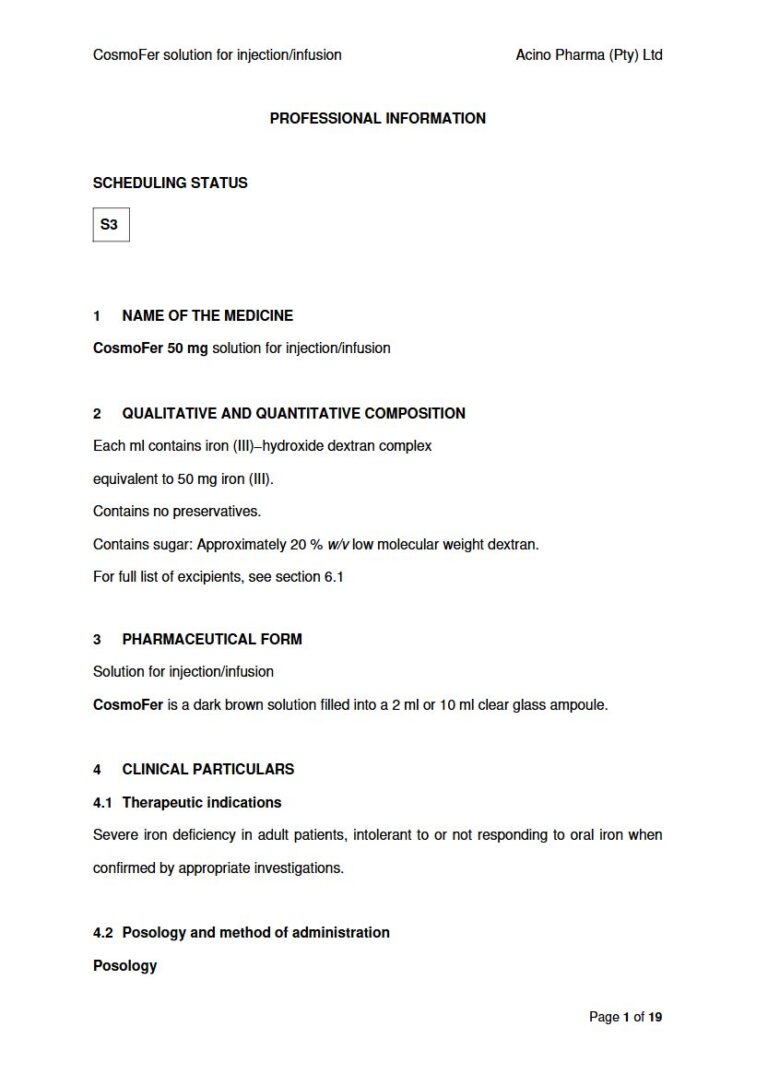
4.1 Therapeutic indications
Severe iron deficiency in adult patients, intolerant to or not responding to oral iron when confirmed by appropriate investigations.
4.2 Posology and method of administration
Posology
Anaphylactoid reactions to CosmoFer are usually evident within a few minutes, and close observation is necessary to ensure recognition. Patients should be carefully monitored for signs and symptoms of hypersensitivity reactions during and following each administration of CosmoFer. CosmoFer should only be administered when staff trained to evaluate and manage anaphylactic reactions is immediately available, in an environment where full resuscitation facilities is assured. The patient should be observed for adverse effects for at least 60 minutes following each CosmoFer injection. (see section 4.4). If at any time during the intravenous administration of CosmoFer, any signs of a hypersensitivity reaction or intolerance are detected, administration must be stopped immediately.
Special Populations
Children (under 14 years): CosmoFer should not be used for children. There is no documentation for efficacy and safety. Elderly patients: No specific dose adjustment for the use of CosmoFer in older people (u2265 65 years) is recommended (see u201cMethod of administrationu201d). Patients with renal impairment: No specific dose adjustment is required, except in cases of acute renal failure where the use of CosmoFer is contraindicated (refer to section 4.3). Patients with hepatic impairment: No specific dose adjustment is required, except for patients with decompensated liver cirrhosis and hepatitis where the use of CosmoFer is contraindicated (refer to section 4.3).
Method of administration:
CosmoFer solution for injection/infusion can be administered by an intravenous drip infusion or by a slow intravenous injection of which the intravenous drip infusion is the preferred route of administration, as this may help to reduce the risk of hypotensive episodes. However, CosmoFer may also be administered as undiluted solution intramuscularly.
Adults and elderly:
The total cumulative dose of CosmoFer is determined by haemoglobin level and body weight. The dose and dosage schedule for CosmoFer must be individually estimated for each patient based on a calculation of the total iron deficit. Dosage: The normal recommended dosage schedule is 100 to 200 mg of iron corresponding to 2 to 4 ml, two or three times a week depending on the haemoglobin level. The CosmoFer injection should not be administered concomitantly with oral iron preparations as the absorption of oral iron will be reduced (see section 4.5).
Intravenous Drip Infusion:
CosmoFer must be diluted only in 0,9 % sodium chloride solution (normal saline) or in 5 % glucose solution. CosmoFer in a dose of 100 to 200 mg elemental iron (2 to 4 ml) may be diluted in 100 ml. On each occasion, the first 25 mg of iron should be infused over a period of 15 minutes. If no adverse reactions occur during this time, the remaining portion of the infusion should be given at an infusion rate of not more than 100 ml in 30 minutes.
Intravenous Injection:
CosmoFer may be administered in a dose of 100 to 200 mg iron (2 to 4 ml) by slow intravenous injection (0,2 ml/min) preferably diluted in 10 to 20 ml of 0,9 % sodium chloride or 5 % glucose solution. On each occasion, before administering a slow intravenous injection, 25 mg of CosmoFer (0,5 ml) should be injected slowly over a period of 1 to 2 minutes. If no adverse reactions occur within 15 minutes, the remaining portion of the injection may be given.
Total Dose Infusion:
Immediately before administration, the total CosmoFer required, determined from the dosage table or by calculation, is added aseptically to the required volume, usually 500 ml of sterile 0,9 % sodium chloride or 5 % glucose solutions. The total amount of CosmoFer, up to 20 mg/kg body weight, is infused intravenously over 4 to 6 hours. The first 25 mg of iron should be infused over a period of 15 minutes. The patient must be kept under close medical observation during this period. If no adverse reactions occur during this time, then the remaining portion of the infusion should be given. The rate of infusion may be increased progressively to 45 to 60 drops per minute (based on a standard infusion set delivering 20 drops/ml of 0,9 % sodium chloride or 5 % glucose). Patients should be observed carefully during the infusion and for at least 1 hour after completion. Total Dose Infusion (TDI) has been associated with an increased incidence of adverse reactions, in particular delayed hypersensitivity-like reactions. The intravenous administration of CosmoFer by the Total Dose Infusion method should be restricted to hospital use only.
Injection into Dialyser:
CosmoFer may be administered during a haemodialysis session directly into the venous limb of the dialyser under the same procedures as outlined for intravenous administration.
Intramuscular Injection:
The total amount of CosmoFer required is determined either from the dosage table or by calculation. It is administered as a series of undiluted injections of up to 100 mg iron (2,0 ml) each determined by the patientu2019s body weight. If the patient is moderately active, injections may be given daily into alternate buttocks. In inactive or bedridden patients, the frequency of injections should be reduced to once or twice a week. CosmoFer must be given by deep intramuscular injection to minimise the risk of subcutaneous staining. It should be injected only into the muscle mass of the upper outer quadrant of the buttocks, never into the arm or other exposed areas. The patient should be lying in the lateral position with the injection site uppermost or standing bearing their weight on the leg opposite the injection site. To avoid injection or leakage into the subcutaneous tissue, a Z-track technique is recommended. CosmoFer is injected slowly. It is important to wait for a few seconds before withdrawing the needle to allow the muscle mass to accommodate the injection volume. To minimise leakage up the injection track, the patient should be encouraged not to rub the injection site.
Calculation of Dose
a) Iron replacement in patients with iron deficiency anaemia Factors contributing to the formula are shown below. The required dose has to be individually adapted according to the total iron deficit calculated by the following formula (haemoglobin in g/l or mmol/l). Total dose (mg Fe) u2013 Hb in g/l : (Body weight (kg) x (target Hb u2013 actual Hb) (g/l) x 0,24) + mg iron for iron stores The factor 0,24 is derived from the following assumptions: a) Blood volume 70 ml/kg of body weight u2248 7 % of body weight b) Iron content of haemoglobin 0,34 % Factor 0,24 = 0,0034 x 0,07 x 1000 (conversion from g to mg). Total dose (mg Fe) u2013 Hb in mmol/l: (Body weight (kg) x (target Hb in mmol/l u2013 actual Hb in mmol/l) x 3,84) + mg iron for iron stores. The factor 3,84 is derived from the following assumptions: a) Blood volume 70 ml/kg of body weight u2248 7 % of body weight b) Iron content of haemoglobin 0,34 % c) Factor for conversion from haemoglobin g/l to mmol/l is 0,06205 Factor 3,84 = 0,0034 x 0,07 x 1 000 / 0,06205 The table below shows the number of millilitres of CosmoFer solution for injection/infusion to be used at various degrees of iron deficiency anaemia. The figures in the table below are based on a target haemoglobin of 150 g/l or 9,3 mmol/l and iron stores of 500 mg which apply to a body weight exceeding 35 kg. Although there are significant variations in body build and weight distribution among males and females, the accompanying table and formula represent a convenient means for estimating the total iron required. This total iron requirement reflects the amount of iron needed to restore haemoglobin concentration to normal or near normal levels plus an additional allowance to provide adequate replenishment of iron stores in most individuals with moderately or severely reduced levels of haemoglobin. It should be remembered that iron deficiency anaemia will not appear until essentially all iron stores have been depleted. Therapy, thus, should aim at not only replenishment of haemoglobin iron but of iron stores as well. If the total necessary dose exceeds the maximum allowed daily dose, the administration has to be split. Evidence of a therapeutic response can be seen within a few days of administration of CosmoFer as an increase in the reticulocyte count. Serum ferritin levels usually provide a good guide to the replenishment of iron stores. In renal dialysis patients receiving CosmoFer, this correlation may not be valid. Total dose of CosmoFer in Millilitres to be administered in iron deficiency anaemia Haemoglobin content 60 g/l u2248 3,7 mmo/l 75 g/l u2248 4,7 mmol/l 90 g/l u2248 5,6 mmol/l 105 g/l u2248 6,5 mmol/l 120 g/l u2248 7,4 mmol/l 135 g/l u2248 8 mmol/l Bodyweight (kg) 35 25 23 20 18 15 12,5 40 27 24 22 19 16 13 45 29 26 23 20 16,5 13 50 32 28 24 21 17 13,5 55 34 30 26 22 18 14 60 36 32 27 23 18,5 14,5 65 38 33 29 24 19,5 14,5 70 40 35 30 25 20 15 75 42 37 32 26 21 15,5 80 45 39 33 27 21,5 16 85 47 41 34 28 22 16 90 49 42 36 29 23 16,5 Note: The table and accompanying formula are applicable for dose determination only in patients with iron deficiency anaemia. They are not to be used for dose determination in patients requiring iron replacement for blood loss.
b) Iron replacement for blood loss Iron therapy in patients with blood loss should be directed towards replacement of an amount of Iron equivalent to the amount of iron represented in the blood loss. The table and formula described are not applicable for simple iron replacement values. Quantitative estimates of the individualu2019s periodic blood loss and haematocrit during the bleeding episode provide a convenient method of calculation of the required iron dose. The required CosmoFer dose to compensate the iron deficit is calculated according to the following formulas: u2022 If the volume of blood lost is unknown: The administration of 200 mg I.V. iron (4 ml CosmoFer) results in an increase of haemoglobin which is equivalent to 1 unit blood (= 400 ml with 150 g/l Hb content or 9,3 mmol Hb/l u2013 equivalent to 0,34 % of 0,4 x 150 or 204 mg iron). Iron to be replaced mg = number of blood units lost x 200. Millilitres of CosmoFer needed = number of blood units lost x 4. u2022 If the Hb level is reduced: Use the previous formula considering that the depot iron does not need to be restored. mg iron to be replaced = body weight (kg) x 0,24 x (target Hb in g/l u2013 actual Hb in g/l). OR mg iron to be replaced = body weight (kg) x 3,84 x (target Hb in mmol/l u2013 actual Hb in mmol/l). e.g.: body weight 60 kg, Hb deficit = 10 g/l or 0,62 mmol/l: Iron to be replaced = 60 x 0,24 x 10 = 60 x 3,84 x 0,62 = 143 mg (u2248 3 millilitres CosmoFer)
4.3 Contraindications
- Hypersensitivity to the active substance, to CosmoFer or any of the excipients (see section 6.1).
- Known hypersensitivity to other parenteral iron products.
- Non-iron deficiency anaemia e.g., haemolytic anaemia and anaemia of chronic disease.
- Iron overload or disturbances in utilisation of iron (e.g. haemochromatosis, haemosiderosis).
- Patients with a history of allergies such as of asthma, eczema, or other atopic allergy.
- Decompensated liver cirrhosis and hepatitis.
- Acute or chronic infection because parenteral iron administration may exacerbate bacterial or viral infections.
- Rheumatoid arthritis with symptoms or signs of active inflammation.
- Acute renal failure.
4.4 Special warnings and precautions for use
Parenterally administered iron preparations, such as CosmoFer can cause hypersensitivity reactions including serious and potentially fatal anaphylactic/anaphylactoid reactions. Hypersensitivity reactions have also been reported after previously uneventful doses of CosmoFer. The risk is enhanced for patients with known allergies including medicine allergies, including patients with a history of severe asthma, eczema or other atopic allergy. There is also an increased risk of hypersensitivity reactions to parenteral iron complexes in patients with immune or inflammatory conditions (e.g. systemic lupus erythematosus, rheumatoid arthritis). CosmoFer should only be administered when staff trained to evaluate and manage anaphylactic reactions is immediately available, in an environment where full resuscitation facilities can be assured. Each patient should be observed for adverse effects for at least 60 minutes following each CosmoFer injection. If hypersensitivity reactions or signs of intolerance occur during administration, the treatment must be stopped immediately. Facilities for cardio-respiratory resuscitation and equipment for handling acute anaphylactic/anaphylactoid reactions should be available, including an injectable 1:1 000 epinepherine (adrenaline) solution. Additional treatment with antihistamines and/or corticosteroids should be given as appropriate. The intramuscular and subcutaneous injection of iron-carbohydrate complexes in very large doses under experimental conditions in animals produced sarcoma in rats, mice, rabbits, possibly hamsters but not in guinea pigs. Cumulative information and independent assessment indicate that the risk of sarcoma formation in man is minimal. Hypotensive episodes may occur if intravenous injection is administered too rapidly.
4.5 Interaction with other medicines and other forms of interaction
The CosmoFer injection should not be administered concomitantly with oral iron preparations as the absorption of oral iron will be reduced. Oral iron therapy should not be started earlier than 5 days after the last injection of CosmoFer. Large doses of CosmoFer (5 ml or more) have been reported to give a brown colour to serum from a blood sample drawn four hours after administration. CosmoFer may cause falsely elevated values of serum bilirubin and falsely decreased values of serum calcium.
4.6 Fertility, pregnancy and lactation
Pregnancy
There are no adequate and well controlled trials on safety from the use of CosmoFer in pregnant women. Studies in animals have shown reproductive toxicity (see section 5.3). A careful risk/benefit evaluation is therefore required before use during pregnancy. (See section 4.4). Iron deficiency anaemia occurring in the first trimester of pregnancy can in most cases be treated with oral iron. Treatment with CosmoFer should be confined to second and third trimester. Foetal bradycardia may occur following administration of parenteral irons. It is usually transient and a consequence of a hypersensitivity reaction in the mother.
Breastfeeding
It is unknown whether the complex iron-dextran is excreted in human or animal breast milk. It is preferable to not use CosmoFer during breastfeeding.
4.7 Effects on ability to drive and use machines
No studies on the effect on the ability to drive and use machines have been performed. Adverse reactions such as blurred vision, dizziness, tremor may influence ability to drive and use machines.
4.8 Undesirable effects
a. Summary of the safety profile
Approximately 5 % of patients can be expected to experience adverse reactions. These are mainly dose dependent. Anaphylactoid reactions are uncommon and include urticaria, rashes, itching, nausea and shivering. Administration must be stopped immediately when signs of an anaphylactoid reaction are observed. Acute, severe anaphylactoid reactions may occur. They usually occur within the first few minutes of administration and are generally characterised by the sudden onset of respiratory difficulty and/or cardiovascular collapse; fatalities have been reported. However, patients should be observed for at least 60 minutes after administration of CosmoFer. Delayed reactions are well described and may be severe. They are characterised by arthralgia, myalgia and sometimes fever. The onset varies from several hours up to four days after administration. Symptoms usually last two to four days and settle spontaneously or following the use of simple analgesics. Exacerbation of joint pain in rheumatoid arthritis can occur. Local reactions reported are soreness and inflammation at or near injection site and local phlebitic reaction. Local complications at the injection site after intramuscular injection such as staining of the skin, bleeding, formation of sterile abscesses, tissue necrosis or atrophy and pain may occur.
b. Tabulated summary of adverse reactions
MedDRA system organ class Uncommon (> 1/1 000; 1/10 000; < 1/1000) Very rare ( 1/1 000; 1/10 000; < 1/1000) Very rare (< 1/10 000) Not Known Gastrointestinal disorders Nausea, vomiting, abdominal pain Diarrhoea General disorders and administration site conditions Feeling hot Fatigue Pain and brown pigmentation at injection site Influenza like illness whose onset may vary from a few hours to several days Immune system disorders Anaphylactoid / anaphylactic reactions including dyspnoea, urticaria, rashes, itching, nausea, shivering and Angioedema, cardiovascular collapse Musculoskeletal and connective tissues disorders Cramps Myalgias Nervous system disorders Blurred vision, numbness Loss of consciousness, seizures, dizziness, restlessness, tremor Headache, paraesthesia Respiratory, thoracic and mediastinal disorders Dyspnoea Chest pain Psychiatric disorders Mental status changes Skin and subcutaneous tissue disorders Flushing, pruritus, rash Sweating Vascular Hypotension Hypertension
4.9 Overdose
See section 4.8. Iron (III)-hydroxide dextran complex, as in CosmoFer injection, has a very low toxicity. The preparation is well tolerated and has a minimal risk of accidental overdosing. Overdose can cause acute iron overloading which may manifest itself as haemosiderosis. Particular caution should be exercised to avoid iron overload where anaemia, unresponsive to treatment, has been incorrectly diagnosed as iron deficiency anaemia. Supportive measures such as an iron chelating agent can be used. With chronic repeated administration of iron at high dose, the excess iron will accumulate in the liver and induce an inflammatory process, which may lead to fibrosis. Further treatment is symptomatic and supportive.
