
Ecotrin 81 mg Enteric coated tablet.
PDF Leaflet Revision Date: 02 February 2023
Clinical Summary
Quick overview from the medicine insert
Indication
To reduce the risk of myocardial infarction and stroke.
Dosage (summary)
1-3 tablets daily as directed by a doctor.
Special Populations
- Elderly
- Renal impairment
- Hepatic impairment
Pregnancy & Breastfeeding
Contraindicated in first and third trimesters; caution during breastfeeding.
Key Drug Interactions
- Methotrexate >15mg/week
- Anticoagulants
- SSRIs
- Diuretics
Contraindications
- Hypersensitivity to aspirin
- Active peptic ulcer
- Severe hepatic impairment
- Severe renal impairment
Common side effects
- Gastrointestinal disturbances
- Increased bleeding tendencies
- Dyspepsia
Counselling Points
- Take with food to reduce GI upset
- Report unusual bleeding
- Do not exceed recommended dose
Serious warnings
- Risk of Reye's syndrome in children
- Increased risk of bleeding
- Caution before surgery
Important Disclaimer
The Ecotrin 81 mg Enteric coated tablet. professional information leaflet below is the property of Acino Pharma and is provided on Medinsert exactly as issued, with no.. alterations or editorial changes. We make every effort to keep content current by updating documents as soon as new versions become available. Medinsert serves as a trusted access point for healthcare professionals, but does not replace official sources or clinical judgement. For more details, please read our full disclaimer. read more>>
 Healthcare Professionals Only
This content is for registered healthcare professionals
Sign in or create a free account to read the full package insert.
Free for HPCSA-registered professionals. Powered by Medinsert.
Clinical Particulars
Section 4 of the official insert — extracted exactly as issued, no alterations
4.1 Therapeutic indications
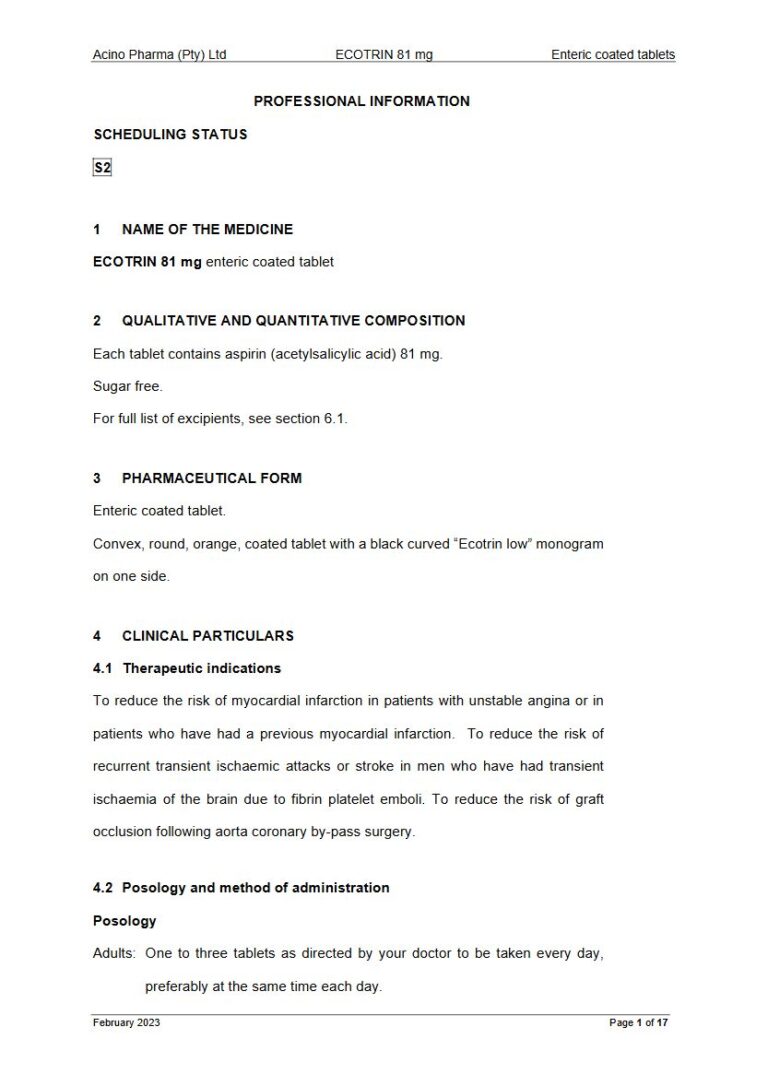
To reduce the risk of myocardial infarction in patients with unstable angina or in patients who have had a previous myocardial infarction.
To reduce the risk of recurrent transient ischaemic attacks or stroke in men who have had transient ischaemia of the brain due to fibrin platelet emboli. To reduce the risk of graft occlusion following aorta coronary by-pass surgery.
4.2 Posology and method of administration
Posology
Adults: One to three tablets as directed by your doctor to be taken every day, preferably at the same time each day.
Warning: The optimal dose for inhibition of platelet aggregation in humans is not known. Do not use this medicine for indications related to the inhibition of platelet aggregation unless directed by a doctor.
Method of administration
For oral use.
4.3 Contraindications
- Hypersensitivity to aspirin, salicylic acid compounds or prostaglandin synthetase inhibitors (e.g. certain asthma patients who may suffer an attack or faint), or to any of the excipients (see section 6.1).
- Active, or history of recurrent peptic ulcer and/or gastric/intestinal haemorrhage, or other kinds of bleeding such as cerebrovascular haemorrhages.
- Should not be administered to patients with haemorrhagic diathesis; coagulation disorders such as haemophilia and thrombocytopenia.
- Severe hepatic impairment.
- Severe renal impairment.
- Gout.
- Severe cardiac insufficiency.
- Methotrexate used at doses >15mg/week (see section 4.5).
- Aspirin should not be taken during the first and third trimesters of pregnancy and during lactation.
- Aspirin should be discontinued one week before scheduled surgical procedures.
- In the event of overdosage and notwithstanding the fact that the person may be asymptomatic, the nearest doctor, hospital, or Poison Control Centre must be contacted immediately.
- Do not exceed the recommended daily dose.
4.4 Special warnings and precautions for use
If symptoms persist consult your doctor. Do not use continuously for more than 10 days without consulting your doctor.
Aspirin has been implicated in Reyeu2019s syndrome, a rare but serious illness in children and teenagers with chickenpox and influenza. A doctor should be consulted before aspirin is used in such patients.
There is an increased risk of haemorrhage and prolongation of bleeding time particularly during or after surgery (even in cases of minor procedures, e.g. tooth extraction). Use with caution before surgery, including tooth extraction. Temporary discontinuation of treatment may be necessary.
ECOTRIN 81 mg is not recommended during menorrhagia where it may increase menstrual bleeding.
ECOTRIN 81 mg is to be used with caution in cases of uncontrolled hypertension and when patients have a past history of gastric or duodenal ulcer or haemorrhagic episodes or are undergoing therapy with anticoagulants.
Patients should report any unusual bleeding symptoms to their medical practitioner. If gastrointestinal bleeding or ulceration occurs the treatment should be withdrawn.
Acetylsalicylic acid should be used with caution in patients with moderately impaired renal or hepatic function (contraindicated if severe), or in patients who are dehydrated since the use of NSAIDs may result in deterioration of renal function. Liver function tests should be performed regularly in patients presenting slight or moderate hepatic insufficiency.
Acetylsalicylic acid may promote bronchospasm and asthma attacks or other hypersensitivity reactions. Risk factors are existing asthma, hay fever, nasal polyps or chronic respiratory diseases. The same applies for patients who also show allergic reaction to other substances (e.g. with skin reactions, itching or urticaria).
Serious skin reactions, including Steven-Johnsons syndrome, have less frequently been reported in association with the use of acetylsalicylic acid (see section 4.8). ECOTRIN 81 mg should be discontinued at the first appearance of skin rash, mucosal lesions, or any other sign of hypersensitivity.
Elderly patients are particularly susceptible to the adverse effects of NSAIDs, including acetylsalicylic acid especially gastrointestinal bleeding and perforation which may be fatal. Where prolonged therapy is required, patients should be reviewed regularly.
Concomitant treatment with ECOTRIN 81 mg and other medicines that alter haemostasis (i.e. anticoagulants such as warfarin, thrombolytic and antiplatelet medicines, anti-inflammatory medicines and selective serotonin reuptake inhibitors) is not recommended, unless strictly indicated, because they may enhance the risk of haemorrhage (see section 4.5). If the combination cannot be avoided, close observation for signs of bleeding is recommended.
Caution should be advised in patients receiving concomitant medications which could increase the risk of ulceration, such as oral corticosteroids, selective serotonin-reuptake inhibitors and deferasirox (see section 4.5).
Acetylsalicylic acid should be avoided in early and late pregnancy and generally during breast feeding (see sections 4.3 and 4.6).
Acetylsalicylic acid in low doses reduces uric acid excretion. Due to this fact, patients who tend to have reduced uric acid excretion may experience gout attacks (see section 4.5).
The risk of hypoglycaemic effect with sulfonylureas and insulins may be potentiated with ECOTRIN 81 mg taken at over dosage (see section 4.5).
Aspirin should be used with caution in patients with glucose-6-phosphate dehydrogenase deficiency.
Drug Reaction with Eosinophillia and Systemic Symptoms (DRESS) has been reported in patients taking NSAIDs such as ECOTRIN 81 mg. Some of these events have been fatal or life-threatening. DRESS typically, although not exclusively, presents with fever, rash, lymphadenopathy, and/or facial swelling. Other clinical manifestations may include hepatitis, nephritis, haematological abnormalities, myocarditis, or myositis. Sometimes symptoms of DRESS may resemble an acute viral infection. Eosinophillia is often present. Because this disorder is variable in its presentation, other organ systems not noted here may be involved. It is important to note that early manifestations of hypersensitivity, such as fever or lymphadenopathy, may be present even though rash is not evident. If such signs or symptoms are present, discontinue ECOTRIN 81 mg and evaluate the patient immediately.
4.5 Interaction with other medicines and other forms of interaction
Contraindicated combinations
Methotrexate (used at doses >15 mg/week) The combined medicines, methotrexate and acetylsalicylic acid, enhance haematological toxicity of methotrexate due to the decreased renal clearance of methotrexate by acetylsalicylic acid. Therefore, the concomitant use of methotrexate (at doses >15 mg/week) with ECOTRIN 81 mg is contraindicated (see section 4.3).
Not recommended combinations
Uricosuric medicines, e.g. probenecid, sulfinpyrazone Salicylates reverse the effect of probenecid and sulfinpyrazone. The combination should be avoided.
Combinations requiring precautions for use or to be taken into account
Anticoagulants and thrombolytics e.g. coumarin, heparin, warfarin, alteplase Increased risk of bleeding due to inhibited thrombocyte function, injury of the duodenal mucosa and displacement of oral anticoagulants from their plasma protein binding sites. The bleeding time should be monitored (see section 4.4). Particularly, treatment with acetylsalicylic acid should not be initiated within the first 24 hours after treatment with alteplase in acute stroke patients. Concomitant use is therefore not recommended.
Anti-platelet medicines (e.g. clopidogrel, ticlopidine, cilostazol and dipyridamole) and selective serotonin reuptake inhibitors (SSRIs; such as sertraline or paroxetine) Increased risk of gastrointestinal bleeding (see section 4.4).
Antidiabetics, e.g. sulfonylureas and insulin Salicylics may increase the hypoglycaemic effect of antidiabetics. Thus, some downward readjustment of the dosage of the antidiabetic may be appropriate if large doses of salicylates are used. Increased blood glucose controls are recommended.
Digoxin and lithium Acetylsalicylic acid impairs the renal excretion of digoxin and lithium, resulting in increased plasma concentrations. Monitoring of plasma concentrations of digoxin and lithium is recommended when initiating and terminating treatment with acetylsalicylic acid. Dose adjustment may be necessary.
Diuretics and antihypertensives NSAIDs may decrease the antihypertensive effects of diuretics and other antihypertensive medicines. Blood pressure should be well monitored.
Concomitant administration with ACE-inhibitors, angiotensin II receptor antagonists and calcium channel blocker increases the risk of acute renal insufficiency in combination with high-dose ASA. Diuretics: Risk of acute renal failure due to the decreased glomerual filtration via decreased renal prostaglandin synthesis. Hydrating the patient and monitoring renal function at the start of the treatment is recommended. In case of association with verapamil the bleeding time should be monitored.
Carbonic anhydrase inhibitors (acetazolamide) May result in severe acidosis and increased central nervous system toxicity.
Systemic corticosteroids The risk of gastrointestinal ulceration and bleeding may be increased when acetylsalicylic acid and corticosteroids are co-administered (see section 4.4).
Methotrexate (used at doses <15 mg/week) The combined medicines, methotrexate and acetylsalicylic acid, may increase haematological toxicity of methotrexate due to decreased renal clearance of methotrexate by acetylsalicylic acid. Weekly blood count checks should be done during the first weeks of the combination. Enhanced monitoring should take place in the presence of even mildly impaired renal function, as well, as in elderly.
Other NSAIDs Increased risk of ulcerations and gastrointestinal bleeding due to synergistic effects.
Ibuprofen Experimental data suggest that ibuprofen may inhibit the effect of low dose acetylsalicylic acid on platelet aggregation when they are dosed concomitantly. However, the limitations of these data and the uncertainties regarding extrapolation of ex vivo data to the clinical situation imply that no firm conclusions can be made for regular ibuprofen use, and no clinically relevant effect is considered to be likely for occasional ibuprofen use (see section 5.1).
Metamizole Metamizole may reduce the effect of acetylsalicylic acid on platelet aggregation, when taken concomitantly. Therefore, this combination should be used with caution in patients taking low dose aspirin for cardio protection.
Ciclosporin, tacrolimus Concomitant use of NSAIDs and ciclosporin or tacrolimus may increase the nephrotoxic effect of ciclosporin and tacrolimus. The renal function should be monitored in case of concomitant use of these medicines and acetylsalicylic acid.
Antacids The excretion of acetylsalicylic acid is increased by alkaline urine, which can occur with some antacids.
Valproate Acetylsalicylic acid has been reported to decrease the binding of valproate to serum albumin, thereby increasing its free plasma concentrations at steady state.
Phenytoin Salicylate diminishes the binding of phenytoin to plasma albumin. This may lead to decreased total phenytoin levels in plasma, but increased free phenytoin fraction. The unbound concentration, and thereby the therapeutic effect, does not appear to be significantly altered.
Alcohol Concomitant administration of alcohol and acetylsalicylic acid increases the risk of gastrointestinal bleeding.
4.6 Fertility, pregnancy and lactation
Pregnancy
ECOTRIN 81 mg is contraindicated in the first and third trimester of pregnancy (see section 4.3).
During the third trimester of pregnancy, all prostaglandin synthesis inhibitors may expose the foetus to:
- cardiopulmonary toxicity (with premature closure of the ductus arteriosus and pulmonary hypertension);
- renal dysfunction, which may progress to renal failure with oligo-hydroamniosis; the mother and the neonate, at the end of pregnancy, to:
- possible prolongation of bleeding time, an anti-aggregating effect which may occur even at very low doses.
- inhibition of uterine contractions resulting in delayed or prolonged labour.
Breastfeeding
Low quantities of salicylates and of their metabolites are excreted into the breast milk. Since adverse effects for the infant have not been reported up to now, short-term use of the recommended dose does not require suspending lactation. In cases of long-term use and/or administration of higher doses, breastfeeding should be discontinued.
4.7 Effects on ability to drive and use machines
No studies on the effects on the ability to drive and use machines have been performed with ECOTRIN 81 mg. Based on the pharmacodynamic properties and the side effects of acetylsalicylic acid, no influence on the reactivity and the ability to drive or use machines is expected.
4.8 Undesirable effects
a. Summary of the safety profile
The most common adverse affects occurring with therapeutic doses of aspirin are gastrointestinal disturbances such as dyspepsia, nausea, vomiting, diarrhoea.
b. Tabulated summary of adverse reactions
Side effects are grouped on the basis of System Organ Class. Within each system organ class the frequencies are defined as: very common (u22651/10), common (u22651/100 to <1/10), uncommon (u22651/1,000 to <1/100), rare (u22651/10,000 to <1/1,000), very rare (<1/10,000) and not known (cannot be estimated from the available data).
MedDRA system organ class Frequency Adverse reactions
Blood and lymphatic system disorders Common Increased bleeding tendencies. Rare Thrombocytopenia, granulocytosis, aplastic anaemia. Not known Cases of bleeding with prolonged bleeding time such as epistaxis, gingival bleeding. Symptoms may persist for a period of 4u20138 days after acetylsalicylic acid discontinuation. As a result there may be an increased risk of bleeding during surgical procedures. Existing (haematemesis, melaena) or occult gastrointestinal bleeding, which may lead to iron deficiency anaemia (more common at higher doses).
Immune system disorders Rare Hypersensitivity reactions, angio-oedema, allergic oedema, anaphylactic reactions including shock.
Metabolism and nutrition disorders Not known Hyperuricemia, hypoglycaemia.
Nervous system disorders Rare Intracranial haemorrhage. Not known Headache, vertigo.
Ear and labyrinth disorders Not known Reduced hearing ability; tinnitus.
Vascular disorders Rare Haemorrhagic vasculitis.
Respiratory, thoracic and mediastinal disorders Uncommon Rhinitis, dyspnoea. Rare Bronchospasm, asthma attacks.
Gastrointestinal disorders Common Dyspepsia, nausea, vomiting, diarrhoea. Rare Severe gastrointestinal haemorrhage. Not known Gastric or duodenal ulcers and perforation.
Hepato-biliary disorders Rare Reye's syndrome. Not known Hepatic insufficiency, hepatic enzyme increased.
Skin and subcutaneous tissue disorders Uncommon Urticaria. Rare Steven-Johnsons syndrome, Lyellu2019s syndrome, purpura, erythema nodosum, erythema multiforme. Not known Drug Reaction with Eosinophillia and Systemic Symptoms (DRESS) (see section 4.4)
Renal and urinary disorders Not known Impaired renal function, salt and water retention.
Reproductive system and breast disorders Rare Menorrhagia.
Reporting of suspected adverse reactions
Reporting suspected adverse reactions after authorisation of the medicine is important. It allows continued monitoring of the benefit/risk balance of the medicine. Health care providers are asked to report any suspected adverse reactions to SAHPRA via the u201c6.04 Adverse Drug Reactions Formu201d, found online under SAHPRAu2019s publications: https://www.sahpra.org.za/Publications/Index/8
4.9 Overdose
Mild chronic salicylate intoxication usually occurs only after repeated administration of large doses. Symptoms include dizziness, tinnitus, deafness, sweating, nausea, headache, vomiting and mental confusion.
Symptoms of more acute or severe intoxication following overdosage include hyperventilation, fever, restlessness, ketosis, respiratory alkalosis and metabolic acidosis. Depression of the central nervous system may lead to coma; cardiovascular collapse or respiratory failure. In children drowsiness and metabolic acidosis commonly occur, hypoglycaemia may be severe.
In cases of overdosage consult a doctor immediately. Gastric lavage, fluid and electrolyte management is the mainstay of treatment with the immediate aim being correction of acidosis, hyperpyrexia, hypokalaemia and dehydration. Salicylate remaining in the stomach may be adsorbed by activated charcoal. Alkaline diuresis, haemodialysis or haemoperfusion are effective methods of removing salicylate from the plasma.
