
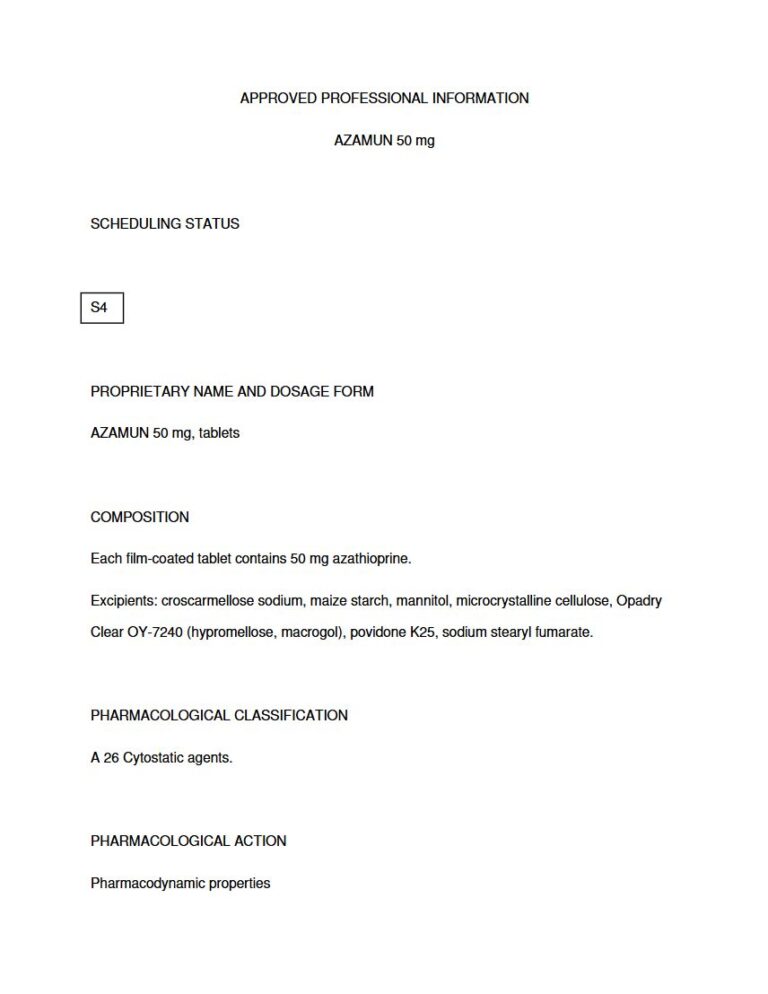
Azamun 50 mg Tablets
PDF Leaflet Revision Date: 27 November 2015
Clinical Summary
Quick overview from the medicine insert
Indication
Immunosuppressant for organ transplants and autoimmune diseases.
Dosage (summary)
1.0 to 5.0 mg/kg/day for transplantation; 1.0 to 2.5 mg/kg/day for autoimmune diseases.
Onset of Action / Duration
Therapeutic effect may take weeks to months.
Special Populations
- Elderly
- Renal impairment
- Hepatic impairment
Pregnancy & Breastfeeding
Contraindicated in pregnancy; safety in lactation not established.
Key Drug Interactions
- Allopurinol
- Other immunosuppressants
- Aminosalicylates
- Captopril
- Warfarin
Contraindications
- Hypersensitivity to azathioprine
- Pregnancy
- Breastfeeding
Common side effects
- Leucopenia
- Thrombocytopenia
- Nausea
- Vomiting
- Infections
Counselling Points
- Monitor for signs of infection
- Report bruising or bleeding
- Use effective contraception
Serious warnings
- Bone marrow depression
- Risk of infections
- Potential teratogenic effects
Important Disclaimer
The Azamun 50 mg Tablets professional information leaflet below is the property of Acino Pharma and is provided on Medinsert exactly as issued, with no.. alterations or editorial changes. We make every effort to keep content current by updating documents as soon as new versions become available. Medinsert serves as a trusted access point for healthcare professionals, but does not replace official sources or clinical judgement. For more details, please read our full disclaimer. read more>>
 Healthcare Professionals Only
This content is for registered healthcare professionals
Sign in or create a free account to read the full package insert.
Free for HPCSA-registered professionals. Powered by Medinsert.
Clinical Particulars
Section 4 of the official insert — extracted exactly as issued, no alterations
4.1 Therapeutic indications
Transplantation
AZAMUN is mainly used as an immunosuppressant in the management of patients receiving organ transplants. It is used in combination with corticosteroids and/or other immunosuppressive agents and procedures.
Auto-Immune Diseases
AZAMUN is used to treat diseases with an auto-immune component. In a proportion of patients suffering from rheumatoid arthritis, systemic lupus erythematosus, auto-immune active chronic hepatitis, pemphigus vulgaris, auto-immune haemolytic anaemia or idiopathic thrombocytopenic purpura, AZAMUN has a therapeutic effect when these conditions are:
(a) refractory to corticosteroids or,
(b) controlled by corticosteroids in dosages which are producing side effects. The aim of AZAMUN is to reduce the required maintenance dose of steroids and thus reducing adverse events. Therapeutic effect may be evident only after weeks or months.
4.2 Posology and method of administration
Specialist medical literature should be consulted for guidance as to clinical experience in particular conditions.
Film-coated tablets should not be divided. Provided that the film-coat is intact, there is no risk in handling film-coated AZAMUN tablets.
Transplantation
u2022 Loading dose: Depending on the immunosuppressive regimen adopted, a loading dose of 1,0 to 5,0 mg/kg body-weight per day is usually given.
u2022 Maintenance dosage after transplantation: Usually 1,0 to 4,0 mg/kg body-weight per day after transplantation. Corticosteroids are usually given concomitantly with AZAMUN in order to facilitate survival and function of the transplanted organ. It may be possible to slowly withdraw the steroids completely in some cases. Cessation of AZAMUN therapy, even after a period of years, carries a risk of rejection within a few weeks.
Auto-Immune Diseases
u2022 Dosage for the treatment of severe rheumatoid arthritis, systemic lupus erythematosus, auto-immune active chronic hepatitis, pemphigus vulgaris, auto-immune haemolytic anaemia, idiopathic thrombocytopenic purpura is usually 1,0 to 2,5 mg/kg body-weight per day, depending on patient response.
u2022 Dosage for the treatment of active chronic hepatitis is usually 1,0 to 2,0 mg/kg body-weight per day.
Directions
The dosage of AZAMUN and the duration of treatment may vary according to the condition, its severity and the clinical response obtained. A therapeutic response in auto-immune disease may not be evident for a few days or even weeks after initiation of AZAMUN therapy.
If no discernible improvement occurs in the patient's condition within three months, consideration should be given to the withdrawal of AZAMUN. Treatment is otherwise undertaken on a long-term basis unless the patient exhibits evidence of intolerance to AZAMUN.
Use in the elderly
The dosage of AZAMUN in the elderly has not been established. It is recommended that the dosage used is at the lower end of the range given. The maintenance dosage should be reduced to the minimum required for clinical response. Care should be taken to monitor haematological responses.
4.3 Contraindications
u2022 Hypersensitivity to azathioprine or any of the excipients. Hypersensitivity to 6- mercaptopurine (6-MP) should alert the prescriber to probable sensitivity to AZAMUN.
u2022 Pregnancy and breastfeeding (see u201cPregnancy and Lactationu201d).
4.4 Special warnings and precautions for use
THE RISKS ASSOCIATED WITH AZAMUN THERAPY SHOULD BE CONSIDERED AGAINST THE SEVERITY OF THE PATIENT'S CONDITION AND THE EXPECTED BENEFICIAL CLINICAL EFFECT.
AZAMUN should not be prescribed unless the patient can be adequately monitored for toxic effects throughout the duration of the therapy.
Bone Marrow Depression and Haematopoiesis
DURING THE FIRST EIGHT WEEKS OF AZAMUN THERAPY COMPLETE BLOOD COUNTS, INCLUDING PLATELET COUNTS MUST BE PERFORMED AT LEAST WEEKLY, OR MORE FREQUENTLY IF HIGH DOSAGE IS USED OR IF SEVERE RENAL AND/OR HEPATIC DISORDER IS PRESENT.
During the course of therapy, AZAMUN may have to be discontinued because of haematopoietic toxicity. The maximum effect of AZAMUN on the white cell count usually becomes manifest within the first two weeks of initiating treatment, but thereafter the risk of complications gradually declines as the duration of therapy increases. The commonest complication is leucopenia which may be accompanied by thrombocytopenia. Thrombocytopenia alone, anaemia, pancytopenia and bleeding have also been reported. It is essential that blood counts be taken monthly throughout the period of therapy. If AZAMUN is used in conjunction with or soon after withdrawal of another medicine known to have a depressive effect on the bone marrow, it is particularly important that frequent blood counts be taken.
Since AZAMUN may have a delayed action, it is important to reduce the dosage or withdraw the medication temporarily at the first sign of an abnormally large fall in leucocyte count and/or other evidence of persistent depression of the bone marrow. Such bone marrow depression is usually reversible at the doses recommended for auto-immune disease. The effect on white cell count is not closely correlated with the immunosuppressive effect of AZAMUN; a good immunosuppressive effect can often be obtained without change in the white cell count, but sometimes the count may be greatly reduced without any apparent immunosuppression.
Therapeutic use of AZAMUN is associated with reversible, dose-related increases in mean corpuscular volume and red cell haemoglobin content. Megaloblastic bone marrow changes have been observed and severe megaloblastic anaemia and erythroid hypoplasia have occurred occasionally.
Infection
AZAMUN has an immunosuppressant effect involving both antibody and cell mediated immunity. Infection, which is always a hazard of immunosuppressive therapy, particularly when corticosteroids are given, may require the dosage of immunosuppressive agents to be reduced temporarily. Fungal, protozoal, viral and uncommon bacterial infections in patients on immunosuppressive therapy including AZAMUN have occurred and should be treated vigorously. Some of these have proved fatal. Patients receiving AZAMUN should be instructed to report immediately any evidence of infection, unexpected bruising or bleeding or other manifestations of bone marrow depression.
Hypersensitivity Reactions
Reversible alopecia, rashes, muscle and joint pains, fever, rigors, pneumonitis, pancreatitis, meningitis, dysrhythmias, renal dysfunction, and hypotension may occur, some or all of which may represent hypersensitivity reactions. Pruritus and erythema, often of an area previously irradiated, may occur. Anaphylaxis may occur. Headache, malaise, weakness, dizziness, vomiting, arthralgia, impaired liver functions and cholestatic jaundice have also been reported. It has been suggested that the imidazole side chain gives rise to sensitivity, whereas the 6- mercaptopurine (6-MP) molecule gives rise to cholestasis.
Hepatic and Renal Impairment
Consideration must be given to withholding AZAMUN if there is evidence of toxic hepatitis or biliary stasis. Elevated serum bilirubin levels have been observed in some patients after initiation of AZAMUN therapy. The dosage of AZAMUN must be reduced for the treatment of active chronic hepatitis (see u201cDosage and Directions for Useu201d). AZAMUN should be used with care in patients with renal or hepatic impairment. These patients may eliminate the medicine and its metabolites at a reduced rate with a consequent cumulative effect. The dosage of AZAMUN should therefore be reduced in such cases, particularly in anuric patients.
The effects of AZAMUN are enhanced by allopurinol. The dose of AZAMUN should be reduced to one-quarter of the usual dose when AZAMUN and allopurinol are given concomitantly. Failure to reduce the dosage of AZAMUN in the presence of allopurinol can result in severe bone marrow depression (see u201cInteractionsu201d).
Gastrointestinal Intolerance
AZAMUN therapy may have to be adjusted if anorexia, nausea, vomiting or diarrhoea occurs. Stomatitis, mouth ulceration, oesophagitis, abdominal pain, intestinal haemorrhage, ulceration and perforation have been reported.
Other
Persistent negative nitrogen balance has been observed in some patients on continuous AZAMUN and corticosteroid therapy. If this occurs, the dosage should be reduced. Other reported complications include drug fever, serum sickness, pulmonary oedema, reversible pneumonitis, peritoneal haemorrhage, retinopathy, alopecia, arthralgia, and Raynaud's phenomenon. Hyperuricaemia and acute renal failure due to uric acid nephropathy and hyperphosphataemia may occur. Pigmentation of the skin and nails may also occur.
4.5 Interactions with other medicines
u2022 Allopurinol, oxipurinol and thiopurinol: Xanthine oxidase activity is inhibited by allopurinol, oxipurinol and thiopurinol, which results in reduced conversion of biologically active 6-thioinosinic acid to biologically inactive 6-thiouric acid. The dose of AZAMUN should be reduced to one-quarter of the usual dose when allopurinol, oxipurinol and/or thiopurinol are given concomitantly (see u201cWarnings and Special Precautionsu201d).
u2022 Other Immunosuppressants: Such as, adrenocorticoids, glucocorticoid, chlorambucil, cyclophosphamide, ciclosporin, mercaptopurine. Concurrent use with AZAMUN may increase the risk of infection and development of neoplasms.
u2022 Aminosalicylates: As there is in vitro evidence that aminosalicylate derivatives (e.g. olsalazine, mesalazine or sulphasalazine) inhibit the thiopurine methyltransferase (TPMT) enzyme, they should be administered with caution to patients receiving concurrent AZAMUN therapy.
u2022 Neuromuscular blockade: AZAMUN can potentiate the neuromuscular blockade produced by depolarising agents such as succinylcholine and reduce the blockade produced by non-depolarising.
u2022 Cytostatic medicine/medicines with myelosuppressive effects: Where possible, concomitant or recent administration of cytostatic medicine, or medicines which may have a myelosuppressive effect, such as penicillamine, should be avoided.
u2022 Furosemide: Furosemide has been shown to impair the metabolism of azathioprine by human hepatic tissue in vitro. The clinical significance is unknown.
u2022 Cimetidine: It has been suggested that cimetidine may have myelosuppresive effects, which may be enhanced by the concomitant administration of AZAMUN.
u2022 Leucocyte production: Medicines which may affect leucocyte production, including co-trimoxazole, may lead to exaggerated leucopenia, especially in renal transplant recipients.
u2022 Angiotensin converting enzyme inhibitors: The use of angiotensin converting enzyme inhibitors to control hypertension in patients on AZAMUN has been reported to induce severe leucopenia.
Captopril: Neutropenia has occurred in some patients receiving both captopril and AZAMUN. Serious infections resulting from the neutropenia and which proved fatal in a few cases occurred only in patients with impaired renal function. Captopril should only be concurrently prescribed when benefit outweighs risk. Neutropenia was noted 2,5 to 13 weeks after captopril was initiated. Thus white blood cell and differential counts should be performed throughout therapy with captopril.
u2022 Warfarin: AZAMUN decreases warfarin activity and severe bleeding has been reported in patients on long-term warfarin treatment after discontinuation of AZAMUN.
u2022 Vaccines, Killed Virus: The patient's anti-body response to the vaccine may be decreased because normal defence mechanisms may be suppressed.
u2022 Vaccines, Live Virus: Concurrent use with a live virus vaccine may potentiate the replication of the vaccine virus, may increase the side effects of the vaccine virus, and/or may decrease the patient's antibody response to the vaccine, because normal defence mechanisms may be suppressed by AZAMUN therapy.
u2022 IUD Contraceptives: There have been several reports of women becoming pregnant during AZAMUN /prednisone treatment whilst IUD devices were in place. Because of these failures it is recommended that additional or other methods of contraception should be employed for sexually active women during AZAMUN /prednisone therapy.
4.6 Fertility, pregnancy and lactation
Safety in pregnancy and lactation has not been established (see u201cContraindicationsu201d).
Pregnancy:
AZAMUN can cause foetal harm when administered to pregnant women. AZAMUN therapy should not be used in patients known to be pregnant. Adequate and well-controlled studies in humans have not been conducted. The fact that AZAMUN is potentially teratogenic must be considered when it is to be administered to males or females who may procreate while receiving therapy. There have been a few reports of congenital deformity when the father was receiving AZAMUN at the time of conception. There have been reports of premature birth and low birth weight following maternal exposure to AZAMUN, particularly in combination with corticosteroids. There have also been reports of spontaneous abortion following either maternal or paternal exposure. AZAMUN and/or its metabolites have been found in low concentrations in foetal blood and amniotic fluid.
Women of Childbearing Potential:
Women of childbearing potential are advised to ensure adequate contraception as AZAMUN is contraindicated for use during pregnancy.
Lactation:
Safety in lactation has not been established. AZAMUN is distributed, at low concentrations into breast milk of patients receiving AZAMUN (see u201cContraindicationsu201d).
4.7 Effects on ability to drive and use machines
There are no data on the effect of AZAMUN on driving performance or the ability to operate machinery. A detrimental effect on these activities cannot be predicted from the pharmacology of the medicine.
4.8 Undesirable effects
Infections and infestations:
Frequent: Viral, fungal and bacterial infections in transplant patients receiving AZAMUN in combination with other immunosuppressants.
Less frequent: Viral, fungal and bacterial infections in other patient populations. (See also u201cWarnings and Special Precautionsu201d).
Neoplasms benign and malignant (including cysts and polyps):
Less Frequent: Neoplasms including non-Hodgkin's lymphomas, skin cancers (melanoma and non-melanoma), sarcomas (Kaposi's and non-Kaposi's) and uterine cervical cancer in situ, acute myeloid leukaemia and myelodysplasia. (See u201cWarnings and Special Precautionsu201d).
Blood and lymphatic system disorders:
Frequent: Depression of bone marrow function; leucopenia, thrombocytopenia.
Less Frequent: Anaemia, agranulocytosis, pancytopenia and bleeding, aplastic anaemia, megaloblastic anaemia, erythroid hypoplasia.
Immune system disorders:
Less Frequent: Hypersensitivity reactions, Stevens-Johnson syndrome and toxic epidermal necrolysis.
Respiratory, thoracic and mediastinal disorders:
Less Frequent: Interstitial pneumonitis.
Gastrointestinal disorders:
Frequent: Nausea and/or vomiting, loss of appetite.
Less Frequent: Pancreatitis, colitis, diverticulitis and bowel perforation reported in the transplant population, severe diarrhoea in inflammatory bowel disease population, sores in mouth and on lips.
Hepato-biliary disorders:
Less frequent: Cholestasis and deterioration of liver function tests, life-threatening hepatic damage, hepatic veno-occlusive disease.
Skin and subcutaneous tissue disorders:
Less Frequent: Alopecia, skin rash.
Renal and urinary disorders:
Frequency unknown: Renal dysfunction.
Cardiac disorders:
Frequency unknown: Tachycardia, hypotension.
General disorders and administrative site conditions:
Frequency unknown: Fever, rigors, muscle pains and weakness.
4.9 Overdose
Unexplained infection, ulceration of the throat, bruising and bleeding are the main signs of overdose with AZAMUN and result from bone marrow depression, which may be maximal after 9 u2013 14 days. These signs are more likely to be manifest following chronic overdosage, rather than after a single acute overdose. Treatment is symptomatic and supportive.
