
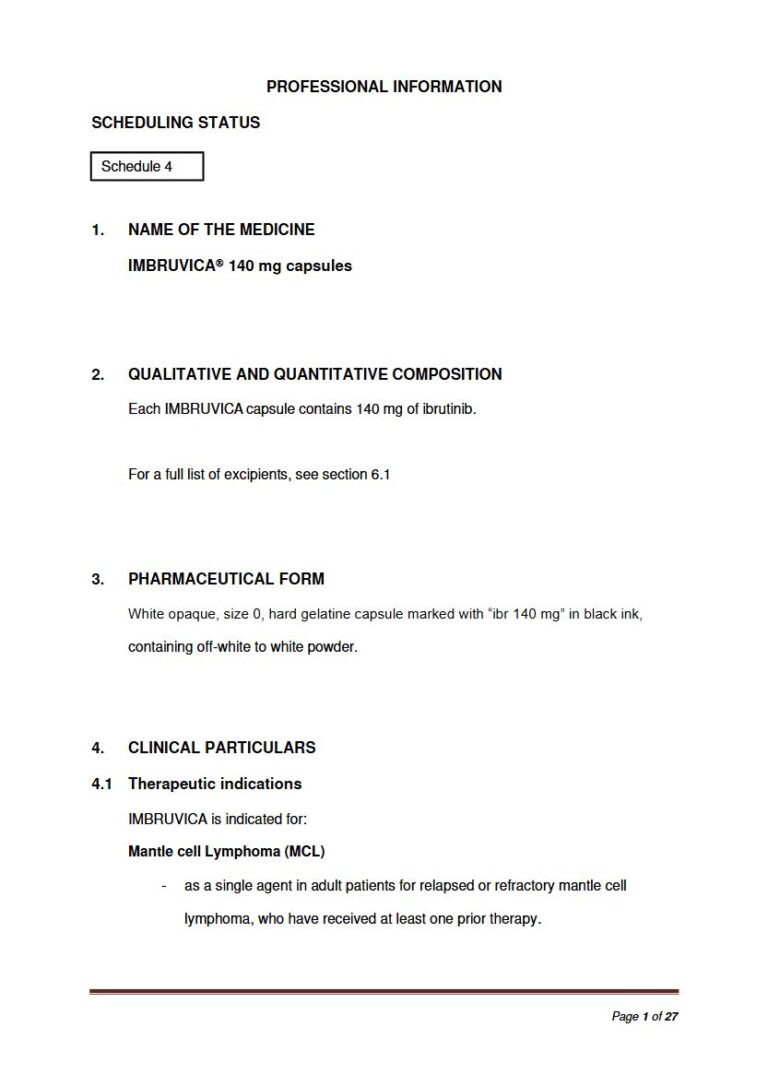
Imbruvica_ 140 Mg Capsules
PDF Leaflet Revision Date: 25 March 2022
Clinical Summary
Quick overview from the medicine insert
Indication
Treatment of MCL, CLL, and WM in adults.
Dosage (summary)
MCL: 560 mg once daily; CLL/WM: 420 mg once daily.
Special Populations
- Renal impairment
- Hepatic impairment
Pregnancy & Breastfeeding
Contraindicated in pregnancy; avoid breastfeeding during treatment.
Key Drug Interactions
- Strong CYP3A inhibitors
- St. John's Wort
Contraindications
- Hypersensitivity to ibrutinib
- Pregnancy
- Severe hepatic impairment
Common side effects
- Diarrhoea
- Neutropenia
- Rash
- Thrombocytopenia
Counselling Points
- Take with water, do not crush capsules
- Avoid grapefruit juice
- Monitor for signs of bleeding
Serious warnings
- Bleeding events
- Hepatic failure
- Cardiac dysrhythmias
Important Disclaimer
The Imbruvica_ 140 Mg Capsules professional information leaflet below is the property of Janssen Pharmaceutica (Pty) Ltd and is provided on Medinsert exactly as issued, with no.. alterations or editorial changes. We make every effort to keep content current by updating documents as soon as new versions become available. Medinsert serves as a trusted access point for healthcare professionals, but does not replace official sources or clinical judgement. For more details, please read our full disclaimer. read more>>
 Healthcare Professionals Only
This content is for registered healthcare professionals
Sign in or create a free account to read the full package insert.
Free for HPCSA-registered professionals. Powered by Medinsert.
Clinical Particulars
Section 4 of the official insert — extracted exactly as issued, no alterations
4.1 Therapeutic indications
IMBRUVICA is indicated for:
- Mantle cell Lymphoma (MCL) - as a single agent in adult patients for relapsed or refractory mantle cell lymphoma, who have received at least one prior therapy.
- Chronic Lymphocytic Leukaemia (CLL) - as a single agent or in combination with rituximab or obinutuzumab for the treatment of adult patients with previously untreated chronic lymphocytic leukaemia (CLL). - as a single agent or in combination with bendamustine and rituximab (BR) for the treatment of adult patients with CLL who have received at least one prior therapy.
- Waldenstru00f6mu2019s Macroglobulinaemia (WM) - as a single agent for the treatment of adult patients with Waldenstru00f6mu2019s macroglobulinaemia (WM) who have received at least one prior therapy, or in first line treatment for patients unsuitable for chemo-immunotherapy. - in combination with rituximab for the treatment of adult patients with WM.
4.2 Posology and method of administration
Posology
Mantle cell lymphoma
The recommended dose of IMBRUVICA for the treatment of MCL is 560 mg (four 140 mg capsules) once daily.
Chronic lymphocytic leukaemia (CLL)
The recommended dose of IMBRUVICA for treatment nau00efve or previously treated CLL, either as a single agent or in combination (see section 4.1), is 420 mg (three 140 mg capsules) orally once daily until disease progression or no longer tolerated by the patient.
For additional information concerning rituximab, BR, or obinutuzumab see the corresponding local rituximab, bendamustine, or obinutuzumab prescribing information. When administering IMBRUVICA in combination with anti-CD20 therapy, it is recommended to administer IMBRUVICA prior to anti-CD20 therapy when given on the same day.
Waldenstru00f6mu2019s Macroglobulinaemia (WM)
The recommended dose of IMBRUVICA for treatment nau00efve or previously treated WM, either as a single agent or in combination (see section 4.1), is 420 mg (three 140 mg capsules) orally once daily until disease progression or no longer tolerated by the patient.
For additional information concerning rituximab, BR, or obinutuzumab see the corresponding local rituximab, bendamustine, or obinutuzumab prescribing information. When administering IMBRUVICA in combination with anti-CD20 therapy, it is recommended to administer IMBRUVICA prior to anti-CD20 therapy when given on the same day.
Dose modification guidelines
Dose modifications are required for the concomitant use of moderate and strong CYP3A inhibitors as these can increase the exposure of ibrutinib (see section 4.5). IMBRUVICA therapy should be withheld for any new onset or worsening Grade u2265 3 non-haematological toxicities, Grade 3 or greater neutropenia with infection or fever, or Grade 4 haematological toxicities. Once the symptoms of the toxicity have resolved to Grade 1 or baseline (recovery), IMBRUVICA therapy may be reinitiated at the starting dose. If the toxicity reoccurs, reduce dose by one capsule (140 mg per day). A second reduction of dose by 140 mg may be considered as needed. If these toxicities persist or recur following two dose reductions, discontinue IMBRUVICA.
Toxicity occurrence
MCL dose modification after recovery
- First restart at 560 mg daily
- Second restart at 420 mg daily
- Third restart at 280 mg daily
- Fourth discontinue IMBRUVICA
CLL/WM dose modification after recovery
- First restart at 420 mg daily
- Second restart at 280 mg daily
- Third restart at 140 mg daily
- Fourth discontinue IMBRUVICA
Missed dose
If a dose of IMBRUVICA is not taken at the scheduled time, it can be taken as soon as possible on the same day with a return to the normal schedule the following day. The patient should not take extra capsules to make up the missed dose.
Special populations
Paediatrics (18 years of age and younger)
The safety and efficacy of IMBRUVICA in children has not been evaluated.
Renal impairment
IMBRUVICA has minimal renal clearance. No specific clinical studies have been conducted in patients with renal impairment. Patients with mild or moderate renal impairment were treated in IMBRUVICA clinical studies. No dose adjustment is needed for patients with mild or moderate renal impairment (greater than 30 mL/min creatinine clearance). Hydration should be maintained, and serum creatinine levels monitored periodically. There are no data in patients with severe renal impairment or patients on dialysis (see section 5.2).
Hepatic impairment
IMBRUVICA is metabolised in the liver. In a hepatic impairment study, data showed an increase in ibrutinib exposure (see section 5.2). For patients with mild liver impairment (Child-Pugh class A), the recommended dose is 280 mg daily (two capsules). For patients with moderate liver impairment (Child-Pugh class B), the recommended dose is 140 mg daily (one capsule). Monitor patients for signs of IMBRUVICA toxicity and follow dose modification guidance as needed. It is not recommended to administer IMBRUVICA to patients with severe hepatic impairment (Child-Pugh class C).
Cases of hepatic failure including fatal outcome have occurred in patients treated with IMBRUVICA (see section 4.8).
Method of administration
IMBRUVICA should be administered orally once daily with a glass of water at approximately the same time each day. The capsules should be swallowed whole with water and should not be opened, broken, or chewed. IMBRUVICA must not be taken with grapefruit juice or Seville oranges. IMBRUVICA should continue until disease progression or no longer tolerated by the patient.
4.3 Contraindications
IMBRUVICA is contraindicated in:
- Patients who have known hypersensitivity (e.g., anaphylactic and anaphylactoid reactions) to ibrutinib or to any of the excipients listed in section 6.1.
- Pregnancy and Lactation (see section 4.6).
- Concomitant use with strong CYP3A inhibitors should be avoided (see section 4.5).
- Concomitant use with preparations containing St. Johnu2019s Wort (see section 4.5).
4.4 Special warnings and precautions for use
Bleeding-related events
There have been reports of bleeding events in patients treated with IMBRUVICA, both with and without thrombocytopenia. These include minor bleeding events such as contusion, epistaxis, and petechiae; and major bleeding events, some fatal, including gastrointestinal bleeding, intracranial haemorrhage, and haematuria.
In an in vitro platelet function study, inhibitory effects of ibrutinib on collagen-induced platelet aggregation were observed. Use of either anticoagulant or antiplatelet agents concomitantly with IMBRUVICA increases the risk of major bleeding. A higher risk for major bleeding was observed with anticoagulant than with antiplatelet agents. Consider the risks and benefits of anticoagulant or antiplatelet therapy when co-administered with IMBRUVICA. Monitor for signs and symptoms of bleeding.
Supplements such as fish oil and vitamin E preparations should be avoided.
IMBRUVICA should be withheld at least 3 to 7 days pre- and post-surgery depending upon the type of surgery and the risk of bleeding.
Patients with congenital bleeding diathesis have not been studied.
Spinal anaesthesia and epidural anaesthesia are not recommended for patients receiving IMBRUVICA.
Leukostasis
Leukostasis syndrome is characterised by a clinically significant elevated white cell count, with abnormal intravascular leukocyte aggregation and symptoms of decreased tissue perfusion caused by microinfarction. Cases of leukostasis have been reported in patients treated with IMBRUVICA. A high number of circulating lymphocytes (> 400 000/u03bcL) may confer increased risk. Consider temporarily withholding IMBRUVICA. Patients should be closely monitored. Administer supportive care including hydration and/or cytoreduction as indicated.
Splenic rupture
Cases of splenic rupture have been reported following discontinuation of IMBRUVICA treatment. Disease status and spleen size should be carefully monitored (e.g., clinical examination, ultrasound) when IMBRUVICA treatment is interrupted or ceased. Patients who develop left upper abdominal or shoulder tip pain should be evaluated, and a diagnosis of splenic rupture should be considered.
Infections
Infections (including sepsis, bacterial, viral, or fungal infections) were observed in patients treated with IMBRUVICA. Some of these infections have been associated with hospitalisation and death. Consider prophylaxis according to standard of care in patients who are at increased risk for opportunistic infections. Cases of progressive multifocal leukoencephalopathy (PML) have occurred in patients treated with IMBRUVICA.
Hepatic events
Cases of hepatotoxicity, hepatitis B reactivation, and cases of hepatitis E, which may be chronic, have occurred in patients treated with IMBRUVICA. Hepatic failure including fatal events have occurred in patients treated with IMBRUVICA. Liver function and viral hepatitis status should be assessed before initiating treatment with IMBRUVICA. Patients should be monitored for signs and symptoms (such as fever, chills, weakness, confusion, vomiting, jaundice and abnormal liver function tests) and appropriate therapy should be instituted as indicated. As clinically indicated, viral load and serological testing for infectious hepatitis should be performed per medical guidelines. For patients diagnosed with hepatic events, consultation with a physician with expertise in the management of liver disease is recommended.
Cytopenias
Treatment emergent Grade 3 or 4 cytopenias (neutropenia, thrombocytopenia and anaemia) were reported in patients treated with IMBRUVICA. Monitor complete blood counts monthly.
Interstitial lung disease (ILD)
Cases of ILD have been reported in patients treated with IMBRUVICA. Monitor patients for pulmonary symptoms indicative of ILD. If symptoms develop, interrupt IMBRUVICA and manage ILD appropriately. If symptoms persist, consider the risks and benefits of IMBRUVICA treatment and follow the dose modification guidelines.
Cardiac dysrhythmias and cardiac failure
Fatal and serious cardiac dysrhythmias or cardiac failure have occurred in patients treated with IMBRUVICA. Patients with significant cardiac co-morbidities may be at greater risk of events, including sudden fatal cardiac events. Atrial fibrillation, atrial flutter, ventricular tachydysrhythmia and cardiac failure have been reported particularly in patients with acute infections or cardiac risk factors including hypertension, diabetes mellitus, and a previous history of cardiac dysrhythmia. Appropriate clinical evaluation of cardiac history and function should be performed prior to initiating IMBRUVICA. Patients should be carefully monitored during treatment for signs of clinical deterioration of cardiac function and clinically managed. Consider further evaluation (e.g., ECG, echocardiogram), as indicated for patients in whom there are cardiovascular concerns. For signs and symptoms that persist, consider the risks and benefits of IMBRUVICA treatment and follow the dose modification guidelines.
In patients who develop signs and/or symptoms of ventricular tachydysrhythmia, IMBRUVICA should be temporarily discontinued, and a thorough clinical benefit/risk assessment should be performed before possibly restarting therapy. In patients with preexisting atrial fibrillation requiring anticoagulant therapy, alternative treatment options to IMBRUVICA should be considered. In patients who develop atrial fibrillation on therapy with IMBRUVICA a thorough assessment of the risk for thromboembolic disease should be undertaken. In patients at high risk and where alternatives to IMBRUVICA are non-suitable, tightly controlled treatment with anticoagulants should be considered. Patients should be monitored for signs and symptoms of cardiac failure during IMBRUVICA treatment. In some of these cases cardiac failure resolved or improved after IMBRUVICA withdrawal or dose reduction.
Class effect of Tyrosine Kinase Inhibitors (TKIs) such as contained in IMBRUVICA
Cases of cerebrovascular accident, transient ischaemic attack, and ischaemic stroke including fatalities have been reported with the use of IMBRUVICA, with and without concomitant atrial fibrillation and/or hypertension, although causality with ibrutinib has not been established (see section 4.8, Post-marketing adverse reactions). These cerebrovascular adverse events may occur in patients on treatment with TKIs with or without risk factors for these events and may occur at any time during treatment with TKIs. Patients on treatment with IMBRUVICA should be carefully monitored, and relevant risk factors managed to reduce the risk for these class related cerebrovascular adverse events. Treatment with IMBRUVICA should be discontinued, and alternative treatment options be considered in patients who developed these class related cerebrovascular adverse events. Regular monitoring and appropriate treatment of conditions that can contribute to the occurrence of these events is recommended (see section 4.4, Cardiac dysrhythmias and Hypertension).
Haemophagocytic lymphohistiocytosis (HLH)
Cases of HLH (including fatal cases) have been reported in patients treated with IMBRUVICA. HLH is a life-threatening syndrome of pathologic immune activation characterised by clinical signs and symptoms of extreme systemic inflammation. HLH is characterised by fever, hepatosplenomegaly, hypertriglyceridaemia, high serum ferritin and cytopenias. Patients should be informed about symptoms of HLH. Patients who develop early manifestations of pathologic immune activation should be evaluated immediately, and a diagnosis of HLH should be considered.
Non-melanoma skin cancer
Non-melanoma skin cancers have occurred in patients treated with IMBRUVICA. Monitor patients for the appearance of non-melanoma skin cancer.
Second primary malignancies
Other malignancies have occurred in patients treated with IMBRUVICA.
Tumour lysis syndrome (TLS)
Tumour lysis syndrome has been reported with IMBRUVICA therapy. Patients at risk of tumour lysis syndrome are those with high tumour burden prior to treatment. Monitor patients closely and take appropriate precautions.
Hypertension
Hypertension has occurred in patients treated with IMBRUVICA. Regularly monitor blood pressure in patients treated with IMBRUVICA and initiate or adjust antihypertensive medication throughout treatment with IMBRUVICA as appropriate.
4.5 Interaction with other medicines and other forms of interaction
IMBRUVICA is primarily metabolised by cytochrome P450 enzyme 3A4 (CYP3A4).
Medicines that may increase IMBRUVICA plasma concentrations
Concomitant use of IMBRUVICA and medicines that strongly or moderately inhibit CYP3A can increase ibrutinib exposure and strong CYP3A inhibitors should be avoided.
Strong CYP3A inhibitors
Co-administration of ketoconazole, a strong CYP3A inhibitor, in 18 healthy subjects, increased exposure (C max and AUC 0-last) of ibrutinib by 29- and 24-fold, respectively. In a dedicated interaction study in patients with B-cell malignancies, co-administration of voriconazole increased C max and AUC by 6,7-fold and 5,7-fold, respectively. In clinical studies, the maximal observed ibrutinib exposure (AUC) was u2264 2-fold in 37 patients treated with mild and/or moderate CYP3A inhibitors when compared with the ibrutinib exposure in 76 patients not treated concomitantly with CYP3A inhibitors. Clinical safety data in 66 patients treated with moderate (n = 47) or strong CYP3A inhibitors (n = 19) did not reveal meaningful increases in toxicities. Voriconazole and posaconazole can be used concomitantly with IMBRUVICA as per dose recommendations in the table below. All other strong inhibitors of CYP3A (e.g., ketoconazole, indinavir, nelfinavir, ritonavir, saquinavir, clarithromycin, telithromycin, itraconazole, nefazodone and cobicistat) should be avoided and an alternative with less CYP3A inhibitory potential should be considered. If a strong CYP3A inhibitor must be used, see recommended dose modifications in the table below.
Moderate and mild CYP3A inhibitors
In patients with B-cell malignancies, co-administration of CYP3A inhibitor erythromycin increased C max and AUC by 3,4-fold and 3,0-fold, respectively. If a moderate CYP3A inhibitor (e.g., fluconazole, erythromycin, amprenavir, aprepitant, atazanavir, ciprofloxacin, crizotinib, diltiazem, fosamprenavir, imatinib, verapamil, amiodarone, dronedarone) must be used, reduce IMBRUVICA dose as per recommended dose modifications in the table below. No dose adjustment is required in combination with mild inhibitors. Monitor patient closely for toxicity and follow dose modification guidance as needed. Avoid grapefruit and Seville oranges during IMBRUVICA treatment as these contain moderate inhibitors of CYP3A (see sections 4.2 and 5.2).
Recommended dose modifications are described below:
Patient Population
Co-administered medicine
Recommended IMBRUVICA Dose for the Duration of the Inhibitor Use
B-Cell Malignancies
- Mild CYP3A inhibitors 420 mg or 560 mg once daily per indication. No dose adjustment required.
- Moderate CYP3A inhibitors 280 mg once daily.
- Voriconazole
- Posaconazole at doses less than or equal to suspension 200 mg twice daily. 140 mg once daily.
- Other strong CYP3A inhibitors
- Posaconazole at higher doses. Avoid concomitant use and consider alternative with less CYP3A inhibitory potential. If these inhibitors will be used short-term (such as anti-infectives for seven days or less), interrupt IMBRUVICA. If the benefit outweighs the risk, and long-term dosing with a CYP3A inhibitor is required (more than seven days), reduce IMBRUVICA dose to 140 mg once daily for the duration of the inhibitor use.
Monitor for adverse reactions to IMBRUVICA and interrupt or modify dose as recommended (see section 4.2).
After discontinuation of a CYP3A inhibitor, resume previous dose of IMBRUVICA (see section 4.2).
Medicines that may decrease IMBRUVICA plasma concentrations
Administration of IMBRUVICA with strong inducers of CYP3A decreases ibrutinib plasma concentrations by approximately 90%. Avoid concomitant use of strong CYP3A inducers (e.g., carbamazepine, rifampicin, phenytoin and St. Johnu2019s Wort). Consider alternative medicines with less CYP3A induction.
Medicines that may have their plasma concentrations altered by IMBRUVICA
In vitro studies indicated that ibrutinib is a weak reversible inhibitor toward CYP2B6, CYP2C8, CYP2C9, CYP2C19, CYP2D6, and CYP3A4/5 and does not display time-dependent CYP450 inhibition. The dihydrodiol metabolite of ibrutinib is a weak inhibitor toward CYP2B6, CYP2C8, CYP2C9, and CYP2D6. Both ibrutinib and the dihydrodiol metabolite are weak inducers of CYP450 isoenzymes in vitro. However, in a medicine interaction study in patients with B-cell malignancies, a single 560 mg dose of ibrutinib did not have a clinically meaningful effect on the exposure of the CYP3A4 substrate midazolam. In the same study, 2 weeks of treatment with ibrutinib at 560 mg daily had no clinically relevant effect on the pharmacokinetics of oral contraceptives (ethinyl oestradiol and levonorgestrel), the CYP3A4 substrate midazolam, nor the CYP2B6 substrate bupropion. In vitro studies indicated that ibrutinib is not a substrate of P-gp nor other major transporters, except OCT2. The dihydrodiol metabolite and other metabolites are P-gp substrates. IMBRUVICA is a mild inhibitor of P-gp and breast cancer resistance protein (BCRP). IMBRUVICA is not expected to have systemic interactions with P-gp substrates. However, it cannot be excluded that IMBRUVICA could inhibit intestinal P-gp and BCRP after a therapeutic dose. There are no clinical data available. To minimise the potential for an interaction in the GI tract, narrow therapeutic range P-gp or BCRP substrates such as digoxin or methotrexate should be taken at least 6 hours before or after IMBRUVICA. IMBRUVICA may also inhibit BCRP systemically and increase the exposure of medicines that undergo BCRP-mediated hepatic efflux, such as rosuvastatin.
4.6 Fertility, pregnancy and lactation
Women of childbearing potential
Women of childbearing potential must use highly effective contraceptive measures while taking IMBRUVICA. Women should avoid becoming pregnant while taking IMBRUVICA and for up to 3 months after ending treatment. If this medicine is used during pregnancy or if the patient becomes pregnant while taking IMBRUVICA, the patient should be apprised of the potential hazard to a foetus. The time period following treatment with IMBRUVICA where it is safe to become pregnant is unknown.
Men
Men should be advised not to father a child or donate sperm while receiving IMBRUVICA, and for 3 months following completion of treatment.
Pregnancy
IMBRUVICA should not be used during pregnancy (see section 4.3). Based on findings in animals, IMBRUVICA may cause foetal harm when administered to pregnant women.
Breastfeeding
Because of the potential for serious adverse reactions in nursing infants from IMBRUVICA, breastfeeding should be discontinued during IMBRUVICA treatment.
4.7 Effects on ability to drive and use machines
Fatigue, dizziness and asthenia have been reported in some patients taking IMBRUVICA and should be considered when assessing a patientu2019s ability to drive or operate machines.
4.8 Undesirable effects
Clinical trial data
Summary of the safety profile
The safety profile is based on pooled data from 1552 patients treated with IMBRUVICA in three phase 2 clinical studies and seven randomised phase 3 studies. Patients treated for MCL received IMBRUVICA at 560 mg once daily and patients treated for CLL or WM received IMBRUVICA at 420 mg once daily. All patients received IMBRUVICA until disease progression or until IMBRUVICA was no longer tolerated.
The most commonly occurring adverse reactions (u2265 20 %) were diarrhoea, neutropenia, musculoskeletal pain, rash, haemorrhage (e.g., bruising), thrombocytopenia, nausea, pyrexia, arthralgia and upper respiratory tract infection.
The most common Grade 3/4 adverse reactions (u2265 5 %) were neutropenia, lymphocytosis, thrombocytopenia pneumonia, and hypertension.
Tabulated summary of adverse reactions
Adverse reactions for MCL, CLL or WM are listed below by system organ class and frequency grouping. Frequency categories are defined as follows: very common (u2265 1/10); common (u2265 1/100 to < 1/10); uncommon (u2265 1/1 000 to < 1/100); rare (u2265 1/10 000 to < 1/1 000) and very rare (< 1/10 000). Within each frequency grouping, undesirable effects are presented in order of decreasing seriousness.
Table 1: Adverse reactions reported in clinical studies in patients treated with B-cell malignancies treated with IMBRUVICA (N = 1552)
| System organ class | Frequency (All grades) | Adverse reactions |
|---|---|---|
| Infections and infestations | Very common | Pneumonia* u2020, Upper respiratory tract infection, Skin infection* |
| Common | Sepsis* u2020, Urinary tract infection, Sinusitis* | |
| Uncommon | Hepatitis B reactivation u2020, Neoplasms benign and malignant (including cysts and polyps) | |
| Common | Non-melanoma skin cancer*, Basal cell carcinoma, Squamous cell carcinoma | |
| Blood and lymphatic system disorders | Very common | Neutropenia*, Thrombocytopenia*, Lymphocytosis* |
| Common | Febrile neutropenia, Leukocytosis | |
| Rare | Leukostasis syndrome | |
| Metabolism and nutrition disorders | Very Common | Hyperuricaemia |
| Uncommon | Tumour lysis syndrome | |
| Nervous system disorders | Very common | Headache, Dizziness |
| Eye disorders | Common | Blurred vision |
| Cardiac disorders | Common | Atrial fibrillation |
| Vascular disorders | Very common | Haemorrhage* u2020, Bruising*, Hypertension* |
* Includes multiple adverse reaction terms. u2020 Includes events with fatal outcome.
Discontinuation and dose reduction due to adverse reactions
Of the 1552 patients treated with IMBRUVICA for CLL, MCL or WM, 6 % discontinued treatment primarily due to adverse reactions. These included pneumonia, atrial fibrillation, thrombocytopenia, haemorrhage, neutropenia, rash and arthralgia. Adverse reactions leading to dose reduction occurred in approximately 8 % of patients.
Leukostasis
Isolated cases of leukostasis have been observed (see section 4.4).
Common: Epistaxis, Petechiae
Uncommon: Subdural haematoma u2020
Gastrointestinal disorders
Very common: Diarrhoea, Vomiting, Stomatitis*, Nausea, Constipation
Skin and subcutaneous tissue disorders
Very common: Rash*
Common: Urticaria, Erythema
Uncommon: Angioedema
Musculoskeletal and connective tissue disorders
Very common: Arthralgia, Muscle spasms, Musculoskeletal pain*
General disorders and administration site conditions
Very common: Pyrexia, Peripheral oedema
Investigations
Very common: Increased blood creatine
Elderly
Of the 1552 patients treated with IMBRUVICA, 52 % were 65 years of age or older. Grade 3 or higher pneumonia occurred more frequently (u2265 5 %) among elderly patients treated with IMBRUVICA (12 % of patients age u2265 65 versus 5 % of patients < 65 years of age) and thrombocytopenia (12 % of patients u2265 65 years of age versus 6 % of patients < 65 years of age).
Post-marketing data
In addition to the adverse reactions reported during clinical studies and listed above, the following adverse reactions have been reported during post-marketing experience (Table 2).
Table 2: Post-marketing adverse reactions
| System Organ Class | Adverse Reaction |
|---|---|
| Eye Disorders | Eye haemorrhage |
| Cardiac disorders | Ventricular tachydysrhythmias* u2020, Cardiac failure |
| Immune system disorders | Interstitial lung disease* |
| Metabolism and nutrition disorders | Tumour lysis syndrome |
| Hepatobiliary disorders | Hepatic failure* , |
| Skin and subcutaneous tissue disorders | Erythema, Onychoclasis, Urticaria, Angioedema, Panniculitis* |
| Nervous system disorders | Peripheral neuropathy*, Cerebrovascular accident u2020, Transient ischaemic attack, Ischaemic stroke u2020 |
* Includes multiple adverse reaction terms. u2020 Includes events with fatal outcome.
Reporting of suspected adverse reactions
Reporting suspected adverse reactions after authorisation of the medicine is important. It allows continued monitoring of the benefit/risk balance of the medicine. Healthcare providers are asked to report any suspected adverse reactions to SAHPRA via u201c6.04 Adverse Drug Reaction Reporting Formu201d found online under SAHPRAu2019s publications: https://www.sahpra.org.za/Publications/index/8 Alternatively, suspected adverse reactions may be reported directly to Janssen Pharmaceutica (see section 7 for contact details or visit www.janssen.com).
4.9 Overdose
There are limited data on the effects of IMBRUVICA overdose. In one study, a healthy subject who received a dose of 1 680 mg experienced reversible Grade 4 hepatic enzyme increases [aspartate aminotransferase (AST) and alanine aminotransferase (ALT)]. Patients who ingested more than the recommended dosage should be closely monitored and given appropriate supportive treatment.
