
Intelence 100 mg Tablets
PDF Leaflet Revision Date: 08 March 2024
Clinical Summary
Quick overview from the medicine insert
Indication
Treatment of HIV-1 infection in antiretroviral treatment-experienced patients.
Dosage (summary)
200 mg (two 100 mg tablets) orally twice daily with food.
Special Populations
- Elderly
- Hepatic impairment
- Renal impairment
Pregnancy & Breastfeeding
Not recommended during pregnancy; avoid breastfeeding while on INTELENCE.
Key Drug Interactions
- Carbamazepine
- Phenobarbital
- Phenytoin
- Rifampicin
- St. John's wort
Contraindications
- Hypersensitivity to etravirine or excipients
Common side effects
- Rash
- Diarrhoea
- Nausea
- Hypertriglyceridaemia
Counselling Points
- Take with food
- Do not miss doses
- Monitor for rash or hypersensitivity
Serious warnings
- Severe skin reactions
- Hypersensitivity reactions
- Immune reconstitution syndrome
Important Disclaimer
The Intelence 100 mg Tablets professional information leaflet below is the property of Janssen Pharmaceutica (Pty) Ltd and is provided on Medinsert exactly as issued, with no.. alterations or editorial changes. We make every effort to keep content current by updating documents as soon as new versions become available. Medinsert serves as a trusted access point for healthcare professionals, but does not replace official sources or clinical judgement. For more details, please read our full disclaimer. read more>>
 Healthcare Professionals Only
This content is for registered healthcare professionals
Sign in or create a free account to read the full package insert.
Free for HPCSA-registered professionals. Powered by Medinsert.
Clinical Particulars
Section 4 of the official insert — extracted exactly as issued, no alterations
4.1 Therapeutic indications
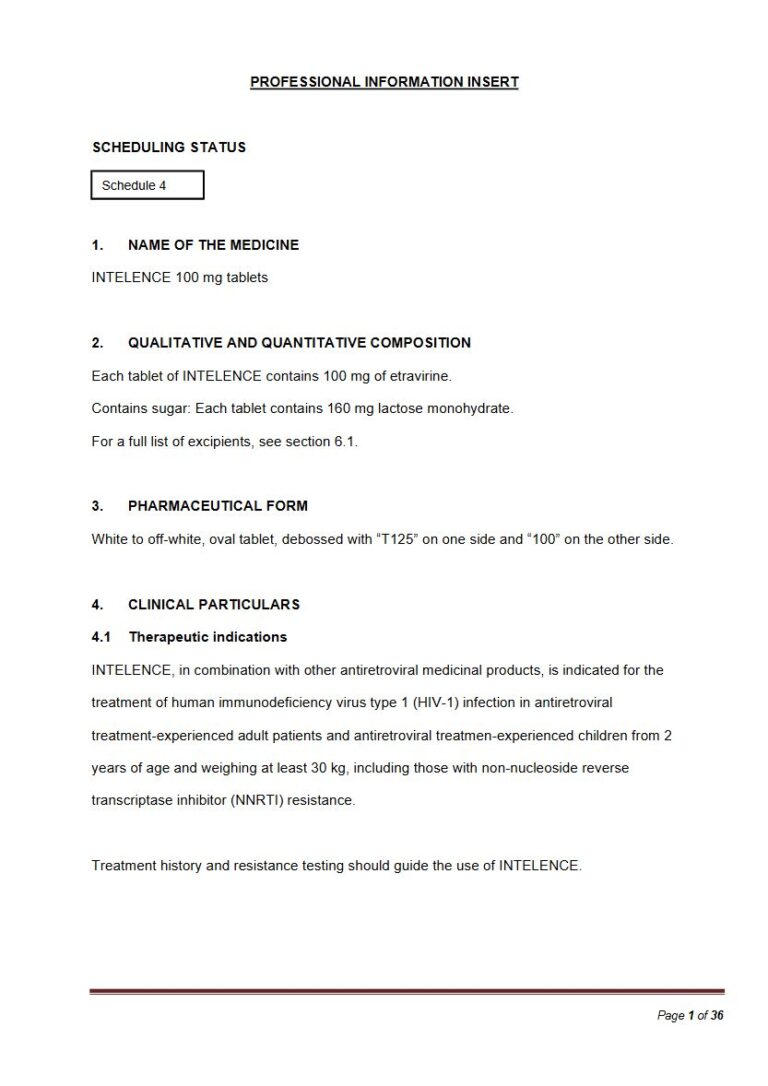
INTELENCE, in combination with other antiretroviral medicinal products, is indicated for the treatment of human immunodeficiency virus type 1 (HIV-1) infection in antiretroviral treatment-experienced adult patients and antiretroviral treatment-experienced children from 2 years of age and weighing at least 30 kg, including those with non-nucleoside reverse transcriptase inhibitor (NNRTI) resistance. Treatment history and resistance testing should guide the use of INTELENCE.
In patients who have experienced virological failure on an NNRTI- and nucleoside or nucleotide reverse transcriptase inhibitor (N(t)RTI)-containing regimen, INTELENCE is not recommended for use in combination with N(t)RTIs only.
4.2 Posology and method of administration
INTELENCE must always be given in combination with other antiretroviral medicinal products.
Adults
The recommended dose of INTELENCE is 200 mg (two 100 mg tablets) taken orally twice daily (b.i.d.), following a meal.
Children and adolescents of at least 2 years of age and weighing at least 30 kg:
The recommended dose of INTELENCE is 200 mg (two 100 mg tablets) taken orally twice daily (b.i.d.), following a meal.
Special populations
Children (less than 2 years of age or weighing less than 30 kg)
Treatment with INTELENCE 100 mg tablet is not recommended in children less than 2 years of age or weighing less than 30 kg. The safety and efficacy in children weighing less than 30 kg has not been established with dosage forms available.
Elderly
Limited information is available in this population (see section 4.4 and section 5).
Hepatic impairment
No dose adjustment is required in patients with mild or moderate hepatic impairment (Child-Pugh score A or B). The pharmacokinetics of INTELENCE have not been studied in patients with severe hepatic impairment (Child-Pugh score C) (see section 4.4 and section 5).
Renal impairment
No dose adjustment is required in patients with renal impairment (see section 4.4 and section 5).
Missed dose(s)
If the patient misses a dose of INTELENCE within 6 hours of the time it is usually taken, the patient should be told to take INTELENCE following a meal as soon as possible and then take the next dose of INTELENCE at the regularly scheduled time. If a patient misses a dose of INTELENCE by more than 6 hours of the time it is usually taken, the patient should be told not to take the missed dose and simply resume the usual dosing schedule.
Administration
Patients should be instructed to swallow the INTELENCE tablet(s) whole with a liquid such as water. Patients who are unable to swallow the INTELENCE tablet(s) whole may disperse the tablet(s) in a glass of water. The patient should be instructed to do the following:
- place the tablet(s) in 5 mL (1 teaspoon) of water, or at least enough water to cover the medication,
- stir well for about 1 minute until the water looks milky,
- if desired, add up to 30 mL (2 tablespoons) more water or alternatively orange juice or milk (patients should not place the tablets in orange juice or milk without first adding water),
- drink it immediately,
- rinse the glass several times with water, orange juice, or milk and completely swallow the rinse each time to make sure the patient takes the entire dose.
The use of warm (> 40u221eC) or carbonated beverages should be avoided. In case of any doubt that a child will take the entire dose of the tablet(s) dispersed in water, treatment with another antiretroviral product needs to be considered. For children who cannot swallow the tablet(s) whole, dispersion of the tablet(s) in water should only be considered if the child is likely to take the entire dose. The importance of consuming the entire dose needs to be highlighted to the child and their caregiver to avoid too low exposure and lack of virologic response. It is recommended that INTELENCE tablet(s) dispersed in water be taken before other antiretroviral liquids that may need to be taken concomitantly.
4.3 Contraindications
Hypersensitivity to etravirine or to any of the excipients.
Carbamazepine, phenobarbital and phenytoin are inducers of CYP450 enzymes. INTELENCE should not be used in combination with carbamazepine, phenobarbital, or phenytoin as co-administration may cause significant decreases in etravirine plasma concentrations. This may result in loss of therapeutic effect of INTELENCE.
Posaconazole is a potent inhibitor of CYP3A4 and may increase plasma concentrations of INTELENCE. Itraconazole and ketoconazole are potent inhibitors as well as substrates of CYP3A4. Concomitant systemic use of itraconazole or ketoconazole and INTELENCE may increase plasma concentrations of INTELENCE. Simultaneously, plasma concentrations of itraconazole or ketoconazole may be decreased by INTELENCE.
Rifampicin and rifapentine are potent inducers of CYP450 enzymes. INTELENCE should not be used in combination with rifampicin or rifapentine as co-administration may cause significant decreases in etravirine plasma concentrations. This may result in loss of therapeutic effect of INTELENCE.
INTELENCE should not be used concomitantly with products containing St. Johnu2019s wort because co-administration may cause significant decreases in etravirine plasma concentrations. This may result in loss of therapeutic effect of INTELENCE.
4.4 Special warnings and precautions for use
Patients should be advised that current antiretroviral therapy does not cure HIV and has not been proven to prevent the transmission of HIV to others through blood or sexual contact. Appropriate precautions should continue to be employed.
Clinical studies are ongoing in HIV-1 infected children and adolescents.
Severe Skin and Hypersensitivity Reactions
Severe, potentially life-threatening and fatal skin reactions have been reported with INTELENCE; Stevens-Johnson Syndrome and toxic epidermal necrolysis have been reported. Hypersensitivity reactions including DRESS (Drug Rash with Eosinophilia and Systemic Symptoms) have also been reported and were characterised by rash, constitutional findings and organ dysfunction, including hepatic failure. Discontinue INTELENCE immediately if signs or symptoms of severe skin reactions or hypersensitivity reactions develop (including, but not limited to, severe rash or rash accompanied by fever, general malaise, fatigue, muscle or joint aches, blisters, oral lesions, conjunctivitis, hepatitis, eosinophilia). Clinical status including liver transaminases should be monitored and appropriate therapy initiated. Delay in stopping INTELENCE treatment after the onset of severe rash may result in a life-threatening reaction.
Rash
Rash has been reported with INTELENCE. Most frequently, rash was mild to moderate, occurred in the second week of therapy and was infrequent after week 4. Rash was mostly self-limiting and generally resolved within 1 to 2 weeks on continued therapy. The incidence of rash was higher in females.
Elderly
Experience in geriatric patients is limited: In the Phase III trials, 6 patients aged 65 years or older and 53 patients aged 56 to 64 years received INTELENCE. The type and incidence of adverse events in patients > 55 years of age were similar to the ones in younger patients (see section 4.2 and section 5.2).
Patients with coexisting conditions
Liver disease
No dose adjustment is required in patients with mild or moderate hepatic impairment (Child-Pugh score A or B). The pharmacokinetics of INTELENCE have not been studied in patients with severe hepatic impairment (Child-Pugh score C) (see section 4.2 and section 5.2).
Renal disease
Since the renal clearance of etravirine is negligible (< 1,2 %), a decrease in total body clearance is not expected in patients with renal impairment. No special precautions or dose adjustments are required in patients with renal impairment. As etravirine is highly bound to plasma proteins, it is unlikely that it will be significantly removed by haemodialysis or peritoneal dialysis (see section 4.2 and section 5.2).
Fat redistribution
Combination antiretroviral therapy (CART) has been associated with redistribution of body fat (lipodystrophy) in HIV infected patients. The long-term consequences of these events are currently unknown. Knowledge about the mechanism is incomplete. A connection between visceral lipomatosis and PIs and lipoatrophy and nucleoside reverse transcriptase inhibitors (NRTIs) has been hypothesised. A higher risk of lipodystrophy has been associated with individual factors such as older age and with medicine-related factors such as longer duration of antiretroviral treatment and associated metabolic disturbances. Clinical examination should include evaluation for physical signs of fat redistribution (see section 4.8).
Immune reconstitution syndrome
In HIV infected patients with severe immune deficiency at the time of institution of CART, an inflammatory reaction to asymptomatic or residual opportunistic pathogens may arise and cause serious clinical conditions, or aggravation of symptoms. Typically, such reactions have been observed within the first weeks or months of initiation of CART. Relevant examples are cytomegalovirus retinitis, generalised and/or focal mycobacterial infections and Pneumocystis jiroveci pneumonia. Any inflammatory symptoms should be evaluated and treatment instituted when necessary (see section 4.8).
Autoimmune disorders such as Gravesu2019 disease and autoimmune hepatitis have also been reported to occur in the setting of immune reconstitution; however, the time to onset is more variable, and can occur many months after initiation of treatment.
Excipients
INTELENCE contains lactose (each tablet contains 160 mg lactose monohydrate) which may have an effect on the glycaemic control of patients with diabetes mellitus. Patients with the rare hereditary conditions of galactose intolerance e.g. galactosaemia, Lapp lactase deficiency, glucose-galactose malabsorption or fructose intolerance should not take INTELENCE.
4.5 Interactions with other medicines
Etravirine is a substrate and weak inducer of cytochrome P450 (CYP) 3A4 and a substrate and weak inhibitor of CYP2C9 and CYP2C19. Medicinal products that inhibit or induce CYP3A4, CYP2C9 and/or CYP2C19 may alter plasma concentrations of etravirine and may alter its therapeutic effect or adverse events profile.
Medicinal products that affect etravirine exposure
Etravirine is metabolised by CYP3A4, CYP2C9 and CYP2C19 followed by glucuronidation by uridine diphosphate glucuronosyl transferase (UDPGT). Medicinal products that induce CYP3A4, CYP2C9 or CYP2C19 may increase the clearance of etravirine resulting in lowered plasma concentrations of etravirine. Co-administration of INTELENCE and medicinal products that inhibit CYP3A4, CYP2C9 or CYP2C19 may decrease the clearance of etravirine and may result in increased plasma concentrations of etravirine.
Medicinal products that are affected by the use of etravirine
Etravirine is a weak inducer of CYP3A4. Co-administration of INTELENCE with medicinal products primarily metabolised by CYP3A4, such as clarithromycin, sildenafil and midazolam, may result in decreased plasma concentrations of such medicinal products, which could decrease or shorten their therapeutic effects. Etravirine is a weak inhibitor of CYP2C9 and CYP2C19. Co-administration with medicinal products primarily metabolised by CYP2C9 or CYP2C19 may result in increased plasma concentrations of such medicinal products, which could increase or prolong their therapeutic effect or adverse events profile.
4.6 Fertility, pregnancy and lactation
Pregnancy
INTELENCE should not be used during pregnancy as safety and efficacy have not been demonstrated.
Women of childbearing potential
No human data on the effect of etravirine on fertility are available. In rats, there was no effect on mating or fertility with INTELENCE treatment.
Lactation
Etravirine is excreted in human breast milk. The potential for HIV transmission and the potential for adverse events in nursing infants, mothers should be instructed not to breastfeed if they are receiving INTELENCE.
4.7 Effects on ability to drive and use machines
No studies on the effects of INTELENCE on the ability to drive or operate machines have been performed. There is no evidence that INTELENCE may alter the patientu2019s ability to drive and operate machines, however, the adverse reaction profile of INTELENCE should be taken into account (see section 4.8).
4.8 Undesirable effects
The safety assessment is based on all data from 1 203 patients in ongoing Phase III placebo-controlled trials DUET 1 and DUET 2 in antiretroviral treatment-experienced HIV-1 infected adult patients; 599 of whom received INTELENCE (200 mg b.i.d.) (see Pharmacodynamics properties). In these pooled trials, the median exposure for patients in the INTELENCE arm and placebo arm was 52,3 and 51,0 weeks, respectively.
The most frequent reported adverse reactions (ARs) that were at least grade 2 in severity were rash, diarrhoea, nausea and hypertriglyceridaemia. Grade 3 and 4 ARs were reported in 22,2 % and 17,2 % of the INTELENCE and placebo treated patients, respectively. The most common reported grade 3 or 4 ARs were hypertriglyceridaemia (4,2 % in the INTELENCE arm and 2,3 % in the placebo arm) and hypercholesterolaemia (2,2 % in the INTELENCE arm and 2,3 % in the placebo arm), renal failure (2,0 % in the INTELENCE arm and 1,2 % in the placebo arm) and anaemia (1,7 % in the INTELENCE arm and 1,3 % in the placebo arm). For treatment emergent clinical laboratory abnormalities (grade 3 or 4) reported in greater than or equal to 2 % of all INTELENCE treated patients, see table Treatment Emergent Laboratory Abnormalities. All other grade 3 and/or 4 ARs were reported in less than 1,5 % of the INTELENCE treated patients. 5,2 % of patients in the INTELENCE arm discontinued treatment due to ARs compared to 2,6 % of patients in the placebo arm. The most common AR leading to discontinuation was rash (2,2 % in the INTELENCE arm versus 0 % in the placebo arm). Most frequently, rash was mild to moderate, occurred in the second week of therapy and was infrequent after week 4. Rash was mostly self-limiting and generally resolved within 1 to 2 weeks on continued therapy. The incidence of rash was higher in women compared to men in the INTELENCE arm in the DUET trials (rash u2265 Grade 2 was reported in 9/60 [15,0 %] women versus 51/539 [9,5 %] men; discontinuations due to rash were reported in 3/60 [5,0 %] women versus 10/539 [1,9 %] men. In patients with a history of NNRTI-related rash, there was no apparent increased risk for the development of INTELENCE-related rash compared to patients without a history of NNRTI-related rash.
Adverse events in patients treated with INTELENCE in clinical studies are summarised in the table below. The adverse events are listed by system organ class (SOC) and frequency. Adverse events at least possibly related in INTELENCE treated subjects. Adverse events appearing only in the placebo group are not shown in the table. Adverse reactions are listed by system organ class and frequency. The following terms and frequencies are applied: very common (u2265 1/10); common (u2265 1/100 to < 1/10); uncommon (u2265 1/1,000 to < 1/100); rare (u2265 1/10,000 to < 1/1,000); very rare (< 1/10,000); and not known (cannot be estimated from the available data).
Adverse reactions observed with etravirine in clinical trials System Organ Class (SOC) Frequency category Adverse Reaction Blood and lymphatic system disorders common thrombocytopaenia, anaemia, decreased neutrophils uncommon decreased white blood cell count Immune system disorders common medicine hypersensitivity uncommon immune reconstitution syndrome Metabolism and nutrition disorders common diabetes mellitus, hyperglycaemia, hypercholesterolaemia, increased low density lipoprotein (LDL), hypertriglyceridaemia, hyperlipidaemia, dyslipidaemia, anorexia Psychiatric disorders common anxiety, insomnia, sleep disorders uncommon confusional state, disorientation, nightmares, nervousness, abnormal dreams Nervous system disorders very common headache common peripheral neuropathy, paraesthesia, hypoaesthesia, amnesia, somnolence uncommon convulsion, syncope, tremor, hypersomnia, disturbance in attention Eye disorders common blurred vision Ear and labyrinth disorders uncommon vertigo Cardiac disorders common myocardial infarction uncommon atrial fibrillation, angina pectoris Vascular disorders common hypertension rare haemorrhagic stroke a Respiratory, thoracic and mediastinal disorders common exertional dyspnoea uncommon bronchospasm Gastrointestinal disorders very common diarrhoea, nausea common gastro-oesophageal reflux disease, vomiting, abdominal pain, abdominal distension, flatulence, gastritis, constipation, dry mouth, stomatitis, lipase increased, blood amylase increased uncommon pancreatitis, haematemesis, retching Hepatobiliary disorders common increased alanine aminotransferase (ALT), increased aspartate aminotransferase (AST) uncommon hepatitis, hepatic steatosis, cytolytic hepatitis, hepatomegaly Skin and subcutaneous tissue disorders very common rash common lipohypertrophy, night sweats, dry skin, prurigo uncommon angioneurotic oedema a , swelling face, hyperhidrosis rare Stevens-Johnson Syndrome a , erythema multiforme a very rare toxic epidermal necrolysis a Renal and urinary disorders common renal failure, blood creatinine increased Reproductive system and breast disorders uncommon gynaecomastia General disorders and administration site conditions common fatigue uncommon sluggishness a These adverse reactions were observed in other clinical trials than DUET-1 and DUET-2.
Laboratory abnormalities Treatment emergent clinical laboratory abnormalities (grade 3 or 4), reported in INTELENCE treated patients are shown in the table below. Treatment emergent Grade 3 to 4 laboratory abnormalities reported Pooled DUET 1 and DUET 2 trials Laboratory Parameter Preferred term n (%) DAIDS Toxicity range Placebo DUET TMC125 DUET GENERAL BIOCHEMISTRY PANCREATIC AMYLASE 57 (9,4) 53 (8,9) Grade 3 > 2 to 5 x ULN 51 (8,4) 44 (7,4) Grade 4 > 5 x ULN 6 (1,0) 9 (1,5) LIPASE 16 (2,6) 20 (3,4) Grade 3 > 3 to 5 x ULN 13 (2,2) 12 (2,0) Grade 4 > 5 x ULN 3 (0,5) 8 (1,3) CREATININE 10 (1,7) 12 (2,0) Grade 3 1,9 to 3.4 x ULN 9 (1,5) 12 (2,0) Grade 4 > 3,4 x ULN 1 (0,2) 0 (0) GENERAL HAEMATOLOGY WHITE BLOOD CELL COUNT 26 (4,3) 12 (2,0) Grade 3 1 to 1,499 x 10 9 /l 22 (3,6) 6 (1,0) Grade 4 < x 10 9 /l 4 (0,7) 6 (1,0) HAEMATOLOGY DIFFERENTIAL COUNTS NEUTROPHILS 45 (7,5) 30 (5,1) Grade 3 0,5 to 0,749 x 10 9 /l 500 to 749/mm 3 26 (4,3) 21 (3,5) Grade 4 < 0,5 x 10 9 /l 13,56 mmol/l > 1 200 mg/dl 11 (1,8) 21 (3,5) TOTAL CHOLESTEROL 32 (5,3) 48 (8,1) Grade 3 > 7,77 mmol/l > 300 mg/dl 32 (5,3) 48 (8,1) LOW DENSITY LIPOPROTEIN CALCULATED 39 (6,6) 42 (7,2) Grade 3 > 4,9 mmol/l > 190 mg/dl 39 (6,6) 42 (7,2) HYPERGLYCAEMIA 14 (2,3) 21 (3,5) Grade 3 13,89 to 27.75 mmol/l 251 to 500 mg/dl 13 (2,2) 21 (3,5) Grade 4 > 27,75 mmol/l > 500 mg/dl 1 (0,2) 0 (0) LIVER FUNCTION ALANINE AMINO TRANSFERASE 12 (2,0) 22 (3,7) Grade 3 5,1 to 10 x ULN 10 (1,7) 16 (2,7) Grade 4 > 10 x ULN 2 (0,3) 6 (1,0) ASPARTATE AMINO TRANSFERASE 12 (2,0) 19 (3,2) Grade 3 5,1 to 10 x ULN 10 (1,7) 16 (2,7) Grade 4 > 10 x ULN 2 (0,3) 3 (0,5) ULN = Upper Limit of Normal
4.9 Overdose
There is no specific antidote for overdose with INTELENCE. Treatment of overdose with INTELENCE consists of general supportive measures including monitoring of vital signs and observation of the clinical status of the patient. Since etravirine is highly protein bound, dialysis is unlikely to result in significant removal of the active substance.
