
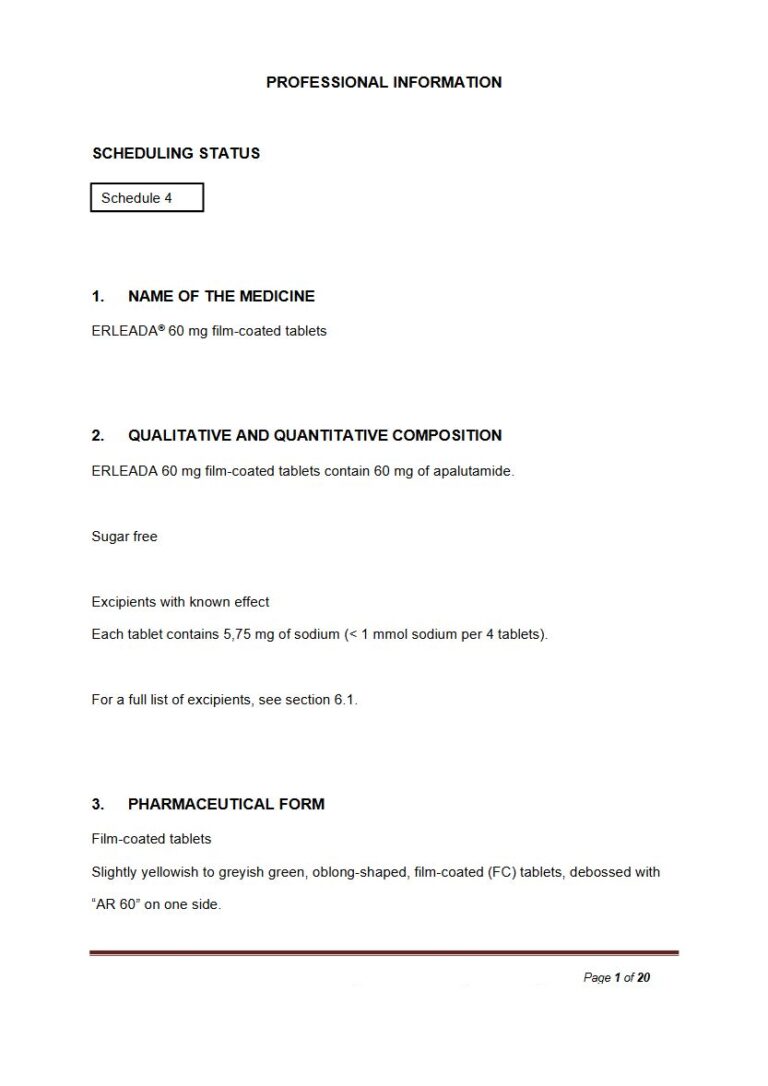
Erleada 60 mg Film coated tablet
PDF Leaflet Revision Date: 07 March 2023
Clinical Summary
Quick overview from the medicine insert
Indication
Treatment of metastatic castration-sensitive and non-metastatic castration-resistant prostate cancer in adult males.
Dosage (summary)
240 mg (four 60 mg tablets) orally once daily.
Special Populations
- Elderly
- Renal impairment
- Hepatic impairment
Pregnancy & Breastfeeding
Contraindicated in pregnancy; not recommended during breastfeeding.
Key Drug Interactions
- CYP2C8 inhibitors
- CYP3A4 inhibitors
- CYP3A4 inducers
Contraindications
- Hypersensitivity to apalutamide
- Pregnancy
- History of seizures
Common side effects
- Fatigue
- Skin rash
- Weight loss
- Arthralgia
- Hypertension
- Hot flush
- Diarrhoea
- Falls
Counselling Points
- Take with or without food
- Monitor for seizures
- Use contraception during treatment
- Do not breastfeed
- Inform about potential for falls
Serious warnings
- Seizures
- Falls and fractures
- Ischaemic heart disease
- Hypothyroidism
- Severe cutaneous adverse reactions
Important Disclaimer
The Erleada 60 mg Film coated tablet professional information leaflet below is the property of Janssen Pharmaceutica (Pty) Ltd and is provided on Medinsert exactly as issued, with no.. alterations or editorial changes. We make every effort to keep content current by updating documents as soon as new versions become available. Medinsert serves as a trusted access point for healthcare professionals, but does not replace official sources or clinical judgement. For more details, please read our full disclaimer. read more>>
 Healthcare Professionals Only
This content is for registered healthcare professionals
Sign in or create a free account to read the full package insert.
Free for HPCSA-registered professionals. Powered by Medinsert.
Clinical Particulars
Section 4 of the official insert — extracted exactly as issued, no alterations
4.1 Therapeutic indications
ERLEADA, in combination with gonadotrophin-releasing hormone analogue (GnRHa) or bilateral orchiectomy, is indicated for treatment of adult males with:
- metastatic castration-sensitive prostate cancer (mCSPC)
- non-metastatic, castration-resistant prostate cancer (nm-CRPC).
4.2 Posology and method of administration
This medicine should be prescribed by an appropriate healthcare professional.
Posology
The recommended dose of ERLEADA is 240 mg (four 60 mg tablets) administered orally once daily. Swallow the tablets whole. ERLEADA can be taken with or without food.
Dose modification
If a patient experiences a u2265 Grade 3 toxicity or an intolerable side effect, hold dosing until symptoms improve to u2264 Grade 1 or original grade, then resume at the same dose or a reduced dose (180 mg or 120 mg), if warranted.
Missed dose(s)
If the patient misses a dose, it should be taken as soon as possible on the same day with a return to the normal schedule on the following day. The patient should not take extra tablets to make up the missed dose.
Special populations
Paediatrics (17 years of age and younger)
The safety and effectiveness of ERLEADA in children have not been evaluated. There is no relevant use of ERLEADA in paediatric patients aged 17 years and younger.
Elderly (65 years of age and older)
Of the 1327 subjects who received ERLEADA in clinical studies, 19% of subjects were less than 65 years, 41% of subjects were 65 years to 74 years, and 40% were 75 years and over. No overall differences in safety or effectiveness were observed between these subjects and younger subjects.
Renal impairment
A dedicated renal impairment study for ERLEADA has not been conducted. Based on the population pharmacokinetic analysis using data from clinical studies in subjects with castration-resistant prostate cancer (CRPC) and healthy subjects, no significant difference in systemic exposure was observed in subjects with pre-existing mild to moderate renal impairment (estimated glomerular filtration rate [eGFR] between 30 to 89 mL/min/1.73 mu00b2) compared to subjects with baseline normal renal function (eGFR u2265 90 mL/min/1.73 mu00b2). No dosage adjustment is necessary for patients with mild to moderate renal impairment. No data is available in patients with severe renal impairment or end-stage renal disease (eGFR u2264 29 mL/min/1.73 mu00b2) [see Section 5.2].
Hepatic impairment
A dedicated hepatic impairment study compared the systemic exposure of apalutamide, as contained in ERLEADA and its N-desmethyl apalutamide metabolite in subjects with baseline mild or moderate hepatic impairment (Child-Pugh Class A or B, respectively) versus healthy controls with normal hepatic function. The systemic exposure of apalutamide and N-desmethyl apalutamide was similar in subjects with mild or moderate baseline hepatic impairment compared to subjects with normal hepatic function. No dosage adjustment is necessary for patients with baseline mild or moderate hepatic impairment. No data are available in patients with severe hepatic impairment (Child-Pugh Class C) [see Section 5.2].
4.3 Contraindications
Hypersensitivity to apalutamide or to any of the excipients. ERLEADA is contraindicated in women who are or may become pregnant [see Section 4.6 - Pregnancy]. A history of seizures or epilepsy [see Section 4.4].
4.4 Special warnings and precautions for use
Seizures
Seizures have been reported with the use of ERLEADA. Patients should be informed of this potential hazardous adverse event. Permanently discontinue ERLEADA in patients who develop a seizure during treatment.
Seizures occurred in 0.4% of patients receiving ERLEADA in clinical studies. In these studies, subjects with a history of seizure or predisposing factors for seizure were excluded. There is no clinical experience in re-administering ERLEADA to patients who experienced a seizure.
Falls and fractures
Falls that may result in bone fractures have been reported with the use of ERLEADA. Patients should be informed about this potential hazardous adverse event. Monitor and manage patients at risk for fractures according to established treatment guidelines and consider use of bone-targeted treatments.
Ischaemic heart disease and ischaemic cerebrovascular disorders
Ischaemic heart disease and ischaemic cerebrovascular disorders, including events leading to death, occurred in patients treated with ERLEADA. Monitor for signs and symptoms of ischaemic heart disease and ischaemic cerebrovascular disorders. Optimize management of risk factors, such as hypertension, diabetes, or dyslipidaemia.
Hypothyroidism
Mild to moderate (grade 1 or 2) hypothyroidism has been reported with the use of ERLEADA, including in patients already on treatment for hypothyroidism. There were no severe (grade 3 or 4) adverse events reported. Thyroid function should be determined before starting treatment with ERLEADA and monitored during treatment with ERLEADA. Treatment for hypothyroidism should be initiated if necessary. Dose adjustments in thyroid therapy may be needed in those patients already on treatment for hypothyroidism.
Severe Cutaneous Adverse Reactions (SCAR)
Rare postmarketing cases of SCAR (including drug reaction with eosinophilia and systemic symptoms [DRESS] and Stevens Johnson syndrome/toxic epidermal necrolysis [SJS/TEN], which can be life-threatening or may lead to death, have been reported with androgen receptor inhibitors including ERLEADA. SCAR was not reported in clinical trials TITAN and SPARTAN. Discontinue ERLEADA immediately if signs or symptoms of SCAR develop (see Section 4.8 u2013 Postmarketing data).
4.5 Interaction with other medicines and other forms of interaction
Medicines that inhibit CYP2C8
In a gemfibrozil interaction study, the Cmax of apalutamide as contained in ERLEADA, decreased by 21% while AUC increased by 68% following co-administration of ERLEADA as a 240 mg single dose with gemfibrozil (strong CYP2C8 inhibitor). Simulations suggest that gemfibrozil may increase the steady-state Cmax and AUC of apalutamide by 32% and 44%, respectively. For the active moieties (sum of unbound apalutamide plus the potency-adjusted unbound active metabolite), the steady-state Cmax and AUC may increase by 19% and 23%, respectively. No initial dose adjustment is necessary however, consider reducing the ERLEADA dose based on tolerability [see Section 4.2 u2013 Dose modification]. Mild or moderate inhibitors of CYP2C8 are not expected to affect the exposure of apalutamide.
Medicines that inhibit CYP3A4
In an itraconazole interaction study, the Cmax of apalutamide, as contained in ERLEADA, decreased by 22% while AUC was similar following co-administration of ERLEADA as a 240 mg single dose with itraconazole (strong CYP3A4 inhibitor). Simulations suggest that ketoconazole (strong CYP3A4 inhibitor) may increase the steady-state Cmax and AUC of apalutamide by 38% and 51%, respectively. For the active moieties, the steady-state Cmax and AUC may increase by 23% and 28%, respectively. No initial dose adjustment is necessary however, consider reducing the ERLEADA dose based on tolerability [see Section 4.2 u2013 Dose modification]. Mild or moderate inhibitors of CYP3A4 are not expected to affect the exposure of apalutamide.
Medicines that induce CYP3A4 or CYP2C8
The effects of CYP3A4 or CYP2C8 inducers on the pharmacokinetics of apalutamide, as contained in ERLEADA, have not been evaluated in vivo. Simulations suggest that rifampin (strong CYP3A4 and moderate CYP2C8 inducer) may decrease the steady-state Cmax and AUC of apalutamide by 25% and 34%, respectively. For the active moieties, the steady-state Cmax and AUC may decrease by 15% and 19%, respectively.
Acid lowering medicines
Apalutamide, as contained in ERLEADA, is not ionisable under relevant physiological pH condition, therefore acid lowering medicines (e.g., proton pump inhibitor, H2-receptor antagonist, antacid) are not expected to affect the solubility and bioavailability of apalutamide.
Medicines that affect transporters
In vitro, apalutamide, as contained in ERLEADA, and its N-desmethyl metabolite are substrates for P-gp but not BCRP, OATP1B1, and OATP1B3. Because apalutamide is completely absorbed after oral administration, P-gp does not limit the absorption of apalutamide and therefore, inhibition or induction of P-gp is not expected to affect the bioavailability of apalutamide.
Effect of ERLEADA on medicine metabolising enzymes
In vitro studies showed that apalutamide, as contained in ERLEADA, and N-desmethyl apalutamide are moderate to strong CYP3A4 and CYP2B6 inducers, are moderate inhibitors of CYP2B6 and CYP2C8, and weak inhibitors of CYP2C9, CYP2C19, and CYP3A4. Apalutamide and N-desmethyl apalutamide do not affect CYP1A2 and CYP2D6 at therapeutically relevant concentrations. In humans, ERLEADA is a strong inducer of CYP3A4 and CYP2C19, and a weak inducer of CYP2C9. In an interaction study using a cocktail approach, co-administration of ERLEADA with single oral doses of sensitive CYP substrates resulted in a 92% decrease in the AUC of midazolam (CYP3A4 substrate), 85% decrease in the AUC of omeprazole (CYP2C19 substrate), and 46% decrease in the AUC of S-warfarin (CYP2C9 substrate). ERLEADA did not cause clinically meaningful changes in exposure to the CYP2C8 substrate. Concomitant use of ERLEADA with medicines that are primarily metabolised by CYP3A4, CYP2C19, or CYP2C9 can result in lower exposure to these medicines. Substitution for these medicines is recommended when possible or evaluate for loss of efficacy if the medicine is continued. If given with warfarin, monitor International Normalised Ratio (INR) during ERLEADA treatment. Induction of CYP3A4 by apalutamide as contained in ERLEADA, suggests that UDP-glucuronosyl transferase (UGT) may also be induced via activation of the nuclear pregnane X receptor (PXR). Concomitant administration of ERLEADA with medicines that are substrates of UGT can result in lower exposure to these medicines. Use caution if substrates of UGT must be co-administered with ERLEADA and evaluate for loss of efficacy.
Effect of Apalutamide on medicine transporters
Apalutamide as contained in ERLEADA, was shown to be a weak inducer of P-glycoprotein (P-gp), breast cancer resistance protein (BCRP), and organic anion transporting polypeptide 1B1 (OATP1B1) clinically. An interaction study using a cocktail approach showed that co-administration of ERLEADA with single oral doses of sensitive transporter substrates resulted in a 30% decrease in the AUC of fexofenadine (P-gp substrate) and 41% decrease in the AUC of rosuvastatin (BCRP/OATP1B1 substrate) but had no impact on Cmax. Concomitant use of ERLEADA with medicines that are substrates of P-gp, BCRP, or OATP1B1 can result in lower exposure of these medicines. Use caution if substrates of P-gp, BCRP or OATP1B1 must be co-administered with ERLEADA and evaluate for loss of efficacy if the medicine is continued. Based on in vitro data, inhibition of organic cation transporter 2 (OCT2), organic anion transporter 3 (OAT3) and multi-medicine and toxin extrusions (MATEs) by apalutamide and its N-desmethyl metabolite cannot be excluded. No in vitro inhibition of organic anion transporter 1 (OAT1) was observed. Simulations suggest that apalutamide does not cause clinically meaningful changes in exposure to metformin (OCT2/MATEs substrate) and benzylpenicillin (OAT3 substrate).
GnRH analogue
In mCSPC subjects receiving leuprolide acetate (a GnRH analogue) co-administered with apalutamide, PK data indicated that apalutamide had no apparent effect on the steady-state exposure of leuprolide.
4.6 Fertility, pregnancy and lactation
Women of childbearing potential / Contraception in males and females
ERLEADA may be harmful to a developing foetus. Male patients on treatment with ERLEADA having sex with female partners of reproductive potential should use a condom and their female partner a highly effective contraceptive method during treatment and for 3 months after the last dose of ERLEADA [see Pregnancy below].
Pregnancy
ERLEADA is contraindicated in women who are or may become pregnant [see section 4.3]. Based on its mechanism of action, ERLEADA may cause foetal harm when administered during pregnancy.
Breastfeeding
Persons taking ERLEADA must not breastfeed their infants.
Fertility
Based on animal studies, ERLEADA may impair fertility in males of reproductive potential.
4.7 Effects on ability to drive and use machines
Patients should not drive and use machines until they know how treatment with ERLEADA affects them. Treatment with ERLEADA is associated with seizures and with falls. These may make driving and the use of machines potentially hazardous.
4.8 Undesirable effects
Clinical trial data
Summary of the safety profile
In studies of patients with mCSPC (TITAN) or nmCRPC (SPARTAN) who were using a GnRH analogue, or were previously treated with orchiectomy, ERLEADA was administered at a dose of 240 mg daily.
The most common adverse reactions (u2265 15%) reported in the pooled randomised clinical studies in the ERLEADA arm were fatigue, skin rash, weight loss, arthralgia, hypertension, hot flush, diarrhoea and falls.
Table 1 shows adverse reactions on the ERLEADA arm in the combined data that occurred with a u2265 2% absolute increase in frequency compared to placebo or were events of special interest. ARs are also listed by system organ class and frequency: very common (u2265 1/10), common (u2265 1/100 to < 1/10), uncommon (u2265 1/1000 to < 1/100), and rare (u2265 1/10000 to < 1/1000). Within each frequency grouping, ARs are presented in order of decreasing frequency.
Table 1: Adverse Reactions due to ERLEADA in the Clinical studies
System/Organ Class ERLEADA N= 1327 Placebo N= 925 Adverse reaction Frequency Category a All Grades % Grade 3 - 4 % All Grades % Grade 3 - 4 % General disorders and administration site conditions Fatigue g very common 26.2 1.1 18.7 0.8 Musculoskeletal and connective tissue disorders Arthralgia g very common 17.1 0.2 12.0 0.5 Muscle spasm common 3.8 0 1.8 0 Skin and subcutaneous tissue disorders Skin rash b very common 25.9 5.7 7.7 0.5 Pruritus g common 8.1 0.2 3.2 0.1 Nervous system disorders Dysgeusia common 5.6 0 1 0 Ischaemic cerebrovascular disorders h common 3.0 1.2 1.3 0.4 Seizure uncommon 0.4 0.1 0.2 0 Metabolism and nutrition disorders Hypercholesterolaemia common 5.7 0.2 1.1 0 Hypertriglyceridaemia common 3.7 0.8 1.1 0.3 Cardiac disorders Ischaemic Heart Disease e common 4.0 1.7 f 2.1 1.1 f Vascular disorders Hypertension very common 22.4 12.1 17.6 10.3 Hot flush very common 17.7 0 13 0 Gastrointestinal disorders Diarrhoea very common 16.3 0.7 10.1 0.3 Injury, poisoning and procedural complications Fracture c very common 10.5 2.3 5.7 0.9 Fall g very common 13.1 1.5 8.0 0.8 Investigations Weight decreased g very common 12.7 1.0 5.6 0.6 Endocrine disorders Hypothyroidism d common 7.8 0 1.5 0 a. Adverse reaction frequencies presented are based on the placebo-controlled period of the clinical studies b. Includes rash, maculo-papular rash, generalised rash, urticaria, pruritic rash, macular rash, conjunctivitis, erythema multiforme, papular rash, skin exfoliation, genital rash, erythematous rash, stomatitis, medicine eruption, mouth ulceration, pustular rash, blister, papule, pemphigoid, skin erosion, dermatitis and vesicular rash c. Includes rib fracture, lumbar vertebral fracture, spinal compression fracture, spinal fracture, foot fracture, hip fracture, humerus fracture, thoracic vertebral fracture, upper limb fracture, fractured sacrum, hand fracture, pubis fracture, acetabulum fracture, ankle fracture, compression fracture, costal cartilage fracture, facial bones fracture, lower limb fracture, osteoporotic fracture, wrist fracture, avulsion fracture, fibula fracture, fractured coccyx, pelvic fracture, radius fracture, sternal fracture, stress fracture, traumatic fracture, cervical vertebral fracture, femoral neck fracture, tibia fracture d. Includes hypothyroidism, increased blood thyroid stimulating hormone, decreased thyroxine, autoimmune thyroiditis, decreased thyroxine free, decreased tri-iodothyronine e. Includes angina pectoris, unstable angina, myocardial infarction, acute myocardial infarction, coronary artery occlusion, coronary artery stenosis, acute coronary syndrome, arteriosclerosis coronary artery, abnormal cardiac stress test, increased troponin, myocardial ischaemia f. Includes Grades 3 - 5 g. Per the Common Terminology Criteria for Adverse Reactions (CTCAE), the highest severity for these events is Grade 3 h. Includes transient ischaemic attack, cerebrovascular accident, cerebrovascular disorder, ischaemic stroke, carotid arteriosclerosis, carotid artery stenosis, hemiparesis, lacunar infarction, lacunar stroke, thrombotic cerebral infarction, vascular encephalopathy, cerebellar infarction, cerebral infarction, and cerebral ischaemia. Addition of adverse reaction was based on data of the final analysis for the SPARTAN study with a median exposure of 32.9 months for ERLEADA and 11.5 months for placebo.
Skin Rash
Skin rash associated with ERLEADA was most commonly described as macular or maculo-papular. Adverse events of skin rash were reported for 26% of subjects treated with ERLEADA versus 8% of subjects treated with placebo. Grade 3 skin rashes (defined as covering > 30% body surface area [BSA]) were reported with ERLEADA treatment (6%) versus placebo (0.5%).
The onset of skin rash occurred at a median of 83 days of ERLEADA treatment and resolved within a median of 78 days from onset of rash for 78% of subjects. Medicines utilised to treat skin rash included topical corticosteroids, systemic corticosteroids and oral antihistamines. Among subjects with skin rash, dose interruption occurred in 28% and dose reduction occurred in 14% [see Section 4.2 u2013 Dose modification]. Skin rash recurred in approximately half of subjects who were re-challenged, with no serious allergic reactions. Skin rash led to ERLEADA treatment discontinuation in 7% of subjects who experienced skin rash.
Hypothyroidism
Hypothyroidism was reported for 8% of subjects treated with ERLEADA and 2% of subjects treated with placebo based on assessments of thyroid-stimulating hormone (TSH) every 4 months. There were no grade 3 or 4 adverse events. Hypothyroidism occurred in 30% of subjects already receiving thyroid replacement therapy in the ERLEADA arm and in 3% of subjects in the placebo arm. In subjects not receiving thyroid replacement therapy, hypothyroidism occurred in 7% of subjects treated with ERLEADA and in 2% of subjects treated with placebo. Thyroid function should be monitored during treatment with ERLEADA. Thyroid replacement therapy, when clinically indicated, should be initiated or dose adjusted. [see Section 4.5 - Effect of ERLEADA on medicine metabolising enzymes].
Postmarketing data
System Organ Class Adverse Reaction Metabolism and nutrition disorders Decreased appetite Respiratory, thoracic and mediastinal disorders Interstitial lung disease Skin and subcutaneous tissue disorders Drug reaction with eosinophilia and systemic symptoms Stevens-Johnson syndrome / Toxic epidermal necrolysis
Reporting of suspected adverse reactions
Reporting suspected adverse reactions after authorisation of the medicine is important. It allows continued monitoring of the benefit/risk balance of the medicine. Healthcare providers are asked to report any suspected adverse reactions via u201c6.04 Adverse Drug Reaction Reporting Formu201d found online under SAHPRAu2019s publications: https://www.sahpra.org.za/Publications/index/8 Alternatively, suspected adverse reactions may be reported directly to Janssen Pharmaceutica (see section 7 for contact details or visit www.janssen.com)
4.9 Overdose
There is no known specific antidote for ERLEADA overdose. Contact a poison control centre or emergency department of a hospital to obtain the latest recommendations for the management of an overdose. In the event of an overdose, treatment with ERLEADA should be stopped. Treatment is symptomatic and supportive until clinical toxicity has been diminished or resolved.
