
Darzalex 20 mg/mL Concentrate for solution for infusion
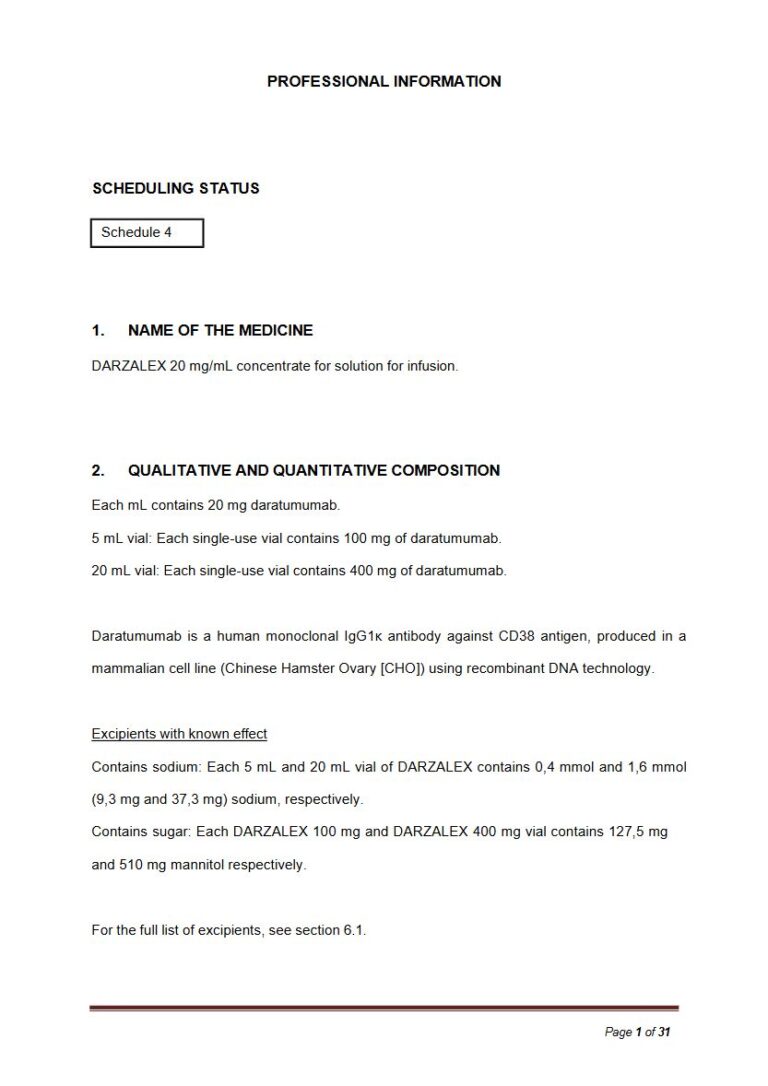
PDF Leaflet Revision Date: 15 January 2026
Clinical Summary
Quick overview from the medicine insert
Indication
Treatment of multiple myeloma.
Dosage (summary)
16 mg/kg IV infusion; schedule varies by therapy type.
Special Populations
- Renal impairment
- Hepatic impairment
- Elderly
Pregnancy & Breastfeeding
Contraindicated in pregnancy; avoid breastfeeding.
Key Drug Interactions
- Live attenuated vaccines
- Indirect Coombs test interference
Contraindications
- Hypersensitivity to daratumumab
- Pregnancy
- Breastfeeding
Common side effects
- Infusion-related reactions
- Fatigue
- Nausea
- Diarrhoea
- Neutropenia
Counselling Points
- Pre-medicate to reduce IRRs
- Monitor for signs of infection
- Avoid live vaccines
Serious warnings
- Serious infusion-related reactions
- HBV reactivation risk
Important Disclaimer
The Darzalex 20 mg/mL Concentrate for solution for infusion professional information leaflet below is the property of Janssen Pharmaceutica (Pty) Ltd and is provided on Medinsert exactly as issued, with no.. alterations or editorial changes. We make every effort to keep content current by updating documents as soon as new versions become available. Medinsert serves as a trusted access point for healthcare professionals, but does not replace official sources or clinical judgement. For more details, please read our full disclaimer. read more>>
 Healthcare Professionals Only
This content is for registered healthcare professionals
Sign in or create a free account to read the full package insert.
Free for HPCSA-registered professionals. Powered by Medinsert.
Clinical Particulars
Section 4 of the official insert — extracted exactly as issued, no alterations
4.1 Therapeutic indications
DARZALEX is indicated for Multiple Myeloma:
- In combination with bortezomib, melphalan and prednisone in adult patients with newly diagnosed multiple myeloma who are ineligible for autologous stem cell transplant (ASCT).
- In combination with lenalidomide and dexamethasone in adult patients with newly diagnosed multiple myeloma who are ineligible for autologous stem cell transplant (ASCT).
- In combination with bortezomib, thalidomide and dexamethasone in adult patients with newly diagnosed multiple myeloma who are eligible for autologous stem cell transplant (ASCT).
- In combination with lenalidomide and dexamethasone in adult patients with multiple myeloma who have received at least one prior therapy.
- In combination with pomalidomide and dexamethasone in adult patients with multiple myeloma who have received at least two prior therapies.
- In combination with bortezomib and dexamethasone in adult patients with multiple myeloma who have received at least one prior therapy.
- As monotherapy for the treatment of adult patients with relapsed and refractory multiple myeloma, whose prior therapy included a proteasome inhibitor and an immunomodulatory agent and who have demonstrated disease progression on the last therapy.
4.2 Posology and method of administration
DARZALEX should be administered by a healthcare professional, with immediate access to emergency equipment and appropriate medical support to manage infusion-related reactions (IRRs) if they occur. Pre- and post-infusion medications should be administered to reduce the risk of IRRs with daratumumab. See below Recommended concomitant medications).
Posology - Adults (u2265 18 years)
The DARZALEX dosing schedule in Table 1 is for combination therapy with 4-week cycle regimens (e.g., lenalidomide, pomalidomide) and for monotherapy as follows:
- Combination therapy with lenalidomide and low-dose dexamethasone for patients with newly diagnosed multiple myeloma ineligible for autologous stem cell transplant (ASCT).
- Combination therapy with lenalidomide or pomalidomide and low-dose dexamethasone for patients with relapsed/refractory multiple myeloma.
- Monotherapy for patients with relapsed/refractory multiple myeloma.
The recommended dose is DARZALEX 16 mg/kg body weight administered as an intravenous infusion according to the following dosing schedule (infusion rates presented in Table 5):
Table 1: DARZALEX dosing schedule for monotherapy and in combination with 4-week cycle dosing regimens
| Weeks | Schedule |
|---|---|
| Weeks 1 to 8 | weekly (total of 8 doses) |
| Weeks 9 to 24 | every two weeks (total of 8 doses) |
| Week 25 onwards until disease progression | every four weeks |
For dosing instructions of medicines administered with DARZALEX, see manufactureru2019s prescribing information.
4.3 Contraindications
Hypersensitivity to daratumumab or to any of the excipients of DARZALEX (see section 6.1). Pregnancy and breastfeeding (see section 4.6). Live attenuated vaccines should not be administered to patients receiving DARZALEX (see section 4.4).
4.4 Special warnings and precautions for use
Infusion-related reactions
DARZALEX can cause serious IRRs, including anaphylactic reactions. These reactions can be life-threatening and fatal outcomes have been reported. Monitor patients throughout the infusion and the post-infusion period. In clinical trials IRRs were reported in approximately half of all patients treated with DARZALEX. The majority of IRRs occurred at the first infusion and were Grade 1 - 2. Four percent of all patients had an IRR at more than one infusion. Severe reactions have occurred, including bronchospasm, hypoxia, dyspnoea, hypertension, laryngeal oedema, pulmonary oedema, myocardial infarction, and ocular adverse reactions (including choroidal effusion, acute myopia and acute angle closure glaucoma). Signs and symptoms may include respiratory symptoms such as nasal congestion, cough, throat irritation, as well as chills, vomiting and nausea. Less common symptoms were wheezing, allergic rhinitis, pyrexia, chest discomfort, pruritus, hypotension and blurred vision (see section 4.8). Fatal IRRs were not reported in these trials.
Pre-medicate patients with antihistamines, antipyretics and corticosteroids to reduce the risk of IRRs prior to treatment with DARZALEX. Interrupt DARZALEX infusion for IRRs of any severity and institute medical management/supportive treatment as needed. For patients with Grade 1, 2, or 3 reactions reduce the infusion rate when re-starting the infusion. If an anaphylactic reaction or life-threatening (Grade 4) IRR occurs, permanently discontinue administration of DARZALEX and institute appropriate emergency care. (see section 4.2).
To reduce the risk of delayed IRRs, administer oral corticosteroids to all patients following all DARZALEX infusions. Additionally, consider the use of post-infusion medications (e.g. inhaled corticosteroids, short and long acting bronchodilators) for patients with a history of chronic obstructive pulmonary disease to manage respiratory complications should they occur (see section 4.2). If ocular symptoms occur, interrupt DARZALEX infusion and seek immediate ophthalmologic evaluation prior to restarting DARZALEX (see section 4.2).
Neutropenia/Thrombocytopenia
DARZALEX may increase neutropenia and thrombocytopenia induced by background therapy (see section 4.8). Monitor complete blood cell counts periodically during treatment according to manufactureru2019s prescribing information for background therapies. Monitor patients with neutropenia for signs of infection. DARZALEX dose delay may be required to allow recovery of blood cell counts. No dose reduction of DARZALEX is recommended. Consider supportive care with transfusions or growth factors.
Interference with Indirect Antiglobulin Test (Indirect Coombs Test)
Daratumumab binds to CD38 found at low levels on red blood cells (RBCs) and may result in a positive indirect Coombs test. Daratumumab-mediated positive indirect Coombs test may persist for up to 6 months after the last DARZALEX infusion. It should be recognised that DARZALEX bound to RBCs may mask detection of antibodies to minor antigens in the patientu2019s serum. The determination of a patientu2019s ABO and Rh blood type are not impacted. Type and screen prior to starting DARZALEX. In the event of a planned transfusion, blood transfusion centres should be notified of this interference with indirect antiglobulin tests (see section 4.5). If an emergency transfusion is required, non-cross-matched ABO/RhD-compatible RBCs can be given per local blood bank practices.
Hepatitis B virus (HBV) Reactivation
Hepatitis B virus reactivation, in some cases fatal, has been reported in patients treated with DARZALEX. HBV screening should be performed in all patients before initiation of treatment with DARZALEX. For patients with evidence of positive HBV serology, monitor for clinical and laboratory signs of HBV reactivation during, and for at least six months following the end of DARZALEX treatment. Manage patients according to current clinical guidelines. Consider consulting a hepatitis disease expert as clinically indicated. In patients who develop reactivation of HBV while on DARZALEX, suspend treatment with DARZALEX and any concomitant steroids, chemotherapy and institute appropriate treatment. Resumption of DARZALEX treatment in patients whose HBV reactivation is adequately controlled should be discussed with medical practitioners with expertise in managing HBV.
Use with vaccines
Currently, there are no data regarding a potential interaction between DARZALEX and vaccines. It is recommended that live viral or live bacterial vaccines should not be given concurrently with monoclonal antibodies.
4.5 Interactions with other medicines
No interaction studies have been performed.
Interference with Indirect Antiglobulin Test (Indirect Coombs Test)
Daratumumab binds to CD38 on RBCs and interferes with compatibility testing, including antibody screening and cross matching. Daratumumab interference mitigation methods include treating reagent RBCs with dithiothreitol (DTT) to disrupt daratumumab binding or genotyping. Since the Kell blood group system is also sensitive to DTT treatment, Kell-negative units should be supplied after ruling out or identifying alloantibodies using DTT-treated RBCs.
4.6 Fertility, pregnancy and lactation
Women of childbearing potential / Contraception
To avoid exposure to the foetus, women of child bearing potential should use effective contraception during, and for 3 months after cessation of DARZALEX treatment.
Pregnancy
DARZALEX should not be used during pregnancy (see section 4.3). IgG1 monoclonal antibodies are known to cross the placenta after the first trimester of pregnancy. If the patient becomes pregnant while taking DARZALEX, the patient should be informed of the potential risk to the foetus.
Breastfeeding
Maternal IgG is excreted in human milk but does not enter the neonatal and infant circulations in substantial amounts as they are degraded in the gastrointestinal tract and not absorbed. Because the risks of DARZALEX to the infant from oral ingestion are unknown, a woman receiving DARZALEX should not breastfeed her infant.
4.7 Effects on ability to drive and use machines
DARZALEX may be associated with fatigue and IRRs may impair the patientu2019s ability to drive and use machines. Patients should determine their personal side effects profile.
4.8 Undesirable effects
Summary of the safety profile
The safety data described below reflect exposure to DARZALEX (16 mg/kg) in 2066 patients with multiple myeloma including 1910 patients who received DARZALEX in combination with background regimens and 156 patients who received DARZALEX as monotherapy. The most frequent adverse reactions (u2265 20 %) were IRRs, fatigue, nausea, diarrhoea, constipation, pyrexia, dyspnoea, cough, neutropenia, thrombocytopenia, anaemia, peripheral oedema, asthenia, peripheral sensory neuropathy, and upper respiratory tract infection. Serious adverse reactions were sepsis, pneumonia, bronchitis, upper respiratory tract infection, pulmonary oedema, influenza, pyrexia, dehydration, diarrhoea and atrial fibrillation.
Tabulated list of adverse reactions
Table 6 summarises the adverse drug reactions that occurred in patients receiving DARZALEX. Frequencies are defined as very common (u2265 1/10), common (u2265 1/100 to < 1/10), uncommon (u2265 1/1,000 to < 1/100), rare (u2265 1/10,000 to < 1/1,000) and very rare (< 1/10,000). Within each frequency grouping, where relevant, adverse reactions are presented in order of decreasing seriousness.
Table 6: Adverse reactions in multiple myeloma patients treated with DARZALEX 16 mg/kg
| System Organ Class | Adverse Reaction | Frequency (all Grades) |
|---|---|---|
| Infections and infestations | Pneumonia + | Very Common |
| Bronchitis + | Very Common | |
| Upper respiratory tract infection + | Very Common | |
| Urinary tract | Sepsis + | Common |
| Cytomegalovirus infection + | Common | |
| Blood and lymphatic system disorders | Anaemia + | Very Common |
| Neutropenia + | Very Common | |
| Thrombocytopenia + | Very Common | |
| Lymphopenia + | Very Common | |
| Leukopenia + | Very Common | |
| Immune system disorders | Hypogammaglobulinaemia + | Common |
| Metabolism and nutrition disorders | Decreased appetite | Very Common |
| Hypokalemia | Very Common | |
| Hyperglycaemia | Common | |
| Hypocalcaemia | Common | |
| Dehydration | Common | |
| Psychiatric disorders | Insomnia | Very Common |
| Nervous system disorders | Peripheral neuropathy | Very Common |
| Paraesthesia | Very Common | |
| Headache | Very Common | |
| Dizziness | Very Common | |
| Syncope | Common | |
| Cardiac disorders | Atrial fibrillation | Common |
| Vascular disorders | Hypertension + | Very Common |
| Respiratory, thoracic and mediastinal disorders | Dyspnoea + | Very Common |
| Cough + | Very Common | |
| Pulmonary oedema + | Common | |
| Gastrointestinal disorders | Nausea | Very Common |
| Diarrhoea | Very Common | |
| Constipation | Very Common | |
| Vomiting | Very Common | |
| Abdominal Pain | Very Common | |
| Pancreatitis + | Common | |
| Skin and subcutaneous tissue disorders | Rash | Very Common |
| Pruritus | Common | |
| Musculoskeletal and connective tissue disorders | Musculoskeletal pain + | Very Common |
| Arthralgia | Very Common | |
| General disorders and administration site conditions | Fatigue | Very Common |
| Pyrexia | Very Common | |
| Peripheral Oedema + | Very Common | |
| Asthenia | Very Common | |
| Injury, poisoning and procedural complications | Infusion - related reaction # | Very Common |
+ Indicates grouping of terms
* No grade 4
# Infusion-related reaction includes terms determined by investigators to be related to infusion, see below
Postmarketing side effects identified with daratumumab
Immune System disorders Anaphylactic reaction
Infections and Infestations COVID-19
Hepatitis B virus reactivation
Infusion related reactions
In clinical trials (monotherapy and combination treatments; N = 2066) the incidence of any grade infusion-related reaction was 37 % with the first (16 mg/kg, Week 1) infusion of DARZALEX, 2 % with the Week 2 infusion, and cumulatively 6 % with subsequent infusions. Less than 1 % of patients had a Grade 3/4 infusion reaction at Week 2 or subsequent infusions. The median time to onset of a reaction was 1,5 hours (range: 0 to 72,8 hours). The incidence of infusion modifications due to reactions was 36 %. Median durations of 16 mg/kg infusions for the 1st, 2nd and subsequent infusions were approximately 7, 4 and 3 hours respectively. Severe infusion-related reactions included bronchospasm, dyspnoea, laryngeal oedema, pulmonary oedema, hypoxia, and hypertension. Other adverse infusion-related reactions included nasal congestion, cough, chills, throat irritation, vomiting and nausea (see section 4.4).
When DARZALEX dosing was interrupted in the setting of ASCT (Study MMY3006) for a median of 3,75 (range: 2,4; 6,9) months, upon re-initiation of DARZALEX the incidence of IRRs was 11 % at first infusion following ASCT. Infusion rate/dilution volume used upon re-initiation was that used for the last DARZALEX infusion prior to interruption due to ASCT. IRRs occurring at re-initiation of DARZALEX following ASCT were consistent in terms of symptoms and severity (Grade 3/4: < 1 %) with those reported in previous studies at Week 2 or subsequent infusions.
In study MMY1001, patients receiving daratumumab combination treatment (n = 97) were administered the first 16 mg/kg daratumumab dose at Week 1 split over two days i.e., 8 mg/kg on Day 1 and Day 2 respectively. The incidence of any grade infusion-related reactions was 42 %, with 36 % of patients experiencing infusion-related reactions on Day 1 of Week 1, 4 % on Day 2 of Week 1, and 8 % with subsequent infusions. The median time to onset of a reaction was 1,8 hours (range: 0,1 to 5,4 hours). The incidence of infusion interruptions due to reactions was 30 %. Median durations of infusions were 4,2 h for Week 1-Day 1, 4,2 h for Week 1-Day 2, and 3,4 hours for the subsequent infusions.
Infections
In patients receiving DARZALEX combination therapy, Grade 3 or 4 infections were reported as follows: Relapsed/refractory patient studies: DVd: 21 %, Vd: 19 %; DRd: 28 %, Rd: 23 %; DPd: 28 %. Newly diagnosed patient studies: D-VMP: 23 %, VMP: 15 %; DRd: 32 %, Rd: 23 %; DVTd: 22 %, VTd: 20 %. Pneumonia was the most commonly reported severe (Grade 3 or 4) infection across studies. In active controlled studies, discontinuations from treatment due to infections (occurred in 1 - 4 % of patients). Fatal infections were primarily due to pneumonia and sepsis. In patients receiving DARZALEX combination therapy, fatal infections (Grade 5) were reported as follows: Relapsed/refractory patient studies: DVd: 1 %, Vd: 2 %; DRd: 2 %, Rd: 1 %; DPd: 2 %. Newly diagnosed patient studies: D-VMP: 1 %, VMP: 1 %; DRd: 2 %, Rd: 2 %; DVTd: 0 %, VTd: 0 %.
4.9 Overdose
Symptoms and signs
Are expected to be an increase in the frequency and severity of the adverse events listed under section 4.8.
Treatment
There is no known specific antidote for daratumumab overdose. In the event of an overdose, the patient should be monitored for any signs or symptoms of adverse effects and appropriate symptomatic treatment should be instituted immediately.
