
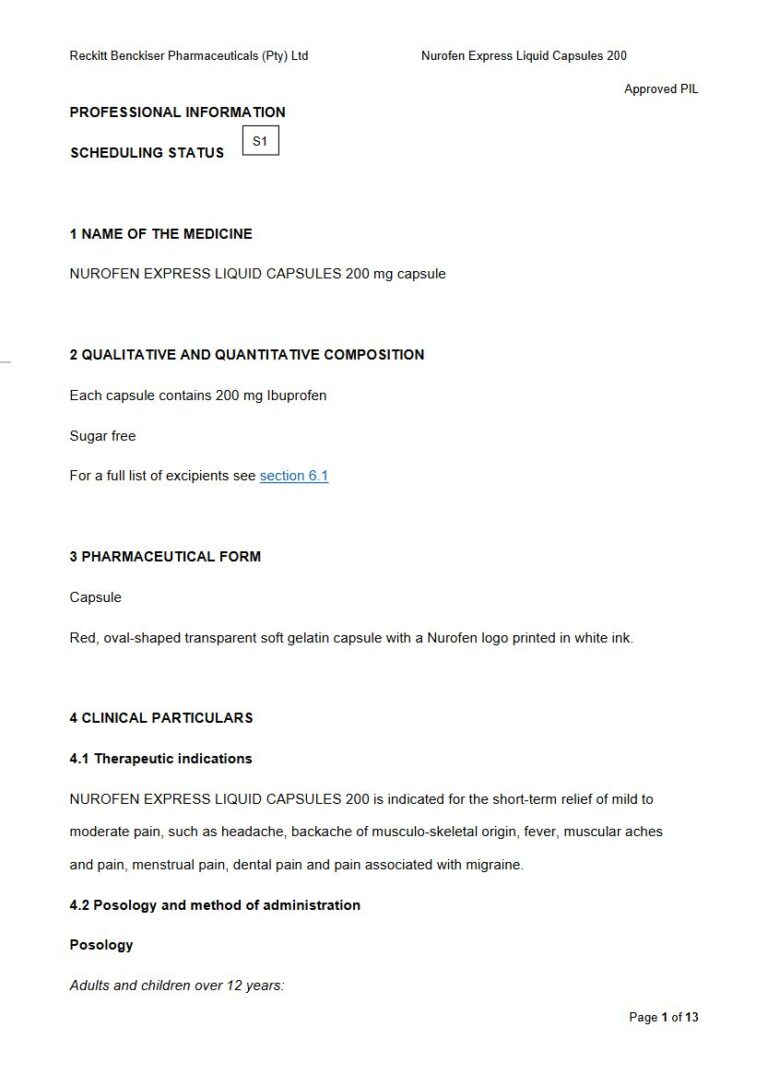
Nurofen Express Liquid Capsules 200 mg Capsule
PDF Leaflet Revision Date: 28 January 2022
Clinical Summary
Quick overview from the medicine insert
Indication
Short-term relief of mild to moderate pain and fever.
Dosage (summary)
Adults and children over 12 years: 1-2 capsules every 4 hours, max 6 capsules/24 hours.
Onset of Action / Duration
Onset: 30 mins, Duration: 6-8 hours
Special Populations
- Elderly
- Renal impairment
- Hepatic impairment
Pregnancy & Breastfeeding
Avoid in pregnancy, especially in the last trimester; low concentration in breast milk.
Key Drug Interactions
- Aspirin
- Other NSAIDs
- Corticosteroids
- Anticoagulants
- Lithium
Contraindications
- Hypersensitivity to ibuprofen
- History of gastrointestinal ulceration
- Severe hepatic failure
- Severe renal failure
- Heart failure
Common side effects
- Abdominal pain
- Nausea
- Headache
- Dizziness
- Hypersensitivity reactions
Counselling Points
- Use the lowest effective dose for the shortest duration
- Monitor for gastrointestinal symptoms
- Discontinue at first sign of hypersensitivity
Serious warnings
- Gastrointestinal bleeding
- Serious skin reactions
- Aseptic meningitis risk in autoimmune disorders
Important Disclaimer
The Nurofen Express Liquid Capsules 200 mg Capsule professional information leaflet below is the property of Reckitt Benckiser Pharmaceuticals and is provided on Medinsert exactly as issued, with no.. alterations or editorial changes. We make every effort to keep content current by updating documents as soon as new versions become available. Medinsert serves as a trusted access point for healthcare professionals, but does not replace official sources or clinical judgement. For more details, please read our full disclaimer. read more>>
 Healthcare Professionals Only
This content is for registered healthcare professionals
Sign in or create a free account to read the full package insert.
Free for HPCSA-registered professionals. Powered by Medinsert.
Clinical Particulars
Section 4 of the official insert — extracted exactly as issued, no alterations
4.1 Therapeutic indications
NUROFEN EXPRESS LIQUID CAPSULES 200 is indicated for the short-term relief of mild to moderate pain, such as headache, backache of musculo-skeletal origin, fever, muscular aches and pain, menstrual pain, dental pain and pain associated with migraine.
4.2 Posology and method of administration
Posology
Adults and children over 12 years: Initial dose, take one or two capsules with water. Then, if necessary, one or two capsules every four hours. Do not exceed six capsules in any 24-hour period. Do not chew. The lowest effective dose should be used for the shortest duration necessary to relieve symptoms (see section 4.4). If symptoms persist for more than 7 days or worsen, consult your doctor. Not to be given to children under 12 years. Elderly: No special dosage modifications are required. Use the lowest effective dose for the shortest possible duration of treatment.
Method of administration
For oral administration
4.3 Contraindications
NUROFEN EXPRESS LIQUID CAPSULES 200 is contra-indicated in the following:
- Hypersensitivity to ibuprofen or to any of the ingredients of NUROFEN EXPRESS LIQUID CAPSULES 200.
- Patients with a history of bronchospasm asthma, rhinitis, or urticaria associated with aspirin or other non-steroidal anti-inflammatory drugs (NSAIDs).
- Patients with a history of, or existing or recurrent gastrointestinal ulceration/perforation or bleeding (PUBs), including that associated with NSAIDs.
- Patients with severe hepatic failure, severe renal failure or heart failure.
- Pregnancy (see section 4.6).
4.4 Special warnings and precautions for use
Caution is required in patients with a history of hypertension and/or heart failure as fluid retention and oedema have been reported in association with NUROFEN EXPRESS LIQUID CAPSULES 200 therapy. Elderly: The elderly have an increased frequency of adverse reactions to NSAIDs, especially gastrointestinal bleeding and perforation (PUBs) may be fatal. The risk of gastrointestinal bleeding or perforation (PUBs) is higher with increasing doses of NUROFEN EXPRESS LIQUID CAPSULES 200, in patients with a history of ulcers, and the elderly. When gastrointestinal bleeding or ulceration occurs in patients receiving NUROFEN EXPRESS LIQUID CAPSULES 200, treatment with NUROFEN EXPRESS LIQUID CAPSULES 200 should be stopped. NUROFEN EXPRESS LIQUID CAPSULES 200 should be given with caution to patients with a history of gastrointestinal disease (e.g. ulcerative colitis, Crohnu2019s disease, hiatus hernia, gastro-oesophageal reflux disease, angiodysplasia) as the condition may be exacerbated. Serious skin reactions, some of them fatal, including exfoliative dermatitis, Stevens-Johnson syndrome, and toxic epidermal necrolysis have been reported. NUROFEN EXPRESS LIQUID CAPSULES 200 should be discontinued at the first appearance of skin rash, mucosal lesions, or any other sign of hypersensitivity. SLE and mixed connective tissue disease: Systemic lupus erythematosus and mixed connective tissue disease, due to increased risk of aseptic meningitis (see section 4.8). Severe skin reactions: Acute generalised exanthematous pustulosis (AGEP) has been reported in relation to ibuprofen-containing products. Masking of symptoms of underlying infections: NUROFEN EXPRESS LIQUID CAPSULES 200 can mask symptoms of infection, which may lead to delayed initiation of appropriate treatment and thereby worsening the outcome of the infection. This has been observed in bacterial community acquired pneumonia and bacterial complications to varicella. When NUROFEN EXPRESS LIQUID CAPSULES 200 is administered for fever or pain relief in relation to infection, monitoring of infection is advised. In non-hospital setting, the patient should consult a doctor if symptoms persist or worsen. Impaired female fertility: There is limited evidence that drugs which inhibit cyclo oxygenase/prostaglandin synthesis may cause impairment of female fertility by an effect on ovulation. This is reversible on withdrawal of treatment. DRESS: Drug Reaction with Eosinophillia and Systemic Symptoms (DRESS) has been reported in patients taking NSAIDs such as NUROFEN EXPRESS LIQUID CAPSULES 200. Some of these events have been fatal or life-threatening. DRESS typically, although not exclusively, presents with fever, rash, lymphadenopathy, and/or facial swelling. Other clinical manifestations may include hepatitis, nephritis, haematological abnormalities, myocarditis, or myositis. Sometimes symptoms of DRESS may resemble an acute viral infection. Eosinophillia is often present. Because this disorder is variable in its presentation, other organ systems not noted here may be involved. It is important to note that early manifestations of hypersensitivity, such as fever or lymphadenopathy, may be present even though rash is not evident. If such signs or symptoms are present, discontinue NUROFEN EXPRESS LIQUID CAPSULES 200 and evaluate the patient immediately. NUROFEN EXPRESS LIQUID CAPSULES 200 should be used with caution in the following:
- if at all, patients with a history of peptic ulceration.
- in patients with infections, since symptoms such as fever and inflammation may be masked.
- in patients with asthma or allergic disorders.
- in the elderly and may need to be given in reduced doses.
- In patients with autoimmune disorders including systemic lupus erythematosus and mixed connective tissue disease, due to increased risk of aseptic meningitis.
General precautions to be observed include use in patients with haemorrhagic disorders, hypertension, and impaired renal, hepatic or cardiac function. Patients on NUROFEN EXPRESS LIQUID CAPSULES 200 should be monitored for the development of blood, kidney, liver, or eye disorders.
4.5 Interaction with other medicines and other forms of interaction
NUROFEN EXPRESS LIQUID CAPSULES 200 (Ibuprofen) should not be used in combination with:
- Aspirin, as NUROFEN EXPRESS LIQUID CAPSULES 200 may reduce the cardio-protective effect of aspirin.
- Other NSAIDs, as these may increase the risk of adverse effects.
NUROFEN EXPRESS LIQUID CAPSULES 200 should be used with caution in combination with:
- Corticosteroids, alcohol and bisphosphonates, as these may increase the risk of adverse reactions, especially gastrointestinal ulceration or bleeding.
- Anti-hypertensive agents and diuretics since NSAIDs may diminish the effects of these medicines.
- Anti-platelet agents and selective serotonin re-uptake inhibitors (SSRIs) may increase the risk of gastrointestinal bleeding.
- Anticoagulants, as there is limited evidence of enhancement of effects or oral anticoagulants such as warfarin.
- Lithium, as there is evidence for potential increase in plasma levels of lithium.
- Cardiac glycosides, as there is evidence for potential increase in plasma levels of cardiac glycosides, such as digoxin.
- Methotrexate, as there is evidence for the potential increase in plasma levels of methotrexate.
- Zidovudine, as there is evidence of an increased risk of hemarthrosis and haematoma in HIV (+) haemophiliacs receiving concurrent treatment of zidovudine and ibuprofen.
- Phenytoin and sulfonylurea anti-diabetic, as NUROFEN EXPRESS LIQUID CAPSULES 200 may enhance the effects of products containing these ingredients.
- ACE-inhibitors, as the risk of nephrotoxicity may be increased if given with ACE-inhibitors such as ciclosporin, tacrolimus, or diuretics.
- There may also be increased risk of hyperkalaemia with ACE-inhibitors and potassium sparing diuretics.
- Quinolones, as convulsions may occur.
- Ritonavir, as it may lead to increased plasma concentrations of NUROFEN EXPRESS LIQUID CAPSULES 200.
- Lipid regulatory agents (such as clofibrate) as this may lead to rhabdomyolysis and renal failure.
- Baclofen, as Baclofen toxicity may develop after starting NUROFEN EXPRESS LIQUID CAPSULES 200 treatment.
4.6 Fertility, pregnancy and lactation
Pregnancy: Safety in pregnancy and lactation has not been established. No specific studies have been conducted with Ibuprofen. The use of the product during pregnancy should be avoided during the first 6 months of pregnancy. It should not be used for the last trimester of pregnancy as there is a risk of premature closure of the foetal ductus arteriosus with possible persistent pulmonary hypertension. The onset of labour may be delayed and duration increased with an increased bleeding tendency in both mother and child.
Lactation: Ibuprofen appears in the breast milk in a low concentration.
Fertility: See section 4.4 regarding female fertility.
4.7 Effects on ability to drive and use machines
NUROFEN EXPRESS LIQUID CAPSULES 200 is not expected to affect the ability to drive and operate machinery at recommended dose and duration of therapy.
4.8 Undesirable effects
Side-effects are classified according to MedRA System Organ Class using the following convention: Frequent, Less frequent and frequency unknown.
System Organ Class Frequency Adverse Events
Blood and lymphatic system disorders Less frequent Haematopoetic disorders (anaemia, leucopenia, thrombocytopenia, neutropenia and agranulocytosis)
Immune system disorders Frequent Hypersensitivity reactions with urticaria and pruritus Less frequent Severe hypersensitivity reactions symptoms could be facial, tongue and larynx swelling, dyspnoea, tachycardia, hypotension, (anaphylaxis, angioedema or severe shock).
Exacerbation of asthma and bronchospasm and fever Less frequent In patients with existing auto-immune disorders (such as systemic lupus erythematosus, mixed connective tissue disease) during treatment with ibuprofen, single cases of symptoms of aseptic meningitis, such as stiff neck, headache, nausea, vomiting, fever or disorientation have been observed
Nervous system disorders Frequent Headache, vertigo, dizziness, nervousness, tinnitus, depression, drowsiness, insomnia and aseptic meningitis
Eye disorders Frequent Visual disturbances Less frequent blurred vision, papilloedema with or without pseudotumor cerebri Frequency unknown Reversible amblyopia
Ear and Labyrinth disorders Frequent Hearing loss
Cardiac disorders Frequency unknown cardiac failure in the elderly
Vascular disorders Frequency unknown Oedema and hypertension
Gastrointestinal disorders Frequent Abdominal pain, dyspepsia and nausea Less frequent Diarrhoea, flatulence, constipation, vomiting, peptic ulcer, perforation or gastrointestinal haemorrhage, melaena, haematemesis, sometimes fatal (particularly in the elderly), exacerbation of ulcerative colitis, ulcerative stomatitis and Crohnu2019s disease
Hepato-biliary disorders Less frequent Liver disorders
Skin and subcutaneous tissue disorders Less frequent Severe forms of skin reactions such as erythema multiforme, epidermal necrolysis and Stevens-Johnson Syndrome can occur frequency unknown Drug reaction with eosinophilia and systemic symptoms (DRESS syndrome) see section 4.4 Acute generalised exanthematous pustulosis (AGEP). Photosensitivity reactions.).
Renal and urinary disorders Less frequent Decrease of urea excretion and oedema can occur. Also, acute renal failure. Papillary necrosis, especially in long-term use, and increased serum area concentrations have been reported
Metabolism and nutrition disorders Frequency unknown hyponatraemia
Reporting of suspected adverse reactions Reporting of Suspected Adverse Reactions Reporting suspected adverse reactions after authorisation of the medicine is important. It allows continued monitoring of the benefit/risk balance of the medicine. Healthcare providers are asked to report any suspected adverse reactions to SAHPRA via the u201c6.04 Adverse Drug Reactions Reporting Formu201d found online under SAHPRAu2019s publications: https://www.sahpra.org.za/Publications/Index/8
4.9 Overdose
The half-life in overdose is 1,5 u2013 3 hours. Symptoms: The most likely symptoms of overdosage of NUROFEN EXPRESS LIQUID CAPSULES 200 are: nausea, vomiting, epigastric pain, or less frequently, diarrhoea. Tinnitus, headache and gastrointestinal bleeding are also possible. In more serious poisoning, toxicity is seen in the central nervous system, manifesting as drowsiness, occasionally excitation and disorientation or coma. Occasionally, patients develop convulsions. In serious poisoning, metabolic acidosis may occur and the prothrombin time/INR may be prolonged, probably due to interference with the actions of circulating clotting factors. Acute renal failure and liver damage may occur. Exacerbation of asthma is possible in asthmatics.
Management u2013 Management should be symptomatic and supportive and include the maintenance of a clear airway and monitoring of cardiac and vital signs until stable. Consider oral administration of activated charcoal if the patient presents within1 hour of ingestion of a potentially toxic amount. If frequent or prolonged, convulsions should be treated with intravenous diazepam or lorazepam. Give bronchodilators for asthma.
