
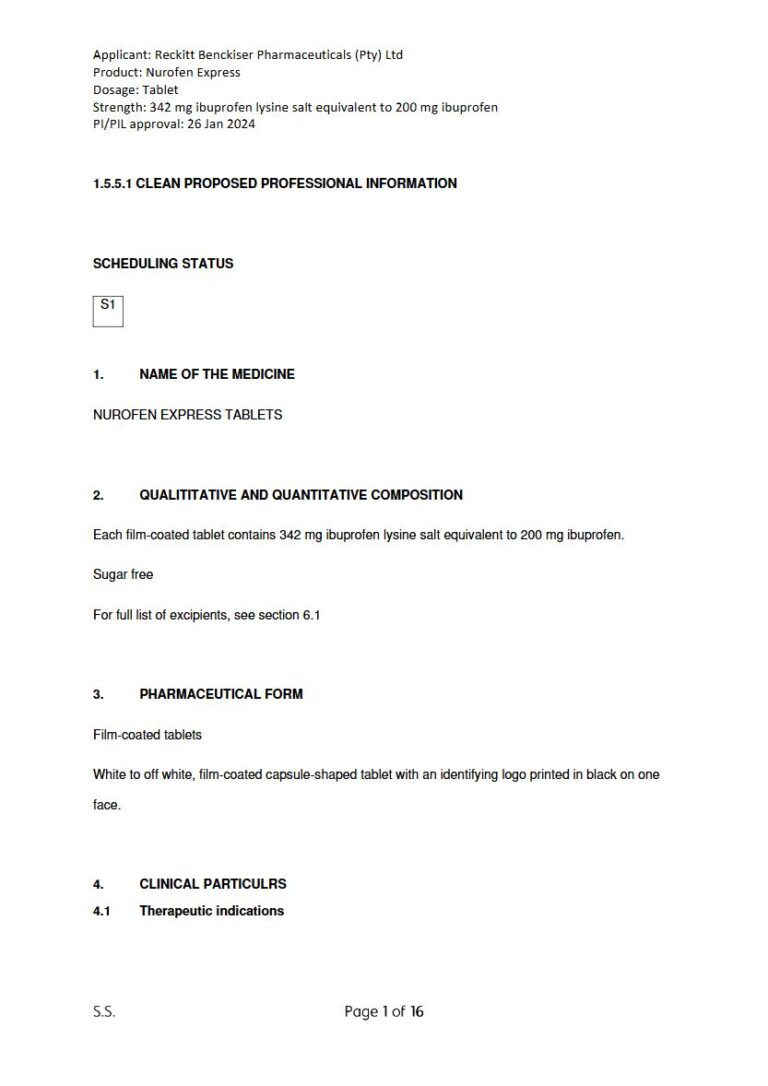
Nurofen Express 200 mg Tablet
PDF Leaflet Revision Date: 26 January 2024
Clinical Summary
Quick overview from the medicine insert
Indication
Short-term relief of pain and fever.
Dosage (summary)
Adults: 2 tablets initially, then 1-2 tablets every 4 hours, max 6 tablets/24 hours.
Onset of Action / Duration
Onset: 30 mins, Duration: 6-8 hours
Special Populations
- Elderly
- Renal impairment
- Hepatic impairment
Pregnancy & Breastfeeding
Contraindicated in pregnancy and breastfeeding.
Key Drug Interactions
- Anticoagulants
- Antihypertensives
- Lithium
- Methotrexate
Contraindications
- Hypersensitivity to ibuprofen
- Gastrointestinal bleeding
- Active ulcers
- Heart failure
- Severe renal failure
- Severe hepatic failure
Common side effects
- Gastrointestinal disturbances
- Headache
- Dizziness
Counselling Points
- Take with water
- Use lowest effective dose
- Consult if symptoms persist or worsen
Serious warnings
- Risk of gastrointestinal bleeding
- Cardiovascular and cerebrovascular effects
- Severe skin reactions
Important Disclaimer
The Nurofen Express 200 mg Tablet professional information leaflet below is the property of Reckitt Benckiser Pharmaceuticals and is provided on Medinsert exactly as issued, with no.. alterations or editorial changes. We make every effort to keep content current by updating documents as soon as new versions become available. Medinsert serves as a trusted access point for healthcare professionals, but does not replace official sources or clinical judgement. For more details, please read our full disclaimer. read more>>
 Healthcare Professionals Only
This content is for registered healthcare professionals
Sign in or create a free account to read the full package insert.
Free for HPCSA-registered professionals. Powered by Medinsert.
Clinical Particulars
Section 4 of the official insert — extracted exactly as issued, no alterations
4.1 Therapeutic indications
NUROFEN EXPRESS is indicated for the short-term relief of headache and back pain of musculo-skeletal origin, feverishness, muscular aches and pain, menstrual pain, dental pain and for the relief of pain associated with migraine.
4.2 Posology and method of administration
Posology
Adults and children over 12 years: Initial dose 2 tablets taken with water, then if necessary, 1 or 2 tablets every four hours. Do not exceed 6 tablets in any 24 hours. Not to be given to children under 12 years. If symptoms persist for more than 7 days or worsen or if new symptoms occur, consult your doctor. Use the lowest effective dose for the shortest duration of treatment.
Method of administration
For oral administration and short-term use only.
4.3 Contraindications
NUROFEN EXPRESS should not be given to patients with:
- Hypersensitivity to ibuprofen or any of the excipients in NUROFEN EXPRESS
- History of gastrointestinal bleeding or perforation (PUBs) related to previous NSAIDs.
- Active or history of recurrent ulcer/haemorrhage/perforations
- Pregnancy and lactation (see section 4.6)
- Heart failure
- Severe renal failure or hepatic failure (see section 4.4)
- Hypersensitivity to ibuprofen, aspirin or other non-anti-inflammatory agents. Because of the possibility of cross-sensitivity due to structural relationships which exist among non-steroidal anti-inflammatory medicines, acute allergic reactions may be more likely to occur in patients who have exhibited allergic reactions such as worsening of asthma, rhinitis or urticaria to these compounds.
4.4 Special warnings and precautions for use
Cardiovascular and cerebrovascular effects: Caution is required in patients with a history of hypertension and as fluid retention and oedema have been reported in association with NUROFEN EXPRESS therapy.
Elderly: The elderly have an increased frequency of adverse reactions to NSAIDs, especially gastrointestinal bleeding and perforation (PUBs) which may be fatal.
Gastrointestinal: The risk of gastrointestinal bleeding or perforation (PUBs) is higher with increasing doses of NUROFEN EXPRESS, in patients with a history of ulcers and the elderly. When gastrointestinal bleeding or ulceration occurs in patients receiving NUROFEN EXPRESS, treatment with NUROFEN EXPRESS should be stopped. NUROFEN EXPRESS should be given with caution to patients with a history of gastrointestinal disease (e.g. ulcerative colitis, Crohn's disease, hiatus hernia, gastro-oesophageal reflux disease, angiodysplasia) as the condition may be exacerbated.
Respiratory, Renal and Hepatic: NUROFEN EXPRESS should be given with care to the elderly, to patients with asthma or bronchospasm, bleeding disorders, cardiovascular disease, or a history of peptic ulceration and in liver or renal failure. Patients with cirrhosis, diuretic-induced volume depletion, or renal insufficiency require local synthesis of vasodilating prostaglandins to maintain renal perfusion, and therefore these patients are at greater risk of developing renal dysfunction due to NSAIDs-induced inhibition of renal prostaglandin synthesis. If suffering from any of the above conditions, a doctor or pharmacist should be consulted before taking NUROFEN EXPRESS.
Other medicines: NUROFEN EXPRESS should not be taken without consulting a doctor or pharmacist if coumarin anticoagulants, antihypertensives, diuretics, lithium and methotrexate are taken and when taking other pain relievers such as aspirin and other NSAIDs. Undesirable effects may be minimised by using the minimum effective dose for the shortest possible duration.
Eyes: NUROFEN EXPRESS should be discontinued in patients who experience blurred or diminished vision, or changes in colour vision. Patients with collagen disease may be at increased risk of developing aseptic meningitis.
Severe skin reactions: Serious skin reactions, some of them fatal, including exfoliative dermatitis, Stevens-Johnson syndrome and toxic epidermal necrolysis have been reported. NUROFEN EXPRESS should be discontinued at the first appearance of skin rash, mucosal lesions, or any other sign of hypersensitivity.
Drug Reaction with Eosinophilia and Systemic Symptoms (DRESS): Drug Reaction with Eosinophilia and Systemic Symptoms (DRESS) has been reported in patients taking NSAIDs such as NUROFEN EXPRESS. Some of these events have been fatal or life-threatening. DRESS typically, although not exclusively, presents with fever, rash, lymphadenopathy, and/or facial swelling. Other clinical manifestations may include hepatitis, nephritis, haematological abnormalities, myocarditis, or myositis. Sometimes symptoms of DRESS may resemble an acute viral infection. Eosinophilia is often present. Because this disorder is variable in its presentation, other organ systems not noted here may be involved. It is important to note that early manifestations of hypersensitivity, such as fever or lymphadenopathy, may be present even though rash is not evident. If such signs or symptoms are present, discontinue NUROFEN EXPRESS and evaluate the patient immediately.
SLE and mixed connective tissue disease: Systemic lupus erythematosus as well as those with mixed connective tissue disease increased risk of aseptic meningitis (see section 4.8). Clinical trial and epidemiological data suggest that the use of ibuprofen, particularly at high doses (2 400 mg daily) and in long term treatment may be associated with a small increased risk of arterial thrombotic events (for example myocardial infarction or stroke). Overall, epidemiological studies do not suggest that low dose ibuprofen (e.g. u2264 1 200 mg daily) is associated with an increased risk of myocardial infarction.
Renal: Renal impairment as renal function may further deteriorate (see sections 4.3 and 4.8). There is a risk of renal impairment in dehydrated children and adolescents.
Hepatic: Hepatic dysfunction (see sections 4.3 and 4.8).
Impaired female fertility: There is limited evidence that medicines which inhibit cyclo-oxygenase/prostaglandin synthesis (such as NUROFEN EXPRESS) may cause impairment of female fertility by an effect on ovulation. This is reversible upon withdrawal of treatment.
Masking of symptoms of underlying infections: NUROFEN EXPRESS can mask symptoms of infection, which may lead to delayed initiation of appropriate treatment and thereby worsening the outcome of the infection. This has been observed in bacterial community acquired pneumonia and bacterial complications to varicella. When NUROFEN EXPRESS is administered for pain or fever in relation to infection, monitoring of infection is advised. In non-hospital settings, the patient should consult a doctor if symptoms persist or worsen.
Other NSAIDs: Using NUROFEN EXPRESS concomitantly with other NSAIDs including cyclooxygenase-2 selective inhibitors should be avoided (see section 4.5).
4.5 Interactions with other medicines
Corticosteroids: increased risk of gastrointestinal ulceration or bleeding (PUBs).
Anti-coagulants: NUROFEN EXPRESS may enhance the effects of anti-coagulants such as warfarin.
Anti-platelet agents and selective serotonin reuptake inhibitors (SSRIs): increased risk of gastrointestinal bleeding.
NSAIDs: Use of two or more NSAIDs concomitantly could result in an increase in side effects.
Lithium: there is evidence for potential increase in plasma levels of lithium.
Digoxin: NSAIDs may exacerbate cardiac failure, reduce GFR and increase plasma levels of digoxin.
Aspirin (acetylsalicylic acid): Unless low-dose aspirin (not above 75 mg daily) has been advised by a doctor, as this may increase the risk of adverse reactions (see section 4.4). Experimental data suggest that NUROFEN EXPRESS may inhibit the effect of low dose aspirin on platelet aggregation when they are dosed concomitantly. However, the limitations of these data and the uncertainties regarding extrapolation of ex vivo data to the clinical situation imply that no firm conclusions can be made for regular NUROFEN EXPRESS use and no clinically relevant effect is considered to be likely for occasional NUROFEN EXPRESS use.
Antihypertensives and diuretics: NSAIDs may diminish the effects of these medicines. In some patients with compromised renal function (e.g. dehydrated patients or elderly patients with compromised renal function) the co-administration of an ACE inhibitor or Angiotensin II antagonist and medicines that inhibit cyclo-oxygenase may result in further deterioration of renal function, including possible acute renal failure, which is usually reversible. These interactions should be considered in patients taking a coxib concomitantly with ACE inhibitors or angiotensin II antagonists. Therefore, the combination should be administered with caution, especially in the elderly. Patients should be adequately hydrated and consideration should be given to monitoring of renal function after initiation of concomitant therapy, and periodically thereafter. Diuretics can increase the risk of nephrotoxicity of NSAIDs.
Methotrexate: There is evidence for the potential increase in plasma levels of methotrexate.
Ciclosporin: Increased risk of nephrotoxicity.
Mifepristone: NUROFEN EXPRESS should not be used for 8-12 days after mifepristone administration as NSAIDs can reduce the effect of mifepristone.
Tacrolimus: Possible increased risk of nephrotoxicity when NUROFEN EXPRESS are given with tacrolimus.
Zidovudine: Increased risk of haematological toxicity when NSAIDs are given with zidovudine. There is evidence of an increased risk haemarthroses and haematoma in HIV-positive haemophiliacs receiving concurrent treatment with zidovudine and NUROFEN EXPRESS.
Quinolone antibiotics: NUROFEN EXPRESS can increase the risk of convulsions associated with quinolone antibiotics. Patients taking NUROFEN EXPRESS and quinolones may have an increased risk of developing convulsions.
4.6 Fertility, pregnancy and lactation
Women of childbearing potential: NUROFEN EXPRESS may cause impairment of female fertility by an effect of ovulation. This is reversible upon withdrawal of treatment.
Pregnancy: NUROFEN EXPRESS is contra-indicated during pregnancy.
First trimester: Inhibition of prostaglandin synthesis may adversely affect the pregnancy and/or the embryo/foetal development. Data from epidemiological studies raise concern about an increased risk of miscarriage and of cardiac malformation and gastroschisis after use of a prostaglandin synthesis inhibitor in early pregnancy. The absolute risk for cardiovascular malformation was increased from less than 1 %, up to approximately 1,5 %. In animals, administration of a prostaglandin synthesis inhibitor has been shown to result in increased pre- and post-implantation loss and embryo-foetal lethality. In addition, increased incidences of various malformations including cardiovascular, have been reported in animals given a prostaglandin synthesis inhibitor during the organogenetic period.
Second and third trimester: During the third trimester of pregnancy, prostaglandin synthesis inhibitors, may expose the foetus to: cardiopulmonary toxicity (with premature closure of the ductus arteriosus and pulmonary hypertension); renal dysfunction, which may progress to renal failure with oligo hydroamniosis. At the end of pregnancy, the mother and the neonate may be exposed to: possible prolongation of bleeding time, an anti-aggregating effect which may occur even at very low doses; inhibition of uterine contractions resulting in delayed or prolonged labour.
Breastfeeding: NUROFEN EXPRESS should not be used by mothers breastfeeding their infants.
4.7 Effects on ability to drive and use machines
Blurred vision has been reported in patients taking NUROFEN EXPRESS, this may negatively affect the patientu2019s ability to drive or operate machinery.
4.8 Undesirable effects
The frequencies of adverse effects are defined as follows: Very common: >1/10; Common: > 1/100, 1/1,000, 1/10,000; <1/1,000; Very Rare: <1/10,000 including isolated reports.
Tabulated summary of adverse reactions
| System Organ Class | Frequency | Adverse Events |
|---|---|---|
| Skin and subcutaneous tissue disorders | Uncommon | Fever and rashes, Bullous reactions, including Stevens-Johnsons syndrome, erythema multiforme and toxic epidermal necrolysis. |
| Not known | Drug Reaction with Eosinophilia and Systemic Symptoms (DRESS syndrome) (see section 4.4), Acute generalised exanthematous pustulosis (AGEP), Photosensitivity reactions | |
| Immune system disorders | Uncommon | Hypersensitivity reactions consisting of urticaria and pruritus |
| Very rare | Severe hypersensitivity reactions, including facial, tongue and throat swelling, dyspnoea, tachycardia, and hypotension (anaphylaxis, angioedema or severe shock) | |
| Gastrointestinal disorders | Common | The most commonly observed adverse events are gastrointestinal in nature |
| Uncommon | Abdominal pain, nausea, dyspepsia | |
| Rare | Diarrhoea, flatulence, constipation and vomiting | |
| Very rare | Peptic ulcer, perforation of gastrointestinal haemorrhage, melaena, haematemesis, sometimes fatal, particularly in the elderly. Ulcers stomatitis, gastritis. Exacerbation of colitis and Crohn's disease | |
| Nervous system disorders | Uncommon | Headache |
| Very rare | Aseptic meningitis | |
| Renal and urinary disorders | Very rare | Cystitis, haematuria, acute renal failure, interstitial nephritis and nephrotic syndrome, papillary necrosis, especially in long-term use, associated with increased serum urea and oedema. |
| Hepato-biliary disorders | Very rare | Hepatotoxicity, abnormalities in liver function tests |
| Blood and the lymphatic system disorders | Very rare | Anaemia, thrombocytopenia, neutropenia, eosinophilia, agranulocytosis, leukopenia, pancytopenia |
| Eye disorders | Very rare | Changes in visual colour perception, and toxic amblyopia. |
| Vascular disorders | Rare | Hypertension |
| Cardiac disorders | Rare | Cardiac failure and oedema |
| Respiratory, thoracic and mediastinal disorders | Very rare | Provocation of bronchospasm in patients with asthma |
| Investigations | Very rare | Decreased haemoglobin levels |
Description of Selected Adverse Reactions
- Hypersensitivity reactions may occur less frequently and include fever and rashes.
- Other side effects include nervousness, tinnitus, depression, drowsiness, insomnia, and blurred vision and other visual field defects.
- NUROFEN EXPRESS can provoke bronchospasm in patients with asthma.
- Other side-effects include blurred vision, changes in visual colour perception, and toxic amblyopia.
- Cardiovascular side-effects include: dizziness, nervousness, tinnitus, depression, drowsiness and insomnia.
Post Marketing Data
Epidemiological data suggest that the use of ibuprofen (particularly at high doses 2400 mg daily) and in long-term treatment may be associated with a small increased risk of arterial thrombotic events (for example myocardial infarction or stroke).
Reporting of suspected adverse reactions
Reporting suspected adverse reactions after authorisation of the medicine is important. It allows continued monitoring of the benefit/risk balance of the medicine. Health care providers are asked to report any suspected adverse reactions to SAHPRA via the u201c6.04 Adverse Drug Reaction Reporting Formu201d, found online under SAHPRAu2019s publications: https://www.sahpra.org.za/Publications/Index/8.
4.9 Overdose
Symptoms: The most likely symptoms of overdosage are pain in upper, middle region of the stomach, nausea, vomiting, dizziness, hypotension, drowsiness and rarely, loss of consciousness.
Management: Management should be symptomatic and supportive and include the maintenance of a clear airway and monitoring of cardiac and vital signs until stable. Consider oral administration of activated charcoal if the patient presents within 1 hour of ingestion of a potentially toxic amount. If frequent or prolonged, convulsions should be treated with intravenous diazepam or lorazepam. Give bronchodilators for asthma. Electrolytes may be corrected by intravenous infusion, if necessary. There is no specific antidote to NUROFEN EXPRESS.
