
Avonex 30 micrograms/0,5 ml Solution
Clinical Summary
Quick overview from the medicine insert
Indication
Treatment of relapsing forms of multiple sclerosis (MS).
Dosage (summary)
30 micrograms (0.5 ml) administered by subcutaneous injection once a week.
Onset of Action / Duration
Initial effects may be observed within a few weeks, with maximum benefit typically seen after several months of treatment.
Special Populations
- Elderly patients
- Patients with hepatic impairment
- Patients with renal impairment
- Patients with a history of depression
Pregnancy & Breastfeeding
Use during pregnancy only if the potential benefit justifies the potential risk to the fetus. Caution is advised when administering to nursing mothers.
Key Drug Interactions
- Other immunomodulatory therapies
- Medications that affect liver enzymes
- Antidepressants
Contraindications
- Hypersensitivity to interferon beta-1A or any excipients
- Severe depression or suicidal ideation
- Severe liver disease
Common side effects
- Flu-like symptoms (fever, chills, fatigue)
- Injection site reactions (redness, swelling, pain)
- Headache
- Nausea
- Depression
Counselling Points
- Instruct patients on proper injection technique.
- Advise patients to report any signs of depression or suicidal thoughts.
- Encourage adherence to the prescribed dosing schedule.
- Inform patients about potential flu-like symptoms and how to manage them.
Serious warnings
- Monitor for signs of depression and suicidal ideation.
- Regular liver function tests are recommended.
- Caution in patients with a history of seizures.
Important Disclaimer
The Avonex 30 micrograms/0,5 ml Solution professional information leaflet below is the property of Acino Pharma and is provided on Medinsert exactly as issued, with no.. alterations or editorial changes. We make every effort to keep content current by updating documents as soon as new versions become available. Medinsert serves as a trusted access point for healthcare professionals, but does not replace official sources or clinical judgement. For more details, please read our full disclaimer. read more>>
 Healthcare Professionals Only
This content is for registered healthcare professionals
Sign in or create a free account to read the full package insert.
Free for HPCSA-registered professionals. Powered by Medinsert.
Clinical Particulars
Section 4 of the official insert — extracted exactly as issued, no alterations
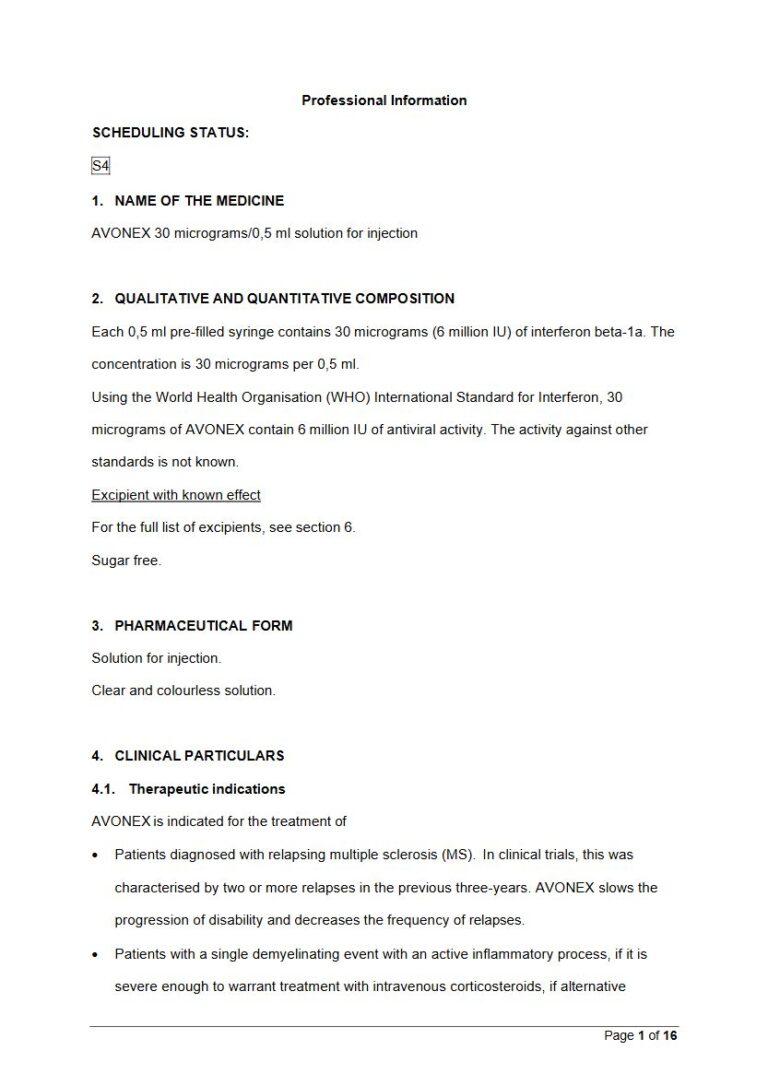
4.1. Therapeutic indications
AVONEX is indicated for the treatment of
- Patients diagnosed with relapsing multiple sclerosis (MS). In clinical trials, this was characterised by two or more relapses in the previous three-years. AVONEX slows the progression of disability and decreases the frequency of relapses.
- Patients with a single demyelinating event with an active inflammatory process, if it is severe enough to warrant treatment with intravenous corticosteroids, if alternative diagnoses have been excluded, and if they are determined to be at high risk of developing clinically definite multiple sclerosis (see section 5.1). AVONEX should be discontinued in patients who develop progressive MS.
4.2. Posology and method of administration
Treatment should be initiated under supervision of a medical practitioner experienced in the treatment of the disease.
Posology
Adults: The recommended dosage for the treatment of relapsing MS is 30 micrograms (0,5 ml solution), administered by intramuscular (IM) injection once a week (see section 6.6). No additional benefit has been shown by administering a higher dose (60 micrograms) once a week.
Prior to injection and for an additional 24 hours after each injection, an antipyretic analgesic is advised to decrease flu-like symptoms associated with AVONEX administration. These symptoms are usually present during the first few months of treatment.
Paediatric population: There is no experience with AVONEX in patients aged 18 years or less. Therefore, AVONEX should not be used in children.
Elderly: Clinical studies did not include a sufficient number of patients aged 65 and over to determine whether they respond differently than younger patients. However, based on the mode of clearance of the active substance there are no theoretical reasons for any requirement for dose adjustments in the elderly.
Method of administration
The intramuscular injection site should be varied each week (see section 5.3). At the present time, it is not known for how long patients should be treated. Patients should be clinically evaluated after two years of treatment and longer-term treatment should be decided on an individual basis by the treating medical practitioner. Treatment should be discontinued if the patient develops chronic progressive MS.
4.3. Contraindications
- Patients with a history of hypersensitivity to natural or recombinant interferon beta, or to any excipient listed in section 6.1.
- Patients with current severe depression and/or suicidal ideation (see sections 4.4 and 4.8).
4.4. Special warnings and precautions for use
AVONEX should be administered with caution to patients with previous or current depressive disorders, in particular to those with antecedents of suicidal ideation (see section 4.3). Depression and suicidal ideation are known to occur in increased frequency in the multiple sclerosis population and in association with AVONEX use. Patients should be advised to immediately report any symptoms of depression and/or suicidal ideation to their prescribing medical practitioner.
Patients exhibiting depression should be monitored closely during therapy with AVONEX and treated appropriately. Cessation of therapy with AVONEX should be considered (see also section 4.3 and 4.8).
AVONEX should be administered with caution to patients with a history of seizures, to those receiving treatment with anti-epileptics, particularly if their epilepsy is not adequately controlled with anti-epileptics (see sections 4.5 and 4.8).
Caution should be used, and close monitoring considered when administering AVONEX to patients with severe renal and hepatic failure and to patients with severe myelosuppression.
Thrombotic microangiopathy (TMA): Cases of thrombotic microangiopathy, manifested as thrombotic thrombocytopenic purpura (TTP) or haemolytic uraemic syndrome (HUS), including fatal cases, have been reported with interferon beta products. Events were reported at various time points during treatment and may occur several weeks to several years after starting treatment with interferon beta. Early clinical features include thrombocytopenia, new onset hypertension, fever, central nervous system symptoms (e.g., confusion, paresis) and impaired renal function. Laboratory findings suggestive of TMA include decreased platelet counts, increased serum lactate dehydrogenase (LDH) due to haemolysis and schistocytes (erythrocyte fragmentation) on a blood film. Therefore, if clinical features of TMA are observed, further testing of blood platelet levels, serum LDH, blood films and renal function is recommended. If TMA is diagnosed, prompt treatment is required (considering plasma exchange) and immediate discontinuation of AVONEX is recommended.
Nephrotic Syndrome: Cases of nephrotic syndrome with different underlying nephropathies including collapsing focal segmental glomerulosclerosis (FSGS), minimal change disease (MCD), membranoproliferative glomerulonephritis (MPGN) and membranous glomerulopathy (MGN) have been reported during treatment with interferon-beta products. Events were reported at various time points during treatment and may occur after several years of treatment with interferon-beta. Periodic monitoring of early signs or symptoms, e.g., oedema, proteinuria and impaired renal function is recommended, especially in patients at higher risk of renal disease. Prompt treatment of nephrotic syndrome is required and discontinuation of treatment with AVONEX should be considered.
Hepatic injury including elevated serum hepatic enzyme levels, hepatitis, autoimmune hepatitis, and hepatic failure has been reported with interferon beta in post-marketing (see section 4.8). In some cases, these reactions have occurred in the presence of other medicines that have been associated with hepatic injury. The potential of additive effects from multiple medicines or other hepatotoxic agents (e.g., alcohol) has not been determined. Patients should be monitored for signs of hepatic injury and caution exercised when AVONEX is used concomitantly with other medicines associated with hepatic injury.
Patients with cardiac disease, such as angina, congestive heart failure or dysrhythmia, should be closely monitored for worsening of their clinical condition during treatment with AVONEX. Flu-like symptoms associated with AVONEX therapy may prove stressful to patients with underlying cardiac conditions.
Laboratory abnormalities are associated with the use of AVONEX. Therefore, in addition to those laboratory tests normally required for monitoring patients with MS, complete and differential white blood cell counts, platelet counts and blood chemistry, including liver function tests, are recommended during AVONEX therapy. Patients with myelosuppression may require more intensive monitoring of complete blood cell counts, with differential and platelet counts.
Patients may develop antibodies to AVONEX. The antibodies of some of those patients reduce the activity of interferon beta-1a in vitro (neutralising antibodies). Neutralising antibodies are associated with a reduction in the in vivo biological effects of AVONEX and may potentially be associated with a reduction of clinical efficacy. It is estimated that the plateau for incidence of neutralising antibody formation is reached after 12 months of treatment. Recent clinical studies with patients treated up to three years with AVONEX suggest that approximately 5 % to 8 % develop neutralising antibodies.
The use of various assays to detect serum antibodies to interferons limits the ability to compare antigenicity among different products.
4.5. Interaction with other medicines and other forms of interaction
No formal interaction studies have been performed in humans. The interaction of AVONEX with corticosteroids or adrenocorticotropic hormone (ACTH) has not been studied systematically. The clinical studies indicate that MS patients can receive AVONEX and corticosteroids or ACTH during relapses.
Interferons have been reported to reduce the activity of hepatic cytochrome P450-dependent enzymes in humans and animals. The effect of high-dose AVONEX administration on P450-dependent metabolism in monkeys was evaluated and no changes in liver metabolising capabilities were observed. Caution should be exercised when AVONEX is administered in combination with medicines that have a narrow therapeutic index and are largely dependent on the hepatic cytochrome P450 system for clearance, e.g. some classes of antiepileptics and antidepressants.
4.6. Fertility, pregnancy and lactation
Pregnancy
A large amount of data (more than 1 000 pregnancy outcomes) from registries and post-marketing experience indicates no increased risk of major congenital anomalies after pre-conception exposure to interferon beta or such exposure during the first trimester of pregnancy. However, the duration of exposure during the first trimester is uncertain, because data were collected when interferon beta use was contraindicated during pregnancy, and treatment likely interrupted when pregnancy was detected and/or confirmed. Experience with exposure during the second and third trimester is very limited.
Based on animal data (see section 5.3), there is a possibly increased risk for spontaneous abortion. The risk of spontaneous abortions in pregnant women exposed to interferon beta cannot adequately be evaluated based on the currently available data, but the data do not suggest an increased risk so far. If clinically needed, the use of AVONEX may be considered during pregnancy.
Breastfeeding
Limited information available on the transfer of interferon beta-1a into breast milk, together with the chemical/physiological characteristics of interferon beta, suggests that levels of interferon beta-1a excreted in human milk are negligible. Patients should consult with their Healthcare Professional and decide either to discontinue breastfeeding or abstain from treatment, as there are limited studies regarding breastfeeding.
Fertility
Fertility and developmental studies in rhesus monkeys have been carried out with a related form of interferon beta 1a. At very high doses, anovulatory and abortifacient effects in test animals were observed (see section 5.3). No information is available on the effects of interferon beta-1a on male fertility.
4.7. Effects on ability to drive and use machines
No studies on the effects of AVONEX on the ability to drive and use machines have been performed. Central nervous system-related adverse reactions may have a minor influence on the ability to drive and use machines in susceptible patients (see section 4.8).
4.8. Undesirable effects
The highest incidence of adverse reactions associated with AVONEX therapy is related to flu-like symptoms. The most commonly reported flu-like symptoms are myalgia, fever, chills, sweating, asthenia, headache and nausea. Flu-like symptoms tend to be most prominent at the initiation of therapy and decrease in frequency with continued treatment.
Transient neurological symptoms that may mimic MS exacerbations may occur following injections. Transient episodes of hypertonia and/or severe muscular weakness that prevent voluntary movements may occur at any time during treatment. These episodes are of limited duration, temporally related to the injections and may recur after subsequent injections. In some cases, these symptoms are associated with flu-like symptoms.
The frequencies of adverse reactions are expressed in patient-years, according to the following categories: Very common ( u2265 1/10 patient-years); Common ( u2265 1/100 to <1/10 patient-years); Uncommon ( u2265 1/1 000 to <1/100 patient-years); Rare ( u2265 1/10 000 to <1/1 000 patient-years); Very rare (<1/10 000 patient-years); Not known (cannot be estimated from the available data).
Patient-time is the sum of individual units of time that the patient in the study has been exposed to AVONEX before experiencing the adverse reaction. For example, 100 person-years could be observed in 100 patients who were on treatment for one year or in 200 patients who were on treatment for half a year.
Adverse reactions identified from studies (clinical trials and observational studies, with a period of follow-up ranging from two years to six years) and other adverse reactions identified through spontaneous reporting from the market, with unknown frequency, are provided in the table below. Within each frequency grouping, undesirable effects are presented in order of decreasing seriousness.
Investigations
- common: decreased lymphocyte count, decreased white blood cell count, decreased neutrophil count, decreased haematocrit, increased blood potassium, increased blood urea nitrogen
- uncommon: decreased platelet count
Cardiac disorders
- not known: cardiomyopathy, congestive heart failure (see section 4.4), palpitations, dysrhythmia, tachycardia
Blood and lymphatic system disorders
- rare: thrombotic microangiopathy including thrombotic thrombocytopenic purpura/haemolytic uraemic syndrome*
- not known: pancytopenia, thrombocytopenia
Nervous system disorders
- very common: headache
- common: muscle spasticity, hypoesthesia
- not known: neurological symptoms, syncope, hypertonia, dizziness, paraesthesia, seizures, migraine
Respiratory, thoracic and mediastinal disorders
- common: rhinorrhoea
- rare: dyspnoea
- not known: pulmonary arterial hypertensionu2020
Gastrointestinal disorders
- common: vomiting, diarrhoea, nausea
Skin and subcutaneous tissue disorders
- common: rash, sweating increased, contusion
- uncommon: alopecia
- not known: angioneurotic oedema, pruritus, vesicular rash, urticaria, aggravation of psoriasis
Musculoskeletal and connective tissue disorders
- common: muscle cramp, neck pain, myalgia, arthralgia, pain in extremity, back pain, muscle stiffness, musculoskeletal stiffness
- not known: systemic lupus erythematosus, muscle weakness, arthritis
Renal and urinary disorders
- rare: nephrotic syndrome, glomerulosclerosis (see section 4.4)
Endocrine disorders
- not known: hypothyroidism, hyperthyroidism
Metabolism and nutritional disorders
- common: anorexia
Infections and infestations
- not known: injection site abscess
Vascular disorders
- common: flushing vasodilatation
- not known:
General disorders and administration site conditions
- very common: flu-like symptoms, pyrexia, chills, sweating
- common: injection site pain, injection site erythema, injection site bruising, asthenia, pain, fatigue, malaise, night sweats
- uncommon: injection site burning, injection site reaction, injection site inflammation, injection site cellulitis, injection site necrosis, injection site bleeding, chest pain
- not known:
Immune system disorders
- not known: anaphylactic reaction, anaphylactic shock, hypersensitivity reactions (angioedema, dyspnoea, urticaria, rash, pruritic rash)
Hepatobiliary disorders
- not known: hepatic failure (see section 4.4), hepatitis, autoimmune hepatitis
Reproductive system and breast disorders
- uncommon: metrorrhagia, menorrhagia
Psychiatric disorders
- common: depression (see section 4.4), insomnia
- not known: suicide, psychosis, anxiety, confusion, emotional lability
* Class label for interferon beta products (see section 4.4)
u2020 Class label for interferon products, see below Pulmonary arterial hypertension.
1 Injection site reactions including pain, inflammation and very rare cases of abscess or cellulitis that may require surgical intervention have been reported.
2 The frequency of occurrence is higher at the beginning of treatment.
3 A syncope episode may occur after AVONEX injection, it is normally a single episode that usually appears at the beginning of the treatment and does not recur with subsequent injections.
Pulmonary arterial hypertension
Cases of pulmonary arterial hypertension (PAH) have been reported with interferon beta products as contained in AVONEX. Events were reported at various time points including up to several years after starting treatment with interferon beta.
Reporting of suspected adverse reactions
Reporting suspected adverse reactions after authorisation of the medicine is important. It allows continued monitoring of the benefit/risk balance of the medicine. Healthcare providers are asked to report any suspected adverse reactions to SAHPRA via the u201c6.04 Adverse Drug Reactions Reporting Formu201d, found online under SAHPRAu2019s publications: https:// www.sahpra.org.za/Publications/Index/8.
4.9. Overdose
No case of overdose has been reported. However, in case of overdosage, patients should be hospitalised for observation and appropriate supportive treatment given.
