
Travocort 10 mg / 1 mg Cream
PDF Leaflet Revision Date: 09 May 2023
Clinical Summary
Quick overview from the medicine insert
Indication
Treatment of fungal infections with inflammatory skin conditions.
Dosage (summary)
Apply twice daily to affected areas.
Pregnancy & Breastfeeding
Not recommended during pregnancy or breastfeeding due to potential risks.
Contraindications
- Hypersensitivity to active substances
- Tuberculous or syphilitic processes
- Viral diseases in treatment area
- Use on skin creases
Common side effects
- Application site irritation
- Burning sensation
- Erythema
Counselling Points
- Avoid contact with eyes
- Change personal linen daily
- Use for short courses only
Serious warnings
- Risk of glaucoma with extensive use
- Potential for rebound flares after discontinuation
Important Disclaimer
The Travocort 10 mg / 1 mg Cream professional information leaflet below is the property of Adcock Ingram and is provided on Medinsert exactly as issued, with no.. alterations or editorial changes. We make every effort to keep content current by updating documents as soon as new versions become available. Medinsert serves as a trusted access point for healthcare professionals, but does not replace official sources or clinical judgement. For more details, please read our full disclaimer. read more>>
 Healthcare Professionals Only
This content is for registered healthcare professionals
Sign in or create a free account to read the full package insert.
Free for HPCSA-registered professionals. Powered by Medinsert.
Clinical Particulars
Section 4 of the official insert — extracted exactly as issued, no alterations
4.1 Therapeutic indications
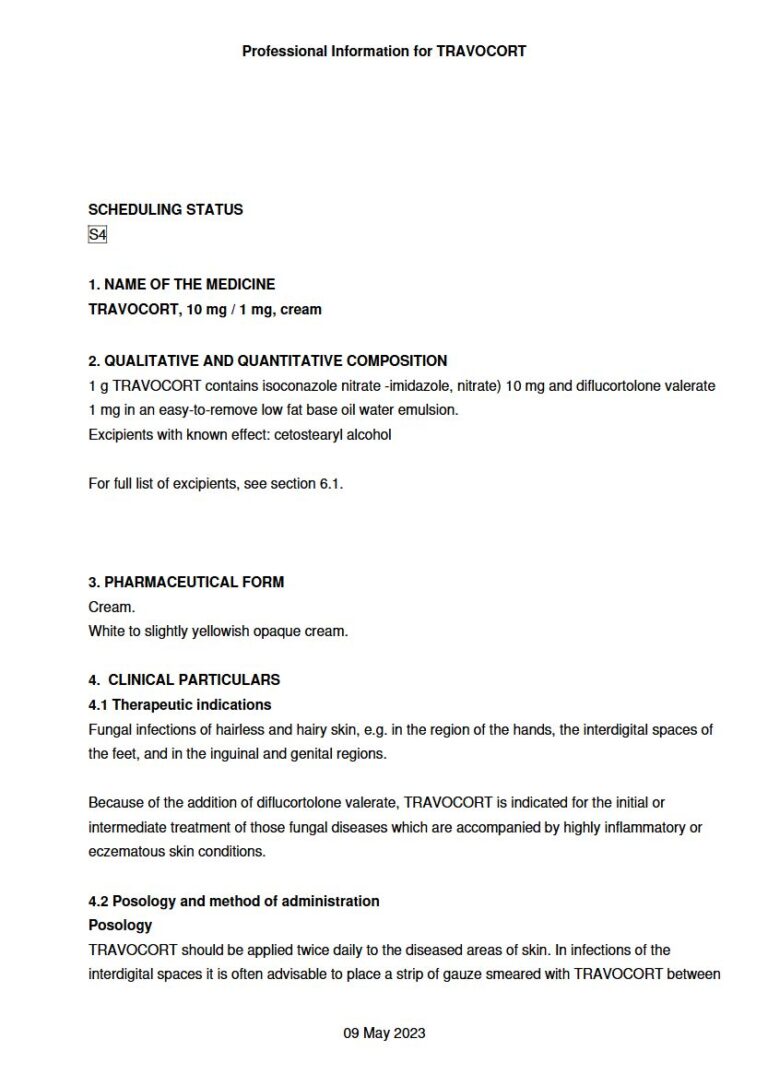
Fungal infections of hairless and hairy skin, e.g. in the region of the hands, the interdigital spaces of the feet, and in the inguinal and genital regions. Because of the addition of diflucortolone valerate, TRAVOCORT is indicated for the initial or intermediate treatment of those fungal diseases which are accompanied by highly inflammatory or eczematous skin conditions.
4.2 Posology and method of administration
Posology
TRAVOCORT should be applied twice daily to the diseased areas of skin. In infections of the interdigital spaces it is often advisable to place a strip of gauze smeared with TRAVOCORT between the toes or fingers. The treatment with TRAVOCORT must be terminated after regression of the inflammatory or eczematous skin condition and the therapy continued or followed up with the isoconazole nitrate preparation without corticoid additive. This applies in particular for use in inguinal and genital regions. If a secondary microbial skin infection is present suitable concomitant anti-microbial therapy should be instituted. If fungal infections are present, a topically active antimycotic should be applied.
Paediatric population
No data are available.
Method of administration
Cutaneous use.
4.3 Contraindications
- Hypersensitivity to the active substances or to any of the excipients listed in section 6.1.
- Tuberculous or syphilitic processes in the area to be treated; virus diseases (e.g. varicella, herpes zoster), rosacea, perioral dermatitis and postvaccination skin reactions in the area to be treated.
- Potent topical corticosteroid preparations (TRAVOCORT) should not be applied to any skin crease areas.
- Corticosteroids have been shown to be teratogenic in animals following dermal application. As these agents are absorbed percutaneously, teratogenicity following topical application cannot be excluded. Therefore, TRAVOCORT should not be used during pregnancy.
4.4 Special warnings and precautions for use
Additional, specific therapy is required for bacterially infected skin diseases. TRAVOCORT should not be allowed to come into contact with the eyes when being applied to the face. Extensive application of topical corticosteroids such as TRAVOCORT to large areas of the body or for prolonged periods of time, in particular under occlusion, significantly increases the risk of side effects. These effects are more likely to occur in children. Glaucoma may also develop from using local corticoids as in TRAVOCORT (e.g. after large-dosed or extensive application over a prolonged period, occlusive dressing techniques, or application to the skin around the eyes). In infections of the interdigital spaces it is advisable to place a strip of gauze smeared with TRAVOCORT between the toes or fingers. To avoid renewed infection, personal linen (face-cloths, towels, underwear etc. - preferably of cotton) should be changed daily and boiled. Regular hygienic measures are essential for successful TRAVOCORT treatment. In tinea pedum, the space between the toes must be thoroughly dried after washing, and stockings or socks should be changed daily. Cetostearyl alcohol may cause local skin reactions (e.g, contact dermatitis). Potent topical corticosteroids should be used for short courses only. Regular review should be made of the necessity for continuing therapy. Long term continuous or inappropriate use of topical steroids can result in the development of rebound flares after stopping treatment (topical steroid withdrawal syndrome). A severe form of rebound flare can develop which takes the form of a dermatitis with intense redness, stinging and burning that can spread beyond the initial treatment area. It is more likely to occur when delicate skin sites such as the face and flexures are treated. Should there be a reoccurrence of the condition within days to weeks after successful treatment a withdrawal reaction should be suspected. Reapplication should be with caution and specialist advise is recommended in these cases or other treatment options should be considered.
4.5 Interactions with other medicines and other forms of interaction
None so far known.
Paediatric population
No information available.
4.6 Fertility, pregnancy and lactation
Pregnancy
Safety in pregnancy has not been established. There are no adequate data from the use of diflucortolone valerate/isoconazole nitrate in pregnant women. Use of topical preparations containing glucocorticoids is not recommended during the first trimester of pregnancy. In particular, treating large areas, prolonged use or occlusive dressings should be avoided during pregnancy. Animal experimental studies with glucocorticosteroids have shown reproductive toxicity. The potential risk for humans is unknown. A number of epidemiological studies suggest that there is an increased risk of oral clefts among newborns of women who were treated with systemic glucocorticosteroids during the first trimester of pregnancy. Oral clefts are a rare disorder and if systemic glucocorticosteroids are teratogenic, these may account for an increase of one or two cases per 1000 women treated while pregnant. Data concerning topical glucocorticosteroid use during pregnancy are insufficient, however, a lower risk might be expected since systemic availability of topically applied glucocorticosteroids is very low. Adverse reactions cannot be excluded in neonates whose mothers have been treated during pregnancy (see section 4.8). Studies in animals (mice, rats and rabbits) have shown reproductive toxicity for diflucortolone valerate (see section 5.3). TRAVOCORT should not be used during pregnancy (see section 4.3).
Breastfeeding
Safety in lactation has not been established. It is not known whether isoconazole nitrate/diflucortolone valerate are excreted in human milk. A risk to the breast-fed infant cannot be excluded. Nursing mothers should not be treated with TRAVOCORT on the breasts to avoid inadvertent ingestion by the child. Use of TRAVOCORT is not recommended while breastfeeding, particularly for the treatment of large areas, prolonged use or occlusive dressings. Adverse reactions cannot be excluded in children whose mothers have been treated while breastfeeding (see section 4.8).
Fertility
Preclinical data did not indicate any risk on fertility.
4.7 Effects on ability to drive and use machines
No effects on the ability to drive and use machines have been observed in patients treated with TRAVOCORT.
4.8 Undesirable effects
a. Summary of the safety profile
Local symptoms such as itching, burning, erythema or vesiculation may occur in isolated cases under treatment with TRAVOCORT. In clinical studies, most frequently observed adverse reactions included application site irritation and application site burning.
b. Tabulated summary of adverse reactions
| SYSTEM ORGAN CLASS | FREQUENCY | ADVERSE REACTIONS |
|---|---|---|
| Eye disorders | Frequency not known | Vision blurred * |
| Skin and subcutaneous tissue disorders | Less frequent | Striae. |
| Frequency not known (cannot be estimated from available data) | Withdrawal reactions -redness of the skin which may extend to areas beyond the initial affected area, burning or stinging sensation, itch, skin peeling, oozing pustules * | |
| General disorders and administration site conditions | Frequent | Application site: irritation, burning. |
| Less frequent | Application site: erythema, dryness. | |
| Frequency not known | Application site: pruritis, blisters. |
* See also section 4.4.
c. Description of selected adverse reactionsThe following reactions may occur when topical preparations containing corticoids such as TRAVOCORT are applied to large areas of the body (about 10 % and more) or for long periods of time (more than 4 weeks) or under occlusion: Local symptoms such as atrophy of the skin, telangiectasia, striae, acneiform changes of the skin. Systemic effects may include depression of the hypothalamic-pituitary-adrenal axis with consequent suppression of the adrenal gland possibly leading to growth retardation or a cushiongoid state. Benign intracranial hypertension may occur. The following side effects may occur in rare cases: Folliculitis, hypertrichosis, perioral dermatitis, skin discoloration, allergic skin reactions to any of the ingredients of the formulation.
d. Paediatric population
Side effects cannot be excluded in neonates whose mothers have been treated extensively or for a prolonged period of time during pregnancy or while lactating (for example, reduced adrenocortical function, when applied during the last weeks of pregnancy).
4.9 Overdose
Results from acute toxicity studies do not indicate that any risk of acute intoxication is to be expected following a single dermal application of an overdose (application over a large area under conditions favourable to absorption) or inadvertent oral ingestion.
