
Zenziket 1 mg Solution
PDF Leaflet Revision Date: 25 June 2025
Clinical Summary
Quick overview from the medicine insert
Indication
Induction and maintenance of general anaesthesia.
Dosage (summary)
Induction: ~1 mg/kg; Maintenance: 1-5 mg/kg/hour, individualized.
Special Populations
- Children under 3 months
- Hepatic impairment
- Renal impairment
Pregnancy & Breastfeeding
Not established; contraindicated in pregnancy and breastfeeding.
Key Drug Interactions
- CNS depressants
- Halogenated anaesthetics
- Barbiturates
- Opiates
Contraindications
- Hypersensitivity to ketamine
- Severe hypertension
- Eclampsia
- Cerebral trauma
Common side effects
- Hallucinations
- Hypertension
- Nausea
- Vomiting
Counselling Points
- Avoid driving for 24 hours
- Do not consume alcohol post-anesthesia
- Accompanied discharge recommended
Serious warnings
- Respiratory depression risk
- Requires monitoring
- Potential for abuse
Important Disclaimer
The Zenziket 1 mg Solution professional information leaflet below is the property of Umsebe Healthcare and is provided on Medinsert exactly as issued, with no.. alterations or editorial changes. We make every effort to keep content current by updating documents as soon as new versions become available. Medinsert serves as a trusted access point for healthcare professionals, but does not replace official sources or clinical judgement. For more details, please read our full disclaimer. read more>>
 Healthcare Professionals Only
This content is for registered healthcare professionals
Sign in or create a free account to read the full package insert.
Free for HPCSA-registered professionals. Powered by Medinsert.
Clinical Particulars
Section 4 of the official insert — extracted exactly as issued, no alterations
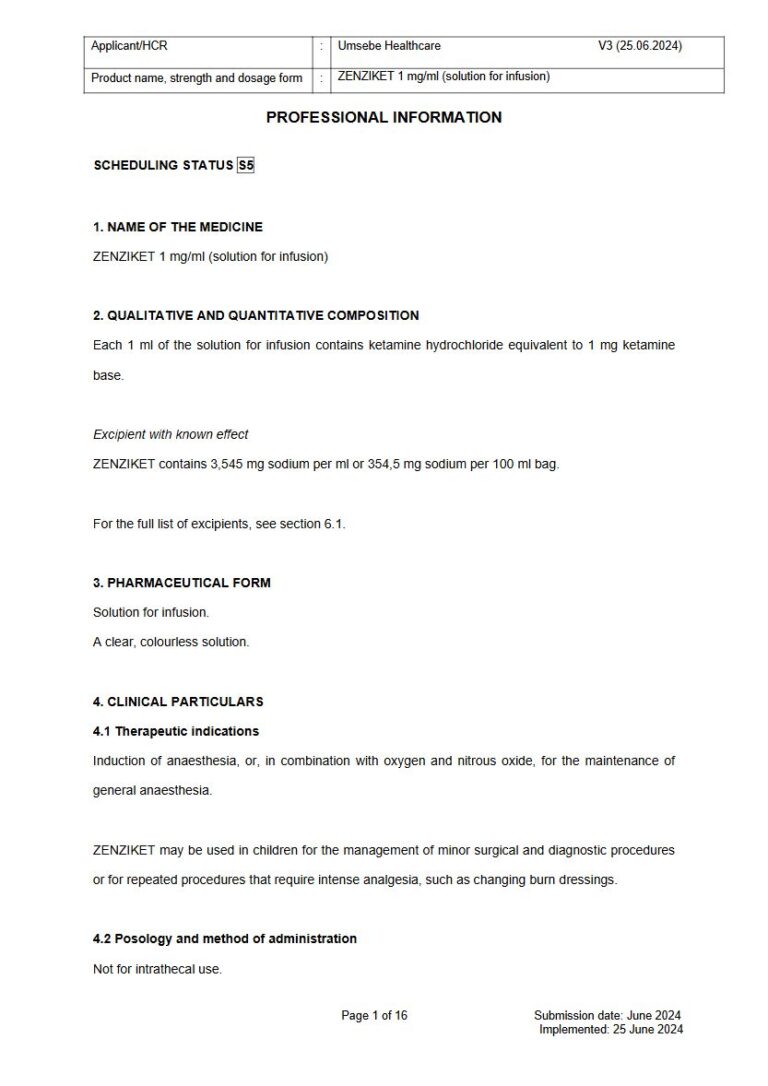
4.1 Therapeutic indications
Induction of anaesthesia, or, in combination with oxygen and nitrous oxide, for the maintenance of general anaesthesia. ZENZIKET may be used in children for the management of minor surgical and diagnostic procedures or for repeated procedures that require intense analgesia, such as changing burn dressings.
4.2 Posology and method of administration
Not for intrathecal use.
Posology Doses should be individualised. The individual response to ZENZIKET varies according to a number of factors, such as the dose, route of injection and the patientu2019s weight. The dosage therefore cannot be rigidly set and must be adjusted to each patient. The dosages stated are in terms of ketamine base. Administration should be preceded by atropine or another suitable antimuscarinic medicine. Induction is accomplished by infusing ZENZIKET until induction is complete. In general, the induction dose will be approximately 1 mg/kg. For maintenance, intravenous infusion rates need to be individualised to prevent nystagmus and response to surgical stimuli, 1 to 5 mg/kg/hour being the usual dose. Upon termination of surgery, the ZENZIKET infusion is discontinued. Development of tolerance When ZENZIKET is administered repeatedly over a short period of time, acute tolerance may occur, particularly in young children; an appropriate increase in the ketamine dose provides the desired anaesthetic effect in these patients. Paediatric population To date, the dosage of ketamine has not been adequately studied in children and adolescents. Due to limited information and experience, the dosage of ZENZIKET in children and adolescents (as in adults) is determined according to body weight. ZENZIKET must not be used in children aged less than 3 months due to potential respiratory complications.
Method of administration ZENZIKET is supplied ready for use and should not be diluted before use. ZENZIKET is administered undiluted via intravenous infusion.
4.3 Contraindications
- Hypersensitivity to ketamine hydrochloride or to any of the excipients listed in section 6.1.
- ZENZIKET is contraindicated in patients in whom elevation of blood pressure would be a serious hazard, including those with hypertension or a history of cerebrovascular accident.
- ZENZIKET should not be used in patients with eclampsia or pre-eclampsia, severe coronary or myocardial disease, or cerebral trauma.
- ZENZIKET should not be given to patients with increased intra-ocular pressure. Alternative anaesthetics should be considered in patients with penetrating wounds of the eye.
- Safety in pregnancy and lactation has not been established (see section 4.6).
- Not for intrathecal use (see section 4.2).
4.4 Special warnings and precautions for use
ZENZIKET should only be used in hospitals by, or under the supervision of, experienced medical practitioners, who are experienced in general anaesthetic techniques, unless under emergency conditions. Resuscitation equipment should be available when ZENZIKET is used, as its use requires careful respiratory monitoring. Respiratory depression may occur with overdosage of ZENZIKET, in which case supportive ventilation should be employed (see section 4.9).
Particular caution is required in the following cases:
- Mild hypertension and impaired cardiac function;
- Unstable angina or myocardial infarction within the last six months;
- Intracranial hypertension, unless the patient is receiving adequate respiratory support;
- Glaucoma and perforating eye injuries.
In patients with hypertension or cardiac decompensation, cardiac function must be monitored continuously during the procedure. Caution must be exercised in cases of pre-existing intracranial hypertension, as ZENZIKET may increase cerebrospinal fluid pressure. ZENZIKET does not reliably suppress pharyngeal and laryngeal reflexes and mechanical stimulation of the pharynx should be avoided unless a muscle relaxant, with proper attention to respiration, is used. Hence, muscle relaxation and appropriate ventilatory support are particularly indicated during procedures on the pharynx, larynx and bronchial tree. Patients should be intubated if there is a risk of aspiration as laryngeal reflexes are not necessarily maintained. In cases of visceral surgery, ZENZIKET should be supplemented with a medicine which obtunds visceral pain. In ophthalmic diagnostic and surgical procedures, adjuvant administration of a local anaesthetic has been shown to be useful, e.g., via the subconjunctival, equatorial or intramuscular route in strabismus surgery, or via the retrobulbar route during intraocular procedures. In cases of chronic alcoholism or intoxication with alcohol, ZENZIKET must be used with caution. Concomitant administration of barbiturates or opiates may prolong the recovery phase. When used as a sole anaesthetic agent, a state of transient disorientation may occur during the awakening phase. The psychological manifestations vary in severity between pleasant dream-like states, vivid imagery, hallucinations, nightmares and emergence delirium (often consisting of dissociative or floating sensations). In some cases, these states have been accompanied by confusion, excitement, and irrational behaviour which a few patients recall as an unpleasant experience (see section 4.8). The incidence of these reactions may be reduced if verbal and tactile stimulation of the patient is minimised during the recovery period. This does not preclude the monitoring of vital signs. If necessary, recording of vital functions can be performed in the usual manner. A short-acting benzodiazepine, such as diazepam 2.5 to 5 mg intravenously (0.05 to 0.1 mg/kg) decreases the incidence of hallucinations during ZENZIKET anaesthesia and decreases the incidence of emergence reactions. ZENZIKET is metabolised in the liver and hepatic clearance is required for termination of clinical effects. A prolonged duration of action may occur in patients with cirrhosis or other types of liver impairment. In cases of prolonged administration (>3 days) or drug abuse, abnormal liver function tests have been observed. Hepatotoxicity has also been reported in patients with extended use (> 3 days). Dosage reductions should be considered in these patients. The dosage of ZENZIKET may need to be decreased in the event of renal impairment. ZENZIKET must be used with caution in patients with a history of severe anginal attacks. Because of the substantial increase in myocardial oxygen consumption, ZENZIKET should be used with caution in patients with hypovolemia, dehydration or cardiac disease, especially coronary artery disease (e.g., congestive heart failure, myocardial ischaemia and myocardial infarction). In addition, ZENZIKET should be used with caution in patients with mild to moderate hypertension and tachydysrhythmias. Elevation of blood pressure begins shortly after the injection of ZENZIKET, reaches a maximum within a few minutes and usually returns to pre-anaesthetic values within 15 minutes after injection. The median peak rise of blood pressure in clinical studies has ranged from 20 to 25 % of pre-anaesthetic values. Depending on the condition of the patients, this elevation of blood pressure may be considered a beneficial effect, or in others, an adverse reaction. When ZENZIKET is administered to patients in a state of shock, the appropriate measures necessary for treating shock must be applied (correction of hypovolemia, oxygen administration). In extremely severe states of shock, when it is very difficult or impossible to measure blood pressure, extreme caution is required as with any other anaesthetic. Antisecretory agents such as atropine must always be administered to prevent hypersalivation. Use with caution in patients with neurotic traits or psychiatric illness (e.g., schizophrenia and acute psychosis). Use with caution in patients with acute intermittent porphyria. Use with caution in patients with a history of seizures. Use with caution in patients with hyperthyroidism or patients receiving thyroid replacement as it may increase the risk of hypertension and tachycardia (see section 4.5). Use with caution in patients with pulmonary or upper respiratory infection (ZENZIKET sensitises the gag reflex, potentially causing laryngospasm). Use with caution in patients with intracranial mass lesions, a presence of head injury, or hydrocephalus. ZENZIKET should be used with caution in patients with a history of convulsive disorders, prone to hallucinations or psychiatric disease. Cases of cystitis, including haemorrhagic cystitis, have been reported in patients being given ketamine on a long-term basis. This adverse reaction develops in patients receiving long-term ketamine treatment after a time ranging from 1 month to several years. ZENZIKET is not indicated nor recommended for long-term use. When ZENZIKET is used on an outpatient basis, the patient should not be released until recovery from anaesthesia is complete and then should be accompanied by a responsible adult. Patients should not participate in decision making and should not take alcohol for 24 hours after receiving ZENZIKET.
4.5 Interactions with other medicines
Concomitant administration of ZENZIKET and halogenated anaesthetics, such as ether, halothane and other cerebral depressants, may prolong the elimination half-life of ZENZIKET and delay the recovery phase. Prolonged recovery has also occurred when barbiturates and/or opioids have been given with ZENZIKET. The risk of bradycardia, of lowering blood pressure or decreased cardiac output may be increased, particularly with high doses or rapid administration combined with halogenated anaesthetics (see section 4.8). The undesirable effects of ketamine, especially those of a psychotomimetic nature, are much less pronounced when it is used as part of an anaesthetic combination. ZENZIKET may potentiate the neuromuscular blocking effects of atracurium and tubocurarine, including respiratory depression with apnoea (see section 4.8). Concomitant administration of ZENZIKET and CNS-inhibiting medicines and substances (e.g., ethanol, phenothiazines, sedating H1-blockers or skeletal muscle relaxers) may potentiate CNS sedation and/or increase the risk of respiratory depression (see section 4.8). A reduction in the ZENZIKET dose may be necessary if ketamine is used at the same time as other anxiolytics, sedatives and hypnotics. In particular, the combination with benzodiazepines or neuroleptics prolongs the effect of ketamine. It is known, for example, that diazepam increases the half-life of ketamine and prolongs its pharmacodynamic effect. Dose adjustments may therefore be necessary. It has been reported that ketamine antagonises the hypnotic effect of thiopental. ZENZIKET may prolong the effect of both non-depolarizing and depolarizing muscle relaxants. Concomitant administration of ZENZIKET with antihypertensive agents increase the risk of developing hypotension. Concomitant administration of ZENZIKET and theophylline or aminophylline may significantly lower the seizure threshold. Unpredictable extensor-type seizures have been reported with concurrent administration of these medicines with ketamine. Concomitant administration of thyroid hormones, direct-acting or indirect-acting sympathomimetics and vasopressin may enhance the sympathomimetic effects of ZENZIKET and cause high blood pressure and tachycardia. Concomitant use of ZENZIKET and ergometrine can cause high blood pressure. It is not recommended that ZENZIKET be combined with ergometrine. Administration of ZENZIKET potentiates the anaesthetic effect of halothane, for which lower doses may therefore be sufficient. Concomitant use of ZENZIKET and halothane may increase the risk of cardiac arrhythmias triggered by the adjuvant administration of epinephrine. Medicines that inhibit the enzymatic activity of CYP3A4 generally reduce hepatic clearance. This leads to elevated plasma concentrations of CYP3A4 substrates such as ketamine. A reduction in the ZENZIKET dose may be necessary if ZENZIKET is used at the same time as medicines that inhibit the CYP3A4 enzyme. Medicines that induce the enzymatic activity of CYP3A4 generally increase hepatic clearance. This leads to decreased plasma concentrations of CYP3A4 substrates such as ketamine. An increase in the ZENZIKET dose may be necessary to achieve the desired clinical outcome if ZENZIKET is used at the same time as medicines that induce the CYP3A4 enzyme.
4.6 Fertility, pregnancy and lactation
Pregnancy Safety in pregnancy has not been established (see section 4.3). ZENZIKET crosses the placenta. Ketamine has not been adequately studied with regard to reproductive toxicity and there are no controlled studies in pregnant women. Neonates exposed to ketamine during delivery have experienced respiratory depression and low Apgar scores requiring newborn resuscitation. Marked increases in maternal blood pressure and uterine tone have been observed at intravenous doses greater than 2 mg/kg. ZENZIKET must not be used during pregnancy.
Breastfeeding Safety in lactation has not been established (see section 4.3). It is not known whether ketamine is excreted in breast milk. ZENZIKET must therefore not be used during breastfeeding.
Fertility No fertility studies have been conducted in humans. Studies in animals have shown reproductive toxicity.
4.7 Effects on ability to drive and use machines
ZENZIKET has a major influence on the ability to drive and use machines. Particularly in situations where the patient may be discharged earlier than scheduled, the duration of the effect of ZENZIKET and other medicines administered during anaesthesia should be taken into account. Patients must be made aware that they should not drive, use dangerous machines or perform hazardous activities for 24 hours after anaesthesia, or even longer (depending on the dose of ZENZIKET and other medicines used). If ZENZIKET is administered in an outpatient setting, patients must undergo post-anaesthetic monitoring and may only return home, accompanied by a responsible adult, when permitted by the attending physician.
4.8 Undesirable effects
The observations described below are partly explained by the mechanism of action of ketamine. The transient increase in heart rate and blood pressure is a characteristic effect regularly observed with ketamine. The increase in blood pressure (at a constant differential pressure) occurs just after the injection, reaches its peak within a few minutes and generally returns to pre-anaesthetic values after 15 minutes. During clinical trials with ketamine, blood pressure increased on average from 20 % to 25 % compared to pre-anaesthetic values. Depending on the patientu2019s condition, this increase in blood pressure may have a positive or adverse impact. Clinical studies currently available for ketamine have shown that, in patients for whom a decrease in blood pressure must be avoided as much as possible on account of their condition, maintenance of a stable or slightly raised blood pressure with ketamine represents an advantage. If the cardio stimulant effect of ketamine must be avoided, pre-medication with intravenous diazepam at a dose of 0.2 u2013 0.25 mg/kg provides good results.
The adverse reactions of ketamine are listed below by organ system and frequency.
System organ class (MedDRA) Adverse event Frequency
- Immune system disorders Anaphylactic reaction. Less frequent
- Metabolism and nutrition disorders Anorexia. Less frequent
- Psychiatric disorders Hallucinations, vivid/abnormal dreams, nightmares, mental confusion, motor agitation, behavioural changes, agitation. Frequent
- Anxiety, delirium, flashback, dysphoria, insomnia, disorientation. Less frequent
- Nervous system disorders Tonic-clonic movements, hypertonia, increased intracranial pressure (unless adequate ventilatory support is available). Frequent
- Vertigo. Less frequent
- Eye disorders Diplopia, nystagmus, visual disturbances. Frequent
- Increase in intraocular pressure, lacrimation. Not known
- Cardiac disorders Hypertension, tachycardia. Frequent
- Dysrhythmias, bradycardia. Less frequent
- Vascular disorders Hypotension. Less frequent
- Respiratory, thoracic and mediastinal disorders Elevated respiratory rate. Frequent
- Laryngospasm (or other forms of airway constriction), respiratory depression, apnoea. Less frequent
- Gastrointestinal disorders Nausea, vomiting. Frequent
- Hypersalivation. Less frequent
- Hepato-biliary disorders Medicine-induced liver injury (reported with extended use (> 3 days) or drug abuse). Not known
- Skin and subcutaneous tissue disorders Erythema, morbilliform erythema. Frequent
- Transient skin rashes. Not known
- Renal and urinary disorders Cystitis, haemorrhagic cystitis. Less frequent
- General disorders and administration site conditions Local pain sensitivity, redness/rash at the injection site. Less frequent
Reporting of suspected adverse reactions Reporting suspected adverse reactions after authorisation of the medicine is important. It allows continued monitoring of the benefit/risk balance of the medicine. Healthcare providers are asked to report any suspected adverse reactions to SAHPRA via the u201c6.04 Adverse Drug Reactions Reporting Formu201d, found online under SAHPRAu2019s publications: https://www.sahpra.org.za/Publications/Index/8
4.9 Overdose
Respiratory depression can result from an overdosage, requiring ventilatory support until adequate spontaneous breathing is restored. Supportive ventilation and resuscitation equipment must always be available when general anaesthesia is administered. If overdosage with ZENZIKET occurs, ventilation should be employed using mechanical support to maintain adequate blood oxygen saturation until adequate spontaneous breathing is restored.
