
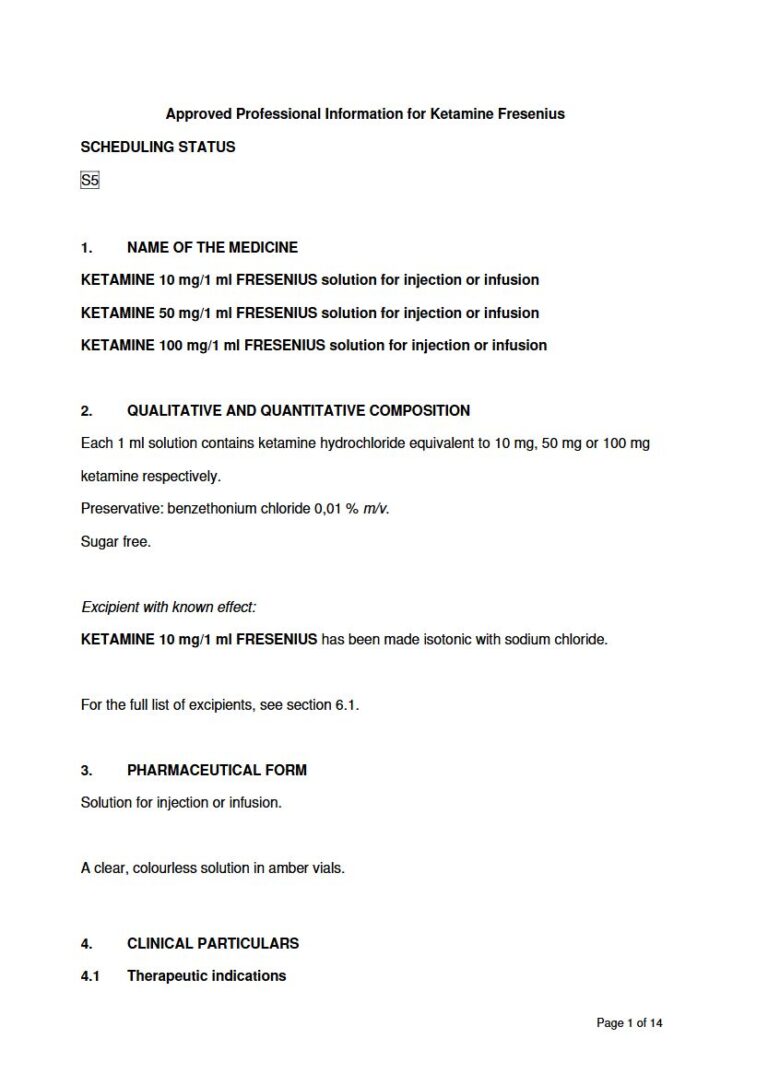
Ketamine Fresenius 10 mg/50 mg/100 mg Solution
PDF Leaflet Revision Date: 25 April 2023
Clinical Summary
Quick overview from the medicine insert
Indication
Induction and maintenance of general anaesthesia.
Dosage (summary)
IV: 1-2 mg/kg; IM: 5-10 mg/kg.
Onset of Action / Duration
Onset: 30 secs (IV), 3-4 mins (IM); Duration: 5-25 mins.
Special Populations
- Hepatic impairment
- Renal impairment
- Hypertension
- Cerebral trauma
- Psychiatric disorders
Pregnancy & Breastfeeding
Safety not established; crosses placenta, may cause respiratory depression in neonates.
Key Drug Interactions
- Incompatible with barbiturates and diazepam
- Increases effects of CNS depressants
- May potentiate neuromuscular blockers
Contraindications
- Hypersensitivity to ketamine
- Severe hypertension
- Eclampsia or pre-eclampsia
- Cerebral trauma
- Increased intra-ocular pressure
Common side effects
- Hallucinations
- Increased blood pressure
- Nausea
- Respiratory depression
- Dysrhythmias
Counselling Points
- Avoid driving for 24 hours post-administration.
- Do not consume alcohol for 24 hours.
- Monitor for emergence reactions.
Serious warnings
- Respiratory depression with overdose
- Emergence reactions
- Caution in cardiac disease
Important Disclaimer
The Ketamine Fresenius 10 mg/50 mg/100 mg Solution professional information leaflet below is the property of Fresenius Kabi Manufacturing Sa and is provided on Medinsert exactly as issued, with no.. alterations or editorial changes. We make every effort to keep content current by updating documents as soon as new versions become available. Medinsert serves as a trusted access point for healthcare professionals, but does not replace official sources or clinical judgement. For more details, please read our full disclaimer. read more>>
 Healthcare Professionals Only
This content is for registered healthcare professionals
Sign in or create a free account to read the full package insert.
Free for HPCSA-registered professionals. Powered by Medinsert.
Clinical Particulars
Section 4 of the official insert — extracted exactly as issued, no alterations
4.1 Therapeutic indications
Induction of anaesthesia, or, in combination with oxygen and nitrous oxide, for the maintenance of general anaesthesia. KETAMINE FRESENIUS may be used in children for the management of minor surgical and diagnostic procedures or for repeated procedures that require intense analgesia, such as changing burn dressings.
4.2 Posology and method of administration
Not for intrathecal use. Doses should be individualised. Administration should be preceded by atropine or another suitable antimuscarinic medicine. KETAMINE FRESENIUS dosages:
- Route Dose mg/kg Onset of anaesthesia Duration Time
- IV 1 u2013 2 30 seconds 5 to 10 minutes
- IM 5 u2013 10 3 to 4 minutes 12 to 25 minutes
A. KETAMINE FRESENIUS may be administered by intravenous or intramuscular injection. Intravenous injection should be over a period of 60 seconds.
B. Alternative method: An intravenous infusion solution (1 mg/ml) is prepared by mixing 500 mg of ketamine in 500 ml of 5 % glucose or 0,9 % sodium chloride solution. Induction is accomplished by infusing the solution until induction is complete. In general, the induction dose will be approximately 1 mg/kg. For maintenance, intravenous infusion rates need to be individualised to prevent nystagmus and response to surgical stimuli, 1 to 5 mg/kg/hour being the usual dose. Upon termination of surgery, the KETAMINE FRESENIUS infusion is discontinued.
4.3 Contraindications
- Hypersensitivity to ketamine hydrochloride or to any of the inactive ingredients in KETAMINE FRESENIUS, as listed in section 6.1.
- KETAMINE FRESENIUS is contraindicated in patients in whom elevation of blood pressure would be a serious hazard including those with hypertension or a history of cerebrovascular accident.
- KETAMINE FRESENIUS should not be used in patients with eclampsia or pre-eclampsia, severe coronary or myocardial disease, or cerebral trauma.
- KETAMINE FRESENIUS should not be given to patients with increased intra-ocular pressure. Alternative anaesthetics should be considered in patients with penetrating wounds of the eye.
- Safety in pregnancy and lactation has not been established (see section 4.6).
- Not for intrathecal use (see section 4.2).
4.4 Special warnings and precautions for use
KETAMINE FRESENIUS should only be used in hospitals by, or under the supervision of, experienced medical practitioners except under emergency conditions. The necessary equipment for airway support, intubation and resuscitation should always be readily available. Respiratory depression may occur with overdosage of KETAMINE FRESENIUS, in which case supportive ventilation should be employed. The intravenous dose should be administered over a period of 60 seconds. More rapid administration may result in respiratory depression or apnoea and enhanced pressor response. KETAMINE FRESENIUS does not reliably suppress pharyngeal and laryngeal reflexes and mechanical stimulation of the pharynx should be avoided unless a muscle relaxant, with proper attention to respiration, is used. Patients should be intubated if there is a risk of aspiration as laryngeal reflexes are not necessarily maintained.
In surgical procedures involving visceral pain pathways, KETAMINE FRESENIUS should be supplemented with a medicine which obtunds visceral pain. When KETAMINE FRESENIUS is used on an outpatient basis, the patient should not be released until recovery from anaesthesia is complete and then should be accompanied by a responsible adult. Patients should not participate in decision making and should not take alcohol for 24 hours after receiving KETAMINE FRESENIUS.
KETAMINE FRESENIUS should be used with caution in patients with the following conditions: Patients with mild hypertension and impaired cardiac function should be appropriately monitored. Use with caution in the chronic alcoholic and the acutely alcohol-intoxicated patient. KETAMINE FRESENIUS is metabolised in the liver and hepatic clearance is required for termination of clinical effects. A prolonged duration of action may occur in patients with cirrhosis or other types of liver impairment. Dose reductions should be considered in these patients. Abnormal liver function tests associated with KETAMINE FRESENIUS use have been reported, particularly with extended use (> 3 days) or drug abuse. Dosage may need to be decreased in the event of renal impairment. Since an increase in cerebrospinal fluid (CSF) pressure has been reported during KETAMINE FRESENIUS anaesthesia, KETAMINE FRESENIUS should be used with special caution in patients with preanaesthetic elevated cerebrospinal fluid pressure. Use with caution in patients with globe injuries because the pressure may increase significantly after a single dose of KETAMINE FRESENIUS. Use with caution in patients with neurotic traits or psychiatric illness (e.g., schizophrenia and acute psychosis). Use with caution in patients with acute intermittent porphyria. Use with caution in patients with a history of seizures. Use with caution in patients with hyperthyroidism or patients receiving thyroid replacement as it may increase the risk of hypertension and tachycardia (see section 4.5).
Use with caution in patients with pulmonary or upper respiratory infection (KETAMINE FRESENIUS sensitises the gag reflex, potentially causing laryngospasm). Use with caution in patients with intracranial mass lesions, a presence of head injury, or hydrocephalus. KETAMINE FRESENIUS should be used with caution in patients with a history of convulsive disorders, prone to hallucinations or psychiatric disease.
Emergence reaction The psychological manifestations vary in severity between pleasant dream-like states, vivid imagery, hallucinations, nightmares and emergence delirium (often consisting of dissociative or floating sensations). In some cases, these states have been accompanied by confusion, excitement, and irrational behaviour which a few patients recall as an unpleasant experience (see section 4.8). Emergence delirium phenomena may occur during the recovery period. The incidence of these reactions may be reduced if verbal and tactile stimulation of the patient is minimised during the recovery period. This does not preclude the monitoring of vital signs. A short-acting benzodiazepine, such as diazepam 2,5 to 5 mg intravenously (0,05 to 0,1 mg/kg) decreases the incidence of hallucinations during ketamine anaesthesia and decreases the incidence of emergence reactions.
Cardiovascular Because of the substantial increase in myocardial oxygen consumption, KETAMINE FRESENIUS should be used with caution in patients with hypovolaemia, dehydration or cardiac disease, especially coronary artery disease (e.g., congestive heart failure, myocardial ischaemia and myocardial infarction). In addition, KETAMINE FRESENIUS should be used with caution in patients with mild-to-moderate hypertension and tachydysrhythmias. Elevation of blood pressure begins shortly after the injection of KETAMINE FRESENIUS, reaches a maximum within a few minutes and usually returns to preanaesthetic values within 15 minutes after injection. The median peak rise of blood pressure in clinical studies has ranged from 20 to 25 % of preanaesthetic values. Depending on the condition of the patients, this elevation of blood pressure may be considered a beneficial effect, or in others, an adverse reaction.
Long-term use Cases of cystitis including haemorrhagic cystitis have been reported in patients being given KETAMINE FRESENIUS on a long-term basis. This adverse reaction develops in patients receiving long-term KETAMINE FRESENIUS treatment after a time ranging from 1 month to several years. KETAMINE FRESENIUS is not indicated nor recommended for long-term use. Hepatotoxicity has also been reported in patients with extended use (> 3 days). Drug abuse and dependence KETAMINE FRESENIUS has been reported as being a drug of abuse. Reports suggest that KETAMINE FRESENIUS produces a variety of symptoms including, but not limited to, flashbacks, hallucinations, dysphoria, anxiety, insomnia, or disorientation (see section 4.8). If used on a daily basis for a few weeks, dependence and tolerance may develop, particularly in individuals with a history of drug abuse and dependence. Therefore, the use of KETAMINE FRESENIUS should be closely supervised, and it should be prescribed and administered with caution.
4.5 Interaction with other medicines and other forms of interaction
Incompatibility exists with soluble barbiturates, and these should not be combined in the same syringe. It is also not recommended that KETAMINE FRESENIUS be combined with ergometrine. Concomitant use with ergometrine may lead to an increase in blood pressure. KETAMINE FRESENIUS is chemically incompatible with diazepam because of precipitate formation. Therefore, it should not be mixed in the same syringe or infusion fluid. Diazepam is also known to increase the half-life of ketamine and prolongs its pharmacodynamic effects. Dose adjustments may therefore be needed. Inhalational anaesthetics, such as ether and halothane, and other cerebral depressants may prolong the effect of KETAMINE FRESENIUS and delay recovery. Prolonged recovery has also occurred when barbiturates and/or opioids have been given with KETAMINE FRESENIUS. Concurrent use of KETAMINE FRESENIUS (especially in high doses or when rapidly administered) with halogenated anaesthetics can increase the risk of developing bradycardia, hypotension or decreased cardiac output (see section 4.8). KETAMINE FRESENIUS may potentiate the neuromuscular blocking effects of atracurium and tubocurarine, including respiratory depression with apnoea (see section 4.8). The use of KETAMINE FRESENIUS with other central nervous system (CNS) depressants (e.g., ethanol, phenothiazines, sedating H1-blockers or skeletal muscle relaxants) can potentiate CNS depression and/or increase risk of developing respiratory depression (see section 4.8). Reduced doses of KETAMINE FRESENIUS may be required with concurrent administration of other anxiolytics, sedatives and hypnotics (see section 4.2). KETAMINE FRESENIUS has been reported to antagonise the hypnotic effect of thiopental. Patients taking thyroid hormones have an increased risk of developing hypertension and tachycardia when given KETAMINE FRESENIUS (see section 4.4). Concurrent use of KETAMINE FRESENIUS and antihypertensive medicines increases the risk of developing hypotension. Sympathomimetics (directly or indirectly acting) and vasopressin may enhance the sympathomimetic effects of KETAMINE FRESENIUS.
When KETAMINE and theophylline are given concurrently, a clinically significant reduction in the seizure threshold is observed. Unpredictable extensor-type seizures have been reported with concurrent administration of these medicines. Medicines that inhibit CYP3A4 enzyme activity generally decrease hepatic clearance, resulting in increased plasma concentration of CYP3A4 substrate medicines, such as ketamine. Coadministration of KETAMINE FRESENIUS with medicines that inhibit CYP3A4 enzyme may require a decrease in ketamine dosage to achieve the desired clinical outcome. Medicines that induce CYP3A4 enzyme activity generally increase hepatic clearance, resulting in decreased plasma concentration of CYP3A4 substrate medicines, such as ketamine. Coadministration of KETAMINE FRESENIUS with medicines that induce CYP3A4 enzyme may require an increase in ketamine dosage to achieve the desired clinical outcome.
4.6 Fertility, pregnancy and lactation
The safety in pregnancy and lactation has not been established (see section 4.3). KETAMINE FRESENIUS crosses the placenta. Neonates exposed to ketamine during delivery have experienced respiratory depression and low Apgar scores requiring new-born resuscitation. Marked increases in maternal blood pressure and uterine tone have been observed at intravenous doses greater than 2 mg/kg.
Fertility Studies in animals have shown reproductive toxicity.
4.7 Effects on ability to drive and use machines
Patients should be cautioned that driving a car, operating hazardous machinery or engaging in hazardous activities should not be undertaken for 24 hours or more after receiving KETAMINE FRESENIUS.
4.8 Undesirable effects
Immune system disorders: Less frequent: Anaphylactic reaction.
Metabolism and nutrition disorders: Less frequent: Anorexia.
Psychiatric disorders: Frequent: Hallucinations, abnormal dreams, nightmares, confusion, agitation, abnormal behaviour. Less frequent: Anxiety, delirium, flashback, dysphoria, insomnia, disorientation.
Nervous system disorders: Frequent: Hypertonia, tonic clonic movements. The following side effect has been reported and the frequency is unknown: Raised cerebrospinal fluid pressure.
Eye disorders: Frequent: Diplopia, nystagmus. The following side effects have been reported and the frequencies are unknown: Lacrimation raised intra-ocular pressure.
Cardiac disorders: Frequent: Blood pressure increased; heart rate increased. Less frequent: Dysrhythmias, bradycardia.
Vascular disorders: Less frequent: Hypotension.
Respiratory, thoracic and mediastinal disorders: Frequent: Respiratory rate increased. Less frequent: Respiratory depression, apnoea, laryngospasm, obstructive airway disorder.
Gastrointestinal disorders: Frequent: Nausea, vomiting. Less frequent: Salivary hypersecretion.
Hepatobiliary disorders: The following side effects has been reported and the frequency is unknown: Liver function test abnormalities, medicine-induced liver injury* *Reported with extended use (> 3 days) or drug abuse.
Skin and subcutaneous tissue disorders: Frequent: Erythema, rash morbilliform. The following side effects have been reported and the frequencies are unknown: Transient skin rashes.
Renal and urinary disorders: Less frequent: Cystitis, haemorrhagic cystitis.
General disorders and administration site conditions: Less frequent: Injection site pain, injection site rash.
Post-marketing data: Less frequent: increased risk of abdominal pain, including pancreatitis has been reported.
4.9 Overdose
Respiratory depression can result from an overdosage. Supportive ventilation should always be available when general anaesthesia is administered. Supportive ventilation should be employed using mechanical support to maintain adequate blood oxygen saturation.
