
Acuvail Eye drops
Clinical Summary
Quick overview from the medicine insert
Indication
Management of postoperative inflammation and pain in the eyes.
Dosage (summary)
Instill 1 drop into the affected eye(s) 4 to 6 times daily, starting 24 hours after surgery and continuing through the first 2 weeks of the postoperative period.
Onset of Action / Duration
Onset of action is typically within 30 minutes, with a duration of effect lasting up to 4-6 hours.
Special Populations
- Elderly patients
- Patients with renal impairment
- Patients with hepatic impairment
Pregnancy & Breastfeeding
Use during pregnancy only if the potential benefit justifies the potential risk to the fetus. Caution is advised during lactation as it is not known if ketorolac is excreted in human milk.
Key Drug Interactions
- Increased risk of bleeding when used with anticoagulants or antiplatelet agents.
- May enhance the effects of other nonsteroidal anti-inflammatory drugs (NSAIDs).
- Caution with concurrent use of corticosteroids.
Contraindications
- Hypersensitivity to ketorolac or any component of the formulation.
- Active or history of peptic ulcer disease.
- Severe renal impairment.
- Patients undergoing cataract surgery.
Common side effects
- Burning or stinging sensation in the eye.
- Redness of the eye.
- Corneal edema.
- Allergic reactions.
Counselling Points
- Instruct patients to avoid touching the dropper tip to any surface, including the eye.
- Advise patients to report any signs of eye infection or unusual eye pain.
- Inform patients about the potential for temporary blurred vision after instillation.
Serious warnings
- Prolonged use may increase the risk of corneal damage.
- Use with caution in patients with a history of asthma or allergic reactions.
- Not recommended for use in children under 2 years of age.
Important Disclaimer
The Acuvail Eye drops professional information leaflet below is the property of AbbVie and is provided on Medinsert exactly as issued, with no.. alterations or editorial changes. We make every effort to keep content current by updating documents as soon as new versions become available. Medinsert serves as a trusted access point for healthcare professionals, but does not replace official sources or clinical judgement. For more details, please read our full disclaimer. read more>>
 Healthcare Professionals Only
This content is for registered healthcare professionals
Sign in or create a free account to read the full package insert.
Free for HPCSA-registered professionals. Powered by Medinsert.
Clinical Particulars
Section 4 of the official insert — extracted exactly as issued, no alterations
4.1 Therapeutic indications
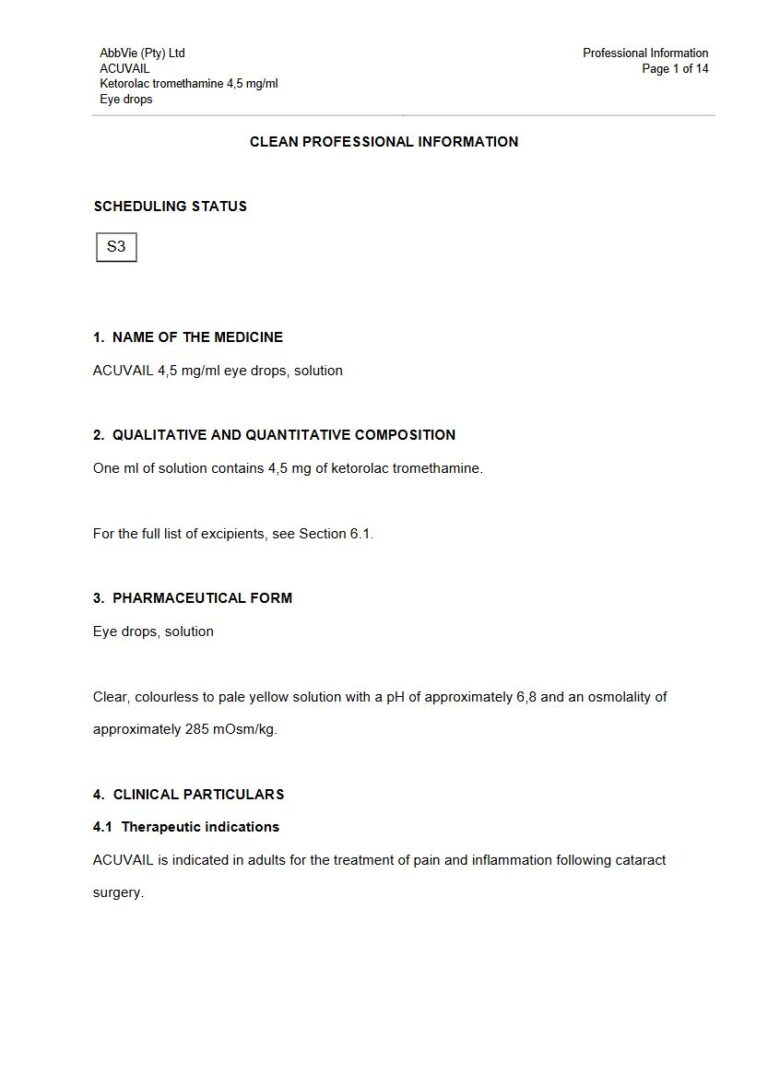
ACUVAIL is indicated in adults for the treatment of pain and inflammation following cataract surgery.
4.2 Posology and method of administration
Posology
Patient dosing
The recommended dose of ACUVAIL is one drop to be applied to the affected eye twice daily beginning 1 day prior to cataract surgery, continued on the day of surgery and through the first two weeks of the post-operative period.
Dosing on the day of cataract surgery by healthcare professional
Approximately two hours prior to surgery, one drop is to be administered approximately every twenty minutes for a total of three drops. Prior to discharge one additional drop is to be administered.
Special populations
Elderly population
No overall differences in safety or effectiveness have been observed between elderly and other adult patients.
Hepatic or renal impairment
There are no data specific for patients with hepatic or renal impairment and therefore specific dosage recommendations cannot be made.
Paediatric population
Safety and effectiveness in paediatric patients have not been established. No data available.
Method of administration
If more than one topical ophthalmic medication is being used the medicines must be administered at least 5 minutes apart.
4.3 Contraindications
ACUVAIL is contraindicated in patients with previously demonstrated hypersensitivity to any of the ingredients in the formulation. For a complete listing of ingredients in ACUVAIL, see Section 6.1.
4.4 Special warnings and precautions for use
Cross-Sensitivity or Hypersensitivity
There is the potential for cross - sensitivity to aspirin, phenylacetic acid derivatives, and other non-steroidal anti-inflammatory drugs (NSAIDs) [see Section 4.5]. Therefore, caution should be used when treating individuals who have previously exhibited sensitivities to these medicines. There have been reports of bronchospasm or exacerbation of asthma, in patients, who have either a known hypersensitivity to aspirin/non-steroidal anti-inflammatory drugs or a past medical history of asthma, associated with the use of ketorolac tromethamine 0,5 % ophthalmic solution which may be contributory. Caution is recommended in the use of ACUVAIL in these individuals.
Bleeding
With some non-steroidal anti-inflammatory agents, like ketorolac tromethamine as in ACUVAIL, there is the potential for increased bleeding time due to interference with thrombocyte aggregation. There have been reports that ocularly applied non-steroidal anti-inflammatory medication, like ketorolac tromethamine, as in ACUVAIL, may cause increased bleeding of ocular tissues (including hyphaemas) in conjunction with ocular surgery. It is recommended that ACUVAIL be used with caution in patients with known bleeding tendencies or who are receiving other medications, which may prolong bleeding time.
Delayed Healing
Topical non-steroidal anti-inflammatory agents, like ketorolac tromethamine as in ACUVAIL, may slow or delay healing. Topical corticosteroids are also known to slow or delay healing. Concomitant use of topical non-steroidal anti-inflammatory agents and topical steroids may increase the potential for healing problems.
Corneal Effects
Use of topical non-steroidal anti-inflammatory agents, like ketorolac tromethamine as in ACUVAIL, may result in keratitis. In some susceptible patients, continued use of topical non- steroidal anti-inflammatory agents, like ketorolac tromethamine as in ACUVAIL, may result in epithelial breakdown, corneal thinning, corneal erosion, corneal ulceration or corneal perforation. These events may be sight threatening. Patients with evidence of corneal epithelial breakdown should immediately discontinue use of ACUVAIL and should be closely monitored for corneal health. ACUVAIL should be used with caution in patients with complicated ocular surgeries, corneal denervation, corneal epithelial defects, diabetes mellitus, ocular surface diseases (e.g. dry eye syndrome), rheumatoid arthritis, or repeat ocular surgeries within a short period of time as they may be at increased risk for corneal adverse events which may become sight threatening. Post - marketing experience with topical non-steroidal anti-inflammatory agents, like ketorolac tromethamine as in ACUVAIL, suggests that use more than 24 hours prior to surgery or use beyond 14 days post - surgery may increase patient risk for the occurrence and severity of corneal adverse events.
Eye Injury and Contamination
Patients should be instructed to avoid allowing the tip of the vial to contact the eye or surrounding structures to avoid injury and contamination of eye drops. The solution from one single - use vial is to be used immediately after opening for administration to the affected eye(s), and the remaining contents should be discarded immediately after administration. Each vial is intended only for a single treatment in the affected eye(s).
Contact Lens Wear
ACUVAIL should not be administered while wearing contact lenses. If contact lens use is recommended by the doctor, they should be removed prior to instillation of ACUVAIL solution and may be re - inserted 15 minutes following administration.
4.5 Interaction with other medicines and other forms of interaction
There is a potential for cross - sensitivity of ketorolac to aspirin, phenylacetic acid derivatives, and other non-steroidal anti-inflammatory agents (NSAIDs). Therefore, caution should be exercised when using ACUVAIL in individuals with previously exhibited sensitivities to these medicines (see Section 4.4). Topical non-steroidal anti-inflammatory agents may slow or delay healing (see Section 4.4). Concomitant use of ACUVAIL and topical steroids may increase the potential for healing problems.
With non-steroidal anti-inflammatory agents, there is the potential for increased bleeding time due to interference with thrombocyte aggregation. There have been reports that ocularly applied non-steroidal anti-inflammatory agents, like ACUVAIL, may cause increased bleeding of ocular tissues (including hyphaemas) in conjunction with ocular surgery. Therefore, it is recommended that ACUVAIL be used with caution in patients with known bleeding tendencies, or who are receiving other medications, which may prolong bleeding time. ACUVAIL may be administered in conjunction with other topical ophthalmic medications such as alpha - agonists, antibiotics, beta blockers, carbonic anhydrase inhibitors, cycloplegics, and mydriatics.
4.6 Fertility, pregnancy and lactation
Pregnancy
There are no adequate and well controlled studies in pregnant women. Ketorolac tromethamine, administered orally during organogenesis, was not teratogenic in rats and rabbits at doses approximately 600 times and 1700 times the typical clinical daily dose of ACUVAIL, respectively. Ketorolac tromethamine resulted in dystocia and increased pup mortality in rats, when administered at oral doses up to approximately 300 times the typical clinical daily dose of ACUVAIL. Because of the known non-teratogenic effects of prostaglandin - inhibiting medicines on the foetal cardiovascular system of rats (closure of the ductus arteriosus), the use of ACUVAIL during late pregnancy should be avoided.
Breastfeeding
ACUVAIL is not recommended for treatment of nursing mothers. Secretion of ketorolac tromethamine in human milk after systemic administration is limited. The milk - to - plasma ratio of ketorolac tromethamine concentrations ranged between 0,015 and 0,037 in a study of 10 women.
Fertility
Ketorolac tromethamine did not impair fertility when administered orally to male and female rats at doses of 9 mg/kg/day and 16 mg/kg/day, respectively. These doses are respectively 1500 and 2700 times higher than the typical human topical ophthalmic daily dose.
4.7 Effects on ability to drive and use machines
If transient blurred vision occurs at instillation, the patient should wait until the vision clears before driving or using machinery.
4.8 Undesirable effects
Summary of safety profile
In clinical trials the most common adverse reactions were increased intra-ocular pressure, conjunctival haemorrhage, eye pain, and blurred vision.
Tabulated list of adverse reactions
The following adverse reactions were reported during clinical trials with ACUVAIL or in the post-marketing period. Very common (u22651/10); common (u22651/100 to <1/10); uncommon (u22651/1,000 to <1/100); rare (u22651/10,000 to <1/1,000); very rare (<1/10,000); not known (cannot be estimated from the available data).
System Organ Class Frequency Adverse Reaction
Eye disorders Common Increased intra-ocular pressure, eye pain, conjunctival haemorrhage, blurred vision
Unknown Ulcerative keratitis, eye swelling, eye oedema, eyelid oedema, ocular hyperaemia
Additional side effects reported for preserved 0,4 % and 0,5 % ketorolac tromethamine formulations which may potentially occur with ACUVAIL are tabulated below:
System Organ Class Adverse Reaction
Eye disorders Stinging or burning on instillation, conjunctival hyperaemia, corneal infiltrates, iritis, ocular inflammation, corneal oedema, eye irritation, superficial keratitis and superficial ocular infections, corneal erosion, corneal perforation, corneal thinning, epithelial breakdown, keratic precipitates, hem retinal, cystoid macular oedema, eye burning, eye pruritus, eye trauma
Nervous system disorders Headache
Skin and subcutaneous tissue disorders Allergic reactions (itching, rash, redness or swelling of skin)
Immune system disorders Hypersensitivity
4.9 Overdose
In the event of topical overdose, wash the eye with water. If ACUVAIL is accidentally ingested, drink fluids to dilute. Treatment is symptomatic and supportive.
