
Provera 10 Mg/5 mg Tablets
PDF Leaflet Revision Date: 20 October 2022
Clinical Summary
Quick overview from the medicine insert
Indication
Dysfunctional uterine bleeding, endometriosis, menopausal symptoms.
Dosage (summary)
5-10 mg for 5-10 days; 10 mg three times daily for endometriosis.
Special Populations
- Renal impairment
- Hepatic impairment
Pregnancy & Breastfeeding
Contraindicated in pregnancy; not recommended during breastfeeding.
Key Drug Interactions
- Aminoglutethimide
- CYP3A4 inducers/inhibitors
Contraindications
- Hypersensitivity
- Thromboembolic disorders
- Liver disease
- Malignancy
- Undiagnosed vaginal bleeding
- Pregnancy
Common side effects
- Dysfunctional uterine bleeding
- Headache
- Nausea
Counselling Points
- Monitor for mood changes
- Avoid if pregnant or breastfeeding
- Inform lab of use before tests
Serious warnings
- Risk of thromboembolic events
- May cause depression
- Fluid retention
Important Disclaimer
The Provera 10 Mg/5 mg Tablets professional information leaflet below is the property of Pfizer Laboratories and is provided on Medinsert exactly as issued, with no.. alterations or editorial changes. We make every effort to keep content current by updating documents as soon as new versions become available. Medinsert serves as a trusted access point for healthcare professionals, but does not replace official sources or clinical judgement. For more details, please read our full disclaimer. read more>>
 Healthcare Professionals Only
This content is for registered healthcare professionals
Sign in or create a free account to read the full package insert.
Free for HPCSA-registered professionals. Powered by Medinsert.
Clinical Particulars
Section 4 of the official insert — extracted exactly as issued, no alterations
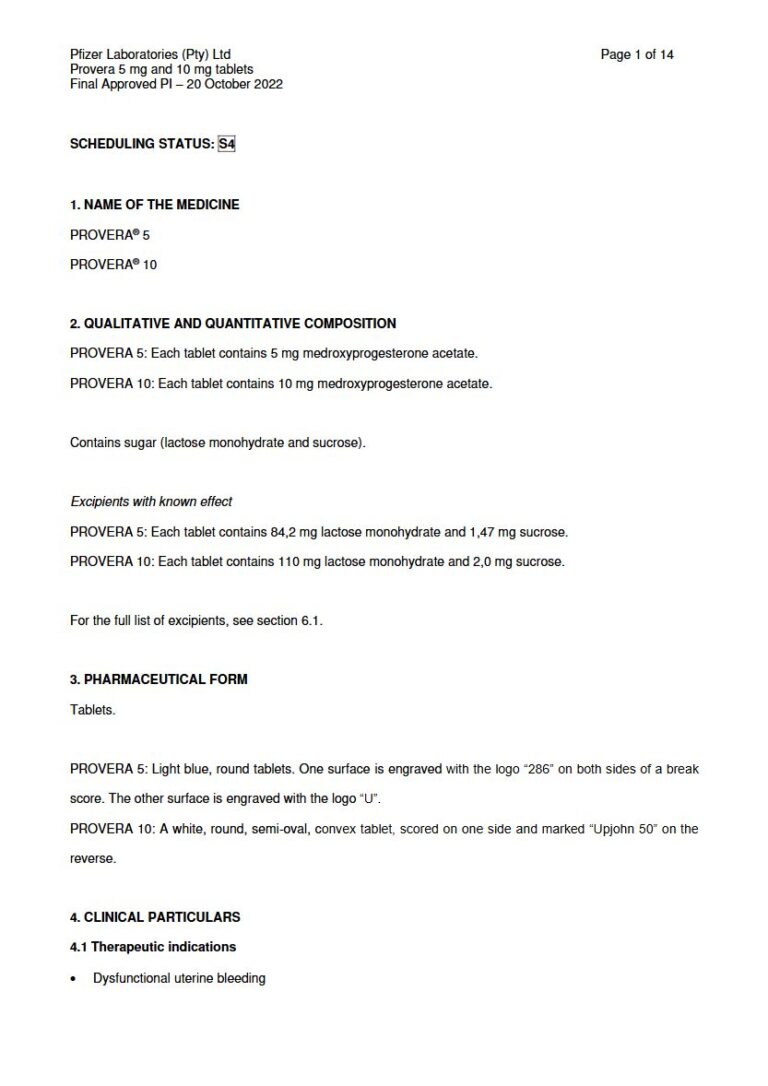
4.1 Therapeutic indications
- Dysfunctional uterine bleeding
- Mild to moderate endometriosis
- To oppose the endometrial effects of estrogen in menopausal women treated with estrogen
- Alleviation of menopausal vasomotor symptoms
- Diagnostic uses:
- Primary amenorrhoea
- Secondary amenorrhoea
4.2 Posology and method of administration
Posology
Dysfunctional uterine bleeding
In dysfunctional uterine bleeding PROVERA may be given in doses ranging from 5 mg to 10 mg for 5 to 10 days beginning on the assumed or calculated 16th to 21st day of the cycle. When bleeding is due to a deficiency of both ovarian hormones, as indicated by a poorly developed proliferative endometrium, estrogens should be used in conjunction with PROVERA. If bleeding is controlled satisfactorily, two subsequent cycles of treatment should be given.
Endometriosis
Beginning on the first day of the menstrual cycle, 10 mg of PROVERA may be given three times a day for 90 consecutive days.
To oppose the endometrial effects of estrogen in estrogen-treated post-menopausal women
5 mg to 10 mg PROVERA per day for at least 10 days beginning on the 16th day of a 25 day course of estrogen therapy. Progestin withdrawal bleeding should occur, beginning on the 3rd to 7th day post PROVERA treatment.
Menopause
10 mg to 20 mg PROVERA per day given continuously.
Primary and secondary amenorrhoea
5 mg to 10 mg PROVERA per day for 10 days. Progestin withdrawal bleeding should ensue within 3 - 7 days if the endometrium has been previously primed with adequate endogenous estrogen. Pregnancy must be excluded before administration of PROVERA.
Method of administration
For oral use.
4.3 Contraindications
PROVERA is contraindicated in patients with the following conditions:
- Known hypersensitivity to medroxyprogesterone acetate or to any of the excipients of PROVERA (listed in section 6.1)
- Thrombophlebitis, thromboembolic disorders, cerebral apoplexy or patients with a past history of these conditions
- Liver dysfunction or disease
- Known or suspected malignancy of breast or genital organs
- Undiagnosed vaginal bleeding
- Missed or incomplete abortion
- Known or suspected pregnancy
4.4 Special warnings and precautions for use
General
Unexpected vaginal bleeding during therapy with PROVERA should be investigated. PROVERA induces withdrawal bleeding in amenorrhoeic anovulatory women. It also produces secretory changes and a luteal type of vaginal smear in anovulatory patients with adequate estrogens. Breakthrough bleeding is likely to occur in patients treated for endometriosis.
PROVERA may cause fluid retention, therefore, caution should be exercised in treating any patient with a pre-existing medical condition that might be adversely affected by fluid retention such as epilepsy, migraine, asthma, cardiac or renal dysfunction.
Depressed mood and depression are well-known undesirable effects of hormonal contraceptive use and preparations containing estrogen and/or progesterone/progestogen (see section 4.8). Depression can be serious and is a well-known risk factor for suicidal behaviour and suicide. Women should be advised to contact their medical practitioner in case of mood changes and depressive symptoms, including shortly after initiating the treatment.
Patients who have a history of treatment for depression should be carefully monitored while receiving PROVERA and PROVERA discontinued if the depression recurs to a serious degree.
Patients receiving PROVERA may exhibit a decreased glucose tolerance. Diabetic patients should be carefully observed while receiving PROVERA.
The pathologist (laboratory) should be informed of the patientu2019s use of PROVERA if endometrial or endocervical tissue is submitted for examination.
The medical practitioner/laboratory should be informed that use of PROVERA may decrease the levels of the following endocrine biomarkers:
- Plasma/urinary steroids (e.g., cortisol, estrogen, pregnanediol, progesterone, testosterone)
- Plasma/urinary gonadotrophins (e.g. luteinising hormone (LH) and follicle-stimulating hormone (FSH))
- Sex hormone-binding-globulin
The following laboratory results may be altered by the use of estrogen progestin combination medicines:
- Gonadotropin levels
- Plasma progesterone levels
- Urinary pregnanediol levels
- Plasma estrogen levels
- Plasma cortisol levels
- Glucose tolerance test
- Metyrapone test: pregnanediol determination
- Increased sulfobromophthalein and other hepatic function tests
- Coagulation tests: increase in prothrombin factors VII, VIII, IX and X
- Thyroid function: increase in PBI and butanol extractable protein bound iodine and decrease in T3 uptake values
If there is a sudden partial or complete loss of vision or if there is a sudden onset of proptosis, diplopia, or migraine, PROVERA should not be used, pending examination. If examination reveals papilloedema or retinal vascular lesions, PROVERA should not be re-used.
The medical practitioner should be alert to the earliest manifestations of thrombotic or thromboembolic disorders (thrombophlebitis, cerebrovascular disorders, pulmonary embolism and retinal thrombosis), however PROVERA is not recommended in any patient with a history of venous thromboembolism (VTE). Should any of these occur or be suspected, PROVERA should be discontinued immediately.
PROVERA may mask the onset of the climacterium. PROVERA may decrease bone mineral density.
Breast cancer
The use of combined oral estrogen/progestin by postmenopausal women has been reported to increase the risk of breast cancer. Results from a randomised placebo-controlled trial, the Womenu2019s Health Initiative (WHI) trial, and epidemiological studies have reported an increased risk of breast cancer in women taking estrogen/progestin combinations for hormone therapy (HT) for several years. In the WHI conjugated equine estrogens (CEE) plus medroxyprogesterone acetate trial and observational studies, the excess risk increased with duration of use. The use of estrogen plus progestin has also been reported to result in an increase in abnormal mammograms requiring further evaluation.
In several epidemiologic studies no overall increased risk for breast cancer was found among users of injectable depot progestogens in comparison to non-users. However, an increased relative risk (e.g. 2,0 in one study) was found for women who currently used injectable depot progestogens or had used them only a few years before. It is not possible to infer from these data whether this increased rate of breast cancer diagnosis among current users is due to increased surveillance among current users, the biological effects of injectable progestogens, or a combination of reasons.
Cardiovascular disorders
Estrogens with or without progestins should not be used for the prevention of cardiovascular disease. Several randomised, prospective trials on the long-term effects, of a combined estrogen/progestin regimen in postmenopausal women have reported an increased risk of cardiovascular events such as myocardial infarction, coronary heart disease, stroke, and venous thromboembolism.
Coronary artery disease
There is no evidence from randomised controlled trials of cardiovascular benefit with continuous use of combined conjugated estrogen and medroxyprogesterone acetate. Two large clinical trials [WHI CEE/medroxyprogesterone acetate and Heart and Estrogen/progestin Replacement Study (HERS)] showed a possible increased risk of cardiovascular morbidity in the first year of use and no overall benefit. In the WHI CEE/medroxyprogesterone acetate trial, an increased risk of coronary heart disease (CHD) events (defined as nonfatal myocardial infarction and CHD death) was observed in women receiving CEE/medroxyprogesterone acetate compared to women receiving placebo (37 vs 30 per 10 000 person years). The increase in VTE risk was observed in year one and persisted over the observation period.
Stroke
In the WHI CEE/medroxyprogesterone acetate trial, an increased risk of stroke was observed in women receiving CEE/medroxyprogesterone acetate compared to women receiving placebo (29 vs 21 per 10 000 person-years). The increase in risk was observed in year one and persisted over the observation period.
Venous thromboembolism/pulmonary embolism
HT is associated with a higher relative risk of developing venous thromboembolism (VTE), i.e., deep vein thrombosis or pulmonary embolism. In the WHI CEE/medroxyprogesterone acetate trial, a 2-fold greater rate of VTE, including deep venous thrombosis and pulmonary embolism was observed in women receiving CEE/medroxyprogesterone acetate compared to women receiving placebo. The increase in risk was observed in year one and persisted over the observation period.
Dementia
The Womenu2019s Health Initiative Memory Study (WHIMS), an ancillary study of WHI, CEE/medroxyprogesterone acetate reported an increased risk of probable dementia in postmenopausal women 65 years of age or older. In addition, CEE/medroxyprogesterone acetate therapy did not prevent mild cognitive impairment (MCI) in these women. Use of hormone therapy (HT) to prevent dementia or MCI in women 65 years or older is not recommended.
Ovarian cancer
Current use of estrogen only or estrogen plus progestin products in post-menopausal women for five or more years, has been associated with an increased risk of ovarian cancer.
History and physical exam recommendation
A complete medical and family history should be taken before the initiation of any hormone therapy. Pretreatment and periodic physical examinations should include special reference to blood pressure, breasts, abdomen, and pelvic organs, including cervical cytology.
Lactose
PROVERA contains lactose. Patients with the rare hereditary problems of galactose intolerance, total lactase deficiency or glucose-galactose malabsorption should not take this medicine.
Sucrose
PROVERA contains sucrose. Patients with rare hereditary problems of fructose intolerance, glucose-galactose malabsorption or sucrase-isomaltase insufficiency should not take this medicine.
4.5 Interaction with other medicines and other forms of interaction
Aminoglutethimide administered concomitantly with PROVERA may significantly depress the serum concentrations of PROVERA. PROVERA is metabolised in-vitro primarily by hydroxylation via CYP3A4. Specific interaction studies evaluating the clinical effects with CYP3A4 inducers or inhibitors on PROVERA have not been conducted and therefore the clinical effects of CYP3A4 inducers or inhibitors are unknown.
4.6 Fertility, pregnancy and lactation
Pregnancy
PROVERA is contraindicated in women who are pregnant (see section 4.3). Cases of clitoral hypertrophy have been reported in newborn females, whose mothers received PROVERA during pregnancy. Prolonged postpartum bleeding, post-abortal bleeding and missed abortion have been reported. Female foetal masculinisation has been observed in infants born from mothers receiving progestins. If the patient becomes pregnant while using PROVERA, the patient should be apprised of the potential hazard to the foetus.
Breastfeeding
PROVERA and its metabolites are excreted in breast milk. PROVERA should not be given to women breastfeeding their infants.
4.7 Effects on ability to drive and use machines
The effect of PROVERA on the ability to drive and use machinery has not been systematically evaluated.
4.8 Undesirable effects
The table below provides a listing of adverse medicine reactions with frequencies based on all-causality data from Phase 3 clinical studies that evaluated efficacy and safety of PROVERA in gynaecology. The most frequently (> 5 %) reported adverse drug reactions were dysfunctional uterine bleeding (19 %), headache (12 %) and nausea (10 %).
Frequencies are defined as: Very common (u2265 1/10), common (u2265 1/100, < 1/10), uncommon (u2265 1/1 000, <1/100), rare (u2265 1/10 000, < 1/1 000), very rare (< 1/10 000)
| System organ class | Frequency | Side effects |
|---|---|---|
| Immune system disorders | Common | Medicine hypersensitivity |
| Not known | Anaphylactic reaction, anaphylactoid reaction, angioedema | |
| Endocrine disorders | Not known | Prolonged anovulation |
| Psychiatric disorders | Common | Depression, insomnia, nervousness |
| Nervous system disorders | Very common | Headache |
| Common | Dizziness | |
| Not known | Somnolence | |
| Vascular disorders | Not known | Venous thrombo-embolism |
| Gastrointestinal disorders | Very common | Nausea |
| Hepato-biliary disorders | Not known | Jaundice, cholestatic jaundice |
| Skin and subcutaneous tissue disorders | Common | Alopecia, acne, urticaria, pruritus |
| Uncommon | Hirsutism | |
| Not known | Rash | |
| Reproductive system and breast disorders | Very common | Dysfunctional uterine bleeding (irregular, increase, decrease, spotting) |
| Common | Cervical discharge, breast pain, breast tenderness | |
| Uncommon | Galactorrhoea | |
| Not known | Amenorrhoea, uterine cervical erosion | |
| General disorders and administration site conditions | Common | Pyrexia, fatigue |
| Uncommon | Oedema, fluid retention | |
| Investigations | Common | Increased weight |
| Not known | Decreased glucose tolerance, decreased weight |
The below side effects were reported during post marketing experience
| System organ class | Side effect |
|---|---|
| Metabolism and nutrition disorders | Moon faces |
| Psychiatric disorders | Severe depression with a higher risk of suicidal thoughts/behaviour and suicide |
| Eye disorders | Neuro-ocular lesions, e.g. retinal thrombosis and optic neuritis |
| Hepato-biliary disorders | Neonatal jaundice |
| Skin and subcutaneous tissue disorders | Melasma or chloasma, acquired lipodystrophy |
The following adverse reactions have been observed in patients receiving estrogen progestin combination medicines. In view of these observations, patients on progestin therapy should be carefully observed.
| System organ class | Side effect |
|---|---|
| Metabolism and nutrition disorders | Changes in appetite |
| Psychiatric disorders | Changes in libido |
| Skin and subcutaneous tissue disorders | Erythema nodosum, erythema multiforme, haemorrhagic eruption |
| Musculoskeletal and connective tissue disorders | Backache |
| Renal and urinary disorders | Cystitis-like syndrome |
| Reproductive system and breast disorders | Premenstrual-like syndrome |
| Investigations | Rise in blood pressure |
Reporting of suspected adverse reactions
Reporting suspected adverse reactions after authorisation of the medicine is important. It allows continued monitoring of the benefit/risk balance of the medicine. Healthcare professionals are asked to report any suspected adverse reactions to SAHPRA via the u201c6.04 Adverse Drug Reaction Reporting Formu201d, found online under SAHPRAu2019s publications: https://www.sahpra.org.za/Publications/Index/8
4.9 Overdose
Treatment should be symptomatic and supportive.
