
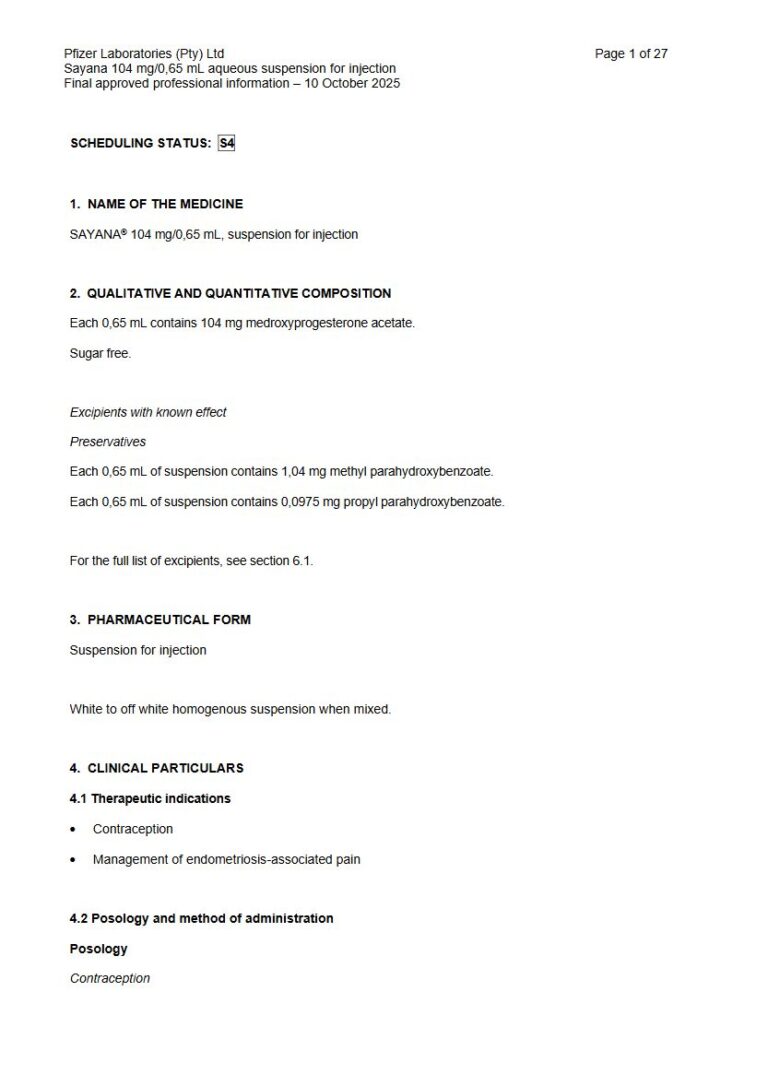
Sayana 104 mg/0,65 mL Suspension for injection
PDF Leaflet Revision Date: 10 October 2025
Clinical Summary
Quick overview from the medicine insert
Indication
Contraception and management of endometriosis-associated pain.
Dosage (summary)
104 mg subcutaneously every 3 months; first injection within 5 days of menstrual period or 6 weeks postpartum if breastfeeding.
Special Populations
- Hepatic insufficiency
- Renal insufficiency
- Paediatric population
Pregnancy & Breastfeeding
Contraindicated in pregnancy; safety in breastfeeding not established.
Key Drug Interactions
- Aminoglutethimide may depress bioavailability
- CYP3A4 inducers/inhibitors may affect kinetics
Contraindications
- Hypersensitivity to medroxyprogesterone acetate
- Pregnancy
- Undiagnosed vaginal bleeding
- Severe liver dysfunction
- Known malignancy of the breast
- Thrombophlebitis
- Meningioma
Common side effects
- Headache
- Metrorrhagia
- Increased weight
- Amenorrhea
- Injection site reactions
Counselling Points
- Counsel on potential menstrual disturbances
- Monitor for signs of depression
- Ensure adequate calcium and vitamin D intake
- Does not protect against STIs
Serious warnings
- Loss of bone mineral density
- Thromboembolic disorders
- Anaphylactic reactions
- Fluid retention
- Depression
Important Disclaimer
The Sayana 104 mg/0,65 mL Suspension for injection professional information leaflet below is the property of Pfizer Laboratories and is provided on Medinsert exactly as issued, with no.. alterations or editorial changes. We make every effort to keep content current by updating documents as soon as new versions become available. Medinsert serves as a trusted access point for healthcare professionals, but does not replace official sources or clinical judgement. For more details, please read our full disclaimer. read more>>
 Healthcare Professionals Only
This content is for registered healthcare professionals
Sign in or create a free account to read the full package insert.
Free for HPCSA-registered professionals. Powered by Medinsert.
Clinical Particulars
Section 4 of the official insert — extracted exactly as issued, no alterations
4.1 Therapeutic indications
- Contraception
- Management of endometriosis-associated pain
4.2 Posology and method of administration
Posology
Contraception
The recommended dose is a pre-filled injection of 104 mg given subcutaneously, once every 3 months.
First injection
The first injection should be given during the first 5 days after the onset of a normal menstrual period; within 5 days postpartum if not breast feeding; or, if exclusively breastfeeding, at or after 6 weeks postpartum.
Second and subsequent injections
The second and subsequent injections should be given at 3-month intervals (12 u2013 14 weeks). If more than 14 weeks have elapsed since the last subcutaneous injection, pregnancy should be ruled out before administering the next subcutaneous injection.
Self-injection
When used for contraception, SAYANA Pre-filled injection (pre-filled single use injection system) may be administered by a health care provider or, when considered appropriate by the health care provider, self-injected by the patient, with medical follow up as necessary in accordance with local clinical guidance. The self-injection option is not recommended for the SAYANA Pre-filled syringe presentation or when SAYANA is used for management of endometriosis-associated pain.
Administration of SAYANA should be initiated under the supervision of a health care provider. After proper training in injection technique and schedule of administration, patients may self-inject with SAYANA Pre-filled injection if their health care provider determines that it is appropriate and with medical follow-up as necessary. See section 4.2 - Instructions for use, for full details on preparing and giving an injection.
Switching from other methods of contraception
When switching from other contraceptive methods, SAYANA should be given in a manner that ensures continuous contraceptive coverage based upon the mechanism of action of both methods, (e.g., patients switching from oral contraceptives should have their first injection of SAYANA within 7 days after taking their last active pill).
Endometriosis
A pre-filled injection of 104 mg given subcutaneously by a health care provider every 3 months for at least 6 months.
Special populations
Hepatic insufficiency
The effect of hepatic disease on the pharmacokinetics of SAYANA is unknown. However, SAYANA is almost exclusively eliminated by hepatic metabolism and steroid hormones may be poorly metabolised in patients with severe liver insufficiency (see section 4.3).
Renal insufficiency
The effect of renal disease on the pharmacokinetics of SAYANA is unknown. However, since SAYANA is almost exclusively eliminated by hepatic metabolism, no dosage adjustment should be necessary in women with renal insufficiency.
Paediatric population
SAYANA is not indicated before menarche. Data in adolescent females (12-18 years) is available for intramuscular administration of medroxyprogesterone acetate (see section 4.4). Other than concerns about loss of bone mineral density (BMD), the safety and effectiveness of SAYANA is expected to be the same for adolescents after menarche and adult females.
Method of administration
For subcutaneous injection. SAYANA must be administered as a subcutaneous injection into the anterior thigh or abdomen. SAYANA subcutaneous suspension is not for intramuscular use. Dosage does not need to be adjusted for body weight.
The sterile aqueous suspension of SAYANA should be vigorously shaken just before use to ensure that the dose being administered represents a uniform suspension. Once opened: use immediately, discard any unused portion.
4.3 Contraindications
- Known hypersensitivity to medroxyprogesterone acetate or to any of the excipients of SAYANA (listed in section 6.1)
- Known or suspected pregnancy and lactation (see section 4.6)
- Undiagnosed vaginal bleeding
- Severe liver dysfunction
- Known or suspected malignancy of the breast
- Thrombophlebitis or a history of thrombophlebitis
- In patients with meningioma or history of meningioma.
4.4 Special warnings and precautions for use
Loss of bone mineral density (BMD)
Use of SAYANA reduces serum oestrogen levels in premenopausal women and is associated with significant loss of BMD as bone metabolism accommodates to a lower oestrogen level. This loss of BMD is of particular concern during adolescence and early adulthood, a critical period of bone accretion. Bone loss is greater with increasing duration of use and may not be completely reversible. It is unknown if use of SAYANA by younger women will reduce peak bone mass and increase the risk for osteoporotic fractures in later life.
Since loss of (BMD) may occur in pre-menopausal women who use SAYANA long-term, a risk/benefit assessment, which also takes into consideration the decrease in BMD that occurs during pregnancy and/or lactation, should be considered. SAYANA should be used as a long-term (e.g., longer than 2 years) birth control method or endometrial treatment only if other birth control methods or endometrial treatments are inadequate. BMD should be evaluated when a female needs to continue use of SAYANA long term.
Other contraceptive methods or endometrial treatments should be considered in the risk/benefit analysis for the use of SAYANA in woman with osteoporotic risk factors such as:
- chronic alcohol and/or tobacco use
- chronic use of medicines that can reduce bone mass, e.g., anticonvulsants or corticosteroids
- low body mass index or eating disorder, e.g., anorexia nervosa or bulimia
- metabolic bone disease
- strong family history of osteoporosis
It is recommended that all patients have adequate calcium and vitamin D intake.
BMD changes in adult women
A controlled, clinical study of adult women using medroxyprogesterone acetate intramuscular injectable suspension for up to 5 years showed spine and hip mean BMD decreases of 5 - 6 %, compared to no significant change in BMD in the control group. The decline in BMD was more pronounced during the first two years of use, with smaller declines in subsequent years. Mean changes in lumbar spine BMD of u2013 2,86 %, -4,11 %, -4,89 %, -4,93 % and u2013 5,38 % after 1, 2, 3, 4 and 5 years, respectively, were observed. Mean decreases in BMD of the total hip and femoral neck were similar. After stopping treatment, there was partial recovery of BMD toward baseline values during the 2-year post-therapy period. BMD increased but deficits at the total hip, femoral neck and lumbar spine remained. A longer duration of treatment was associated with a slower rate of BMD recovery.
A study comparing changes in BMD in women using SAYANA 104 mg subcutaneously with women using medroxyprogesterone acetate intramuscular injectable suspension 150 mg showed no significant differences in BMD loss between the two groups after two years of treatment.
Bleeding irregularities
Most women using SAYANA experience disruption of menstrual bleeding patterns (e.g., irregular or unpredictable bleeding or spotting, heavy or continuous bleeding). Patients should be appropriately counselled concerning the likelihood of menstrual disturbance. As women continue using SAYANA, fewer experience irregular bleeding and more experience amenorrhoea. If abnormal bleeding associated with SAYANA persists or is severe, appropriate investigation and treatment should be instituted. Unexpected vaginal bleeding should be investigated.
Prolonged anovulation with amenorrhoea and/or erratic menstrual patterns may follow the administration of either a single or multiple injectable dose of SAYANA. Patients should be appropriately counselled concerning the likelihood of menstrual disturbance.
In cases of breakthrough bleeding, organic causes should be excluded. In cases of undiagnosed vaginal bleeding, adequate diagnostic measures are indicated.
The use of SAYANA may mask the onset of the climacteric.
Thromboembolic disorders
A patient who develops a thrombotic or thromboembolic event, e.g., pulmonary embolism, cerebrovascular disease, retinal thrombosis or deep venous thrombosis, while undergoing therapy with medroxyprogesterone containing medicines such as SAYANA should not be re-administered SAYANA. Women with a prior history of thromboembolic disorders should not receive SAYANA.
Meningioma
Meningiomas have been reported following long-term administration of progestins, including medroxyprogesterone acetate (MPA). SAYANA should be discontinued if a meningioma is diagnosed. SAYANA is contraindicated in patients with meningioma or a history of meningioma (see section 4.3)
Anaphylactic and anaphylactoid reactions
Anaphylactic and anaphylactoid reactions have been reported in patients treated with SAYANA.
Ocular disorders
In any patient who develops an acute impairment of vision, proptosis, diplopia, or migraine headache, SAYANA should be discontinued, and the patient carefully evaluated ophthalmologically to exclude the presence of papilloedema or retinal vascular lesions before continuing treatment.
Fluid retention
SAYANA may cause fluid retention; therefore, caution should be exercised in treating any patient with a pre-existing condition that might be adversely affected by fluid retention, such as epilepsy, migraine, asthma or cardiac or renal dysfunction.
Central nervous system disorders
Depressed mood and depression are well-known undesirable effects of hormonal contraceptive use and preparations containing estrogen and/or progesterone/progestogen (see section 4.8). Depression can be serious and is a well-known risk factor for suicidal behaviour and suicide. Women should be advised to contact their medical practitioner in case of mood changes and depressive symptoms, including shortly after initiating the treatment.
Patients with a history of treatment for mental depression should be carefully observed and SAYANA discontinued if the depression recurs to a serious degree. Some patients may complain of premenstrual-like depression while on SAYANA therapy.
Carbohydrate metabolism
Some patients receiving SAYANA may exhibit a decreased glucose tolerance. Diabetic patients should be carefully observed while receiving SAYANA.
Physical examination
The pre-treatment physical examination should include special reference to blood pressure, breasts, abdomen and pelvic organs, including cervical cytology.
Effects on laboratory tests
The pathologist (laboratory) should be informed of the patientu2019s use of SAYANA if endometrial or endocervical tissue is submitted for examination. The medical practitioner/laboratory should be informed that use of SAYANA may decrease the levels of the following endocrine biomarkers:
- Plasma/urinary steroids (e.g., cortisol, oestrogen, pregnanediol, progesterone, testosterone)
- Plasma/urinary gonadotrophins (e.g., LH and FSH)
- Sex-hormone-binding-globulin
Liver function
Liver function tests may be affected by treatment with SAYANA. Therefore, if such tests are abnormal in a patient taking SAYANA, it is recommended that they be repeated after SAYANA has been withdrawn. If jaundice develops, consideration should be given to not re-administer SAYANA.
Weight changes
Weight gain may be associated with the use of SAYANA.
Cancer risks
Long-term case-controlled surveillance of users of medroxyprogesterone acetate intramuscular injectable suspension for contraception found slight or no increased overall risk of breast cancer and no increased overall risk of ovarian, liver, or cervical cancer. There was a prolonged effect of reducing the risk of endometrial cancer.
Sexually transmitted infections
Patients should be counselled that SAYANA does not protect against sexually transmitted infections (STIs) including HIV infection (AIDS) but equally, SAYANA is a sterile injection and, used as directed, will not expose them to sexually transmitted infections. Safer sex practices including correct and consistent use of condoms reduce the transmission of STIs through sexual contact, including HIV.
Paediatric population
BMD changes in adolescent females (12 u2013 18 years) after long-term treatment for contraception
An open-label clinical study of medroxyprogesterone acetate injectable suspension (150 mg intramuscularly every 3 months for up to 240 weeks) in adolescent females (12 u2013 18 years) for contraception showed a significant decline in BMD from baseline. The mean decrease in lumbar spine BMD was -2,1 % after 240 weeks; mean decreases for the total hip and femoral neck were -6,4 % and -5,4 % respectively. In general, adolescents increase bone density during the period of growth following menarche. Post-treatment follow-up showed that lumbar spine recovered to baseline levels approximately 1,2 years after treatment was discontinued and hip and femoral neck BMD recovered to baseline levels approximately 4,6 years after treatment was discontinued.
Preservative sensitivity
SAYANA contains the excipients methyl parahydroxybenzoate and propyl parahydroxybenzoate which may cause allergic reactions (possibly delayed), and exceptionally, bronchospasm. If an anaphylactic reaction occurs appropriate therapy should be instituted. Serious anaphylactic reactions require emergency medical treatment.
4.5 Interaction with other medicines and other forms of interaction
No interaction studies have been performed with SAYANA. SAYANA is metabolised in vitro primarily by hydroxylation via cytochrome P450 3A4 (CYP3A4). Specific interaction studies evaluating the clinical effects of CYP3A4 inducers or inhibitors on SAYANA have not been conducted and therefore the clinical effects of CYP3A4 inducers or inhibitors are unknown. The possibility of interactions should be borne in mind in patients receiving concurrent treatment with other medicines.
The clearance of SAYANA is approximately equal to the rate of hepatic blood flow. Because of this fact, it is unlikely that medicines which induce hepatic enzymes will significantly affect kinetics of SAYANA. Therefore, no dose adjustment is recommended in patients receiving medicines known to affect hepatic metabolising enzymes. Aminoglutethimide administered concomitantly with SAYANA may significantly depress the bioavailability of SAYANA.
4.6 Fertility, pregnancy and lactation
Pregnancy
SAYANA is contraindicated in women who are pregnant. Reports suggest an association between intra-uterine exposure to progestational medicines in the first trimester of pregnancy and genital abnormalities in male and female foetuses. Infants from unintentional pregnancies that occur 1 to 2 months after injection with SAYANA may be at an increased risk of low birth weight, which, in turn, is associated with an increased risk of neonatal death. The attributable risk is low because pregnancies while on SAYANA are uncommon. If the patient becomes pregnant while using SAYANA, the patient should be apprised of the potential hazard to the foetus.
Breastfeeding
Safety in breastfeeding has not been established. SAYANA and its metabolites are excreted in breast milk and mothers receiving SAYANA should not breastfeed their infants.
4.7 Effects on ability to drive and use machines
The effect of SAYANA on the ability to drive and use machinery has not been systematically evaluated. Dizziness is a potential side effect. Patients should be aware of how they might be affected by SAYANA before driving or operating machinery.
4.8 Undesirable effects
Tabulated summary of adverse reactions
Side effects reported during safety and efficacy studies have been classified as follows: Very common ( uf0b3 1/10); common ( uf0b3 1/100 to < 1/10); uncommon ( uf0b3 1/1 000 to < 1/100); rare ( uf0b3 1/10 000 to < 1/1 000); very rare ( < 1/10 000); not known (cannot be estimated from the available data).
Contraception
Adverse reactions reported by 5 % or more of all women in clinical trials of SAYANA for contraception included headache (9 %), metrorrhagia (7 %), increased weight (7 %), amenorrhea (6 %) and injection site reactions (6 %).
System organ class
Frequency
Adverse events
Neoplasms benign, malignant and unspecified (including cysts and polyps)
Not known
Meningioma
Metabolism and nutrition disorders
Very common
Increased weight
Uncommon
Decreased weight, increased appetite, fluid retention, decreased appetite
Psychiatric disorders
Common
Depression, decreased libido, affective disorder, anxiety, insomnia, irritability
Uncommon
Anorgasmia, emotional disorder
Nervous system disorders
Common
Headache, dizziness, migraine
Ear and labyrinth disorders
Uncommon
Vertigo
Vascular disorders
Uncommon
Hot flushes, hypertension, varicose veins
Gastrointestinal disorders
Common
Abdominal pain, nausea
Uncommon
Abdominal distension
Skin and subcutaneous tissue disorders
Common
Acne, dermatitis
Uncommon
Hirsutism, chloasma, ecchymosis, rash, alopecia
Musculoskeletal and connective tissue disorders
Common
Back pain, pain in extremity
Uncommon
Muscle spasms
Reproductive system and breast disorders
Common
Amenorrhoea, breast pain, metrorrhagia, menometrorrhagia, menorrhagia, dysmenorrhoea, vaginitis
Uncommon
Breast tenderness, vaginal discharge, vulvovaginal dryness, breast enlargement, dyspareunia, ovarian cyst, pelvic pain, premenstrual syndrome
General disorders and administration site conditions
Common
Fatigue, injection site reaction
Investigations
Common
Abnormal smear cervix
Uncommon
Abnormal hepatic enzyme
Please note that in patients taking medroxyprogesterone acetate injection (150 mg intramuscular), there have been reports of anaphylactic responses, thromboembolic events and rare cases of osteoporosis including osteoporotic fractures.
4.9 Overdose
Overdose treatment is symptomatic and supportive.
